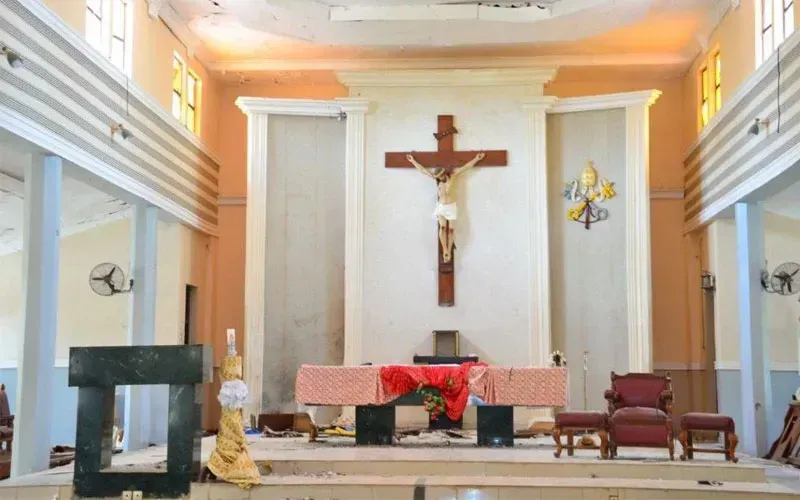
Altar of St. Francis Xavier Owo Catholic Parish of Ondo Diocese, Nigeria, where dozens were slain in a massacre on June 5, 2022. / Courtesy of ACN
Ado Ekiti, Nigeria, Dec 9, 2022 / 12:05 pm (CNA).
Six months after the Pentecost Sunday attack on St. Francis Xavier Owo Catholic Parish in Ondo Diocese, which left 39 Catholic worshipers killed and more than 80 injured, there have been arrests and promises but no prosecution, Bishop Felix Femi Ajakaye has lamented.
“Dec. 5, 2022, is the sixth month of the evil attack, the dead have been buried and their people and other well-wishers are still in sorrowful moods,” the leader of Ondo’s neighboring Ekiti Diocese said in a Dec. 5 statement.
“Nigeria is still waiting.”
On Aug. 11, Nigeria’s Chief of Defence Staff General Lucky Irabor told journalists that four suspects allegedly involved in the June 5 attack had been arrested. He identified the suspects as Idris Omeiza (a.k.a Bin Malik), Momoh Abubakar, Aliyu Itopa, and Auwal Onimisi.
“More than ever, the people who have been in custody since they were arrested need to be prosecuted now,” Femi emphasized.
“General Irabor, Nigeria is still waiting,” he said, adding that the Nigerian security official should issue an update on the investigation and the status of the prosecution.
There were “outcries, condemnations, and there were promises” made nationally and internationally, the bishop noted.
“As usual, the Buhari-led government commiserated with the people concerned. Typical of the administration’s trademark, it vowed to be on top of the situation and fish out the culprits,” Femi said. Yet authorities have said little since announcing the arrests months ago.
Referring to the Gospel of St. Matthew, the bishop said: “A voice is heard in Ramah, lamenting and weeping bitterly: It is Rachel weeping for her children, refusing to be comforted because they are no more.”
If you value the news and views Catholic World Report provides, please consider donating to support our efforts. Your contribution will help us continue to make CWR available to all readers worldwide for free, without a subscription. Thank you for your generosity!
Click here for more information on donating to CWR. Click here to sign up for our newsletter.
Pope Francis praying at the general audience on St. Peter’s Square / Daniel Ibáñez / CNA
Rome Newsroom, Nov 23, 2022 / 02:37 am (CNA).
Pope Francis used the example of several Catholic saints to explain the concept of spiritual consolation during his weekly audience on Wednesday.
“What is spiritual consolation?” he said Nov. 23. “It is a profound experience of interior joy, consisting in seeing God’s presence in everything. It strengthens faith and hope, and even the ability of doing good.”
The pope continued his teachings on the theme of discernment at his public audience in St. Peter’s Square, where he contrasted last week’s reflection on spiritual desolation with consolation, as experienced by several of the Church’s saints.
“The person who experiences consolation never gives up in the face of difficulties because he or she always experiences a peace that is stronger than any trial,” Francis said. Consolation “is, therefore, a tremendous gift for the spiritual life as well as life in general.”
Pope Francis arriving for the general audience on St. Peter’s Square, Nov. 23, 2022. Daniel Ibáñez / CNA
The pope began his explanation by drawing from the Spiritual Exercises of St. Ignatius of Loyola, who wrote about rules for the discernment of spirits.
Francis said “consolation is an interior movement that touches our depths. It is not flashy but soft, delicate, like a drop of water on a sponge.”
He went on to describe consolation as not “a passing euphoria,” nor something which tries to force our will or inhibit our freedom. “Even the suffering caused, for example, by our own sins can become a reason for consolation,” he added.
St. Augustine was consoled when he spoke with his mother, St. Monica, about the beauty of eternal life, the pope said. And St. Francis of Assisi experienced perfect joy despite the difficult situations he had to bear.
“Let’s think of the many saints who were able to do great things not because they thought they were magnificent or capable, but because they had been conquered by the peaceful
sweetness of God’s love,” Pope Francis said. “This is the peace that St. Ignatius discovered in himself with such amazement when he would read the lives of the saints.”
The pope also quoted St. Edith Stein, who is also known by the name she took in religious life: Teresa Benedicta of the Cross.
A year after her baptism as a Christian, following her conversion from Judaism, St. Edith Stein wrote about her interior feeling of peace: “As I abandon myself to this feeling, little by little a new life begins to fill me and — without any pressure on my will — to drive me toward new realizations. This living inpouring seems to spring from an activity and it gives a strength that is not mine and which, without doing me any violence, becomes active in me.”
Francis emphasized the importance of action following consolation.
“Consolation is such peace, but not to sit there enjoying it, no, it gives you peace and draws you to the Lord and sets you on a path to do things, to do good things,” he said.
“In a time of consolation, when we are consoled, we get the desire to do so much good, always. Instead, when there is a time of desolation, we get the urge to close in on ourselves and do nothing. Consolation pushes you forward, in service to others, to society, to people.”
He recalled when St. Therese of the Child Jesus, at the age of 14, visited the Basilica of the Holy Cross of Jerusalem in Rome.
The girl from Lisieux, France, “tried to touch the nail venerated there, one of the nails with which Jesus was crucified,” the pope said. “Therese understood her daring as a transport of love and confidence. Later, she wrote, ‘I truly was too audacious. But the Lord sees the depths of our hearts. He knows my intention was pure […] I acted with him as a child who believes everything is permissible and who considers the Father’s treasures their own.’”
This, Pope Francis said, is a “splendid description of spiritual consolation.”
“We can feel a sense of tenderness toward God that makes us audacious in our desire to participate in his own life, to do what is pleasing to him because we feel familiar with him, we feel that his house is our house, we feel welcome, loved, restored,” he added.
Consolation gives one the strength to continue in the face of difficulty, Francis said, pointing to St. Therese’s request to the pope to enter the Carmelite order even though she was too young.
According to the pope, St. Bernard teaches us about consolation and discernment, especially the pitfall of “false consolations.”
“If an authentic consolation is like a drop on a sponge, is soft and intimate, its imitations are noisier and flashier, like straw fires, lacking substance, leading us to close in on ourselves and not to take care of others,” Francis said. This is where discernment comes in.
“False consolation can become a danger if we seek it obsessively as an end in itself, forgetting the Lord,” he pointed out. “As St. Bernard would say, this is like seeking the consolations of God rather than the God of consolations.”
There is a risk of treating our relationship with God in a childish way, he concluded, “of reducing it to an object that we use and consume, losing the most beautiful gift which is God himself.”
Gunmen on motorbikes reportedly shot dead at least 22 people at a baptism ceremony in an attack on a village in western Niger. The Sept. 15, 2025, attack happened in the Tillaberi region near Burkina Faso and Mali, where jihadist groups linked t… […]
The ordination of Jonathan Goodall (former Anglican Bishop) to the Catholic priesthood in Westminster Cathedral, London, March 12, 2022. / Mazur/CBCEW.org.uk
London, England, Mar 12, 2022 / 16:02 pm (CNA).
Cardinal Vincent Nichols of Westminste… […]
2 Comments
Justice is a one way street in the annals of islamic decrees. Muslims are vocal about being treated well, yet no quid pro quo is offered in return. To expect kindness and fair play from from a bellicose religion bent on hostility and conquest is unrealistic at best.
To find peace with God, we must to turn our hearts to Jesus Christ (the Prince of Peace).
John 14:27 Peace I leave with you; my peace I give to you. Not as the world gives do I give to you. Let not your hearts be troubled, neither let them be afraid.
Isaiah 26:3 You keep him in perfect peace whose mind is stayed on you, because he trusts in you.
Isaiah 9:6 For to us a child is born, to us a son is given; and the government shall be upon his shoulder, and his name shall be called Wonderful Counsellor, Mighty God, Everlasting Father, Prince of Peace.
2 Thessalonians 3:16 Now may the Lord of peace himself give you peace at all times in every way. The Lord be with you all.
Colossians 3:15 And let the peace of Christ rule in your hearts, to which indeed you were called in one body. And be thankful.
Philippians 4:7 And the peace of God, which surpasses all understanding, will guard your hearts and your minds in Christ Jesus.
Sorry to say the devout Muslim dreads the day of judgement. Allah gives him no tangible hope, only vague maybes! The Koran is not a book of peace, rather it is a manual of war and strife.
A Muslim is cordially invited to explore what is the comfort and assurance of salvation that Jesus Christ offers to all believers in Him. Even a cursory examination of the Koran fails to encourage because it is not divinely inspired by God.
These remarks may appear to be harsh, yet who will take up the challenge to find God’s mercy and love? A mans eternal soul is of great worth. God’s message is one of life.and love.
Justice is a one way street in the annals of islamic decrees. Muslims are vocal about being treated well, yet no quid pro quo is offered in return. To expect kindness and fair play from from a bellicose religion bent on hostility and conquest is unrealistic at best.
To find peace with God, we must to turn our hearts to Jesus Christ (the Prince of Peace).
John 14:27 Peace I leave with you; my peace I give to you. Not as the world gives do I give to you. Let not your hearts be troubled, neither let them be afraid.
Isaiah 26:3 You keep him in perfect peace whose mind is stayed on you, because he trusts in you.
Isaiah 9:6 For to us a child is born, to us a son is given; and the government shall be upon his shoulder, and his name shall be called Wonderful Counsellor, Mighty God, Everlasting Father, Prince of Peace.
2 Thessalonians 3:16 Now may the Lord of peace himself give you peace at all times in every way. The Lord be with you all.
Colossians 3:15 And let the peace of Christ rule in your hearts, to which indeed you were called in one body. And be thankful.
Philippians 4:7 And the peace of God, which surpasses all understanding, will guard your hearts and your minds in Christ Jesus.
Sorry to say the devout Muslim dreads the day of judgement. Allah gives him no tangible hope, only vague maybes! The Koran is not a book of peace, rather it is a manual of war and strife.
A Muslim is cordially invited to explore what is the comfort and assurance of salvation that Jesus Christ offers to all believers in Him. Even a cursory examination of the Koran fails to encourage because it is not divinely inspired by God.
These remarks may appear to be harsh, yet who will take up the challenge to find God’s mercy and love? A mans eternal soul is of great worth. God’s message is one of life.and love.
In the peace that is Jesus Christ.
Wasn’t Nigeria just removed from the “dangerous for Christians/believers” list?
