


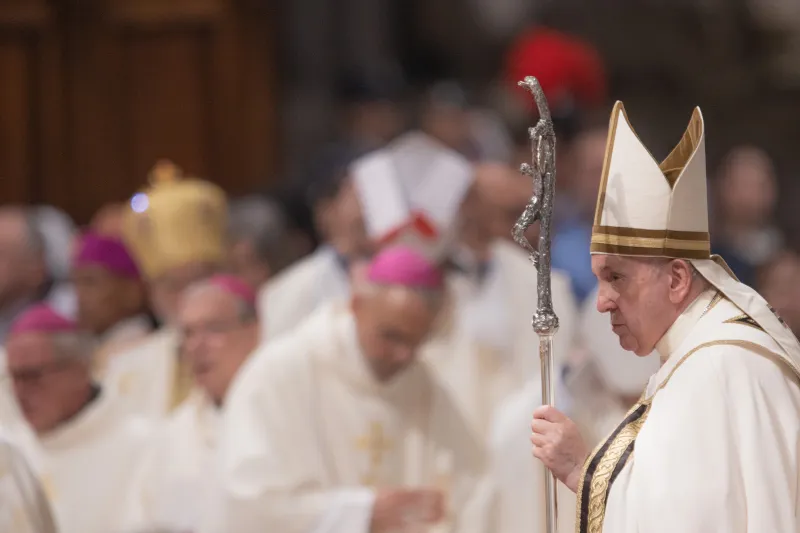
Vatican City, Oct 11, 2022 / 13:04 pm (CNA).
On the 60th anniversary of the opening of the Second Vatican Council, Pope Francis encouraged Catholics to leave behind criticism and anger and to live the faith with joy.
“May the Church be overcome with joy. If she should fail to rejoice, she would deny her very self, for she would forget the love that begot her,” the pope said during Mass in St. Peter’s Basilica Oct. 11.
“Yet,” he continued, “how many of us are unable to live the faith with joy, without grumbling and criticizing? A Church in love with Jesus has no time for quarrels, gossip, and disputes. May God free us from being critical and intolerant, harsh, and angry. This is not a matter of style but of love. For those who love, as the Apostle Paul teaches, do everything without murmuring.”
The Mass marked the 60th anniversary of the day the Second Vatican Council was opened by St. John XXIII on Oct. 11, 1962. The council closed on Dec. 8, 1965.
Oct. 11 is also celebrated as St. John XXIII’s feast day in the Catholic Church.
In his homily, Pope Francis encouraged members of the Church to return “to the council’s pure sources of love.”
“Let us rediscover the council’s passion and renew our own passion for the council,” he said. “Immersed in the mystery of the Church, Mother and Bride, let us also say, with St. John XXIII: Gaudet Mater Ecclesia.”
Francis also warned Catholics about the strategy of the devil, who sows weeds of division among the faithful. “Let us not succumb to his flattery, let us not give in to the temptation of polarization,” he urged.
“How many times since the council have Christians gone out of their way to choose a side in the Church, not realizing that they were tearing their Mother’s heart,” the pope said. “How many times have they preferred to be ‘supporters of their own group’ rather than servants of all, progressives and conservatives rather than brothers and sisters, ‘of the right’ or ‘of the left’ rather than of Jesus; standing up as ‘guardians of the truth’ or ‘soloists of novelty,’ rather than recognizing themselves as humble and grateful children of holy Mother Church.”
All people are children of God and our brothers, he added. “The Lord does not want us this way: We are his sheep, his flock, and we are so only together, united. Let us overcome polarization and guard communion, let us become more and more ‘one,’ as Jesus pleaded before he gave his life for us.”
Pope Francis noted that there is always the temptation to start from one’s self and one’s agenda, rather than from God and his Gospel.
We “let ourselves be caught up in the winds of worldliness in order to chase the fashions of the moment or to turn back the time that Providence has granted us,” he said. “Yet let us be careful: both the ‘progressivism’ that lines up behind the world and the traditionalism — or ‘indietrism’ — that longs for a bygone world are not evidence of love, but of infidelity.”
“Let us rediscover the council in order to restore primacy to God, to what is essential: to a Church madly in love with its Lord and with all the men and women whom he loves; to a Church that is rich in Jesus and poor in assets; to a Church that is free and freeing. This was the path that the council pointed out to the Church,” he said.
If you value the news and views Catholic World Report provides, please consider donating to support our efforts. Your contribution will help us continue to make CWR available to all readers worldwide for free, without a subscription. Thank you for your generosity!
Click here for more information on donating to CWR. Click here to sign up for our newsletter.


One criticism of Gaudium et spes (“The Joys and Hopes”) has been its early-1960s and Teilhardian optimism, when subsequent history has shown all of us that this is a more complicated and conflicted age. As suggested in the balancing next few words of the same document’s title line: “the joys and the hopes, the griefs and the anxieties of the men of this age…”
This big picture is forced toward “the temptation of polarization” only when the second half is still dismissed. So, yes to hope and joy, but also sober thought and governance, as in acting unambiguously on the obvious adulteration of joyful synodality.
Rescue the real Vatican II from the termites—the council’s Ratzinger over today’s Batzinger. (Also Marx, Hollerich, Grech, and the backstage Kasper).
As a 40 year street grunt in the pro-life movement, I do appreciate the strong definitive statement for defending life in GS. But in reading the complete document the overall bias is that of an optimism that seems to trivialize an awareness of original sin and the permanent imperfectability of the human condition. This could not help but provide impetus for validating the nefarious “spirit” of Vatican II.
Espléndida o Asquerosa. A Church espléndida, madly in love, free and freeing. Progressivism that lines up behind the world. Or Asquerosa. Traditionalism. Indietrism that longs for a bygone world not of love, but of infidelity.
Rarely has El Capo so clearly defined the divergent paths taken from the Council. And the one true path he, he alone has revealed. An epiphany. Rich with intoxicating freedom. Expansive. The other, stifling, mean, judgmental. His Holiness extols this “Church that is free and freeing. The path the council pointed out to the Church” [how could so many of us have missed this?].
New doctrine, paradigmatic that liberates us from repentance, the sacrament of marriage instituted for a man and woman. Free from remaining imprisoned in a body with which we’re disappointed. Love all. Love who you wish. Love as you wish.
Liberation at last. Free at last. After 2000 years of constricted infidelity worshiping a mistake, delusional martyrs spilling their blood for naught. Until the deliverance of El Gran Libertador.
Jorge Bergoglio’s apostasy was external and made public and notorious, when as a cardinal, he stated in his book, On Heaven and Earth, in regards to same-sex sexual relationships, and thus same-sex sexual acts, prior to his election as pope, on page 117, denying The Unity Of The Holy Ghost (Filioque)and demonstrating that he does not hold, keep, or teach The Catholic Faith, and he continues to act accordingly:
“If there is a union of a private nature, there is neither a third party, nor is society affected. Now, if the union is given the category of marriage, there could be children affected. Every person needs a male father and a female mother that can help shape their identity.”- Jorge Bergoglio, denying The Sanctity of the marital act within The Sacrament of Holy Matrimony, and the fact that God, The Most Holy And Undivided Blessed Trinity, Through The Unity Of The Holy Ghost (Filioque), Is The Author Of Love, Of Life, And Of Marriage, while denying sin done in private is sin. To deny The Unity Of The Holy Ghost, is to deny The Divinity Of The Most Holy And Undivided Blessed Trinity, Father, Son, And Holy Ghost, which is Apostasy.
From The Catechism Of The Catholic Church:
II. THE DEFINITION OF SIN
“1849 Sin is an offense against reason, truth, and right conscience; it is failure in genuine love for God and neighbor caused by a perverse attachment to certain goods. It wounds the nature of man and injures human solidarity. It has been defined as “an utterance, a deed, or a desire contrary to the eternal law.”121
1850 Sin is an offense against God: “Against you, you alone, have I sinned, and done that which is evil in your sight.”122 Sin sets itself against God’s love for us and turns our hearts away from it. Like the first sin, it is disobedience, a revolt against God through the will to become “like gods,”123 knowing and determining good and evil. Sin is thus “love of oneself even to contempt of God.”124 In this proud self- exaltation, sin is diametrically opposed to the obedience of Jesus, which achieves our salvation.125
1851 It is precisely in the Passion, when the mercy of Christ is about to vanquish it, that sin most clearly manifests its violence and its many forms: unbelief, murderous hatred, shunning and mockery by the leaders and the people, Pilate’s cowardice and the cruelty of the soldiers, Judas’ betrayal – so bitter to Jesus, Peter’s denial and the disciples’ flight. However, at the very hour of darkness, the hour of the prince of this world,126 the sacrifice of Christ secretly becomes the source from which the forgiveness of our sins will pour forth inexhaustibly.”
It is a sin to accomodate an occasion of sin, and thus cooperate with evils.”
Pray for the safety of Pope Benedict XVI.
Dear Blessed Mother Mary, Mirror Of Justice And Destroyer Of All Heresy, Who Through Your Fiat, Affirmed The Filioque, and thus the fact that There Is Only One Son Of God, One Word Of God Made Flesh, One Lamb Of God Who Can Taketh Away The Sins Of The World, Our Only Savior, Jesus The Christ, thus there can only be, One Spirit Of Perfect Complementary Love Between The Father And The Son, Who Must Proceed From Both The Father And The Son, In The Ordered Communion Of Perfect Complementary Love, The Most Holy And Undivided Blessed Trinity (Filioque), hear our Prayer that The True Pope, Pope Benedict XVI,and those Faithful Bishops In Communion With Christ and His Church, Through The Unity Of The Holy Ghost, will do The Consecration Of Russia to your Immaculate Heart, exactly as you requested, visibly separating the counterfeit church from The True Church Of Christ, and affirming The Filioque. Although at the end of the Day, it is still a Great Mystery, It is no Mystery, that we exist, because God, The Communion Of Perfect Love, The Most Holy And Undivided Blessed Trinity, Exists.
“Hail The Cross, Our Only Hope.”
“Come, Holy Ghost”.
Disposed apologetically having recognized [while watching Arroyo’s George Weigel interview] my error of misinterpreting Pope Francis on a “Progressivism that lines up behind the world” that he is actually criticizing not approving, emphasizing unity. My apology to Francis.
“Pope Francis noted that there is always the temptation to start from one’s self and one’s agenda, rather than from God and his Gospel.”
Take a long look in the mirror, Pope Francis.
A mind with as little self-awareness as his, as Orwellian as his, is very far gone. It seems the only hope would be for someone, acting with the instrumentality of God’s grace were to get in his face, behind closed doors, and read him the riot act, and not stop until the Swiss Guards dragged him out.
Joy was in my heart when I heard them sing, let’s go to God’s House. Saint John XXIII – Pray for us.
Our Lady at the Annunciation was NOT first moved on or with joy. She was moved in prudence. Joy is always a fruit and we have it as a set lesson from the BVM in the way of being immaculate.
The Holy Father needs to be careful. The problems he here distills, do not define VATICAN II, on the one hand; and on the other, do not address differing realities in specific situations.
Wrong prescriptions would sustain wrongs and make them worse. And meantime his supplying over-riding spiritual direction -as for eg., he is now doing with “desire”- would root them in deeper.
More generally, I feel the Holy Father has lost sight of the fact that he is not the only one who can raise a valid criticism. He points fingers at partisans, then protects particular erring sides.
This word indietrism is not helpful. People will understand “indoctrination” easier. Indietrism is allowing things to pass as “not indoctrinating” that in fact push irreligion and anti-faith.
https://www.catholicnewsagency.com/news/252522/pope-francis-on-vatican-ii-anniversary-may-the-church-be-overcome-with-joy
https://www.catholicnewsagency.com/news/252527/pope-francis-desire-points-our-discernment-in-the-right-direction