




St. Louis, Mo., Aug 25, 2022 / 15:37 pm (CNA).
The College of Cardinals is the group of the pope’s closest assistants and advisers, made up of all of the Catholic Church’s cardinals from around the world. On Aug. 27, Pope Francis will create 20 new cardinals, bringing the total number in the college to 229.
But not all of the 229 cardinals will be eligible to elect a new pope.
Pope St. Paul VI established in 1970 that cardinals aged 80 and over cannot participate in the process of electing a pope — thus, cardinals who are younger than 80 are known as “electors.” Paul VI also established a numerical limit for the number of electors, capping it at 120.
At his Aug. 27 extraordinary consistory — a meeting of all the world’s cardinals — Pope Francis is expected to create 16 new cardinals who will be electors, bringing the total number of cardinals who are eligible to vote for the next pope in a future conclave to 132. The pope will also create four new cardinals who have already passed 80 years of age.
Six of the current cardinal electors will turn 80 by the end of 2022; two of them will have turned 80 by the end of September.
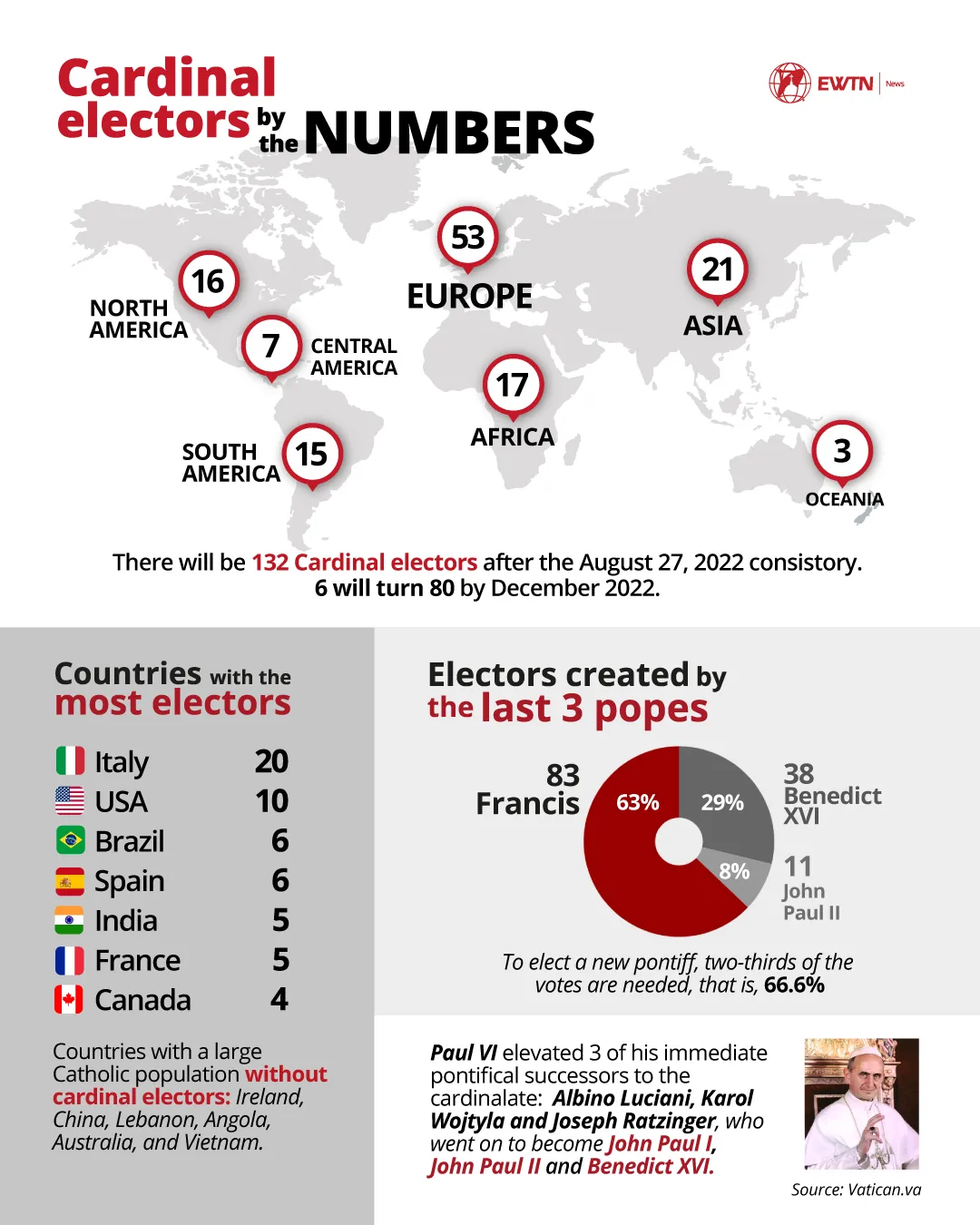
Europeans will account for 53 cardinals in the college after the consistory, the most of any region. Of those, 28 will be electors, or 34% of the total.
Italy will have the most cardinals of any one country — 47 — and the most cardinal electors, with 20.
Meanwhile, other parts of the world have gained ground, led by the Asia-Pacific region, whose overall representation of voting-age cardinals has risen from 9% in 2013 to 17% in 2022, an analysis from Pew Research Center found.
Sub-Saharan Africa is on the upswing with electors as well, rising from 9% to 12%. Latin America and the Caribbean have had a more modest gain, rising from 16% to 18%.
By the end of the consistory, 63% of the college will have been appointed by Pope Francis, with the remainder appointed by Pope St. John Paul II and Pope Emeritus Benedict XVI. John Paul II and Benedict XVI — as well as Pope John Paul I — were all appointed cardinals by Paul VI. Benedict XVI is the only surviving cardinal created by him.
In 2007 Pope Benedict XVI returned to the long-standing tradition requiring a two-thirds majority to elect a pope; St. John Paul II had allowed for a simple majority for a valid election in the case of extended deadlock.
If you value the news and views Catholic World Report provides, please consider donating to support our efforts. Your contribution will help us continue to make CWR available to all readers worldwide for free, without a subscription. Thank you for your generosity!
Click here for more information on donating to CWR. Click here to sign up for our newsletter.



What are the cardinal ordinances of the church? Have some of the cardinals in the church strayed from the gospel of Jesus Christ?
Some may say that Papa has displayed overweening pride in appointing so many cardinals! God always reminds us of what our duties as servants of Christ.
Matthew 28:19 Go therefore and make disciples of all nations, baptizing them in the name of the Father and of the Son and of the Holy Spirit,
1 John 1:9 If we confess our sins, he is faithful and just to forgive us our sins and to cleanse us from all unrighteousness.
1 Peter 3:18 For Christ also suffered once for sins, the righteous for the unrighteous, that he might bring us to God, being put to death in the flesh but made alive in the spirit,
Hebrews 7:25 Consequently, he is able to save to the uttermost those who draw near to God through him, since he always lives to make intercession for them.
Colossians 2:14 By cancelling the record of debt that stood against us with its legal demands. This he set aside, nailing it to the cross.
Ephesians 2:15 By abolishing the law of commandments expressed in ordinances, that he might create in himself one new man in place of the two, so making peace,
Ephesians 1:7 In him we have redemption through his blood, the forgiveness of our trespasses, according to the riches of his grace,
This is good news indeed, political correctness and tree hugging aside, Jesus is our answer, let us ask in faith.
More important than who will vote, is who they might vote for…
A timely, professional, balanced, matter-of-fact, and thorough profile for nineteen of the most likely papabili is supplied by an independent and unaffiliated team of anonymous scholars, and edited by Edward Pentin. Very well worth reading: “The Next Pope: The Leading Cardinal Candidates” (Sophia Institute Press, 2020).
The alphabetical presentation includes: Bagnasco, Burke, Duka, Eijk, Erdo, Muller, O’Malley, Ouellet, Parolin, Piacenza, Ranjith, Ravasi, Sarah, Schonborn, Scola, Tagle, Turkson, and Zuppi.
Each profile includes a short biography, together with three following sections reporting on the apostolic roles to teach (prophet), govern (king), and sanctify (priest). In the Introduction, Pentin writes, “I have tried to ensure that the cardinals are presented in charity and truth, offering what I hope is an accurate picture of what sort of man might one day fill the shoes of the Fisherman.”
As a lay reader of this well-documented piece, the contrast between this informational approach and other possible approaches (e.g., the St. Gallen Mafia, as self-labeled by the late Cardinal Danneels) is restoring, reassuring, and refreshing.
Allow me to say, Burke or Muller might make excellent candidates! Yet the matter is in the hands of the Lord. He gave us Bergollio so that we might reflect on the folly of man and once again put our trust and confidence in Jesus Christ!
Proverbs 3:5 Trust in the Lord with all your heart, and do not lean on your own understanding.
Hebrews 13:8 Jesus Christ is the same yesterday and today and forever.
Psalm 28:7 The Lord is my strength and my shield; in him my heart trusts, and I am helped; my heart exults, and with my song I give thanks to him.
Romans 15:13 May the God of hope fill you with all joy and peace in believing, so that by the power of the Holy Spirit you may abound in hope.
Jeremiah 17:7-8 “Blessed is the man who trusts in the Lord, whose trust is the Lord. He is like a tree planted by water, that sends out its roots by the stream, and does not fear when heat comes, for its leaves remain green, and is not anxious in the year of drought, for it does not cease to bear fruit.”
Mark 5:36 But overhearing what they said, Jesus said to the ruler of the synagogue, “Do not fear, only believe.”
Psalm 9:10 And those who know your name put their trust in you, for you, O Lord, have not forsaken those who seek you.
Blessings
Pope Francis is doing fine. The Holy Father has a long way to go. Before the real hour comes for consideration, several cardinals with voting rights will have triumphantly crossed the 80 year mark and attain liberation from the voting process.