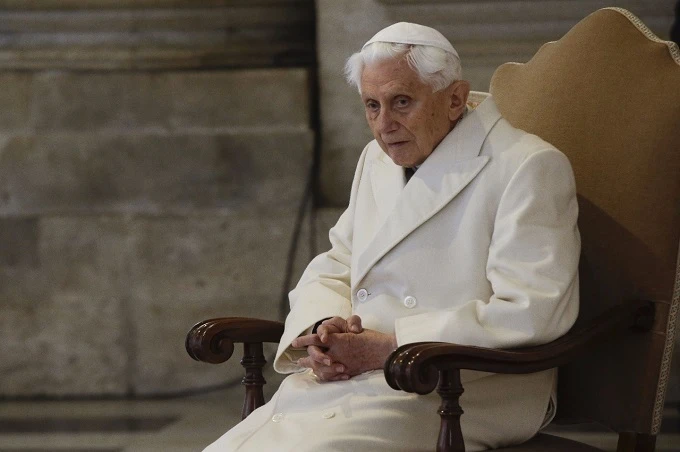
Vatican City, Jul 16, 2017 / 09:16 am (CNA/EWTN News).- In a letter sent for the funeral of the late Cardinal Joachim Meisner, retired Pope Benedict XVI praised the prelate as a passionate pastor, who died a happy man at peace with the Lord and his will for the universal Church.
“What particularly impressed me in my last conversations with the now deceased Cardinal was the serene cheerfulness, the inner joy and the confidence at which he had arrived,” Benedict said in the letter, read aloud by Archbishop Georg Ganswein at the prelate’s July 15 funeral in Cologne.
Benedict, who had known Meisner personally, noted that the late prelate, a “passionate shepherd and pastor,” had found it difficult to leave his post in Cologne upon retirement, especially at a time when the Church needs persuasive priests “who resist the dictatorship of the Zeitgeist and who live and think the faith with complete determination.”
“However, what moved me all the more was that, in this last period of his life, he learned to let go and to live all the more deeply with the conviction, that the Lord does not abandon His Church, even when sometimes the boat has taken on so much water as to be on the verge of capsizing.”
Cardinal Meisner, archbishop emeritus of Cologne, died July 5 while on vacation in Bad Füssing, Germany, at the age of 83. His funeral was celebrated July 15 in the cathedral of Cologne.
Archbishop of Cologne from 1989-2014, he retired with the permission of Pope Francis in February 2014, at the age of 80, the same year his age made him ineligible to vote in a conclave.
Meisner, alongside Cardinals Carlo Caffarra, Walter Brandmüller and Raymond Leo Burke, submitted five “dubia,” or doubts, about the interpretation of Amoris laetitia to Pope Francis on Sept. 19, 2016.
The letter, made public in November, asked for clarification on Chapter 8 of the document, which touches on the reception of communion for divorced and remarried couples.
In May, the four – dubbed the “dubia cardinals” – sent a letter to the Pope requesting a private audience to discuss the content of the “dubia,” since they have not yet received a response.
Cardinal Meisner, considered a leading conservative Catholic figure in Germany, stood in contrast to other German prelates who have propagated one of the more liberal interpretations of Chapter 8 of the post-synodal document.
In his letter, Benedict said that when he first received the news of Cardinal Meisners death, he couldn’t believe it, as they had spoken over the phone the day before.
In the conversation, Benedict recalled that Meisner was “audibly grateful” to be on vacation, and to have participated in the beatification ceremony of Bishop Teofilius Matulionis – a Lithuanian priest who was consecrated a bishop in secret during Soviet persecution, and who spent the majority of his episcopate in prison before being poisoned by the USSR – the day before.
For Benedict, Meisner’s whole life “was ingrained both with a love for the churches of the neighboring countries to the East, who had suffered under Communist persecution, as well as an appreciation for their holding fast amidst the suffering of those times.”
“Thus it is probably no coincidence that the final visit of his life was dedicated to a Confessor of the Faith from those lands.”
In addition to the beatification and the state of peace he had attained before his death, Benedict said there were two specific reasons the cardinal was so cheerful in his final years.
For one, “he repeatedly told me how it profoundly delighted him to see young people, especially young men, experience the grace of forgiveness in the Sacrament of Confession – the gift of having truly found that life which only God can give them,” Benedict said.
The second thing he cited for putting the cardinal in “a joyful mood” was the “quiet growth of Eucharistic Adoration.”
Benedict recalled how at World Youth Day in Cologne in 2005, Meisner was adament that there be adoration, and a space for “ a silence in which only the Lord speaks to the hearts.”
While some of those in the field of pastoral and liturgical work thought it would be impossible or even “obsolete” to accomplish with such a large group of people, arguing that the Lord desires to be received and not looked at, what happened proved them wrong.
It became abundantly clear, Benedict said, “that you can not eat this bread like it were just some food, and that ‘receiving’ the Lord in the Eucharistic Sacrament makes demands upon every dimension of our existence – that to receive necessarily also means to adore.”
This became “an interior event, one that remained, not only for the Cardinal, unforgettable. This moment remained ever present, like a great light, within him.”
Benedict concluded his letter noting how on the morning he died, Cardinal Meisner was found in his room with his breviary on his lap.
“He had died whilst in prayer, his gaze fixed on the Lord, in conversation with the Lord,” Benedict said, adding that “the manner of death which was granted to him yet again shows how he lived: gaze fixed to the Lord and conversing with the Lord.”
 […]
[…]




Promoting human dignity, justice, and reconciliation are vital engagements for an ethically healthy world-building.
According to CLIMATE IMPACT PARTNERS website at this time, the global carbon footprint for internet and its tech, is 3.7%, which is the equivalent measure for the entire airline industry. It is expected that by 2025 this number for internet footprint will have doubled. The article makes no mention of blockchain or similar crypto-ledger mechanisms, nor Web3, within the various components it identifies for its footprint computation. I suspect that separate measures would have to be added on for them, to get the full picture.
According to DOWN TO EARTH and UNFCCC, blockchain electricity consumption ranks with that for New Zealand and/or Argentina. If you read some of the wider literature on the internet the question arises how much of that electricity is coal-powered. As always, the information being collated is based on known activities and producers. Blockchain has the potential to be fueled “off-grid” and even produced privately; what this is eventually going to mean for emissions and legality, is a huge area.
With the arrival of new technologies like Web3 etc., the rate of usage is bound to increase by exponents and so the 2025 carbon footprint estimate is likely very low.
https://www.climateimpact.com/news-insights/insights/infographic-carbon-footprint-internet/
https://www.downtoearth.org.in/blog/environment/as-cryptocurrency-becomes-mainstream-its-carbon-footprint-can-t-be-ignored-81118
https://unfccc.int/blog/the-good-the-bad-and-the-blockchain
The amount of energy needed to replace the work done by people with robots and robotics, will at some point not be “sustainable”. I am not suggesting it is moral and I am not in favour of replacing people. Can you possibly conceive the level of artificiality that will reign in robot-based economics!
‘ Considering heavy reliance on robotics to achieve business objectives, there would be a time when robots are required to develop and maintain economic relationships. …..
With advanced encryption techniques such as cryptographic digital signatures and cryptographically secure public-key cryptography that form an integral part of the blockchain, the users can stay assured of the optimum security for data across shared channels. The information shared is highly secured for the fact that its accessibility is controlled by the specific private key available to a robot.
With blockchain technology in place, a pair of public and private keys can be assigned to each robot in the group, considering the case of swarm robots. Here, the public key can be the foremost information available about a robot whereas the private key can identify a robot before initiating the communication. …..
Possibly, one of the best solutions to employ would be to opt for a market mechanism, leveraging game theory, decision theory, and economic mechanisms to assign work. ‘
https://www.analyticsinsight.net/the-impact-of-blockchain-technology-on-robotics/
There is public crypto/blockchain and private. Private would be more “dependable” in the sense that the parties involved would tend to be in direct contact with one another and the systems are purposed to their arrangements. But even so, these things can “go dark” just as with the corollary “public bureaux” frameworks. Some articles explaining the new things, are here -:
https://brave.com/web3/intro-to-blockchain/
https://brave.com/web3/built-on-web3/
https://brave.com/web3/what-are-web3-browsers/