Washington, D.C. Newsroom, Mar 4, 2022 / 09:14 am (CNA).
Bishop Gustavo Zanchetta was sentenced to four and a half years in prison on Friday, March 4, after an Argentine court found him guilty of sexually abusing seminarians.
Zanchetta, 58, pleaded not guilty to the charge of “aggravated continued simple sexual abuse committed by a recognized minister of religion” on Feb. 21. He was accused of abusing two seminarians, who were identified by the acronyms “G.G.F.L.” and “C.M.”
The two victims said that Zanchetta had made “amorous proposals” and had requested “massages” from the two.
Zanchetta led the Diocese of Orán, located in northern Argentina, from 2013 until 2017. His episcopal appointment was one of the first done by Pope Francis in his native Argentina.
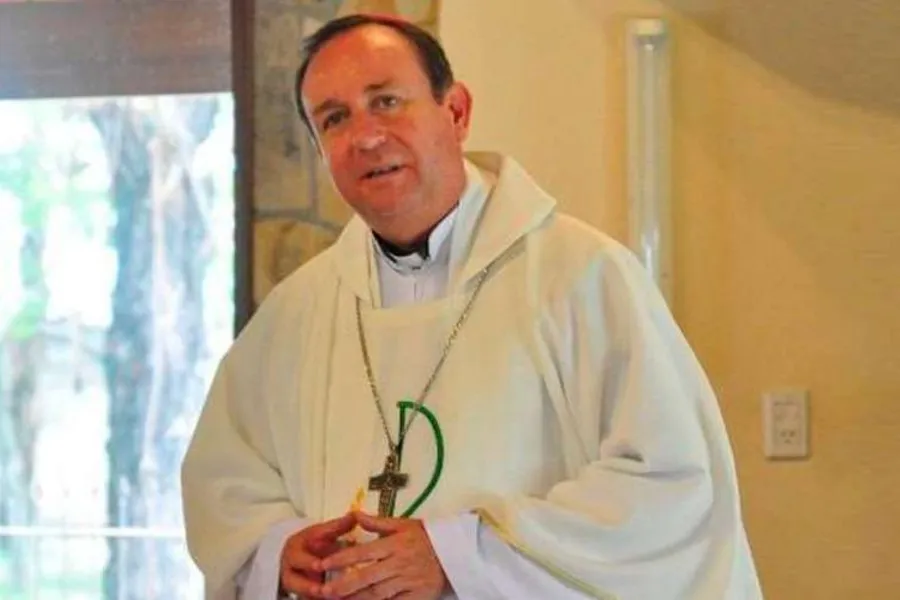
Bishop Gustavo Zanchetta. . Diocesis de Orán
He stepped down in 2017, claiming “health reasons,” and was subsequently appointed as an assessor at the Vatican’s Administration of the Patrimony of the Holy See (APSA), a specially created position. The APSA oversees the Vatican’s real estate holdings and other sovereign assets.
As of June 2021, Zanchetta was no longer with the APSA. He previously had been suspended, then reinstated, from the role amid a canonical investigation into his conduct.
Zanchetta’s trial, which was initially set to begin in October, was delayed four months at the request of his attorney. The defense attorney had asked the judges to wait for the files of the canonical process that Bishop Zanchetta is undergoing at the Congregation for the Doctrine of the Faith.
The Vatican has not yet publicized any information regarding the canonical process, and any determinations that have been reached, regarding Zanchetta.
While this is Zanchetta’s first conviction in a criminal court, allegations of sexual misconduct were first raised in 2015.
According to Argentinian newspaper El Tribuno, one of Zanchetta’s secretaries accidentally discovered sexually explicit images that were sent and recieved from his cell phone in 2015. The secretary alerted authorities, stating that the pictures included “young people” engaged in sexual activity, as well as lewed images of the bishop.
In October 2015, Pope Francis summoned Zanchetta to Rome for five days. At the time, Zanchetta informed Pope Francis that his phone had been hacked, and that the allegations against him were motivated by anti-Pope Francis sentiment.
Francis reportedly accepted the bishop’s explanation that his cell phone had been hacked, and took no further action.
This is a developing story.
If you value the news and views Catholic World Report provides, please consider donating to support our efforts. Your contribution will help us continue to make CWR available to all readers worldwide for free, without a subscription. Thank you for your generosity!
Click here for more information on donating to CWR. Click here to sign up for our newsletter.
Pope Francis speaks to religious leaders on the grounds of Indonesia’s national mosque in Jakarta, Indonesia, Sept 5, 2024. / Daniel Ibáñez/CNA
Jakarta, Indonesia, Sep 5, 2024 / 00:13 am (CNA).
Pope Francis visited the grounds of Southeast Asia’s largest mosque on Wednesday for an interfaith meeting in Indonesia, where he signed a joint declaration condemning religious-based violence with Muslim leader Grand Imam Nasaruddin Umar.
The Istiqlal Joint Declaration 2024 is titled “Fostering Religious Harmony for the Sake of Humanity.”
Named for Indonesia’s national Istiqlal Mosque, the document calls for religious leaders to work together to promote human dignity, interreligious dialogue, and environmental protection.
“The values shared by our religious traditions should be effectively promoted in order to defeat the culture of violence,” the declaration says.
“Our religious beliefs and rituals have a particular capacity to speak to the human heart and thus foster a deeper respect for human dignity.”
Pope Francis arrives at Istiqlal Mosque in Jakarta, Indonesia for an interreligious meeting on Sep. 5, 2024. Daniel Ibáñez / CNA
Pope Francis became the first pope to visit the grounds of Jakarta’s Istiqlal Mosque on Sept. 5. The massive mosque is among the largest in the world, accommodating up to 250,000 people at a time. John Paul II, who visited Indonesia in 1989, was the first pope to ever visit a mosque during his visit to Damascus in 2001.
According to the mosque’s grand imam, Istiqlal is second only in size to Mecca and Medina, and its influence extends to Indonesia’s roughly 242 million Muslims.
The interfaith meeting sought to promote religious tolerance and moderation in Indonesia, which faces challenges with the rise of hardline Islamist groups and instances of violence against Christians.
Speaking to representatives of Indonesia’s six officially recognized religions — Islam, Buddhism, Hinduism, Confucianism, Catholicism, and Protestantism — Pope Francis articulated his vision for interreligious dialogue.
“Sometimes we think that a meeting between religions is a matter of seeking common ground between different religious doctrines and beliefs no matter the cost. Such an approach, however, may end up dividing us, because the doctrines and dogmas of each religious experience are different,” the pope said.
“What really brings us closer is creating a connection in the midst of diversity, cultivating bonds of friendship, care and reciprocity.”
Pope Francis added that when religious leaders cultivate bonds, it enables them “to move forward together in pursuit of the same goals: defense of human dignity, the fight against poverty and the promotion of peace.”
Pope Francis arrived at the mosque through the Alfattah Gate, where Grand Imam Nasaruddin Umar warmly greeted him. The two leaders then proceeded to the newly constructed “Tunnel of Friendship,” an underground passage connecting the mosque to Jakarta’s Catholic Cathedral of Our Lady of the Assumption, built by the Indonesian government to foster dialogue and unity.
Before entering the “Tunnel of Friendship,” Pope Francis expressed his hope that it would become “a place of dialogue and encounter.”
Pope Francis told the grand imam, “I hope that our communities may increasingly be open to interreligious dialogue and be symbols of the peaceful coexistence that characterizes Indonesia.”
Representatives of Indonesia’s six officially recognized religions — Islam, Buddhism, Hinduism, Confucianism, Catholicism, and Protestantism — attend the interfaith meeting with Pope Francis and Grand Imam Nasaruddin Umar on Sept. 5, 2024, in Jakarta, Indonesia. Daniel Ibáñez/CNA
´The interfaith event took place in a red and white tent on the mosque grounds. It unfolded with a traditional Muslim welcome dance known as Marawis, followed by a brief chanting of a passage from the Quran by an Indonesian woman and a reading from the Gospel of Luke.
Representatives of the other four recognized religions stood in solidarity as the declaration was read aloud to participants in the tent.
The Istiqlal document identifies dehumanization and climate change as two serious crises facing the world today, emphasizing the shared responsibility of religious communities in tackling global challenges. It also affirms the need for interreligious dialogue to resolve “local, regional and international conflicts, especially those incited by the abuse of religion.”
The joint declaration at the Indonesian mosque was reminiscent of the Abu Dhabi declaration on “Human Fraternity” that Pope Francis signed with Ahmed el-Tayeb, Grand Imam of al-Azhar in the United Arab Emirates, when he became the first pope to visit the Arabian Peninsula in 2019.
On Thursday, the Indonesian grand imam underlined the significance of the meeting, pointing to Istiqlal Mosque’s influence across Indonesia, the world’s most populous Muslim country.
As Indonesia’s only state mosque, the Istiqlal Mosque is “expected to provide guidance to more than one million mosques and prayer rooms scattered throughout the islands of the Republic of Indonesia,” he explained.
“This mosque also seeks to promote religious tolerance and moderation in Indonesia,” the Muslim leader underlined.
Pope Francis kisses the hand of Grand Imam Nasaruddin Umar after the signing of the Istiqlal Joint Declaration on Sept. 5, 2024, in Jakarta, Indonesia. Daniel Ibáñez / CNA
In a moving gesture of solidarity and friendship at the closing of the event, the imam kissed Pope Francis on the head, while the pope kissed the grand imam’s hand and then touched it to his cheek.
Pope Francis will conclude the third day of his apostolic journey to Southeast Asia and Oceania by celebrating Holy Mass in Gelora Bung Karno Stadium in Jakarta. On Friday he is expected to depart Indonesia for Papua New Guinea.
Congresswoman América Rangel of Mexico City. / Credit: Official América Rangel website
ACI Prensa Staff, Feb 24, 2023 / 12:15 pm (CNA).
A group of LGBT demonstrators attacked the Mexico City Congress Feb. 22, damaging doors and windows. Some in… […]
A 40 Days for Life event in Pforzheim, Germany. / ADF International.
Frankfurt, Germany, Dec 21, 2021 / 08:05 am (CNA).
A court has declared a German city’s restrictions on a pro-life prayer vigil in front of a pre-abortion advisory center unla… […]
2 Comments
Pope Francis promoted and protected this monster. He too needs to be held accountable.
First extradition from Santa Marta to Argentina. Patience Jonathan. Only a matter of time before the no longer deaf nor dumb from Buenos Aires have the International Media Blackout lifted, and are heard.
Pope Francis promoted and protected this monster. He too needs to be held accountable.
First extradition from Santa Marta to Argentina. Patience Jonathan. Only a matter of time before the no longer deaf nor dumb from Buenos Aires have the International Media Blackout lifted, and are heard.
