A statue of Charles de Foucauld in front of the Church of Saint-Pierre-le-Jeune in Strasbourg, France. / Maykova Galina via Shutterstock.
Vatican City, Nov 9, 2021 / 04:50 am (CNA).
The Vatican on Tuesday announced that the canonization of Bl. Charles de Foucauld and six others will take place in Rome on May 15, 2022.
The date of the canonization had been delayed due to the uncertainty of the COVID-19 pandemic, Foucauld’s postulator told CNA last month.
The May 15 ceremony will be the Catholic Church’s first canonization Mass since the start of the coronavirus outbreak. It will take place two years and seven months after the most recent canonization, that of St. John Henry Newman and four others in October 2019.
Bl. Charles de Foucauld was a dissolute French soldier who became a Trappist monk and Catholic missionary to Muslims in Algeria. Known as Brother Charles of Jesus, he was killed in 1916 at the age of 58.
After his reversion to the Catholic faith, Foucauld wanted to imitate the life of Jesus, spending his last 13 years living among the Muslim Tuareg people, a nomadic ethnic group, in the desert of French-occupied Algeria.
Pope Francis approved a miracle obtained through Foucauld’s intercession in May 2020, and the Church’s cardinals signed off on his and six other canonizations during a Vatican consistory a year later.
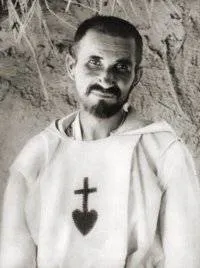
Charles de Foucauld. Public domain.
With Foucauld, Pope Francis will also canonize Devasahayam Pillai, a layman from India who was martyred after converting from Hinduism to Catholicism in the 18th century.
Pillai, who is also known by his baptismal name, Lazarus, was beatified in 2012 in southern India. He will be the first lay Catholic in India to be declared a saint.
Seven years after his conversion, Pillai was killed at the age of 40 by gunshot, after he had been falsely accused of treason, arrested, and tortured for three years.
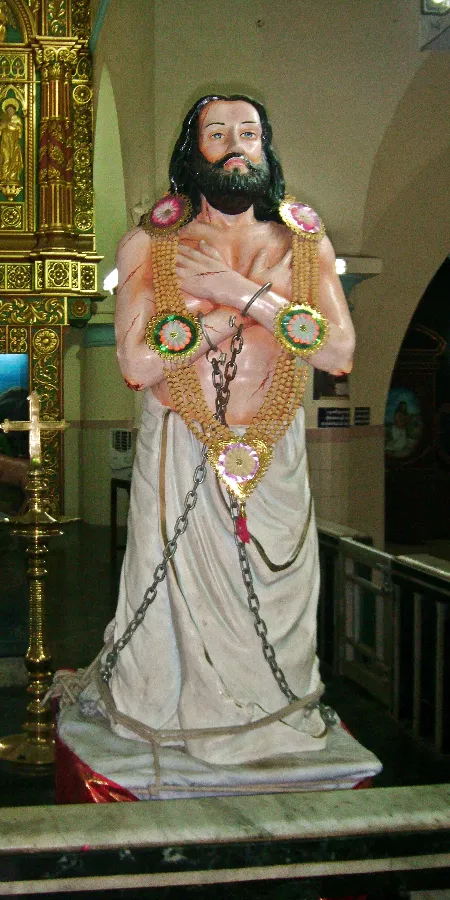
A statue of Bl. Devasahayam Pillai at St. Francis Xavier Cathedral, Kottar, India. Kumbalam via Wikimedia (CC BY-SA 3.0).
Two religious sisters will also be canonized on May 15: Bl. Maria Francesca di Gesù, the foundress of the Capuchin Tertiary Sisters of Loano, and Bl. Maria Domenica Mantovani, the co-foundress and first general superior of the Institute of the Little Sisters of the Holy Family.
Bl. César de Bus, Bl. Luigi Maria Palazzolo, and Bl. Giustino Maria Russolillo — three priests who founded religious congregations and institutes — will also be declared saints.
In October, Fr. Bernard Ardura, the postulator of Foucauld’s cause, told CNA that the canonization would likely take place next spring.
The Vatican was waiting for the global situation with COVID-19 to improve before it scheduled the event, Ardura explained, noting that thousands of people from countries such as the United States, Canada, France, and Algeria traveled to Rome for Foucauld’s beatification in 2005.
“Canonizations are not for the saints, they are for us,” the priest said. “Because for them it changes nothing. It changes nothing for them. It is for us. It is a great ecclesial act.”
If you value the news and views Catholic World Report provides, please consider donating to support our efforts. Your contribution will help us continue to make CWR available to all readers worldwide for free, without a subscription. Thank you for your generosity!
Click here for more information on donating to CWR. Click here to sign up for our newsletter.
A Vatican flag, with the incorrect design likely drawn from Wikipedia, and the dome of St. Peter’s Basilica. / Bohumil Petrik/ACI
St. Louis, Mo., Apr 8, 2023 / 13:00 pm (CNA).
The flag of Vatican City, with its distinctive yellow and white, is instantly recognizable to many Catholics. Likely far fewer people, though, have scrutinized the papal coat of arms on the right-hand side, instead taking the intricate design — which includes famous crossed keys — for granted.
As it turns out, there’s a good chance that the coats of arms on many of the Vatican flags you’ve seen out in the world are rendered incorrectly. And it took until 2023 for the internet to start taking notice.
Imagine you wanted to print your own version of the Vatican flag. Where would you go to find a high-quality picture of one? If you’re like most internet users, your first stop would probably not be the Vatican’s official (but admittedly outdated) vatican.va website. You’re probably going to pull up Wikipedia, one of the world’s most visited websites and an endless storehouse of free image content. Flagmakers the world over appear to have done so over the years.
Imagine many people’s surprise, then, to discover that the image of the “Flag of Vatican City” displayed on Wikipedia has been wrong several times over the years, most recently from 2017 to 2022. (It was also wrong from 2006–2007.)
What is “wrong” about these flags, you might ask? It’s a small detail in the grand scheme of things but easy to spot once you know about it. The erroneous Wikipedia file includes a red disk at the bottom of the papal tiara as well as a different shade of yellow on portions of the coat of arms.
The anonymous Wikipedia editor who changed the look of the flag in 2017 wrote that he or she did so for “color correction” purposes, noting that the Vatican’s coat of arms includes the red at the bottom of the tiara. The only problem? The Vatican’s official flag design renders the coat of arms differently, with the circular bottom of the tiara in white.
The image was reverted to the correct one in 2022, but the damage was done. A casual internet search will turn up dozens of Vatican flags for sale that clearly used the incorrect image downloaded from Wikipedia. The incorrect flag has even made its way into emojis. (This whole situation gained attention last month after a Reddit user made a post about it.)
An inexpensive Vatican flag available for sale on Amazon that makes use of the incorrect Wikipedia flag design. Amazon/Screenshot
Father William Becker, pastor at St. Columbanus Parish in Blooming Prairie, Minnesota, read the Reddit post with interest and amusement. Becker, a self-described “flag guy,” has studied the Vatican flag for years and even wrote an entire book about it. He has fond memories of raising the yellow and white colors over his alma mater, the North American College in Rome.
Becker told CNA that the saga of the Vatican flag on Wikipedia demonstrates a need for the Vatican to step in and clarify exactly what its flag should look like, especially considering the fact that Catholic churches all over the world display the Vatican flag.
It was precisely this lack of clarity on the official design of the Vatican flag that led Becker to create a website detailing, as best as he could, the correct design for the flag.
“Cultural communities in general have turned to flags in a stunning way,” Becker commented, citing in part a proliferation of cheaply made, mass-produced flags. And, anecdotally, there seems to be an ever-increasing interest in the Vatican flag as a way for Catholics to claim an identity, whether by flying a flag at home, waving it at a papal event, or by putting one in their social media profile picture.
The Vatican flag. Bohumil Petrik/CNA
Perhaps surprisingly, the Vatican flag is less than 100 years old, as is Vatican City itself. For more than a millennium before 1870, the pope ruled over the Papal States, large regions mainly within present-day Italy. After the Vatican lost control of the Papal States, it found itself a tiny island surrounded by an acrimonious Italy. It took nearly 60 years until the ratification of the Lateran Accords of 1929 ushered in harmony between the Vatican and Italy, and the creation of the world’s smallest sovereign country.
In the days of the Papal States, many different flags were used, but the yellow and white color scheme was a common feature. Becker said the modern design was first used by the merchant fleet in the Papal States from 1825 to 1870. In 1929, that design was chosen as the new flag of Vatican City, the sovereign country.
“It took a while in 1929 to get some flags made. The techniques of mass production weren’t available yet, and so it would have been a matter of sewing up some flags and fitting out buildings with flag staffs,” Becker noted, saying that during this time and for years afterward there was quite a bit of variation between the Vatican flags people flew, perhaps even more so than today.
“That’s kind of common with other countries too, especially those that don’t really take pains to standardize their design. [Nowadays] a flagmaker is likely to go to a source like Wikipedia, and it may vary in its accuracy,” Becker told CNA.
The same flag chosen in 1929 was reconfirmed in a revised Vatican constitution, issued by Pope John Paul II in 2000. The original Vatican flag was actually square, as indeed the official version is today. Since roughly the 1960s, though, buildings began to fly oblong state flags that followed Italy’s flag proportions, probably because most Vatican flags at the time were mass-produced there.
The flag has special significance beyond the walls of Vatican City as a marker for the Vatican’s extraterritorial properties, of which there are more than a dozen. These properties, which include major basilicas such as St. Paul Outside the Walls and St. Mary Major, are marked as the Vatican’s through their flying of the papal flag.
Becker said he hopes his website will serve as a helpful resource for anyone looking for the exact Vatican flag design, at least until the Vatican issues some kind of clarification on what exactly the flag should look like.
“The papal flag is interesting because on the one hand, the Vatican is such a small state, but the papal flag is seen all over the world. Anywhere there’s a Catholic church, you might be likely to run into a papal flag,” he said.
“It would be nice if somebody at the Holy See could, through their website or wherever, make some design specifications more available … design specifications that manufacturers could rely on a bit more.”
Vatican City, Oct 25, 2017 / 05:40 am (CNA/EWTN News).- Pope Francis on Wednesday spoke about the hope Christians have at the end of life, which is found in God’s promise to be with us at the moment of our death, and to give us eternal life with … […]
Strasbourg, France, Jul 5, 2021 / 05:45 am Cardinal Pietro Parolin said on Sunday that Europe needs faith in God as it struggles with a “demographic winter.” Preaching at Mass in Strasbourg Cathedral in France […]
Leave a Reply
