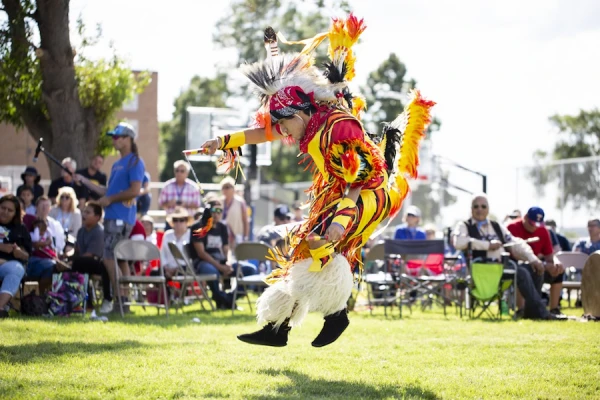
Chamberlain, SD, Jan 30, 2020 / 03:31 am (CNA).- In central South Dakota, along the northern jog of the Missouri River in what one might call “the middle of nowhere,” sits St. Joseph’s Indian School, a modern school with a long history.
While it seems remote, the location of the school is fitting for the Lakota Sioux tribes it serves – Crow Creek, Lower Brule, Rosebud, Pine Ridge, and several other reservations are within roughly two hours of the school.
At a time when public schools in the state are failing to successfully educate Native American students, St. Joseph’s has seen notable success. The high school graduation rate for students who attended St. Joseph’s at some point in their education is around 96% – while state high school graduation rates for Native American students is around 60%. On their assessment tests, St. Joseph’s students consistently show 85% grade-level improvement every year, the Argus Leader reported.
School officials told CNA that it’s a combination of factors that drive student success at the school, from small class sizes to a safe residential environment to numerous educational supports, such as tutoring, that are available on campus.
“I think we are really fortunate that we have small class sizes,” LaRayne Woster, who teaches Lakota Studies at St. Joseph’s, told CNA.
“We’ve got about 12 students in a class and they get a lot more individual attention and we’re able to individualize the work that we do for them to meet them where they’re at. We also have a very large counseling program here,” she said. Each of the school’s 221 students is paired with a counselor who meets with them weekly, helping to evaluate and support their mental health, since they live away from their family, and many have experienced trauma.
The model of the school is unique – every student is required to live on campus, in family-style homes divided by gender and age range, and looked after by house parents. The K-8 school also includes a high school program, where high school aged students live on campus and attend the local public school. A transition specialist works with the students to prepare them for post-graduate life.
The “secret sauce” is also in the school’s religious identity and its desire to give students a well-rounded education that focuses not only on academics but also on faith and culture, school officials told CNA.
 LaRayne Woster teaches Lakota Studies at St. Joseph’s Indian School. Photo courtesy of St. Joseph’s Indian School.
Artwork in the school depicts Jesus dressed in native attire, Joe Tyrell, Director of Mission Integration for St. Joseph’s, told CNA. “So our kids don’t feel like church is just for white people,” or that they have to choose between a Catholic or Lakota identity, he added.
“They can be proud of who they are. They can look and say: ‘This is who I am. I’m Catholic, Christian and I’m Lakota,’” he said. “You just see the integration of both cultures in everything that we do.”
But this mentality of encouraging students to embrace their Lakota culture was not always the case in educational models for Native Americans.
‘Kill the Indian, Save the Man’
A Catholic residential school for Native American students may conjure up unsavory images of the past, when the goal of boarding schools for Native Americans was to rid the students of their native culture and “Americanize” them.
Starting in the mid-late 19th century, Native American parents in the U.S. typically had three schooling options for their children: public reservation day schools, private reservation boarding schools, and off-reservation boarding schools, which appealed especially to families who lived in remote areas.
The first off-reservation boarding school was Carlisle Indian School in Carlisle, Pennsylvania, founded by Colonel Richard Henry Pratt in 1879.
Pratt operated his school with the idea that Native Americans must be “civilized,” and he came up with the motto: “Kill the Indian, Save the Man.” Pratt, like many others at the time, believed that separating Native American children from their indigenous roots and culture was the only way they could be transformed into productive citizens and members of United States society.
Chamberlain Indian School, a government boarding school for Native Americans, opened in 1898 on the grounds which now belong to St. Joseph’s, and operated under a similar education model and mentality as Carlisle.
But the school struggled materially, as the surrounding acres were poor for farming and were not enough to sustain the school. Schools like Carlisle and Chamberlain also struggled with communicable diseases like smallpox and tuberculosis, which spread swiftly among the students living and learning in such close quarters, often killing a number of students.
In the early 20th century, the tide started to turn and preferences for the education of Native American students shifted to reservation-based day schools – they were less expensive, and educators felt that the students might be a good influence on the reservation.
Tornadoes and fires and nuns: The founding of St. Joseph’s Indian School
It was in this movement away from boarding schools that the Chamberlain Indian School was sold to a religious order for a brief time, and then in 1927 was sold to the Priests of the Sacred Heart (the SCJs), an order of priests that was looking to build a Catholic school for the local reservations.
There had been calls from the local native tribes for a Catholic school to be built in the area since the mid-1800s. At an Indian Congress held in 1922, representatives from tribes across the state voted for a Catholic Mission School to be built on the Cheyenne River Reservation.
With permission from the Bishop of Sioux Falls and the Bureau of Catholic Indian Missions, Father Henry Hogebach, SCJ, founded St. Joseph’s on the Chamberlain campus in 1927.
“The charism of the Priests of the Sacred Heart would be to look to those situations where people are not treated justly, and to try and work for a more just solution,” Clare Willrodt, director of communications and outreach for St. Joseph’s, told CNA. “So, I’m sure that that influenced their feeling called to be here.”
“The school was probably pretty much founded on the boarding school model,” she added. “But …where the government schools would go around the reservations and round up kids, and take them from their parents, any children who have ever attended (St. Joseph’s) were sent here by their parents. We didn’t go out and round them up.”
Prior to purchasing St. Joseph’s, the SCJs attempted to build a Catholic school on the Cheyenne River reservation, as the Indian Congress desired. However, the grounds lacked the necessary water supply for a school, and so the school was moved to the Chamberlain campus.
The first few years were rough – the nuns that were supposed to teach the first year bailed at the last minute after not receiving the proper permissions from Rome, and Fr. Hogebach scrambled to hire some teachers before the children arrived. There was a tornado, a fire, financial hardships and students sent to the school beyond its official capacity, including an orphan baby sent to be taken under the care of the Franciscan sisters, who came to the school in its second year.
Despite the challenges, St. Joseph’s school grew rapidly, peaking with enrollment levels of 300-340 students in the 1950s and ‘60s.
It was also in the 1950s that the priests of the school started incorporating some traditional cultural activities into the school setting, even while laws at the time still made it illegal for them to let the children speak their native language in school, Willrodt said.
“Those priests did do quite a bit of work to try and keep the culture alive – beautiful beadwork, dancing, things like that,” she said.
By the 1970s, civil rights movements and changing philosophies in education – particularly towards boarding schools – brought changes to St. Joseph’s. By 1981, the school transitioned the students to family-style residential homes, rather than dormitories.
It was also in the 1980s that the Lakota language was incorporated into prayer services at St. Joseph’s, and that the school’s religion department published documents exploring the links between Catholicism and Lakota religious beliefs.
St. Joseph’s today
“At this point in St. Joseph’s history, Lakota culture no longer involves taking a class or attending a Pow Wow,” Kathryn Cravens wrote in Educating for the Future, a book about St. Joseph’s Indian School.
“Native culture pervades every aspect of the school, from the look and feel of the campus, to the manner in which values and religion are reinforced. A sweat lodge has been built on the grounds of the school campus and is available for students who wish to participate in this Lakota ritual,” Cravens wrote.
There are also Lakota tribal flags hung in the school cafeteria. The Lakota Medicine Wheel, called the Circle of Courage at the school, emphasizes Lakota values of generosity, courage, wisdom, and respect, and are displayed in the family homes on campus. Lakota language is taught and encouraged daily in school, and extracurricular activities for students include cultural activities like traditional beading, drum group, archery or dancing. Students also go on regular field trips to culturally important sites both near and far.
The school also continues to embrace its Catholic identity, and to help students understand that they can be both Lakota and Catholic. The church on campus is called Our Lady of the Sioux, and the Virgin Mary is depicted in traditional Lakota regalia.

Our Lady of the Sioux chapel on St. Joseph’s campus. Photo courtesy of St. Joseph’s Indian School.
“I’m proud to work here to show our kids the ability to pray and be proud of who they are as a Lakota kid, and if they’re Christian as well,” Tyrell said, though he added that he helps students learn how to pray no matter what their faith background is.
“My goal as a religion teacher for the past eight years was to have our kids know that they have some way to pray,” he said, so that they’re able to navigate the tough times in their lives once they leave the school.
“I really love the ability for our kids to find who they are as an individual and then tie that in with their culture and spirituality. And then that amplifies who they truly are and (they’re able) to use it for the rest of their lives.”
Woster, a member of the Rosebud tribe, said she is glad that the students have an opportunity to learn so much about their culture in a safe environment, which not all reservation towns may be able to provide.
“I think what a lot of our South Dakota residents and citizens would say is, ‘I grew up either on a reservation or a border town and didn’t know anything about the people who first lived here,’” she said.
“We’re at a place in education where kids are getting to learn the correct history and who they are and they’re able to be proud of what that is. As a mission, we’re supporting and embracing the fact that this is…a living culture. I was not raised learning about my culture and who I was at school, so I’m super excited and proud of the fact that I get to do that here everyday,” Woster added.
Danielle Kucera, associate director of communications and outreach for the school, told CNA she is proud that St. Joseph’s provides a safe environment in which students can learn and be involved in extracurricular activities, and where their parents trust that they are safe. She said that even if students come from stable homes, reservation environments on the whole can be unstable, with high rates of drug and alcohol addiction, depression, violence and other issues.
“…it wasn’t necessarily that (families) couldn’t provide for their students or for their children, it was more so that they wanted them to be in a place that they could guarantee that they were in a safe environment and learning in a way that was impacting,” Kucera said. “We provide this safe place for our students, and our families know that they’re a part of our family here.”
St. Joseph’s is able to provide all of its additional support for students – including counselors, speech and occupational therapists, and tutors – through private donations. The school receives a small amount of Title I funding from the government for children who need educational support, but everything else is donor-funded. The school also provides resources such as food assistance to struggling families and alumni who need it.
“Our resources are large because of our donor base, and so we’re able to do a lot of things for our families,” Kucera said. “I’ve always said that if the families are doing good back home, that means our students probably are, too.”
Sharmel Olson, director of education at St Joseph’s, told CNA that she is most proud of the school’s educational legacy, as well as its ability to educate the whole person and prepare each student for life after high school.
“Certainly education for me is at the forefront, but at the same time we’re able to do things that other schools honestly don’t get to focus on,” such as faith and culture, she said. Their numerous avenues of support also allow them to look out for all the needs of their students.
“If (a student is) struggling emotionally, we make sure we take care of that, and sometimes that has to be above school, that has to be taken care of so that you can learn. We have a strong team, and a philosophy here that the kids come first and whatever their needs are at that time is what we’re going to take care of. And so I think that’s very unique that a lot of schools don’t necessarily have those capabilities to do that,” she said.
Teachers and staff who come to St. Joseph’s often end up staying for a long time, she added, because they feel a strong sense of mission in serving the Native American population.
“We’re very mission-based, and I think most of (the staff) at our school…we’re here for a reason,” she added. “We really feel that calling to be here.”
 […]
[…]






In California, it might behoove the pro-life movement to limit the discussion to minority LGBTQ babies.
Who are registered Democrats.
(Sigh.)
Archbishop Cordileone should punish the students who walked out by denying them communion.
Aside from that, the students should be punished by requiring them to read and write about Archbishop Cordileone’s recent pastoral letter on abortion.
It sounds like Archbishop Cordileone should be more concerned about his own flock rather than a USCCB letter that will never see the light of day and which Bergoglio has effectively rendered meaningless.
Multiple generations of pseudo-Catholicism. Why should we expect the children of the latest generation to not be, well, charitably speaking, airheads?
That is it in a nutshell with the San Francisco location as the topper.
You had to guess it happened in California. Lemming behavior is all they have. A private Catholic school is not a place for this sort of behavior….it was rude, childish and unchristian for the students to walk out on a speaker. Since most left, it has the feel of a planned political action. One would suspect the ring -leaders among the newly admitted girls. Students do not run the school or make the decisions on speakers. In a catholic school one would think that learning aspects of catholic morality would be part of the expectation. The students who walked out should be disciplined with several weeks of detention and a long essay assignment about why their behavior was inappropriate, and their parents should be informed. Those who decline to cooperate should be expelled. .
Their parents are pro-abortion “catholics” who vote Democrat, so this cannot be a surprise. The Catholic Church in America is mission territory, and the USCCB is merely a self-promoting welfare agency of the Federal Government. This is why I now support the SSPX without reservation.
Accepting that their parents are politically Democrats, there is also the propaganda the students are exposed to due to the ubiquitous presence of their cell phones. The world of the woke and progressives is always at the tips of their fingers.
Further evidence of the extraordinary catechetics in place for the last fifty-five years. The new evangelization has so many success stories. Given the locale one can only imagine the other moral issues held in mid-air by the next generation of katholics. Maybe they should be at the synod on synods…
But we don’t want to make them too rigid.
Ah, but these are difficult times they say.
One is left to wonder how less difficult they might be if we had not sold out to the world, the flesh and the devil while we were opening all the windows…
A couple of points. First of all, I graduated from the school in question in 1971. Secondly, the Society of Mary has not been at the school for a number of years. Frankly, I don’t know if they have any role in administering the school. Thirdly, I was disturbed at the idea of the girl who stayed for the assembly, but did not want to be quoted by name. I wrote to the CHRONICLE reporter to point that out. She replied that the girl did not want to be quoted because she wasn’t sure how her parents would feel about her talking to a reporter and that the reporter had witnessed an open discussion among that girl and classmates who felt differently about the issue.
Did Nancy lead the walkout?
Whomever is the spiritual leader of the Catholic kids in the school need to have a serious conversation with them. I, for one, will not be attending their graduation ceremonies.
California. San Francisco.
“We ask that all students listen respectfully to the speaker, who is nationally recognized for her work on this subject.”
Before we even get into the topic of abortion the issue to be addressed is the protester’s lack of respect for and unwillingness to hear an opposing viewpoint. Who empowered them to take such an action? They come across as a bunch of spoiled ignorant lemmings who think that the world revolves around them and their precious opinion, all other viewpoints be damned. There should be profound attention-getting consequences for their action and if they don’t like it then “Don’t let the door hit you on the way out.” Clearly Catholic doctrine is lost on them.
Returning to the topic of abortion, ultimately what a sad statement they make of the condition of their soul. So young to be so poisoned.
Of course, I don’t know what has been going on in the school prior to this incident, but it appears there is not much about the school that is Catholic. How Catholic can these young people be or how Catholic do they perceive they are supposed to be, and then betray a fundamental teaching of the church.
I don’t have a problem making efforts to help them better understand why the church teachers what She teachers, but if there is continued resistance they need to be expelled. If the entire school is infected with compromise, then it might be time to close the school until A proper foundation is established allowing it to reopen as an authentic Catholic institution.
I think your comment could apply to a number of Catholic high schools, and even more so to a great number of the Catholic colleges and universities in this country.
So very sad. Very sad. These students at a CATHOLIC SCHOOL not only did not want to hear about the value of life and why we, as CATHOLICS, believe every life is sacred, they did not want to value the educational ideal of listening to what amounts to a “philosopher” speaking. Like walking out on Plato, for example, because he espoused a Republic. Closing their minds, let alone their spirits, to ideas they don’t want to hear about, so young, so sad. Better to keep an open mind and spirit to the wisdom of others, throughout life.
And their ability to protest a pro-life speaker was guaranteed by a mother who respect their right to life from conception.
And they wonder why people homeschoool…
…And don’t save several thousand dollars a year as well.
It’s very difficult to be a principal or president of a Catholic high school these days. That said, I believe the interim president of this school made two mistakes in this matter. First, he should not have, in effect, apologized to parents for programming authentic Catholic teaching on the protection of life from conception to natural death. The teaching is only “polarizing” in the sense that radical dissenters and apostates do not accept it, and it is relativistic to acknowledge any legitimacy in their positions. Second, the event should not have been a mandatory assembly, but rather an optional lecture during school hours. The walk-out, which was foreseeable, has caused scandal. Yes, it is sad that many people think they can claim to be Catholic and also pro-“choice”, but offering them opportunities like this to cause scandal only wounds the Church. My opinions on this matter are informed by the comparatively successful approaches taken by leaders of Catholic high schools where I have worked or sent my children.
This is happening in a lot of Catholic schools where parents send their children primarily for academic and less of religious studies of learning the Catholic faith. These are children of parents who failed to lay a good solid moral foundation prior to their children getting indoctrinated by the secular society. “… do not weep for me, but for yourselves and for your children.” Lk 23:28
If only Catholic schools weren’t concerned with filling seats in order to stay in business…
As mass population centers continue to lose Catholics more schools will close.
The church has not “led” on this issue, even In the beginning. They left it to grass routes as a way of messaging truth. But too many changes accompanied the decades and for myriad reasons, we lost the young. Morality must be organic for it to be lived. Mixed messages from a video of the Pope and the President lockedin a seemingly harmonious handclaps all but adds a final period to the efficacy of the Church’s teaching authority.
We have been warned about being in the last battle against family and marriage ;
one has to wonder if Christianity is beeing seen by many any more just as a ‘nice , nice ‘ wimpy and effeminate , impractical faith and the related contempt against same .
The Way of the marvelous spiritual warfare in a bloodless manner that we have been blessed with – more focus on same could be one means . There is the occasion of Elisha, the mocking ‘kids’ and and the bears – invoking The Lord to bind and command away the spiritual bears in the lives of the mockers and to heal their wounds can be one good exercise in warfare for all involved –
https://answersingenesis.org/bible-questions/elisha-little-children-and-the-bears/
Similarly , St.Joseph , from the Line of David who tore up lions and bears , to be invoked to help protect the ‘sheep ‘ – the inner thought life and purity of the hearts – being there to tear up all seductive spirits , to restore blessed thoughts and prayers as the saintly children in Fatima , to live in holy and good relatioships .
The Holy Father reminding us to focus on The Cross where in all evils get burned up in the Flames of Love , to bless us with New Life – as the Most Powerful in the warfare – thank God that families too have easy access to these truths and occasions in the Holy Mass and Sacraments .
May The Spirit help to burn away all lukewarmness in many hearts to keep us too from walking away from Life Giving Blessings and protection in The Precious Blood !
The pro- life lecture should not have been mandatory. The school administrators could have turned it into a “pro-choice” moment in which students are told they’ll have a choice, either attend the pro-life presentation or go downtown and work at the soup kitchen feeding the homeless and washing dishes.
Wouldn’t expelling all the walkouts be a life lesson to be remembered for the rest of their lives?
The chaplain of the school needs to be replaced. He seemingly wants woke friends instead of religious Catholics.
As a Catholic high school theology teacher, I would not be too hard on the students or the leadership. Most of the students who walked out were probably just ignorant. The leadership did well to bring in this speaker.
I’d suggest a way forward is to schedule a debate between two competent speakers on each side of the issue.
Kudos to the school for teaching the pro-life stance.
Shame on the students who walked out thus demonstrating they—the woke—cannot tolerate differing opinions. God save us from them. They, terrifyingly, are the future.
Sad commentary on the state of Catholic schools, but great comments except for the suggestions of “choice of activity” and debate. A wise spiritual director once amended my thinking, as he asserted there is no argument for abortion—there is no “pro” position that withstands the objective truth that induced abortion is always murder. How to help women in crisis pregnancies or what society can do to turn around faulty rationale are open to dialogue and debate. As for providing students the option of a corporeal work of mercy is rather than listen to this speaker still misses the larger objective: education. This is obviously sorely needed, as these students—by their demonstration—expressed their lack of a yi comprehensive understanding of abortion—not just as evil—but all of the realities of the procedures and aftermath—lifelong consequences. Yet, an option might have been individual library research that demonstrated a better grasp of those risks, spiritually, emotionally, and physically. Finally, that this walk out caused scandal—for whom? Jesus Christ experienced numerous walk always but still affirmed truth. At least we know who needs our prayers.
Why all this “tolerance” of people protesting on Church property, in support of murder. Please, stop this acceptance of things divisive, destructive, and evil. This is the Church we are talking about! Defend Her, Protect Her, Boldly make our Biblical stand. Expel these students. Closet smokers don’t get as much tolerance.
Abortion is certainly one of the great spiritual battles of our time, and the devil seems to be winning many to his side.
In Ephesians 6:12,St. Paul writes: “For we are not contending with flesh and blood, but against the principalities, against the powers, against the world rulers of this present darkness, against the spiritual hosts of wickedness in heavenly places.”
In John 8:42-47 Jesus said this to a group who opposed Him: 42 “If God were your Father, you would love me, for I have come here from God. I have not come on my own; God sent me. 43 Why is my language not clear to you? Because you are unable to hear what I say. 44 You belong to your father, the devil, and you want to carry out your father’s desires. He was a murderer from the beginning, not holding to the truth, for there is no truth in him. When he lies, he speaks his native language, for he is a liar and the father of lies. 45 Yet because I tell the truth, you do not believe me! 46 Can any of you prove me guilty of sin? If I am telling the truth, why don’t you believe me? 47 Whoever belongs to God hears what God says. The reason you do not hear is that you do not belong to God.”
And in St. Faustina’s Dairy (#1276) there is this:
“At eight o’clock, I was seized with such violent pains that I had to go to bed at once. I was convulsed with pain for three hours; that is, until eleven o’clock at night. At times, the pains that caused me to lose consciousness.
“Jesus had me realize that in this way, I took part in His Agony in the garden, and that He Himself allowed these sufferings in order to offer reparation to God for the souls murdered in the wombs of mothers.”
“If only I could save even one soul from murder by means of these sufferings!”