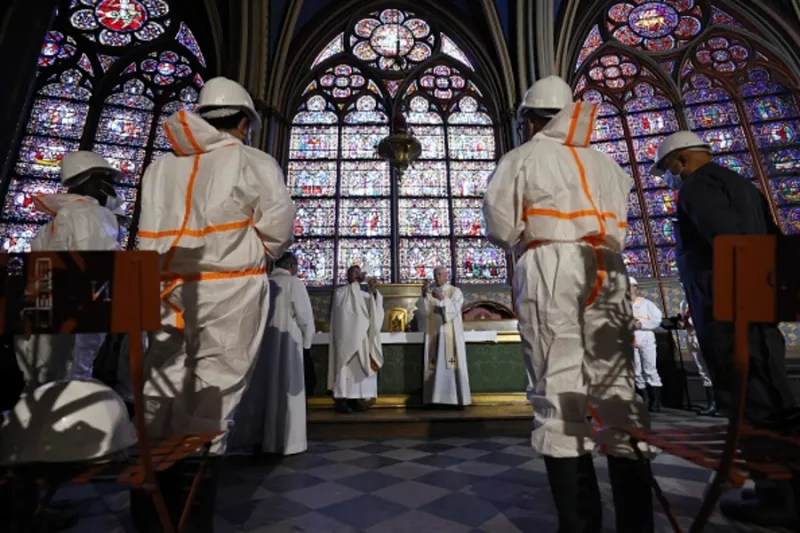
Archbishop Michel Aupetit, center left, celebrates Mass at Notre-Dame Cathedral, Paris, France, June 16, 2021. / Thomas Samson/ Pool/AFP via Getty Images.
Rome Newsroom, Jun 18, 2021 / 08:00 am (CNA).
Wearing a hard hat and boots, the archbishop of Paris offered Mass in a nearly empty Notre-Dame Cathedral this week as restoration of the fire-damaged interior of the Gothic cathedral kicks off.
Archbishop Michel Aupetit used the occasion of the feast of the dedication of Notre-Dame de Paris to reflect on the spiritual metaphor of restoring one of the most important cathedrals in France, which was once called the “eldest daughter of the Church.”
“This cathedral is also the symbol of the restoration of this Church founded 2,000 years ago by Christ himself,” the archbishop said in his homily on the evening of June 16.
“Some believe that it is in ruins and that it is on the verge of collapse. Yet Christ asserted that the gates of death would not prevail against her. We believe it deeply: like our cathedral, the Church of Christ will remain standing.”
Aupetit pointed out that St. Peter’s first letter in the Bible calls the members of the Church “living stones.”
“St. Augustine reminds us: ‘What we see here physically accomplished with walls must be spiritually accomplished with souls. What we see here accomplished with stones and wood must be accomplished in our bodies with the grace of God,’” he said, quoting Augustine’s Sermon 366 for the dedication of a church.
The archbishop continued: “The chief architect is the Father; the model is Christ; the director is the Holy Spirit. What will bring us together, shape us, and unify us to build a Church more beautiful than ever is the fulfillment of the great commandment of Christ: ‘Love one another as I have loved you.’”
Aupetit spoke beneath the large stained-glass windows of Notre Dame’s Saint-Georges chapel, which includes two 13th-century medallions.
The closed-door Mass, broadcast by the Catholic television station KTO, took place with only 12 people present, each wearing a hard hat for security reasons.
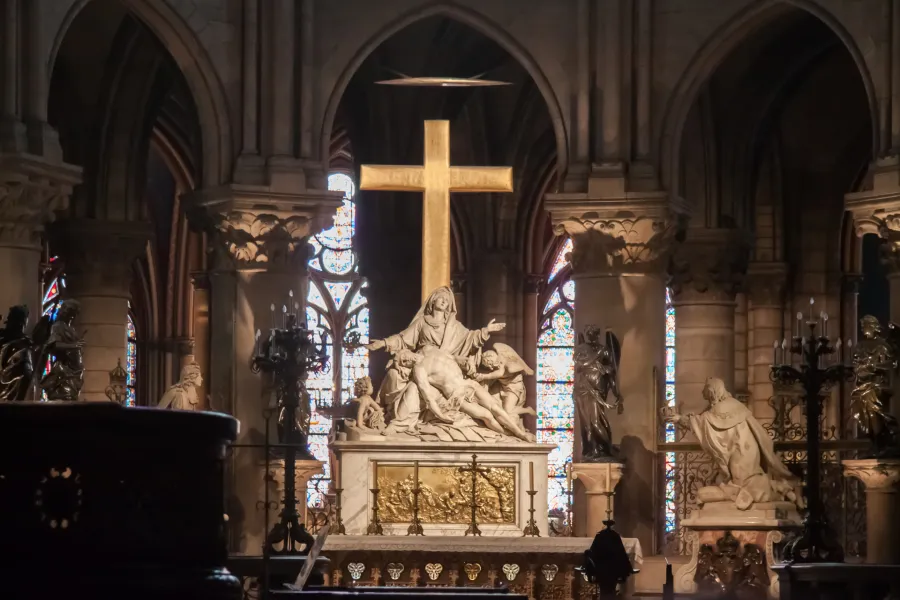
The Descent from the Cross, also known as Pieta, statue inside the Cathedral Notre-Dame de Paris before the fire. / Jeanne Emmel/Shutterstock.
Aupetit has offered a private Mass inside the closed cathedral to mark the anniversary of its dedication each year since the devastating fire in April 2019.
While the French government is overseeing the cathedral’s structural restoration and conservation, the Catholic Church is responsible for its interior renewal.
Paris archdiocese launched an appeal on June 14 for this interior restoration, starting with the reliquary case of the Crown of Thorns, which was damaged on the night of the fire before it was rescued by Fr. Jean-Marc Fournier, chaplain of the Paris Fire Department.
The cathedral will reportedly reopen for worship with a Te Deum on April 16, 2024, five years after the blaze. Later that year, Paris will host the Summer Olympics.
“We are so happy now that our cathedral, which was in danger of ruin, is stabilized. We are now entering the restoration phase. It will be more beautiful than ever and this makes our hearts happy and fills us with hope,” Aupetit said.
If you value the news and views Catholic World Report provides, please consider donating to support our efforts. Your contribution will help us continue to make CWR available to all readers worldwide for free, without a subscription. Thank you for your generosity!
Click here for more information on donating to CWR. Click here to sign up for our newsletter.
When Pope Pius IX declared the doctrine of the Immaculate Conception of the Virgin Mary on December 8, 1854, he had a golden crown added to the mosaic of Mary, Virgin Immaculate, in the Chapel of the Choir in St. Peter’s Basilica. / Daniel Ibañez/CNA
Vatican City, May 29, 2023 / 10:30 am (CNA).
To honor the Blessed Virgin Mary, the Vatican offers a special Marian pilgrimage within St. Peter’s Basilica each Saturday afternoon during the month of May.
The Marian itinerary brings pilgrims from Michelangelo’s marble sculpture of the Pieta to Our Lady of Perpetual Help, a 12th-century painting brought into the basilica in 1578 in a solemn procession.
For those unable to travel to the Eternal City, CNA is providing the following “virtual tour” with photos by Daniel Ibañez of eight beautiful images of Our Lady in St. Peter’s Basilica for the feast of Mary, Mother of the Church.
In St. Peter’s Basilica’s Chapel of the Choir, a large mosaic based on painting by Italian artist Pietro Bianchi depicts Mary, Virgin Immaculate, in the glory of heaven being venerated by St. John Chrysostom (left) and other saints. Daniel Ibañez/CNA
Virgin Immaculate
In the basilica’s Chapel of the Choir, a large altarpiece reveals Mary, Virgin Immaculate, in the glory of heaven above angels and saints. The mosaic based on an 18th-century painting by Italian artist Pietro Bianchi depicts St. John Chrysostom St. Francis of Assisi, and St. Anthony of Padua venerating the Blessed Virgin Mary.
The chapel is located on the left side of the basilica behind an iron gate designed by Gian Lorenzo Bernini. St. John Chrysostom is buried beneath the altar, which also contains relics of St. Francis and St. Anthony.
When Pope Pius IX declared the doctrine of the Immaculate Conception of the Virgin Mary on December 8, 1854, he had a golden crown added to the mosaic of Mary. Pope Pius X later added a larger diamond crown to mark the 50th anniversary of the declaration in 1904.
The original painting by Bianchi can be found in Rome’s Basilica di Santa Maria degli Angeli e dei Martiri.
Mother of the Church
St. Peter’s Basilica contains an icon of the Virgin Mary titled “Mater Ecclesiae,” which means “Mother of the Church.”. Daniel Ibañez/CNA
The basilica contains an icon of the Virgin Mary titled “Mater Ecclesiae,” which means “Mother of the Church.”
The original image of the Virgin Mary and the Christ Child was painted on a column in old St. Peter’s Basilica, built by Emperor Constantine in the fourth century. It was later transferred to the 16th-century St. Peter’s Basilica. Paul VI honored the icon with the title “Mater Ecclesiae” after the Second Vatican Council.
A mosaic of the Virgin Mary overlooking St. Peter’s Square was inspired by the original Mater Ecclesiae image. The mosaic was installed after the assassination attempt against St. John Paul II in 1981.
When he blessed the mosaic, John Paul II prayed “that all those who will come to this St. Peter’s Square will lift up their gaze towards you [Mary], to direct, with feelings of filial trust, their greetings and their prayers.”
In 2018, Pope Francis added the memorial of “Mary, Mother of the Church” to the liturgical calendar for the Monday after Pentecost.
Mother of Pilgrims
A restored 16th-century painting of Our Lady holding her Son can be found in St. Peter’s Basilica above the sarcophagus of Pope Gregory XIV under the title “Mother of Pilgrims.”. Daniel Ibañez/CNA
A restored 16th-century painting of Our Lady holding her son can be found in St. Peter’s Basilica above the sarcophagus of Pope Gregory XIV.
The image is titled “Mater Peregrinorum” or Mother of Pilgrims. The original artist is not known, but Italians also refer to the painting as the “Madonna di Scossacavalli” because it came from Rome’s Church of San Giacomo Scossacavalli, which was demolished in 1937 to create the current Via della Conciliazione leading to St. Peter’s Basilica.
Our Lady of Perpetual Help
A 12th-century painting on wood titled Our Lady of Perpetual Help in the Gregorian Chapel of St. Peter’s Basilica. Daniel Ibañez/CNA
A 12th-century painting on wood titled Our Lady of Perpetual Help, also known as Our Lady of Succor, was transferred to an altar in St. Peter’s Gregorian Chapel on February 12, 1578 with a solemn procession.
The painting was the first artistic restoration completed under Pope Francis’ pontificate during the Year of Faith, according to a book published by the Knights of Columbus.
The remains of the Doctor of the Church St. Gregory of Nazianzus (d. 390) are preserved in an urn beneath the Altar of Our Lady of Succor in the Gregorian Chapel, found on the right side of the basilica.
Ark of the Covenant
A mosaic altarpiece of the Presentation of the Virgin Mary in the Temple can be found above the tomb of Pope St. Pius X near the left-front entrance of the basilica. Daniel Ibañez/CNA
A colorful mosaic altarpiece of the Presentation of the Virgin Mary in the Temple brightens the wall above the tomb of Pope St. Pius X (d. 1914) in the Presentation Chapel near the left-front entrance of the basilica.
A young Mary is depicted on the steps of the Temple with her parents, Sts. Anne and Joachim, the grandparents of Jesus.
The mosaic completed by Pietro Paolo Cristofari in 1728 is based on a painting by 17th-century artist Giovanni Francesco Romaneli, the original of which can be found in Rome’s Basilica di Santa Maria degli Angeli e dei Martiri.
Gate of Heaven
According to Father Agnello Stoia, the pastor of the parish of St. Peter’s Basilica, the 15th-century image of Mary on the oldest door of St. Peter’s Basilica is a reminder of Mary’s title, “Gate of Heaven.”. Daniel Ibañez/CNA
The central door leading to basilica was retained from the old St. Peter’s Basilica and is known as the Filarete Door. Created by a Florentine artist in 1455, the door depicts Christ, the Virgin Mary, and the apostles Sts. Peter and Paul.
According to Father Agnello Stoia, the pastor of the parish of St. Peter’s Basilica, the 15th-century image of Mary on the door is a reminder of Mary’s title, “Gate of Heaven.”
Queen Assumed into Heaven
The mosaics decorating the interior dome of St. Peter’s Basilica depict the Blessed Virgin Mary next to Christ the Redeemer and the Apostles. Daniel Ibañez/CNA
Looking up at the soaring cupola, or dome, of St. Peter’s Basilica, one sees mosaics depicting the Blessed Virgin Mary next to Christ the Redeemer, along with St. John the Baptist and the apostles.
The mosaic of the Virgin Mary on the Great Dome, completed in 1610 by Orazio Gentileschi, is based on drawings by Italian Mannerist painter Giuseppe Cesari.
Mother of the Redeemer
Michelangelo’s Pieta conveys the faith and emotion of the Blessed Virgin Mary as she cradles in her arms the dead body of her only son after witnessing him crucified. Daniel Ibañez/CNA
Michelangelo Buonarroti carved the Pieta from a single slab of Carrara marble when he was 24-years old. The sculpture was unveiled in St. Peter’s Basilica for the Jubilee of 1500.
The moving sculpture conveys the faith and emotion of the Blessed Virgin Mary as she cradles in her arms the dead body of her only son after witnessing him crucified.
The sculpture sits above a side-altar near the front entrance of St. Peter’s Basilica, where Mass was sometimes offered before recent restrictions. Visitors to the basilica can only see the Pieta behind bulletproof glass after a man attacked the sculpture with a hammer in May 1972.
The Pieta was the only work of art that Michelangelo ever signed.
Larry Hogan, Republican candidate for U.S. Senate in Maryland, greets supporters before casting his ballot in the state primary election at Davidsonville Elementary School on May 14, 2024, in Davidsonville, Maryland. / Credit: Chip Somodevilla/G… […]
Toronto, Canada, Jun 3, 2021 / 03:00 am (CNA).
The Archbishop of Toronto released a pastoral letter earlier this year offering meditations on and insights into the significance of the Sacred Heart of Jesus, to which the month of June is dedicat… […]
Allan Temko, in his book “Notre Dame of Paris” (Time/Viking, 1952/55/62), mentions two previous fires and a bomb:
“The roof of Paris—the most magnificent fore[s]t left in France—has twice caught fire. Each time the flames were extinguished by luck, faith, what you will; and the Cathedral stands.
“On the eve of the Feast of the Assumption in 1218, fire broke out in the choir. A thief of British origin (“Anglicus natione”) had concealed himself for several days in the roofing of the tribunes; and when the Cathedral’s treasure was put on display for the fete of the Virgin, he tried to hook a valuable chandelier. The burning candles ignited a tapestry, and soon Notre Dame was blazing. The fire caused no permanent damage….”
“Periodically, throughout the nineteenth century, the priests were chased out and readmitted to the sanctuary, the last expulsion taking place under the Commune. On May 26, 1871, chairs—a modern convenience medieval worshipers had done without—were stacked in the choir and set aflame. The fire was extinguished by the interns of the Hotel-Dieu, who broke in the doors which the communards had locked, and saved the monument.
“Notre Dame has resisted all, including the German bomb that pierced its roof during the First World War. It withstood the Nazis, who marched onto the parvis in 1940. It merely rose upward before them, a serene and massive lesson in history, unconquerable and silent, profiling the soul of its city.”
Thank God.
Allan Temko, in his book “Notre Dame of Paris” (Time/Viking, 1952/55/62), mentions two previous fires and a bomb:
“The roof of Paris—the most magnificent fore[s]t left in France—has twice caught fire. Each time the flames were extinguished by luck, faith, what you will; and the Cathedral stands.
“On the eve of the Feast of the Assumption in 1218, fire broke out in the choir. A thief of British origin (“Anglicus natione”) had concealed himself for several days in the roofing of the tribunes; and when the Cathedral’s treasure was put on display for the fete of the Virgin, he tried to hook a valuable chandelier. The burning candles ignited a tapestry, and soon Notre Dame was blazing. The fire caused no permanent damage….”
“Periodically, throughout the nineteenth century, the priests were chased out and readmitted to the sanctuary, the last expulsion taking place under the Commune. On May 26, 1871, chairs—a modern convenience medieval worshipers had done without—were stacked in the choir and set aflame. The fire was extinguished by the interns of the Hotel-Dieu, who broke in the doors which the communards had locked, and saved the monument.
“Notre Dame has resisted all, including the German bomb that pierced its roof during the First World War. It withstood the Nazis, who marched onto the parvis in 1940. It merely rose upward before them, a serene and massive lesson in history, unconquerable and silent, profiling the soul of its city.”