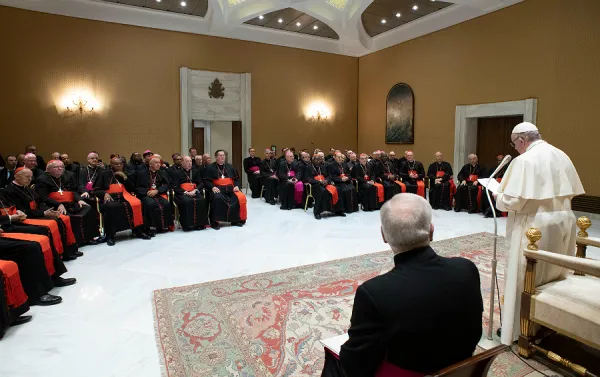
Pope Francis addresses participants in the plenary assembly of the Congregation for Divine Worship in the auletta of the Vatican’s Paul VI Hall, Feb. 14, 2019. / Vatican Media.
Vatican City, Mar 16, 2021 / 05:00 pm (CNA).- An Italian bishop is carrying out a visitation at the Vatican’s Congregation for Divine Worship and the Discipline of the Sacraments less than a month after Cardinal Robert Sarah resigned as prefect.
According to media reports, Bishop Claudio Maniago of Castellaneta, president of the liturgy commission of the Italian bishops’ conference, began a visitation to the Vatican’s liturgy office March 15.
Maniago is also a member of the Congregation for Divine Worship, appointed in 2016.
Pope Francis accepted Cardinal Sarah’s resignation as prefect of the Divine Worship congregation Feb. 20. His successor to lead the office has not yet been named.
Information about Maniago’s visitation has not been made public, but the Italian newspaper La Stampa wrote March 16 that it had confirmed it was taking place and seen an internal email of the congregation announcing the visitation.
According to La Stampa, the March 12 email, from Archbishop Arthur Roche, secretary of the Congregation for Divine Worship, said: “The Holy Father has decided, before making appointments to the Congregation, that there should be a visit to the Dicastery by one of his representatives.”
The email reportedly further said that Maniago would be learning about the congregation’s work and meeting with officials one by one.
“I have already expressed to the Holy Father our openness to this visit and our sure and sincere welcome to Msgr. Maniago,” Roche reportedly wrote.
“There is nothing to be alarmed about in this. As you know, this style of visit is now becoming a regular occurrence at the end of the mandate of the heads of the Dicastery or at the time of a significant change.”
La Stampa reported that internal consultations of the sort described in Roche’s email did not take place, however, in the Congregation for the Evangelization of Peoples or the Congregation for the Causes of Saints, which both received new prefects in recent years.
Since Sarah’s resignation was accepted in February, the question has been who might be chosen to replace the Guinean cardinal at the head of the liturgy congregation.
CNA reported last month that Pope Francis could be looking at three possible candidates, one of which is Maniago, the bishop carrying out this month’s visitation.
In his role at the Italian bishops’ conference, Maniago, 62, oversaw the new Italian translation of the Roman Missal.
Another possible option for prefect is Roche, currently the congregation’s number two.
Before being appointed to his Vatican position in 2012, Roche, 70, served as chairman of the International Commission on English in the Liturgy.
During the last eight years, the English archbishop has been a go-between for Pope Francis and Cardinal Sarah on liturgical issues.
Bishop Vittorio Viola of Tortona, Italy, is a third possible candidate. The 55-year-old is a member of the Order of Friars Minor.
His first appointment as a bishop, in 2014, was on the initiative of Pope Francis, who took him from a position as president of the Assisi-based branch of Caritas.
Viola was also formerly the Custodian of the Papal Basilica of Saint Mary of the Angels in Assisi. He got to know the pope during his 2013 visit to the city when they sat next to each other during a lunch with the poor.
Viola is also a good friend of Bishop Domenico Sorrentino of Assisi, who was secretary of the Congregation for Divine Worship from 2003 to 2005.
If you value the news and views Catholic World Report provides, please consider donating to support our efforts. Your contribution will help us continue to make CWR available to all readers worldwide for free, without a subscription. Thank you for your generosity!
Click here for more information on donating to CWR. Click here to sign up for our newsletter.
Lisbon, Portugal, Feb 19, 2021 / 02:01 pm (CNA).- Portugal’s president on Thursday requested a constitutional review of a recently-passed bill to legalize euthanasia and assisted suicide in the country.
Marcelo Rebelo de Sousa wrote Feb. 18 to the country’s Constitutional Court, laying out concerns that the proposed law, passed late last month, is vague enough as to not be in accord with the Portuguese constitution, which describes human life as “sacrosanct.”
The bill would apply to patients over 18 who are “in a situation of extreme suffering, with an untreatable injury or a fatal and incurable disease.”
He pointed to the bill’s provision that allows terminally ill adults experiencing “intolerable suffering” to end their own lives, and noted that it “seems to inculcate a strong dimension of subjectivity” and wondered how physicians were expected to measure pain as “intolerable.”
The question is not over the constitutionality of euthanasia, he wrote, but whether the specific regulation is in conformity with the constitution.
“It does not seem that the legislator provides the physician involved in the procedure with a minimally secure legislative framework that can guide his performance,” Rebelo de Sousa wrote.
“This insufficient normative densification does not seem to comply with the constitutional requirement regarding the right to life and human dignity, nor with the certainty of the Law.”
Rebelo de Sousa, a Catholic who was reelected in a landslide vote Jan. 24, is a former law professor who helped to draft Portugal’s constitution in 1976.
Portugal’s parliament passed the bill to legalize euthanasia and assisted suicide Jan. 29 by a vote of 136-78-4.
Upon a bill’s passage the president has three options: giving the bill assent, sending it for review to the constitutional court, or employing his veto. Parliament can override a presidential veto by backing legislation a second time.
Portugal’s bishops expressed “sadness and indignation” at the bill’s passage.
They criticized both the content and the timing of the bill; the bishops were recently forced to suspend public Masses amid a surge in COVID-19 deaths.
“It is a contradiction to legalize death in this context, rejecting the lessons that this pandemic has given to us on the precious value of human life, which the community in general and health professionals in particular are trying to save with extraordinary efforts,” the bishops said Jan. 29.
If the bill is signed into law, Portugal will become the fourth country in Europe to legalize euthanasia, alongside the Netherlands, Belgium, and Luxembourg. Around 81% of Portugal’s 10 million population are baptized Catholics.
The bishops said that accepting the law would “convey the erroneous idea that life marked by illness and suffering no longer deserves protection and becomes a burden to oneself, to those around them, to health services and to society as a whole.”
They added: “The response to illness and suffering should rather be the protection of life, especially when it is more fragile, by all means, and especially by access to palliative care, which the majority of the Portuguese population is still deprived of.”
Portugal, while still a Catholic-majority country, has legalized same-sex marriage and abortion in the past several decades.
The Socialist Party, one of the left-of-center parties leading the charge to push the euthanasia legislation in Portugal, also led proposals to permit same-sex marriages and abortion in Portugal, the AP reports.
Portugal’s parliament failed to pass several proposals to legalize euthanasia and assisted suicide in mid-2018.
When lawmakers began debating five pieces of legislation in February 2020 to decriminalize euthanasia and assisted suicide, doctors in the country joined with the Catholic Church in opposing the potential change.
The Portuguese Doctors’ Association says the legislation violates key principles of the medical profession.
“Doctors learn to treat patients and save lives. They are not prepared to take part in procedures leading to death,” PDA president Miguel Guimaraes said after meeting with President Rabelo de Sousa.
Pro-life groups protested the euthanasia bills in the weeks leading up to the vote in Lisbon, where they held signs saying, “We demand palliative care for ALL” and “Euthanasia is a recipe for elder abuse.”
Denver Newsroom, Sep 16, 2022 / 13:00 pm (CNA).
Bishop Joseba Segura Etxezarraga of Bilbao, Spain, has announced that Pope Francis has ordered a new canonical process for a case of abuse that took place at a school run by th… […]
Pope Francis presides over the funeral Mass for Pope Emeritus Benedict XVI in St. Peter’s Square on Jan. 5, 2023. / Vatican Media
Rome Newsroom, Jan 15, 2023 / 11:00 am (CNA).
It was widely anticipated that a major reform of the Diocese of Rome was coming, as Pope Francis has been thinking about it for some time.
But no one expected it to come when it did: On Jan. 6, one day after the funeral of Francis’ predecessor as Bishop of Rome, Pope Emeritus Benedict XVI.
With the reform, Pope Francis firmly took over the reins of the vicariate, or hierarchy, of the diocese. Everything is centralized, and everything must pass, at least formally, under the control of the pontiff.
Cardinal Angelo de Donatis, the pope’s vicar for the diocese, sees his role deeply diminished. The diocese’s auxiliary bishops strengthen their direct link with the pope. In the end, the pope has made it clear that he is the one who also formally presides over the Episcopal Council, a new body established as an “expression of synodality.”
Cardinal Angelo De Donatis. . Daniel Ibanez/CNA
The backstory
Before going into some details of the new decree, however, some background is necessary.
The last reform of the structure of the Vicariate of Rome was outlined by John Paul II in 1908, with the apostolic constitution Ecclesia In Urbe. For the new reform, Pope Francis copied and pasted several passages from that document. In some cases, these have been minimally rewritten to emphasize some details instead of others. In other cases, greater changes were made but these do little to alter the basic substance of things.
The reform presents two general characteristics of Pope Francis’ way of legislating: using councils or commissions and requiring those bodies to report directly to him.
It is clear that the pope is the bishop of Rome and that the pope’s vicar for the diocese is his auxiliary. Pope Francis, however, in this case, goes further, including with the constitution a decree that directly defines the areas of competence of the auxiliary bishops.
Pope Francis shows, in this way, a willingness to exercise greater personal control over everything that happens in the vicariate. At the same time, this choice also testifies to a “break” in the relationship of trust with his vicar, Cardinal de Donatsi.
Although Francis called de Donatis to preach retreats to the Roman Curia in 2014, he was never the pope’s candidate to succeed Cardinal Vallini as vicar. That was Cardinal Paolo Lojudice.
Pope Francis, however, wanted to first consult the parish priests of Rome, 80% of whom preferred de Donatis. It was impossible, therefore, for the pope not to listen to them. He appointed De Donatis vicar (and cardinal) and made Lojudice archbishop of the prestigious Diocese of Siena, and a cardinal, as well.
Last May, at the general assembly of the Italian Episcopal Conference, it seemed clear that Pope Francis preferred the appointment of Cardinal Lojudice as the new president of the CEI.
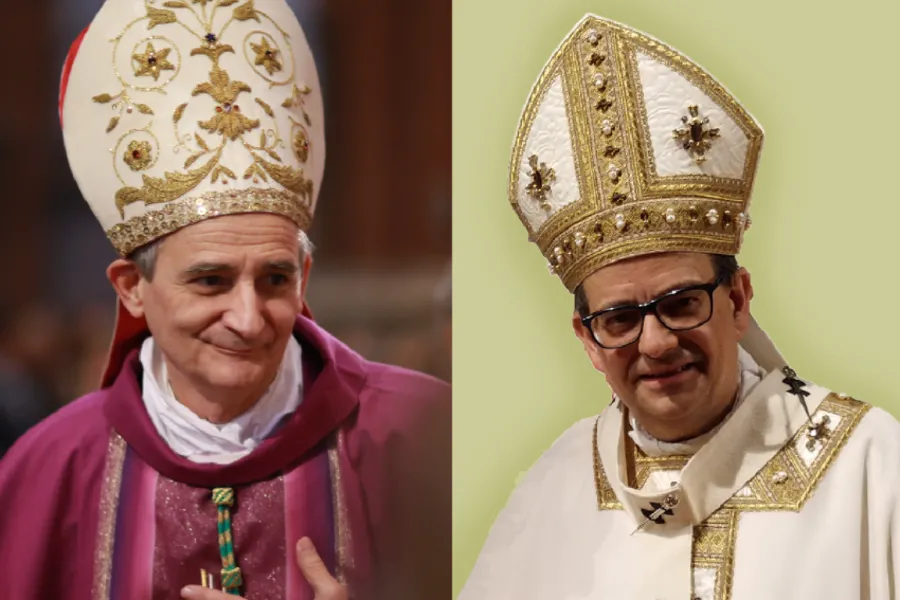
Cardinal Matteo Zuppi and Cardinal Augusto Paolo Lojudice. Francesco Pierantoni via Wikimedia (CC BY 2.0)/Pufui PcPifpef via Wikimedia (CC BY-SA 4.0).
The plan was to appoint Lojudice vicar of the Diocese of Rome to succeed Cardinal de Donatis, who had finished his five-year term, which would then have made Lojudice the primary contact person for the pope both in Rome and among the Italian bishops. De Donatis would have been appointed the new Penitentiary in place of Cardinal Mauro Piacenza, who has now turned 78.
The Italian bishops, however, preferred Cardinal Matteo Zuppi, archbishop of Bologna, who was not unwelcome to Pope Francis.
Lojudice didn’t become vicar for the Rome Diocese, either, as everyone assumed would happen. Meanwhile, the relationship of trust between de Donatis and the pope seemed to have been interrupted in 2020, when, at the beginning of the lockdown for COVID-19, de Donatis decided to close the churches of Rome. When Pope Francis later highlighted the inadvisability of closing churches, de Donatis withdrew the decree but announced that every decision had been made in agreement with the pope. There also have been other moments of friction in recent years.
The pope, however, now seems intent on changing the vicar this year when de Donatis’ mandate expires. An indication of this is the fact that in the decree in which the Pope defines the area and pastoral competencies of the auxiliary bishops, de Donatis is not mentioned as vicar. One might take his presence for granted, of course, but the general interpretation is that the change will be made.
What’s new
What are the novelties introduced by Pope Francis? First, the figure of the prelate general secretary disappears, while the vicegerente (or the deputy of the vicar) manages the offices of the General Secretariat. The prelate secretary also had the function of the moderator of the Curia. In this case, everything is entrusted to the vicegerente, who thus sees his functions and weight increase.
The pope chose the vicegerente from among the auxiliary bishops, and in this case, Baldassare Reina was selected. Bishop Reina does not come from the Diocese of Rome but was called from Agrigento. The pope’s logic is to break possible power chains by bringing in fresh and foreign forces.
The choice of a new parish priest is entrusted to a lengthy procedure which must then, in any case, be submitted to the pope, who acts as the true and proper bishop of Rome without relying on the vicar, who is left with the appointment of assistant parish priests.
Article 20 of the Constitution requests a report for each candidate for the priesthood or diaconate to be submitted before ordination. Also, in this case, the candidates must be presented by the cardinal vicar to the pope, and only after obtaining the Episcopal Council’s consent. Therefore, the vicar seems to be practically a commissariat: He does not choose the candidates but submits them to the pope and can submit them only after the Episcopal Council has endorsed the choice.
The council is defined as the “first organ of Synodality” and must meet “at least three times a month,” presided over by the pope. Only in the absence of the pope can the cardinal vicar preside over the council, which is made up of the vicegerent and the auxiliary bishops. However, the pope wants to receive “the agenda for each meeting as soon as possible.”
Finally, there is also the establishment of an Independent Supervisory Commission. This will have a regulation that must be “approved by the Pope” and six members appointed by the pope who can remain in office for a maximum of two five-year terms.
The service for the protection of minors and vulnerable people is also added, which “reports to the Episcopal Council, through the auxiliary bishop appointed by me,” the pope has decreed.
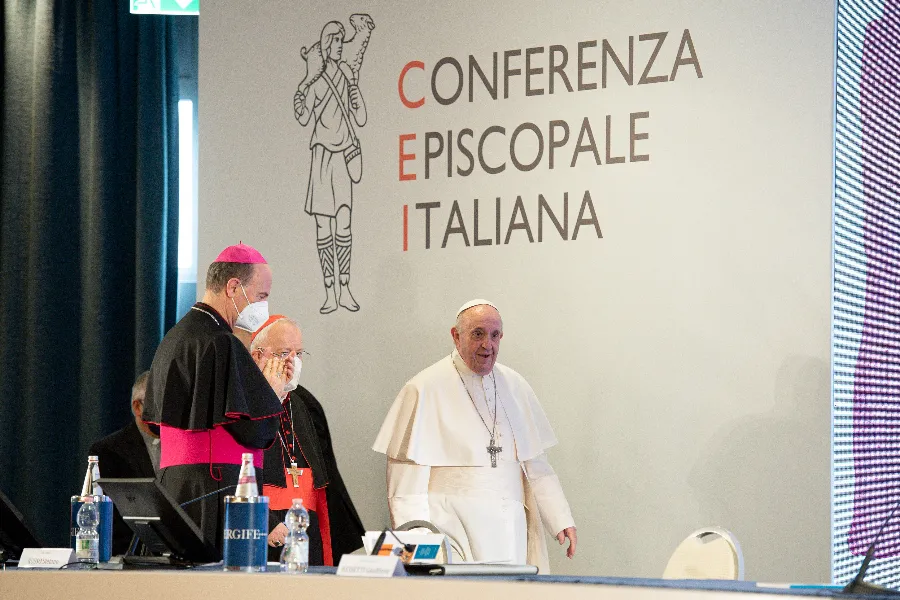
Pope Francis attends the Italian bishops’ plenary assembly in Rome on May 24, 2021. Vatican Media.
The effects of the reform
The constitution also redistributes the areas and offices of the Vicariate’s Curia, and the accompanying decree gives each auxiliary bishop a specific task.
Beyond the reorganization, it should be noted how the pope enters into action as the actual bishop of Rome. Everything must pass through the decisions of the pope, while before, the cardinal vicar enjoyed trust and discretion. For the first time, however, the pope’s vicar is defined as an “auxiliary.” He is, therefore, an auxiliary among the auxiliaries, with a considerable reduction in his weight.
With this centralization, Pope Francis probably wants to overcome the risk of having “abuses” within the Vicariate.
It is worth remembering that in June 2021, Pope Francis ordered an inspection of the Vicariate itself. It was an audit entrusted to the Auditor General of the Holy See, Alessandro Cassinis Righini. It was the first time the Vicariate sifted through the accounting books, registers, and cooperative societies.
However, the Pope, as a matter of practice, has sent an inspection to all the dicasteries of the Curia every time there is a reform or a new mandate. The review, therefore, already predicted the change of pace in the Vicariate, one that has led Pope Francis to be increasingly alone in command.




Leave a Reply