CNA Staff, Oct 28, 2020 / 06:19 pm (CNA).- During a visit to Sri Lanka on Wednesday, US Secretary of State Mike Pompeo visited St. Anthony’s Shrine, Kochchikade, one of the sites of the 2019 Easter bombings.
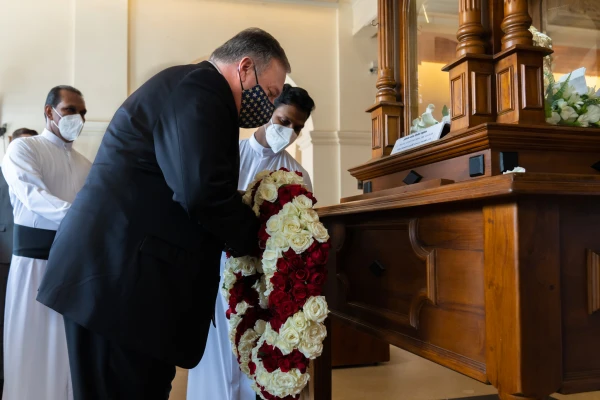
Pompeo laid a wreath at the shrine in Colombo Oct. 28.
Speaking to the press earlier in the day, he said that “it’s important for me to take a moment to go and visit the Shrine of St. Anthony, one of the five sites that was attacked by ISIS on Easter Sunday of 2019.”
Today, I laid a wreath at the Shrine of St. Anthony, one of the sites of the 2019 #EasterAttacks which killed and injured hundreds of innocent people. We stand with the Sri Lankan people and the world to defeat violent extremism and bring perpetrators to justice. #USwithSLpic.twitter.com/toQYKKHEPp
He continued: “I’ll shortly have the chance to pay my respects to the hundreds of victims of evil terrorists, including five Americans. I’m proud that the State Department has offered substantial counterterrorism assistance to help Sri Lankans bring killers of Americans and their own people to justice.”
“These Easter Sunday attacks represent the kind of sectarianism that Sri Lankans are ready to leave behind forever. Sri Lankans of all backgrounds – Buddhists, Hindus, Christians and Muslims alike – want a peaceful nation where their human rights are respected.”
Pompeo’s visit to Sri Lanka comes amid a week-long trip during which he is also travelling to India, Maldives, Indonesia, and Vietnam.
The State Department said that he is visiting Colombo “to underscore the commitment of the United States to a partnership with a strong, sovereign Sri Lanka and to advance our common goals for a free and open Indo-Pacific region.”
In his address with the Sri Lankan foreign minister, Pompeo emphasized their countries’ partnership, and contrasted it with what is sought by China. He added that the US “fully expect(s) that Sri Lanka will fulfill its pledges to take meaningful, concrete steps to promote accountability, justice, and reconciliation.”
On April 21, 2019, two Catholic churches, one evangelical Christian church, four hotels, and a housing complex were hit by nine suicide bombers. The attacks killed 259 people and injured another 500.
Five of seven suspects arrested in connection with the attacks were recently released by the country’s government.
The government has said the suspects were released due to a lack of evidence. However, Cardinal Malcolm Ranjith of Colombo, as well as friends and family of the victims, have said they fear the release means corruption, or a lack of a thorough investigation, on the part of the Sri Lankan Criminal Investigation Department.
Earlier this month the nation’s bishops said democracy would decay there if parliament passes a constitutional amendment that would strengthen the president's power.
If you value the news and views Catholic World Report provides, please consider donating to support our efforts. Your contribution will help us continue to make CWR available to all readers worldwide for free, without a subscription. Thank you for your generosity!
Click here for more information on donating to CWR. Click here to sign up for our newsletter.
Canberra, Australia, Apr 10, 2019 / 04:03 pm (CNA).- Australia’s high court on Wednesday threw out cases brought by pro-life activists challenging “buffer zone” laws in Victoria and Tasmania that bar any protests within 150 meters (nearly 500 feet) of a clinic or hospital that performs abortions.
In its April 10 decision, the court said that “given that the proscription leaves protesters free to conduct protests in relation to terminations outside the access zone, and that there is no evidence or other reason to accept that political protest against terminations outside the access zone is any less effective as a tool of political persuasion than protest within”, the buffer zones’ effect on political freedom was “negligible”.
The Victorian case was brought by Kathleen Clubb, a pro-life campaigner who was fined $5,000 in 2016 for “communicating about abortion” to a woman using an abortion clinic. The same year, Graham Preston was fined $3,000 for violating Tasmania’s similar buffer zone law.
Both plaintiffs argued that the laws violate their freedom of speech, since they prohibit political speech in a place where “communications on [abortion] are likely to occur and be most politically resonant.”
Clubb has said that “the prohibition applies whether or not discomfort is caused, and irrespective of the political significance of the communication in the circumstances” and that the appeal asked “whether a prohibition of that kind is compatible with a constitution which protects a freedom of political communication.”
Their lawyers had argued that because there are already laws in both states that protect against harassment and intimidation, the only further effect of the buffer zone laws is essentially to ban peaceful protest, and that Australia grants an implied freedom to political speech.
The court responded to the “implied freedom” argument saying that “it is no part of the implied freedom to guarantee a speaker an audience, much less a captive audience.”
It added that “the limited interference with the implied freedom is not manifestly disproportionate to the objectives of the communication prohibition. The burden on the implied freedom is limited spatially, and is confined to communications about abortions. There is norestriction at all on political communications outside of safe access zones. There is no discrimination between pro-abortion and anti-abortion communications. The purpose of the prohibition justifies a limitation on the exercise of free expression within that limited area.”
The governments of Victoria and Tasmania had contended that the laws are designed to allow women to access legal medical services.
The Australian Capital Territory, the Northern Territory, New South Wales, and Queensland have similar buffer zone laws.
Buffer zones are being debated elsewhere, including in the United Kingdom. British Home Secretary Sajid Javid rejected proposals for buffer zones around abortion clinics throughout England and Wales as disproportionate in a Sept. 13, 2018 decision, after finding that most abortion protests are peaceful and passive. Local jurisdictions in England and Wales are able to establish their own buffer zones.
In the United States, three states have passed buffer zone laws: Colorado, Montana, and Massachusetts.
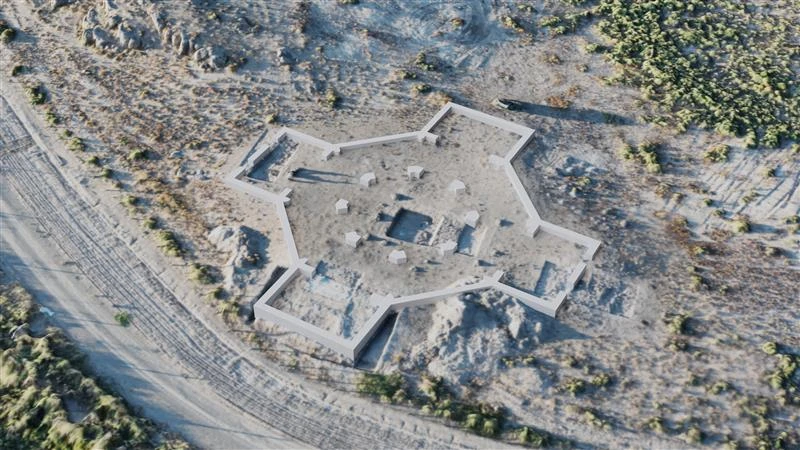
A reconstruction of an ancient church recently discovered in Armenia. The newly discovered church measures about 100 feet across and is shaped like an octagon with “cruciform annexes oriented east-west and north-south,” according to Achim Lictenberger, who noted the discovery of a similar structure from a slightly later period found in Abchazia (Sebastopol). / Credit: AGAP
Washington, D.C. Newsroom, Oct 24, 2024 / 08:00 am (CNA).
A team of German and Armenian researchers made a groundbreaking discovery last week of an ancient church in Armenia dating back to the fourth century, making it the oldest documented church in Armenia, which is considered the first Christian nation in the world.
In an email correspondence with CNA, co-directors of the project Achim Lichtenberger and Torben Schreiber of the University of Münster and Hayk Gyulamiryan of the Armenian Academy of Sciences explained the significance of the discovery made by the team at the site of the ancient city of Artaxata. The project’s fourth co-director, Mkrtich H. Zardaryan, could not be reached for comment by the time of publication.
Historic roots of Christianity in Armenia
“Being the first country which adopted Christianity at the state level, and where the apostles Thaddeus and Bartholomew preached Christianity in the early first century, this discovery is a very important fact for Armenians,” Gyulamiryan told CNA, further stating that “the findings are among the most important in Armenia in recent decades.”
Lichtenberger also emphasized the site’s particular importance, as the church was discovered near the monastery of Khor Virap, where Gregory the Illuminator had been kept in prison before he converted the Armenian king Tiradates III to Christianity in the fourth century.
The monastery of Khor Virap and Ararat in Armenia. Credit: AGAP
As Gyulamiryan stated, although the roots of Christianity may be traced back to the time of the apostles in Armenia, it was not until 301 that Christianity was proclaimed the official religion of Armenia.
According to tradition, Armenia’s conversion is attributed to St. Gregory the Illuminator, a Christian evangelist and convert from Zoroastrianism who miraculously cured the nation’s pagan king of a peculiar “illness” after no other pagan priest was able to do so.
The widely-adopted story of how Armenia became Christian draws from a mythical history promulgated by the fifth-century author Agathangelos, the Armenian researcher explained.
As the legend goes, the pagan king of Armenia had become fascinated by the beauty of St. Hripsime, a nun who had fled with her abbess and community from persecution in Rome. The king offered to marry and make her queen, but Hripsime refused and was able to ward off the king’s advances through miraculous strength.
After the king ultimately had Hripsime and her community killed, historians claim he was “turned into a wild boar who tore at his own flesh” and could not be cured by any priests of pagan or Zoroastrian temples who attempted the feat.
Eventually, the king’s sister persuaded him to appeal to St. Gregory, whom the king had imprisoned for the past 15 years. Once St. Gregory was released, he cured the king of his “disease” and converted him and the entire royal family to the Christian faith.
Artaxata, where these events are believed to have taken place, is “a major place related to early Christianity in Armenia,” Lichtenberger told CNA.
St. Gregory is revered both in the Orthodox Armenian Apostolic Church and in the Catholic Church traditions. In 2005, Pope John Paul II erected a 19-foot statue of St. Gregory in the north courtyard of St. Peter’s Basilica in Vatican City.
The excavation area of the archeological site where the remains of an ancient church were found in Armenia. Credit: AGAP
The discovery
The newly-discovered church measures about 100 feet across and is shaped like an octagon with “cruciform annexes oriented east-west and north-south,” according to Lichtenberger, who noted the discovery of a similar structure from a slightly later period found in Abchazia (Sebastopol).
Although the Araxata site was previously discovered, Lichtenberger told CNA that the church had been buried underground and gone undiscovered until the team carried out its magnetic prospections and excavations this past spring.
The researchers confirmed in September the age of the church to be from about 350 A.D. using radiocarbon dating techniques on a series of samples taken from a wooden platform belonging to the original construction of the building.
Ahead of the autumn excavations this year, Gyulamiryan told CNA he remembered thinking that the team “should confidently dig up the next chapter of the history of Armenia.”
The massive mortar wall of the recently discovered ancient church believed to be the oldest in Armenia. Credit: AGAP
According to Lichtenberger, the radiocarbon date from the wooden samples corresponded with pottery shards that were also discovered inside the church and with “the overall construction technique of the building using substantial amounts of mortar.”
“In the center of the church we encountered significant amounts of marble decoration that suggest that this part was prominently adorned,” he said. Interestingly, the German researcher noted that the state of the building upon discovery indicated that it had perhaps met a hostile end.
“The building was heavily destroyed (maybe intentionally),” he wrote, “the marble construction smashed, parts of the floor tiles removed, the roof set on fire, and all was buried in a huge collapse of roof tiles and burnt roof beams.”
However, according to Lichtenberger, there are no primary literary sources that correspond to the church, as “literary sources only relate to a seventh-century A.D. church in Artaxata.”
By contrast, while the Armenian literary tradition attests that the oldest church in the country is the Etchmiadzin Cathedral, Lichtenberger noted, “archeological evidence from this place does not date back to the mid-fourth century A.D.”
“This does not mean that Etchmiadzin is younger than the Artaxata church, it only means that the Artaxata church provides earlier archaeological evidence,” he added. “Therefore we assume that the Artaxata church is the oldest archaeologicallyattested church in Armenia.”
The Etchmiadzin Cathedral, which Armenian literary tradition attests is the oldest church in the country. But Achim Lichtenberger says this “does not mean that Etchmiadzin is younger than the Artaxata church, it only means that the Artaxata church provides earlier archaeological evidence. Therefore we assume that the Artaxata church is the oldest archaeologically attested church in Armenia.” Credit: Madalaine Elhabbal
Future of the project
Schreiber shared with CNA in another email chain that analysis of data collected from the site will play a significant role in future archeological measures.
“The interaction of the excavation results, the geophysical survey, and the scientific investigations (natural sciences) will keep us busy in the coming year,” Schreiber said. “However, we are certain that these measures will provide us with a very comprehensive picture of this extraordinary and important find.”
Excavations in the ancient ruins of a church recently discovered in Armenia, the oldest Christian nation in the world. Credit: AGAP
The research team from the University of Münster and the Armenian Academy of Sciences have been at the Artaxata site since 2018 and have also made other noteworthy discoveries, including an unfinished Roman aqueduct, a Hellenistic sanctuary, and the remains of an Urartian settlement, according to Lichhtenberger.
The team of researchers also includes 10 students from the German university along with various internal and external specialists who consulted with the team on different groups of materials at the site, including animal and human bones, plants, or “archaeobotanical” matter, marble, plaster, pottery, and roof tiles — “of which we found a lot,” Lichtenberger said.
“We will continue the work of the Armenian-German Artaxata Project in the future,” he told CNA.
Malaybalay, Philippines, Jan 25, 2021 / 03:43 pm (CNA).- A Filipino diocese demanded justice and decried the murder of a priest who was shot and killed by an unknown perpetrator on Sunday.
The Diocese of Malaybalay issued a statement Jan. 25 expressing sorrow for the death of Father Rene Bayang Regalado, 42.
“The Diocese of Malaybalay with its Clergy, Consecrated Persons and Lay Faithful especially the Regalado Family in San Jose Parish, Sinayawan, Valencia City are deeply wounded and saddened with the news of the untimely passing to eternal life of one its clergy, Rev. Fr. Rene B. Regalado,” the statement reads.
“We express our deepest sympathy to his immediate family and supplicate to the Lord of Life that justice will be served to the perpetrators of this heinous crime without compromising the Lord’s gift of mercy. “
The priest’s body was discovered on a road near the Malaybalay Carmel Monastery in Patpat village. Another priest at the monastery called the police when he heard gunshots at around 7:30 pm Jan. 24.
Fr. Regalado was found by the police with a bruised left eye, multiple gunshot wounds to the head, and his left hand tied with a white shoelace.
Following the autopsy, the priest will be laid at the San Isidro Labrador Cathedral and then buried at Malaybalay Catholic cemetery on a date that will be decided between the family and the diocese.
“For those who want to visit him and his family at the Cathedral as soon as the wake is ready, we request that the pandemic protocols be strictly observed,” the statement reads.
According to the Rappler, PNP Bukidnon Chief Colonel Roel Lami-Ing said the potential motive behind the attack could be revenge for the priest’s activism or alleged rape.
He said Regalado was accused of rape in 2020 during his time as a parish priest in Lala, Lanao del Norte. The priest posted bail in December and Regalado returned to the monastery until his death on Sunday, he added.
The police also pointed to the priests’ activism against illegal logging operations and advocacy for farmers’ rights. Fr. Regalado endorsed organic farming initiatives and other agricultural causes through blogs.
According to the Inquirer, colleagues of Fr. Regalado said they last saw the priest when he left to pick up his bicycle helmet at another seminary fewer than five miles away. Fr. Virgilio Delfin, Malaybalay diocese official spokesperson, said the priest had been receiving death threats since December.
He said the priest actively served the community and was particularly involved with singing at the parish. He said the priest did not have any enemies in the community.
“As a priest, his work is to serve the community,” Fr. Delfin further added, according to the Inquirer. “Help us to seek justice, not only for all the priests but also for the family, who are grieving for their loss.”






Leave a Reply