Vatican City, Sep 7, 2020 / 05:15 am (CNA).- Pope Francis has accepted the resignation of the Bishop-elect of Duluth, Minnesota, Michel J. Mulloy, after an accusation that he abused a minor in the 1980s surfaced in early August.
Mulloy, 66, was appointed to lead the Minnesota diocese on June 19, and his consecration and installation as bishop were scheduled to take place Oct. 1.
According to a statement from the Diocese of Rapid City, where Mulloy had been administrator since August 2019, the diocese on Aug. 7 “received notification of an allegation against Father Mulloy of sexual abuse of a minor in the early 1980s.”
The diocese said it “has no other allegations of sexual abuse involving Father Mulloy.”
Press releases from the Vatican and from the United States Conference of Catholic Bishops did not state a reason for the bishop-elect’s resignation.
The Rapid City diocese said it is “following the established procedure” and informed law enforcement about the allegation. Mulloy was also directed to refrain from engaging in ministry.
The diocese commissioned an independent investigation into the allegation, which a review board then agreed merited a full investigation according to canon law. The diocese informed the Holy See about the development.
Mulloy received a summary of the allegation against him and subsequently submitted his resignation as the bishop-elect of Duluth.
Mulloy had been vicar general and vicar for clergy in the Diocese of Rapid City since 2017.
His appointment as bishop of Duluth almost three months ago followed the unexpected death of Bishop Paul Sirba on Dec. 1, 2019, at the age of 59.
With the resignation of Mulloy as bishop-elect, Msgr. James Bissonnette will continue to administer the Diocese of Duluth until the appointment of a new bishop.
Bissonnette said in a brief statement Sept. 7, “we grieve with all who have suffered sexual abuse and their loved ones. I ask you to pray for the person who has come forward with this accusation, for Father Mulloy, for the faithful of our diocese, and for all affected. We place our hope and trust in God’s providence as we await, again, the appointment of our next bishop.”
At a televised press conference in Duluth after his appointment June 19, a visibly emotional Mulloy said “it’s truly amazing, I give thanks to God for this opportunity.”
“I’m humbled. I’m deeply grateful that the Holy Father, Pope Francis, thought I could handle and take on this opportunity.”
Mulloy was born in Mobridge, South Dakota, in 1954. He said that during his childhood his family moved houses a lot. He also lost his mother at an early age; she died when he was 14.
He received a bachelor of arts degree from St. Mary University in Winona, Minnesota, and he was ordained a priest for the Diocese of Sioux Falls in 1979.
Mulloy was assigned to assist the Diocese of Rapid City at the Cathedral of Our Lady of Perpetual Help immediately after his ordination.
In 1981 he returned to the Diocese of Sioux Falls, where he served at several parishes, including the mission parishes of St. Anthony in Red Owl and Our Lady of Victory in Plainview.
Five years later, Mulloy was incardinated in the Diocese of Rapid City and appointed pastor of St. Joseph’s church with continued ministry at the two mission parishes.
The 100-year-old Our Lady of Victory parish in Plainview was closed by the diocese in 2018 due to a declining rural population in the area.
The priest has been pastor at several other parishes in the Rapid City diocese. He also served as director of vocations from 1989 to 1992, and director for the office of worship in 1994.
Mulloy was also director of spiritual life and liturgy at the Terra Sancta Retreat Center in 2018.
If you value the news and views Catholic World Report provides, please consider donating to support our efforts. Your contribution will help us continue to make CWR available to all readers worldwide for free, without a subscription. Thank you for your generosity!
Click here for more information on donating to CWR. Click here to sign up for our newsletter.
Swiss Guard cadets prepare their armor in the guards’ barracks at the Vatican on April 30, 2024. / Credit: Matthew Santucci/CNA
Vatican City, May 5, 2024 / 17:00 pm (CNA).
For the newest class of 34 Swiss Guards who will be sworn in on Monday, their service is based on faith and a love for the Church and the pope, as storied as the uniform itself.
“For me it was something, first and foremost, to give something to the Church, because the Catholic Church gave us a lot when I was a child and with this service, I can give something back,” explained Nicolas Hirt, one of the new guards who hails from the Swiss canton of Fribourg.
The cadets, joined by their instructors, gathered for a media event on April 30 in the courtyard behind the barracks adjacent to the Sant’Anna entrance, which was adorned with the flags from each of the Swiss cantons.
The Swiss Guard’s annual swearing-in ceremony will take place on Monday, May 6, in the San Damaso courtyard of the Apostolic Palace. There, the new guards will solemnly raise their right hands, with three fingers extended, representing the Holy Trinity, and proclaim their oath: “I swear I will faithfully, loyally, and honorably serve the Supreme Pontiff and his legitimate successors and I dedicate myself to them with all my strength. I assume this same commitment with regard to the Sacred College of Cardinals whenever the Apostolic See is vacant.”
Swiss Guard cadets drill at the Vatican on April 30, 2024. Credit: Matthew Santucci/CNA
There was a palpable sense of pride, perhaps even a hint of nervousness, as the young men marched last week in the storied corridors, perfecting the ancient rites ahead of a day that will mark a milestone in their lives.
Renato Peter, who comes from a small village near St. Gallen (the first from his village to enter the guards), said he first developed a desire to enter into the service of the papal guards after a trip to Rome in 2012 with his diocese.
“When you work in the Vatican, you have to feel like you go back in history because a lot of European history has been made here,” said Peter, who is mindful that those who wear the iconic tricolor uniform bear a great responsibility and represent a connection to the history of the Church.
“We are the smallest military in the world,” Peter continued, emphasizing that service in the Swiss Guards is like no other. “But, we are not training to make war. We are like the military, yes, but we’re for the security of the Pope.”
The Swiss Guard is indeed the smallest standing army in the world, numbering only 135 members (Pope Francis increased its ranks from 110 in 2018), protecting not only the smallest sovereign territory in the world, Vatican City State, but also acting as the personal security force of the Holy Father.
This year the Swiss Guard celebrated 518 years of service to the Apostolic See. Its history dates back to Jan. 22, 1506, when 150 Swiss mercenaries, led by Captain Kasper von Silenen from the central Swiss canton of Uri, arrived in Rome at the request of Pope Julius II.
But the swearing-in ceremony takes place on May 6, marking the anniversary of the Sack of Rome in 1527 by the Holy Roman Emperor Charles V when 147 guards died protecting Pope Clement VII.
The Swiss Guards form an integral part of the history of the papacy, and a core component of the security apparatus of the Vatican, but they also occupy a special palace in the popular imagination, one underscored by a profound spirituality.
“It’s another world, another culture, and above all doing a fairly unique job, that is to say, there is the protection of the Holy Father,” said Vice-Corporal Eliah Cinotti, spokesman for the guards.
“I don’t think there are many of us who are lucky enough to have the opportunity to serve the Holy Father in that way, therefore the Swiss Guard is a quite unique institution.”
Cinotti observed that for many of the pilgrims coming to Rome, which is often a once-in-a-lifetime experience, the guards act as a point of encounter between the people and the Church, shedding light on an evangelical dimension of their mission.
“Since we are Swiss Guards and represent the pope, we are also there to be Christians, to listen to these people. There is no specific training for this because it already comes from our Christian character to help others.”
Service in the Swiss Guards is both physically and psychologically demanding, and the entry requirements are strict, even though the guards do not face deployment to active war zones, like conventional soldiers.
A prospective guard must hold Swiss citizenship, be Catholic, single, and male (after five years in service the guards are allowed to marry), and be at least 1.74 meters tall (approximately 5’8”). They are required to have completed secondary school (or the equivalent) and have completed mandatory military service.
Despite what some may consider prohibitive entry restrictions, Cinotti noted, during the annual call for applications there are anywhere from 45-50 applicants, and there has not been a problem with recruitment.
During the first round, prospective candidates go through a preliminary screening and, if selected, they will sit with a recruitment officer in Switzerland for an initial interview, which generally lasts anywhere from 30 minutes to one hour. Candidates also have to undergo an intensive psychological test, to assess whether they can withstand the demands of the job.
Should their candidacy proceed, they are then sent to Rome where, for the first two months, they are exposed to the working environment of the Vatican, and around 56 hours of intensive instruction in Italian. Their instruction also includes an emphasis on their cultural and spiritual formation.
Swiss Guard cadets inspect their armor in their barracks at the Vatican on April 30, 2024. Credit: Matthew Santucci/CNA
The cadets are then sent to the Italian-speaking canton of Ticino in Switzerland, where they are instructed in self-defense and the use of firearms by local police. While the guards carry medieval halberds — an ax blade topped with a spike mounted on a long shaft — during official papal events, each is equipped with a 9mm GLOCK 19 Gen4 pistol, taser, and pepper spray.
There is also a two-year minimum service requirement after which they can decide to remain, or return to Switzerland.
“About 80% return to Switzerland and 20% stay,” Cinotti said. “And the 80% who return to Switzerland go to the police or the army or return to their basic profession or go to study at university.”
He also noted there have been some years where a guard will discern a vocation to the priesthood. “And we also had a certain point, people who entered the seminary at the time, one per year more or less.”
He added: “We haven’t had anyone for two years, but I think they will arrive, or rather it’s a question of vocations.”
Swiss Guards stand in the middle of Paul VI Hall during Pope Francis’ general audience on Jan. 10, 2024. Credit: Vatican Media
Cinotti spoke on the myriad security challenges that a guard will have to face in his day-to-day work, which can last anywhere from six to 12 hours of continuous duty, noting that there has been an uptick in the number of people coming to the Vatican for help.
Cinotti also noted that for all of the guards, there has been the additional learning curve of adapting to Pope Francis’ pastoral style, which has brought him in close proximity to the faithful during his audiences in Rome and his travels abroad.
“Pope Francis is like every pope,” Cinotti remarked. “He has his own style, and we must adapt to the pope.”
“If he wants to go to contact the people of God, we must guarantee that, of course, everything is fine, but we cannot prevent it. He does what he wants, he is the pope,” he added.
While this can raise some logistical problems, Cinotti reassured that the guards have been trained to respond to possible threats. He said they have developed a symbiotic, and always professional, relationship with Francis.
“He transmits a certain serenity and a certain awareness that we are there next to him, we are there, like the gendarmerie, which allows us to operate in complete tranquility on the ground without being disturbed,” he said.
“He likes to change plans and will change plans throughout the day,” Cinotti added, “but it suits us very well because we adapt to him and we do this service and for us, it is still important to guarantee his safety.”
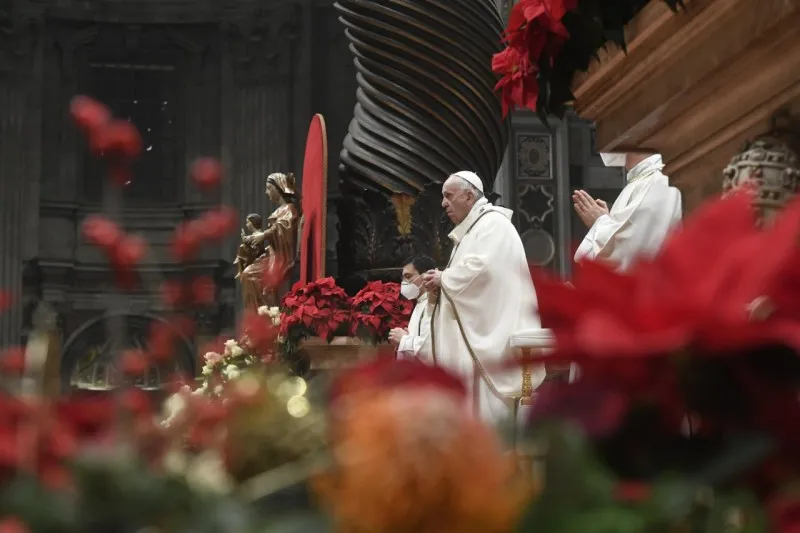
Pope Francis offers Christmas Mass in St. Peter’s Basilica on Dec. 24, 2021 / Vatican Media
Vatican City, Dec 24, 2021 / 14:00 pm (CNA).
Below is the full text of Pope Francis’ homily for the Solemnity of the Nativity of the Lord, delivered Dec. 24, 2021 in St. Peter’s Basilica.
In the darkness, a light shines. An angel appears, the glory of the Lord shines around the shepherds and finally the message awaited for centuries is heard: “To you is born this day a Savior, who is Christ the Lord” (Lk 2:11). The angel goes on to say something surprising. He tells the shepherds how to find the God who has come down to earth: “This will be a sign for you: you will find a child wrapped in swaddling clothes, and lying in a manger” (v. 12). That is the sign: a child, a baby lying in the dire poverty of a manger. No more bright lights or choirs of angels. Only a child. Nothing else, even as Isaiah had foretold: “unto us a child is born” (Is 9:6).
The Gospel emphasizes this contrast. It relates the birth of Jesus beginning with Caesar Augustus, who orders the census of the whole world: it presents the first Emperor in all his grandeur. Yet immediately thereafter it brings us to Bethlehem, where there is no grandeur at all: just a poor child wrapped in swaddling clothes, with shepherds standing by. That is where God is, in littleness. This is the message: God does not rise up in grandeur, but lowers himself into littleness. Littleness is the path that he chose to draw near to us, to touch our hearts, to save us and to bring us back to what really matters.
Brothers and sisters, standing before the crib, we contemplate what is central, beyond all the lights and decorations, which are beautiful. We contemplate the child. In his littleness, God is completely present. Let us acknowledge this: “Baby Jesus, you are God, the God who becomes a child”. Let us be amazed by this scandalous truth. The One who embraces the universe needs to be held in another’s arms. The One who created the sun needs to be warmed. Tenderness incarnate needs to be coddled. Infinite love has a miniscule heart that beats softly. The eternal Word is an “infant”, a speechless child. The Bread of life needs to be nourished. The Creator of the world has no home. Today, all is turned upside down: God comes into the world in littleness. His grandeur appears in littleness.
Let us ask ourselves: can we accept God’s way of doing things? This is the challenge of Christmas: God reveals himself, but men and women fail to understand. He makes himself little in the eyes of the world, while we continue to seek grandeur in the eyes of the world, perhaps even in his name. God lowers himself and we try to become great. The Most High goes in search of shepherds, the unseen in our midst, and we look for visibility, to be seen. Jesus is born in order to serve, and we spend a lifetime pursuing success. God does not seek power and might; he asks for tender love and interior littleness.
This is what we should ask Jesus for at Christmas: the grace of littleness. “Lord, teach us to love littleness. Help us to understand that littleness is the way to authentic greatness”. What does it mean, concretely, to accept littleness? In the first place, it means to believe that God desires to come into the little things of our life; he wants to inhabit our daily lives, the things we do each day at home, in our families, at school and in the workplace. Amid our ordinary lived experience, he wants to do extraordinary things. His is a message of immense hope. Jesus asks us to rediscover and value the little things in life. If he is present there, what else do we need? Let us stop pining for a grandeur that is not ours to have. Let us put aside our complaints and our gloomy faces, and the greed that never satisfies! The littleness, the wonder at that small child – this is the message.
Yet there is more. Jesus does not want to come merely in the little things of our lives, but also in our own littleness: in our experience of feeling weak, frail, inadequate, perhaps even “messed up”. Dear sister or brother, if, as in Bethlehem, the darkness of night overwhelms you, if you feel surrounded by cold indifference, if the hurt you carry inside cries out, “You are of little account; you are worthless; you will never be loved the way you want”, tonight, if you hear this, God answers back. Tonight he tells you: “I love you just as you are. Your littleness does not frighten me, your failings do not trouble me. I became little for your sake. To be your God, I became your brother. Dear brother, dear sister, don’t be afraid of me. Find in me your measure of greatness. I am close to you, and one thing only do I ask: trust me and open your heart to me”.
To accept littleness means something else too. It means embracing Jesus in the little ones of today. Loving him, that is, in the least of our brothers and sisters. Serving him in the poor, those most like Jesus who was born in poverty. It is in them that he wants to be honored. On this night of love, may we have only one fear: that of offending God’s love, hurting him by despising the poor with our indifference. Jesus loves them dearly, and one day they will welcome us to heaven. A poet once wrote: “Who has not found the Heaven – below – Will fail of it above” (E. DICKINSON, Poems, P96-17). Let us not lose sight of heaven; let us care for Jesus now, caressing him in the needy, because in them he makes himself known.
We gaze once again at the crib, and we see that at his birth Jesus is surrounded precisely by those little ones, by the poor. It is the shepherds. They were the most simple people, and closest to the Lord. They found him because they lived in the fields, “keeping watch over their flocks by night” (Lk 2:8). They were there to work, because they were poor. They had no timetables in life; everything depended on the flock. They could not live where and how they wanted, but on the basis of the needs of the sheep they tended. That is where Jesus is born: close to them, close to the forgotten ones of the peripheries. He comes where human dignity is put to the test. He comes to ennoble the excluded and he first reveals himself to them: not to educated and important people, but to poor working people. God tonight comes to fill with dignity the austerity of labour. He reminds us of the importance of granting dignity to men and women through labour, but also of granting dignity to human labour itself, since man is its master and not its slave. On the day of Life, let us repeat: no more deaths in the workplace! And let us commit ourselves to ensuring this.
As we take one last look at the crib, in the distance, we glimpse the Magi, journeying to worship the Lord. As we look more closely, we see that all around Jesus everything comes together: not only do we see the poor, the shepherds, but also the learned and the rich, the Magi. Everything is unified when Jesus is at the center: not our ideas about Jesus, but Jesus himself, the living One.
So then, dear brothers and sisters, let us return to Bethlehem, let us return to the origins: to the essentials of faith, to our first love, to adoration and charity. Let us look at the Magi who make their pilgrim way, and as a synodal Church, a journeying Church, let us go to Bethlehem, where God is in man and man in God. There the Lord takes first place and is worshipped; there the poor have the place nearest him; there the shepherds and Magi are joined in a fraternity beyond all labels and classifications. May God enable us to be a worshipping, poor and fraternal Church. That is what is essential. Let us go back to Bethlehem.
It is good for us to go there, obedient to the Gospel of Christmas, which shows us the Holy Family, the shepherds, the Magi: all people on a journey. Brothers and sisters, let us set out, for life itself is a pilgrimage. Let us rouse ourselves, for tonight a light has been lit, a kindly light, reminding us that, in our littleness, we are beloved sons and daughters, children of the light (cf. 1 Thess 5:5). Brothers and sisters, let us rejoice together, for no one will ever extinguish this light, the light of Jesus, who tonight shines brightly in our world.






Leave a Reply