CNA Staff, Sep 1, 2020 / 01:30 pm (CNA).- From this weekend, Catholics living in Wisconsin will once again be required to go to Mass on Sunday, provided they are healthy and not at risk for coronavirus.
“With new measures now firmly in place to promote and preserve the safety of those attending public Mass, it is with elation that the bishops of Wisconsin have announced plans to end the dispensation from the Sunday Mass obligation in September 2020,” said a statement from the Wisconsin Catholic Conference, released August 31.
The Wisconsin Catholic Conference speaks on behalf of the 10 current and retired bishops, auxiliary bishops, and archbishops of the state’s five Catholic dioceses.
The bishops noted that “in recent months, dioceses and parishes throughout the state have been able to resume public worship by adhering to strict safety standards and by restricting access to services for those who are symptomatic, sick, or at risk of serious illness,” yet there was still no obligation in place to actually go to Mass.
Despite the restored obligation, not everyone will be required to go to Mass, and who is still exempt from the obligation will be up to the individual dioceses. The dioceses will separately announce when they have lifted the dispensation, said the release, and the dioceses will clarify in these proclamations who is not required to attend Mass.
“As pastors, the bishops of Wisconsin encourage all who are healthy to seek the healing presence of Christ the Bread of Life through a return to Mass,” said the statement.
The Sunday obligation has been dispensed throughout Wisconsin, as has been in most states, since the start of the coronavirus pandemic in mid-March.
While most areas have resumed some form of public worship in recent months, only the Diocese of Sioux Falls in South Dakota had, so far, lifted the dispensation and is requiring healthy Catholics to attend Mass.
The Catechism of the Catholic Church states that “The Sunday Eucharist is the foundation and confirmation of all Christian practice. For this reason, the faithful are obliged to participate in the Eucharist on days of obligation, unless excused for a serious reason (for example, illness, the care of infants) or dispensed by their own pastor.”
Failure to do so, without a “serious reason,” is considered to be a mortal sin.
If you value the news and views Catholic World Report provides, please consider donating to support our efforts. Your contribution will help us continue to make CWR available to all readers worldwide for free, without a subscription. Thank you for your generosity!
Click here for more information on donating to CWR. Click here to sign up for our newsletter.
Leon is a baby boy cared for and loved at Mary’s Shelter, a pro-life maternity home in Fredericksburg, Virginia. / Courtesy of Mary’s Shelter
Washington, D.C. Newsroom, May 24, 2022 / 13:15 pm (CNA).
Amid a shortage of baby formula in the U.S., experts recommend parents scour smaller drug stores, check online, and join social media groups sharing information.
But here’s another, perhaps lesser-known, option they can also turn to for help: pregnancy resource centers.
Nearly 3,000 pro-life pregnancy centers serve millions of people each year in the United States. They offer women and parents in need everything from health care and material assistance to educational classes and job support — at little to no cost. Right now, for many of these centers, their work also includes connecting struggling families to baby formula.
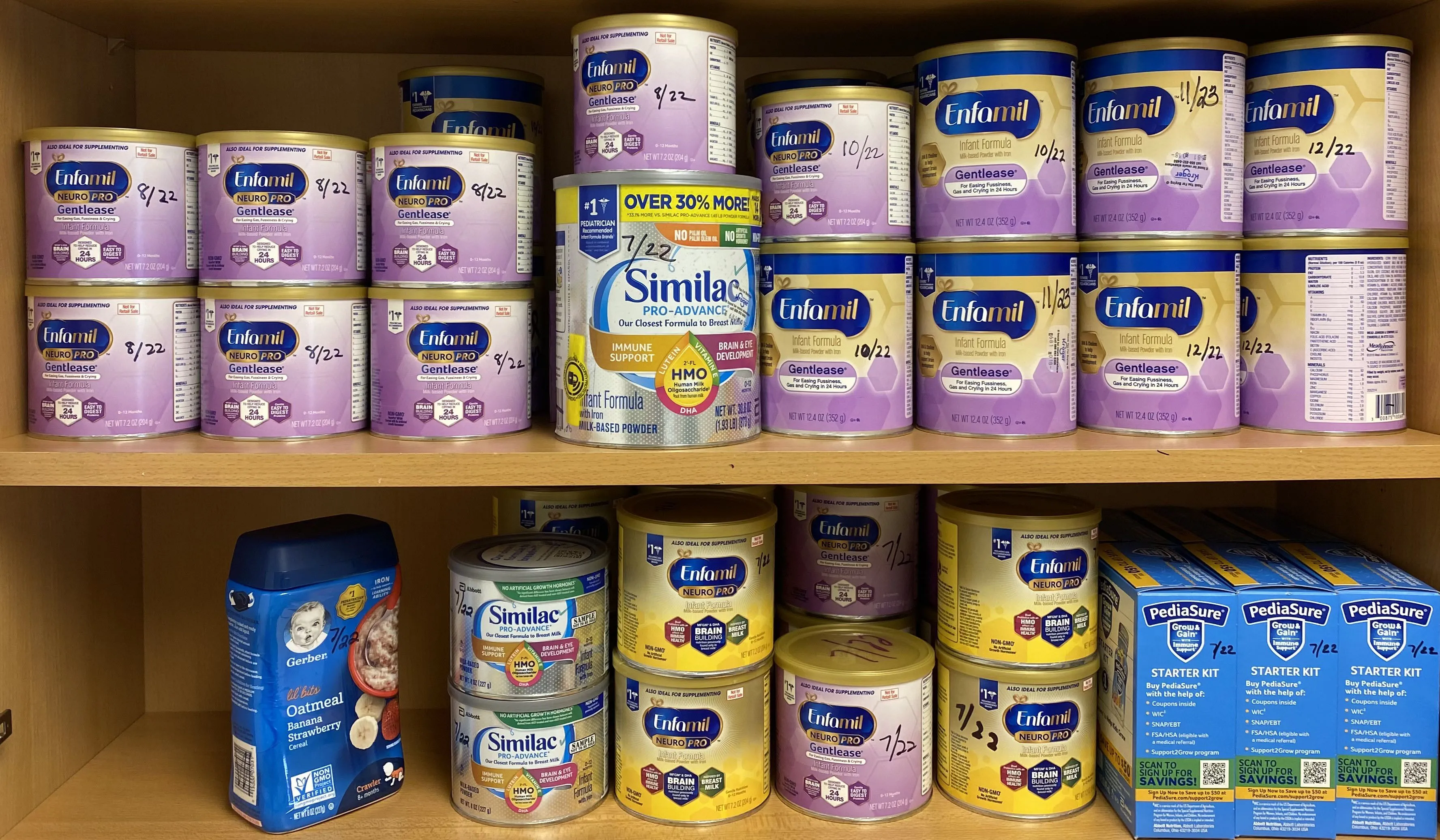
One center in Michigan, an affiliate of Heartbeat International, a pro-life pregnancy resource center network, revealed to CNA that it has a surplus of formula.
“At this time, we haven’t heard of formula shortages at the pregnancy centers,” Andrea Trudden, vice president of communications and marketing at Heartbeat International, told CNA. “Quite the contrary, actually!”
Trudden recommended families turn to their local pregnancy help organizations for assistance and use OptionLine.org as a tool to find the center closest to them.
“Since pregnancy centers are equipped to help pregnant women and new families with practical resources such as diapers and formula,” Trudden said, “they have been able to step into that gap during this time.”
Some pro-life maternity homes in states such as Virginia and North Carolina said mothers are in desperate need and exploring all of their options, including feeding their babies with formula samples. But, these homes tell CNA, they are walking with mothers in their search, every step of the way.
What is this shortage about?
The nationwide baby formula shortage was caused, and then exacerbated, by a series of factors: supply-chain issues, recalls, the closure of a major production plant in February, and even U.S. trade policy. The result, data-firm company Datasembly found, is that more than 40 percent of baby formulas were out of stock in early May.
Babies with special needs and allergies rely on formula, along with babies in general. According to data from the Centers for Disease Control and Prevention (CDC), 63.3% of infants were exclusively breastfeeding seven days after birth in 2018. Three months after birth, only 46.3% of infants exclusively breastfed. Six months after birth, that percentage changed to 25.8%
The trouble with formula began partially with the Covid-19 pandemic. Parents stockpiled baby formula at the beginning, which increased production, only to later discover that they had a surplus to use up, which decreased production.
After consuming formula from an Abbott plant in Sturgis, Michigan, four babies became sick, including two who died, from bacterial infections. This led to a recall and the plant shutting down in February.
These incidents exposed the formula market as one not structurally prepared for emergencies, with just four companies largely in control of supply in the United States. U.S. and regulatory trade policy only added to the problem, restricting the exchange of formula internationally, The Atlantic reported.
Months into the shortage, the Food and Drug Administration (FDA) has reached an agreement with Abbott, one of the largest U.S. baby formula manufacturers, to reopen its Sturgis plant in the coming weeks. President Joe Biden invoked the Defense Production Act to prioritize the production of formula. And, in the meantime, the U.S. military has begun importing formula from Europe.
Members of Congress on both sides of the aisle have called for action. Senate Democrats are pushing a bill that would send $28 million in emergency funding to the FDA. Congress passed, and Biden signed into law, a bill to expand access to formula for lower-income families during emergencies.
In the meantime, before the shelves are fully stocked once more, pregnancy centers and maternity homes around the country are helping parents in need.
“I have never seen this much formula. We have an overflow!” Lois Stoll, a volunteer who manages the formula supply at the center, said in a press release. The center, one of Heartbeat International’s 1,857 affiliate locations, accumulated its surplus over the last two years, during the pandemic.
“It really is the result of an unexpected set of circumstances,” Bryce Asberg, the executive director, added in the release. “During the COVID-19 pandemic, the number of clients fell but donations continued to come in.”
Baby formula is stored on shelves at Helping Hands Pregnancy Resource Center in Hillsdale, Michigan. Courtesy of Helping Hands
Asberg told CNA that the center has been running a material assistance program for several years where it provides mothers and families with baby clothes, diapers, wipes, and baby food or formula.
“We still offer all those items to clients who come in, but recently we have noticed a surge of interest in formula,” he said. “God has been building our supply of formula for many months, and we didn’t know why we had so much. Now we do!”
Washington, D.C.
In Washington, D.C., Janet Durig, the executive director of Capitol Hill Pregnancy Center, said that her center also has baby formula on hand.
“We’ve had some phone calls seeking help and we’ve had formula to give them,” she told CNA. But, she emphasized, the supply is limited because they rely on donations.
“We have it to help people on a limited basis and are helping people on a limited basis,” she said, adding that the center welcomes donations of unopened bottles or cans of formula as long as they have not expired.
Connecticut
Leticia Velasquez, executive director and co-founder of Pathways Pregnancy in Norwich, Connecticut, encouraged moms and families to reach out if they need formula.
She told CNA that the three-year-old center is there for any woman or mom in need.
“We just say, ‘How can we fill the need? That’s what we’re here for,’” she said. “We definitely stand with them in any crisis, whether it be a formula shortage or an unplanned pregnancy.”
Parents in eastern Connecticut looking for baby formula can text the center at (860) 222-4505.
North Carolina
Debbie Capen, the executive director of MiraVia, said that the baby formula shortage is affecting her group’s work in supporting and providing resources to new moms in need. The Catholic nonprofit runs an outreach center in Charlotte and a free college residence at nearby Belmont Abbey College where a pregnant student — from any university or college — can stay until her child turns two years old.
“Yes, the mothers we serve are very concerned about the baby formula shortage,” Capen told CNA. “We always encourage breastfeeding for our expectant mothers, but for those who cannot breastfeed, they usually rely on vouchers for baby formula through the USDA’s WIC program.”
The U.S. Department of Agriculture’s WIC program, also known as the “Special Supplementation Nutrition Program for Women, Infants and Children,” offers federal grants to states for supplemental foods, health care referrals, and nutrition education for low-income pregnant and postpartum women, and young children at nutritional risk.
Capen highlighted that WIC only covers one specific brand of formula, which means that moms must pay full price for any other label. Formula is at a premium price right now, she added, which only puts more stress on their limited resources.
In each state, baby formula manufacturers bid for exclusive rights to provide formula to WIC participants in that state. In return, they offer the state discounts, or rebates. For those who rely on WIC, this means that they face limited options.
In response to the scarcity, the mothers at MiraVia are turning to alternatives: food pantries and the MiraVia community.
“They communicate with our staff and each other when they find formula at a certain location, as well as contact stores to find out when shipments are expected,” Capen said. “They substitute with generic brands when possible and reach out to their pediatricians for recommendations and even free samples.”
Capen listed some ways that people can help during this shortage, beginning with communication and the sharing of resources.
“For example, you can help by searching posts on social media and community apps like NextDoor or OfferUp to find those with formula and suggest where it can be donated,” she said. “Remind friends and family not to stockpile so that the supply of formula can flow to those in most urgent need. If you are pregnant and have received free samples of formula, donate what you won’t use to food pantries or programs for new mothers.”
Virginia
Kathleen Wilson, the executive director of Mary’s Shelter, a faith-centered maternity home in Fredericksburg, Virginia, agreed that “our moms have had many difficulties.”
She told CNA about one of their mothers who gave birth to her fourth baby three months ago. At first, she used a formula brand called Enfamil Reguline. After it became unavailable, she began switching between brands and using whatever she can find, Wilson said. The mother has also tried ordering on Amazon and turned to her pediatrician for samples.
Yaretzi is a baby girl cared for and loved at Mary’s Shelter, a pro-life maternity home in Fredericksburg, Virginia. Courtesy of Mary’s Shelter
“This is a mom who is trying to hold down a job, with an infant and other children to tend to,” Wilson stressed the “very difficult” situation.
Wilson said that two of the other mothers spent days driving around at one point to try to find formula for their babies. When necessary, they are also turning to sample packets of baby formula.
“Our staff and volunteers have been assisting with this and picking up and delivering formula when they can get their hands on it,” Wilson said, adding that donors have also pitched in.
“We are blessed with wonderful donors,” she said. “A friend just stopped in this morning with two cans of formula that he was able to find.”
“If donors are willing and can find formula, we would be thrilled to take their donation,” she said, concluding that she is “praying this comes to an end soon.”
Three women at the 2022 March for Life who have struggled to cope with their decisions to have abortions shared their experiences with CNA. They are (left to right): Shelley, who declined to provide her full name; Jody Duffy, and Leslie Blackwel… […]
Peoria, Ill., Jun 10, 2019 / 02:51 pm (CNA).- The Diocese of Peoria has confirmed that the Archdiocese of New York has “indicated their willingness” to cooperate with the transfer of Venerable Fulton Sheen’s remains to Peoria, potentially clearing the way for the Illinois-born archbishop’s beatification.
“Bishop Jenky is overjoyed and elated that, for the fifth time, the New York courts have upheld Joan Sheen Cunningham’s petition,” the diocese said June 9.
Sheen’s will had declared his wish to be buried in the Archdiocese of New York Calvary Cemetery. Soon after Sheen died, Cardinal Terence Cooke of New York asked Joan Sheen Cunningham, Sheen’s niece and closest living relative, if his remains could be placed in the crypt of St. Patrick’s Cathedral in New York City, and she consented.
However, Cunningham has since said that Sheen would have wanted to have been interred in Peoria if he knew that he would be considered for sainthood. In 2016, she filed a legal complaint seeking to have her uncle’s remains moved to the Cathedral of St. Mary in Peoria.
“Bishop Jenky is also grateful to hear reports that the New York Archdiocese has indicated their willingness to cooperate with Joan Sheen Cunningham and the Diocese of Peoria to transfer the remains of Venerable Archbishop Fulton Sheen. The Diocese of Peoria will be contacting the New York Archdiocese in order to facilitate this transfer.”
The New York Court of Appeals denied the Archdiocese of New York’s appeal to keep his remains there June 7. The appeals court had dismissed New York’s previous appeal in May.
The appeals court first unanimously ruled that Sheen’s remains be transferred to Peoria in March 2019. The Superior Court of New York had issued a similar ruling in June 2018.
The Peoria diocese opened the cause for Sheen’s canonization in 2002, after the Archdiocese of New York said it would not explore the case. In 2012, Benedict XVI recognized the heroic virtues of the archbishop.
However, Bishop Daniel Jenky of Peoria suspended the beatification cause in September 2014 on the grounds that the Holy See expected Sheen’s remains to be in the Peoria diocese.
The New York archdiocese, however, has previously said that Vatican officials have said the Peoria diocese can pursue Sheen’s canonization regardless of whether his body is at rest there.
Sheen was born in Illinois in 1895, and was ordained a priest of the Diocese of Peoria at the age of 24. He was appointed auxiliary bishop of New York in 1951, and he remained there until his appointment as Bishop of Rochester in 1966. He retired in 1969 and moved back to New York City until his death in 1979.
An initial court ruling had sided with Cunningham, but a state appeals court overturned that ruling, saying it had failed to give sufficient attention to a sworn statement from a colleague of Archbishop Sheen, Monsignor Hilary C. Franco, a witness for the New York archdiocese.
Msgr. Franco had said that Sheen told him he wanted to be buried in New York and that Cardinal Cooke had offered him a space in the crypt of St. Patrick’s Cathedral. The appeals court ordered “a full exploration” of the archbishop’s desires.
“The Trustees of St. Patrick’s and the Archdiocese believed that it was not simply their duty, but a solemn obligation, to seek to uphold Archbishop Sheen’s last wishes, as directed in his Will, to be buried in New York – a position held until recently by Joan Cunningham herself,” Joseph Zwilling, spokesperson for the Archdiocese of New York, told CNA June 8.
“In light of the court’s denial of further appeal, the Trustees of St. Patrick and the Archdiocese will work cooperatively with Mrs. Cunningham and the Diocese of Peoria to arrange for the respectful transfer of Archbishop Sheen’s mortal remains.”
Bishop Jenky thanked Patricia Gibson, the diocese’s chancellor and attorney, for her work on the case, and asked for prayers for the advancement of the sainthood cause of Venerable Sheen.
Unless all the restrictions– masks, anti-social distancing, advance reservations and capacity– are removed, this amounts to bishops talking out of both sides of their mouths. You can’t say, “welcome, but we’re still treating you like lepers, and if too many of you come we’re sending you packing.” They’re still trying to have their cake and eat it too, and it won’t wash. They have to challenge the mass insanity and the prevailing anti-social attitudes head-on, or else people just won’t care and stay home, which is probably what will happen– because that’s what most people have been doing for decades anyway. They simply must choose between serving God or serving coronavirus, government, and insanity; there is no other way.
Do the people of Kenosha need to return? It’s pretty violent in the streets; that is certainly a good reason.
.
I agree with Andrew S, the masks and social distancing need to be done away with.






Unless all the restrictions– masks, anti-social distancing, advance reservations and capacity– are removed, this amounts to bishops talking out of both sides of their mouths. You can’t say, “welcome, but we’re still treating you like lepers, and if too many of you come we’re sending you packing.” They’re still trying to have their cake and eat it too, and it won’t wash. They have to challenge the mass insanity and the prevailing anti-social attitudes head-on, or else people just won’t care and stay home, which is probably what will happen– because that’s what most people have been doing for decades anyway. They simply must choose between serving God or serving coronavirus, government, and insanity; there is no other way.
Do the people of Kenosha need to return? It’s pretty violent in the streets; that is certainly a good reason.
.
I agree with Andrew S, the masks and social distancing need to be done away with.