CNA Staff, Jul 17, 2020 / 04:42 pm (CNA).- The leader of the largest independent Muslim organization in the world says that a resurgence of fundamentalist Islam threatens not only non-Muslim minorities, but feeds a cycle of retaliatory violence against Muslims.
Sheikh Yahya Cholil Staquf warned of a “political weaponization of fundamentalist Islam,” in an essay published in The Public Discourse on July 11. He said that religious minorities around the world “from sub-Saharan Africa to South and Southeast Asia” are discriminated against and attacked for their beliefs.
At issue, he said, is “a supremacist, ultraconservative interpretation of Islam” pushed even by U.S. allies including Saudi Arabia and Qatar.
This resurgence of theocracies and sectarian violence around the world, he said, most notably manifested by the rise of the terror group ISIS in 2014, is actually the historical norm.
ISIS’ efforts to establish a caliphate based on an ultraconservative seventh-century interpretation of Islam “is not a historical aberration in the Middle East,” he wrote. “Rather, it is the historical norm,” as the Middle East up until the end of the Ottoman Empire “has been dominated by caliphs and/or those who ruled in their name, and governed according to the provisions of classical Islamic law.”
At the heart of the matter, he wrote, is the question of whether Muslims will choose to “remain silent and ignore the suffering of others,” or rather “pursue the truth and obey the dictates of conscience, whatever the consequences may be?”
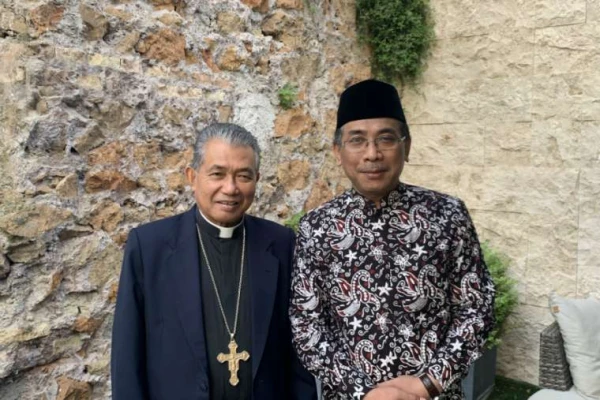
Staquf is the general secretary of Indonesia’s Nahdlatul Ulama, the world’s largest Muslim organization with more than 90 million followers. He has also co-founded a global movement promoting a “humanitarian Islam” that shuns the ideas of a caliphate, Sharia law, and “kafir,” or infidels.
These efforts need to become a global pursuit to truly bear fruit, Staquf wrote on July 11.
Widespread discrimination and violence against non-Muslim minorities simply feed a “cycle of retaliatory bloodshed,” he warned, citing attacks on Muslims at Christchurch, New Zealand, and attempts to displace or subdue whole groups of Muslims such as Xinjiang, China, or the Rohingya Muslims in Burma.
In 2019, the NU published fiqh rulings – or interpretations of Islamic law – from nearly 20,000 Muslim scholars, and Staquf presented the recommendations to Pope Francis when he met with him at the Vatican.
Among the recommendations were abolishing the legal category of “infidel” in Islamic law, pushing for equal treatment under the law for Christians and other religious minorities, and asking Muslims to be law-abiding citizens who work for peace. The document also affirmed the nation-state over a Muslim caliphate.
Earlier in 2019, Pope Francis had signed a document on religious pluralism together with the Grand Imam of al-Azhar Ahmed el-Tayeb, the declaration on “Human Fraternity for World Peace and Living Together.”
Staquf told CNA that he was “thrilled and excited” at the signing, which he said promoted the “compassionate Islam” that he has been advocating for.
“We cannot just pretend that there are no problems in Islamic views. There are problems there. You need to acknowledge that so that we can work for the solution. If you do not acknowledge the problem, you cannot resolve it,” Staquf told CNA.
“My hope is that these documents will be examined seriously by the Vatican so that the Vatican can make decisions to engage with us and work together with this,” Staquf said.
If you value the news and views Catholic World Report provides, please consider donating to support our efforts. Your contribution will help us continue to make CWR available to all readers worldwide for free, without a subscription. Thank you for your generosity!
Click here for more information on donating to CWR. Click here to sign up for our newsletter.
New York City, N.Y., Sep 17, 2019 / 02:00 pm (CNA).- Cardinal Timothy Dolan of the Archdiocese of New York issued a statement Monday clarifying that he will not and has never used social media to privately solicit donations. The cardinal made the statement in response to an online scam operation being conducted using his name to solicit funds.
“I’ve heard from some of you you’ve received Facebook or Twitter messages from an account pretending to be me,” said the archbishop on Twitter Sept. 16. “Please know I will never reach out privately on social media to ask for donations.”
Dolan encouraged anyone who had been asked to donate money by an account purporting to be him on Twitter or Facebook to report it to the archdiocese.
A spokesman for the Archdiocese of New York told CNA that they had received “several reports” that someone impersonating Cardinal Dolan was requesting money from people, “ostensibly for charitable purposes,” and that this was not the first time something like this has happened.
“Sadly, we’ve seen this scam being used in the past few months with other religious figures – pastors, priests, other clergy – being impersonated, and so wanted to remind people that Cardinal Dolan will never solicit donations in this way,” said Joseph Zwilling, the archdiocese’s director of communications.
Zwilling added that, “While the internet and social media can be great tools of evangelization, they can also be used by unscrupulous individuals seeking to ‘rip-off’ trusting and generous people.”
“It’s always a good idea to be cautious, and double or triple check, especially online, that the person is who he or she claims to be!”
These types of scams are called “phishing,” and are relatively common. A “phisher” will pose as either a known, trusted person or as a website, and request money, passwords, or other protected information. Frequently, phishers will create spoof emails and addresses that look like genuine emails from an organization or person in order to harvest passwords and credit card information from an unsuspecting victim.
A person can protect themselves from phishing by using security tools like two-factor authentication, and exercising constant vigilance before sending personal information or money electronically. Electronic security experts advise considering if any request is typical policy for an organization, and to take a step back before blindly giving away sensitive info.
Other safety recommendations include checking the full email or account address to ensure the authenticity of the sender or, in the example of a public figure such as Cardinal Dolan, to see if the social media account is verified as authentic.
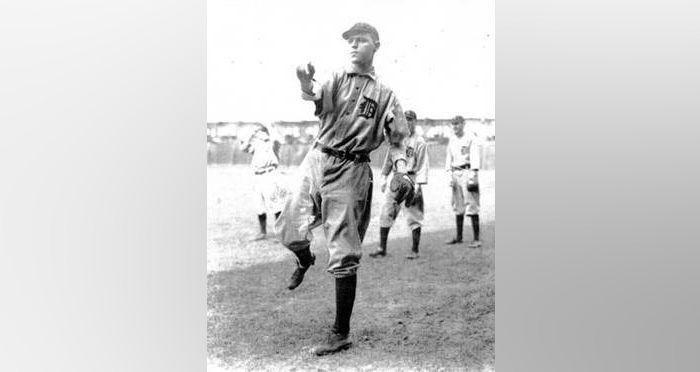
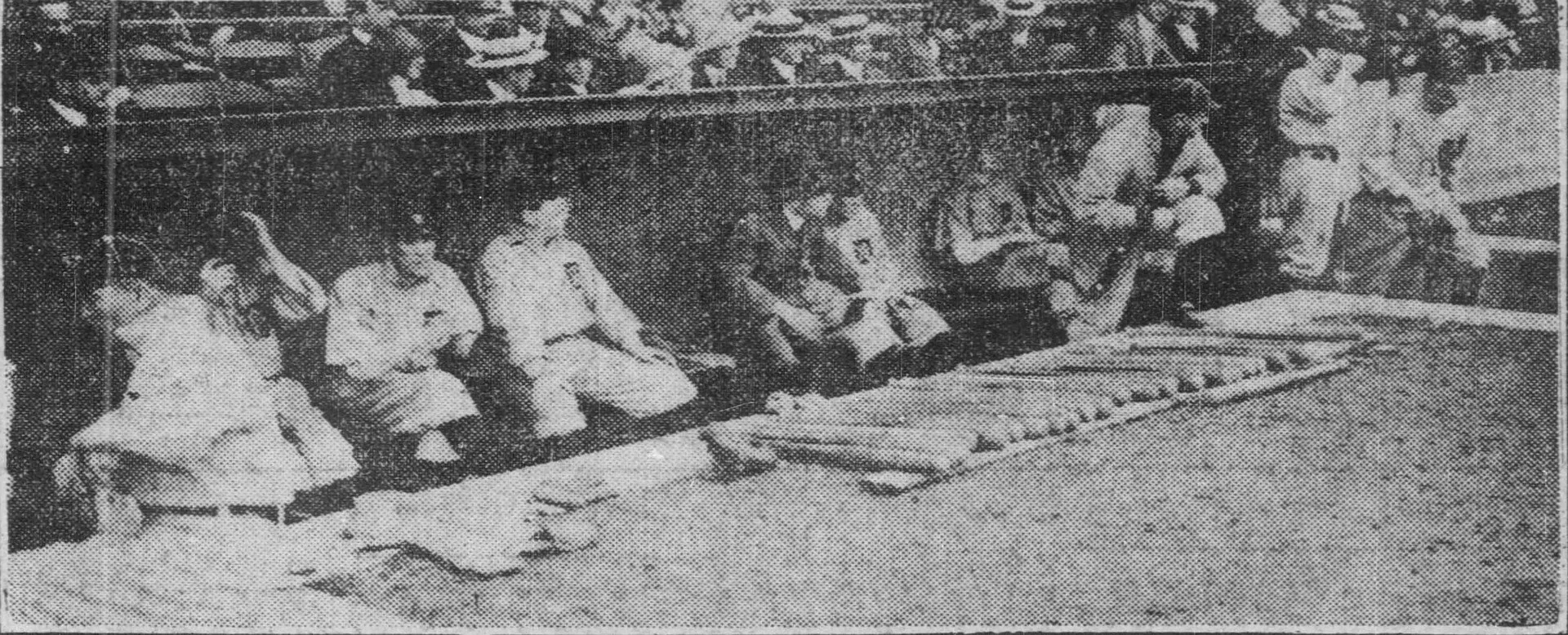
This photo of Father Allan Travers was featured in the local newspaper after his pitching “performance” for the Detroit Tigers against the Philadelphia A’s on May 18, 1912. The photo featured the caption “strikebreaker,” which worried Travers’ mother, since there was a street trolley strike in Philadelphia earlier in the month, and she didn’t want her son caught in the confusion. / Photo credit: Public domain
Detroit, Mich., Jul 23, 2023 / 08:00 am (CNA).
The worst pitcher ever to take the mound for the Detroit Tigers became a Catholic priest.
Granted, Allan Travers was already on the path to the priesthood before suiting up for Detroit on May 18, 1912. But his story — and place in baseball history — is the prime example of being in the right place at the right time (or the wrong place at the wrong time).
Travers played in only one game, but one was enough to show that God had plans for him that didn’t involve the big leagues.
The story begins, as most stories of Tigers lore do, with Ty Cobb.
The Tigers were in New York on May 15 to play the Highlanders (the precursor to the Yankees). Cobb was playing in the outfield when he was verbally abused by a New York fan who was using profanity and racial slurs to describe Cobb’s play.
Cobb — never known for keeping his cool — stormed into the stands and unleashed a volley of punches on the fan. Tigers players rushed to the scene of the chaos, yelling at Cobb to lay off the man, who was missing one hand and three fingers on his other hand after suffering an industrial accident.
Cobb didn’t care and continued the barrage.
Ban Johnson, president of the American League, happened to be at the game, checking on the family-friendly excitement of what was turning into America’s pastime.
Having one of the league’s star players beat up a disabled spectator didn’t jibe well with Johnson’s vision for baseball, so Cobb was suspended indefinitely.
The Tigers felt Cobb’s punishment was unfair, so the players voted to strike until Cobb was reinstated for the club’s next game in three days against the two-time defending World Series champion Philadelphia Athletics.
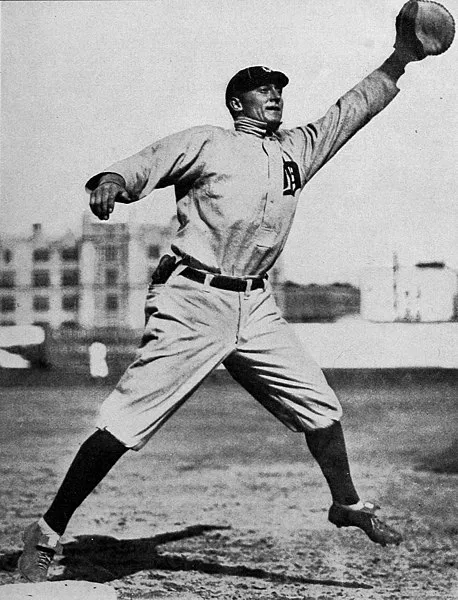
Detroit Tigers legend Ty Cobb is pictured in 1911. Not one to keep his cool, Cobb launched himself into the stands to attack a fan who insulted him in 1912, resulting in a league suspension and sparking his teammates to strike in protest. Credit: Public domain
Johnson called the Tigers’ bluff, informing then Tigers owner Frank Navin the team would face a $5,000 fine for every game Detroit forfeited.
Navin needed to field a team, and quick, so he and Tigers manager Hughie Jennings collaborated with Athletics owner/manager Connie Mack to field a team of players to take the field.
This was well before the age of expansive minor league rosters — or commercial airlines, for that matter — so it wasn’t as though the Tigers could call up the farm team in Toledo and get them to Philadelphia in time to play the A’s. Instead, scouting was done the old-fashioned way, spreading word throughout town, asking who wanted to play baseball.
And this is where Aloysius Joseph “Allan” Travers, the student manager on the St. Joseph’s College baseball team, comes into the story.
Jennings worked with a friend of his, Joe Nolan, a sportswriter for The Philadelphia Bulletin,to field a team. Nolan knew Travers, a junior at St. Joseph’s who lived in Philadelphia, from the time the A’s fielded a second-stringer team to play St. Joseph’s College.
Nolan asked Travers to find 10-12 amateur players in the area who could suit up for the Tigers in case the Tiger players followed through on their strike threats. The idea was that the amateurs would never actually take the field; rather, it was just a tactic to get Jennings’ “real” players on the field.
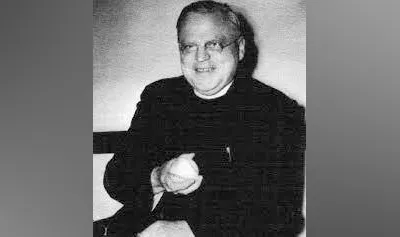
Father Allan Travers, SJ, was a priest who taught at St. Joseph’s College (now St. Joseph’s University) in Philadelphia. But in 1913, while a student at St. Joseph, he was the improbable pitcher for the Detroit Tigers, where he secured a bizarre spot in baseball history. Credit: Public domain
Travers rounded up eight players who were free that day and enticed by the $25 Navin offered to each player.
Jennings had his team of strike-breakers, as requested by Navin.
When the umpire called “play ball,” the Tiger regulars took the field, but when the umpire spotted Cobb and told him to take a seat, the rest of the team walked out and took off their uniforms.
The strike-breakers would have to play after all. They were ushered into the locker room and donned the Tigers’ gray uniforms (this was in the days before names were on the back of uniforms). Two bench coaches joined the group to offer the squad some big league experience.
The question was, who would pitch?
There were no takers at first, so Navin offered an extra $25. Travers volunteered; $50 was good money for a college kid in 1912. There was one small problem — Travers had never played organized ball.
He was the assistant manager on the college baseball team, tasked with keeping stats and writing game summaries.
But there he was, the college student with plans to join the seminary after graduation, pitching before 20,000 fans at Shibe Park against the two-time defending World Series champions. A modern David versus Goliath, a plucky underdog story.
This time Goliath won.
Travers did as well as one would expect the assistant manager of a college baseball team to do against professionals. He pitched a complete game, surrendering 24 runs on 26 hits (both American League records), walking seven and striking out one. He got an MLB strikeout — they can’t take that away from him.
But the 15.75 ERA leaves a mark. He also batted 0-for-3 at the plate.
Travers’ time in the major leagues was abrupt. After the 24-2 shellacking the A’s put on the strikebreaking Tigers, Cobb persuaded his teammates to end the strike before the team’s upcoming series against the Washington Senators.
Travers’ calling was the priesthood, not pitching.
After graduating from St. Joseph’s College in 1913, he joined the Society of Jesus, studying at St. Andrew on the Hudson in New York and Woodstock College in Maryland. He was ordained a priest in 1926, making him the only priest ever to play in a Major League game.
His ministry took him to teaching positions at St. Francis Xavier High School in Manhattan and St. Joseph’s Prep and St. Joseph’s College in Philadelphia.
Father Travers didn’t speak about his baseball exploits, but he did give an interview about his bizarre start for the Tigers.
“About noon when Nolan told me about the strike of Detroit, he told me the club would be fined and might lose its franchise if 12 players didn’t show up,” Travers told sportswriter Red Smith. “He told me to round up as many fellows as I could. We never thought we’d play a game.”
The replacement Detroit Tigers are pictured in the dugout against the Philadelphia A’s on May 18, 1912. Photo credit: Public domain
The priest said Jennings told him to avoid throwing fastballs to “avoid getting killed out there,” but the A’s didn’t hold back, even resorting to bunting when they found out the third baseman had never played baseball before.
“I fed ‘em nothing but slow stuff after Frank Baker almost hit one out of the park on me, which fortunately went foul,” Travers said. “I was doing fine until they started bunting. The guy playing third base had never played baseball before. I just didn’t get any support. I threw a beautiful slow ball and the A’s were just hitting easy flies. Trouble was, no one could catch them.”
Curious enough, the only “fame” Travers got from his start was his picture in the newspaper with the word “Strikebreaker” printed above. There was a trolley strike in Philadelphia that month, and Travers’ mother was worried for her son’s safety because people might suspect he was a scab.
Travers didn’t like talking about his baseball “career” with his students, and his story is not well known, save for a few baseball history blogs.
He did sign a ball from that fateful day that wound up in the collection of Ada, Michigan, resident Steve Nagengast, who claims to have the largest collection of Tigers autographs. Nagengast was featured in the Detroit News, and the anecdote about Travers piqued Detroit Catholic’s interest.
Travers didn’t have the greatest impact on Tigers history. But the $5,000-per-game fine the Tigers faced for each game the club forfeited would have been devastating, especially in an era when professional teams folded and changed towns all the time.
So who knows.
Father Travers’ one-game career might have just saved the Tigers.
Washington D.C., Oct 26, 2017 / 03:01 pm (CNA).- A pro-marriage student group at Georgetown University has drawn support from prominent Catholic scholars, after a student petition accused the group of promoting intolerance.
Love Saxa is a pro-marriage student group at Georgetown, which faces an Oct. 30 hearing before the Student Activities Commission, an advisory body to the university’s Vice President of Student Affairs.
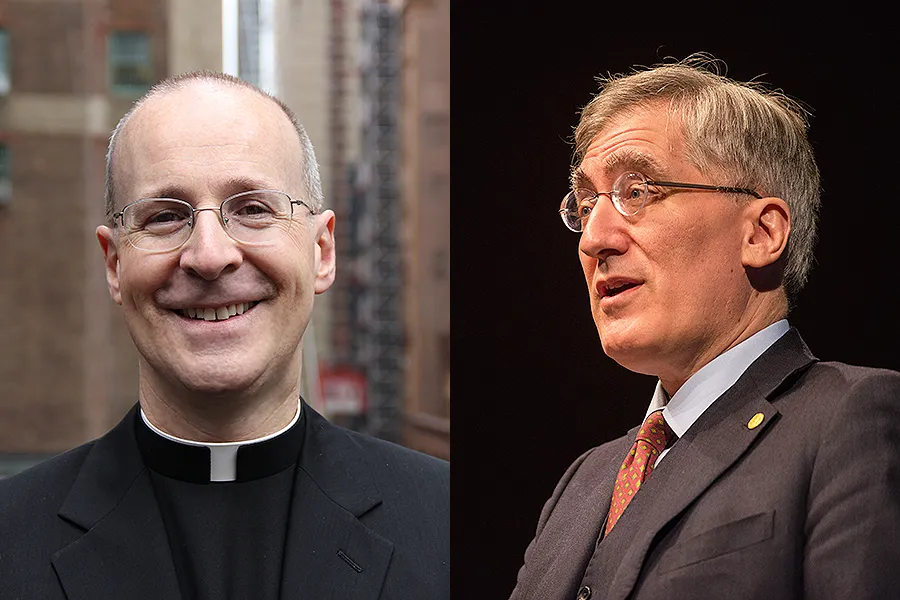
Fr. James Martin, SJ, author of “Building a Bridge,” a book on dialogue between the Catholic Church and LGBT groups, said that he supports the right of “Love Saxa,” to promote its views at Georgetown.
“Why should a student group that espouses Catholic teaching respectfully be defunded by a Catholic university?” Martin told CNA. “As long as Love Saxa treats LGBT people (both on campus and off campus) with ‘respect, compassion and sensitivity,’ as the Catechism requires, then they should be able to have their say on campus.”
The group, which says it “exists to promote healthy relationships on campus through cultivating a proper understanding of sex, gender, marriage, and family among Georgetown students,” has been accused by a student petition of violating university standards for student organizations by “fostering hatred and intolerance.”
Robert P. George, a professor of constitutional law at Princeton University and noted scholar of marriage and religious liberty, also voiced support for Love Saxa.
“The illiberal – even authoritarian – spirit infusing the effort to defund Love Saxa at Georgetown ought to be a matter of grave concern for honorable people across the ideological spectrum,” he said.
“And on top of that, as Fr. Martin suggests, there is something approaching absurdity in the idea that at a Catholic university a group ought to be defunded for upholding and teaching the idea of marriage and the principles of sexual morality upheld and taught by the Catholic Church.”
If Love Saxa is found to be in violation of university standards, as the student petition alleges, the commission could recommend that the university impose sanctions, including a loss of funding and access to university facilities.
A spokesperson for Georgetown University told CNA that such sanctions are only used as a last resort, and that groups in violation of university standards are first given opportunities to rectify violations.
“We strongly support a climate that continues to provide students with new and deeper contexts for engaging with our Catholic tradition and identity. Love Saxa is one of many groups operating on campus with positions that affirm the teachings of the Catholic Church. We also support a climate that is welcoming to all students and supporting of our LGBTQ communities,” the spokesperson added.
As the complaint is reviewed by the Student Advisory Commission, Georgetown’s spokesperson told CNA that “we encourage all students to follow our community commitment to open dialogue and mutual respect.”
Martin also encouraged respectful dialogue, rather than conflict, at Georgetown.
“Groups that oppose the point of view of Love Saxa should also be able to have their say,” he told CNA. “For a true dialogue to happen around LGBT issues, especially at Catholic universities, all participants should be willing to, first, treat one another respectfully and lovingly; second, listen to one another with open minds; and third, be willing to learn from one another.”
George also called for respectful conversation on the matter.
“The sheer, brute, undeniable fact is that reasonable people of goodwill disagree today about fundamental questions having to do with the nature and social purposes of marriage and with sexuality and sexual morality,” he said.
“When reasonable people of goodwill find themselves in disagreement, even on issues of profound social importance and deep personal meaning, they engage each other in robust but civil and respectful discourse – they do not attempt to win cheap victories by smearing those who disagree with them as ‘bigots’ or ‘haters’,” he continued. “They recognize their own fallibility and do not try to immunize their beliefs from responsible criticism. They acknowledge that their deepest, most cherished, even identity-forming beliefs could be wrong. That motivates them to listen to critics, rather than trying to banish them.”
George added that as a Catholic university, Georgetown “does not present itself as a non-sectarian institution that maintains a stance of neutrality on moral questions currently in dispute among reasonable citizens.”
“So it would be fully within its rights in declining to fund a group that promoted values contrary to its own,” he said. “But, as Fr. Martin observed, it is Love Saxa that is upholding the values of Georgetown as a Catholic institution. It is those who are pressing Georgetown to defund Love Saxa who teach doctrines concerning marriage and sexual morality that are contrary to those of the Catholic Church.”
Another Muslim apologist re writing his faith,by wanting to sanitize the fundamental core values of it,which as its own history exposes, is a violent, militant faith with the same objective as all supremacist political ideologies,i.e.world domination.
The only difference with Islam is it puts a religious spin on its narrative.
Beware, those who have not read the Islamic sources for themselves,lest you be deceived to believe otherwise.




Dialogue brings about better understanding of the rich values in different religions.
Another Muslim apologist re writing his faith,by wanting to sanitize the fundamental core values of it,which as its own history exposes, is a violent, militant faith with the same objective as all supremacist political ideologies,i.e.world domination.
The only difference with Islam is it puts a religious spin on its narrative.
Beware, those who have not read the Islamic sources for themselves,lest you be deceived to believe otherwise.
Oxymoron of the century – ‘Compassionate Islam.’