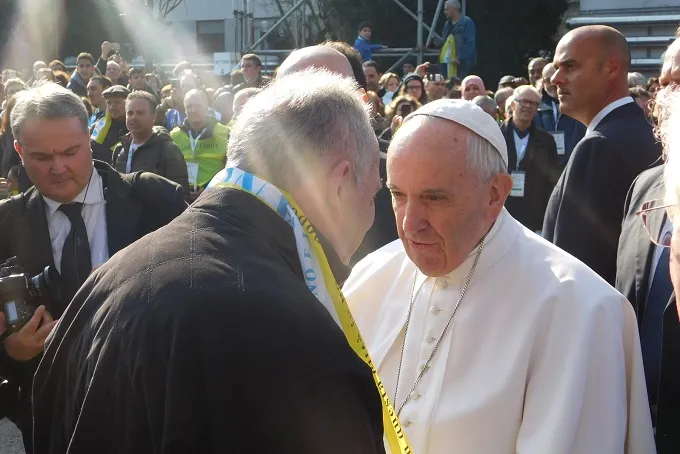
Milan, Italy, Mar 25, 2017 / 06:31 am (CNA/EWTN News).- During his daytrip to Milan Saturday, Pope Francis told the diocese’s priests and religious not to fear the challenges that come with their ministry nor the increasing number of empty convents, urging them instead to focus on the core of their mission: bringing Christ to his people.
“Our congregations were not born to be the mass, but a bit of salt and yeast which would have given their own contribution so that the mass grows; so that the People of God have that ‘condiment’ they were missing,” the Pope said March 25.
He noted that for many years in the past, congregations moved forward with the idea that they needed to “occupy spaces” more than launching new processes and projects.
The perception then, he said, was that “ideas (or our impossibility to change) were more important than reality; or that the part (our small part or vision of the world) was superior to the whole Church.”
But today’s reality serves as a challenge, and “invites us to again be a bit of yeast and a bit of salt,” he said, asking “Can you imagine a meal with too much salt? Or a pasta that’s totally fermented? No one would eat it, no one could digest it.”
“I’ve never seen a pizzamaker use a kilo of yeast and a gram of flour” to make the dough, Francis said, and urged religious to “listen to reality, to open ourselves to the ‘mass,’ to the Holy People of God, to the entire Church.”
Pope Francis spoke to priests and religious inside Milan’s cathedral of St. Mary of the Nativity during his March 25 daytrip to the city.
He kicked off the visit by stopping by the “White Houses” high-rise complex in the eastern quarter of the city, an area marked by acute poverty where many migrants, including Muslim families, live. He then headed directly to Milan’s cathedral where he met with the priests and religious.
<blockquote class=”twitter-video” data-lang=”en”><p lang=”en” dir=”ltr”>Up-close view of a papal blessing to some small pilgrims in <a href=”https://twitter.com/hashtag/Milan?src=hash”>#Milan</a> via <a href=”https://twitter.com/andygag”>@andygag</a> <a href=”https://twitter.com/hashtag/PopeFrancis?src=hash”>#PopeFrancis</a> <a href=”https://t.co/lEiFe59PCE”>pic.twitter.com/lEiFe59PCE</a></p>— Catholic News Agency (@cnalive) <a href=”https://twitter.com/cnalive/status/845563394254082048″>March 25, 2017</a></blockquote>
<script async src=”//platform.twitter.com/widgets.js” charset=”utf-8″></script>
The Pope took questions from three members of the audience, including Ursuline sister Mother M. Paola Paganoni, parish priest Fr. Gabriele Gioia and Robert Crespi, one of the diocese’s 143 permanent deacons.
Instead of taking notes and giving an entirely off-the-cuff speech as usual during his Q&A sessions, this time Francis decided to follow a written text due to the day’s full schedule, deviating to add a few lines here and there.
The question on numbers was posed by Sr. Paganoni, who asked the Pope how to be a prophetic sign in modern society, and to which peripheries they should go, given that religious are small in number and constitute a “minority” in the Church.
In response, the Pope not only told the nun to not fret about numbers, but he also cautioned against the feeling of “resignation,” which he said can frequently creep up when looking at how few they are.
“Without realizing it, each time that we think or see that we are few, or in many cases elderly, we experience the weight, the fragility more than the splendor, and our spirit begins to corrode from resignation,” he said.
In turn, resignation can lead to the spiritual sin – also called a “disease” – of acedia, about which the Fathers of the Church issued sharp warnings since it essentially leads a person into despair, indifference and apathy regarding the faith and one’s vocation.
“Few yes, a minority yes, elderly yes, but resigned no!” he said, explaining that the lines in this regard are fine, are can only be recognized by a process of self-reflection in front of the Lord.
“When resignation takes hold of us,” he said, “we live with the imagination of a glorious past which, far from awakening the original charism, increasingly surrounds us in a spiral of existential heaviness. Everything becomes heavier and difficult to lift up.”
He warned religious to stay away from this attitude, as well as the temptation to use the empty structures to get money by turning them into hotels or looking for other “human solutions” to the problem. Doing this, he said, “hinders or deprives us of joy.”
And while he said he can’t tell them which peripheries to go to, since that’s the job of the Holy Spirit, who inspired their original charism, Pope Francis urged religious to choose them well and reawaken “the hope spent and sapped by a society that has become insensitive to the pain of others.”
“Go and bring the ‘anointing’ of Christ,” he said, telling them never to forget “that when you put Jesus in the midst of your people, they find joy…only this will render our lives fruitful and will keep our hearts alive.”
In response to Crespi’s question on what contribution deacons can give to the Church, the Pope said they have “a lot to give,” specifically when it comes to managing the tensions and blessings of ministry and family life.
However, Francis also cautioned against viewing deacons as “half-priests and half-laity,” because in reality “they are neither here nor there.”
Looking at them in this way “does harm to us and does harm to them” and takes strength away from their vocation in the Church, he said, explaining that the deaconate “is a specific vocation, a family vocation that recalls service as one of the characteristic gifts of the people of God.”
“The deacon is – so to speak – the guardian of service in the Church,” Pope Francis said. Because of this, his specific mission consists of “reminding all of us that faith, in its various expressions – communitarian liturgy, personal prayer, different forms of charity – and in its various states of life – lay, clerical, familial – has an essential dimension of service.”
Speaking directly to the deacons, he said they are “a sacrament of service to God and to your brothers. A vocation which like all vocations is not only individual, but lived inside the family and with the family, inside the People of God and with the People of God.”
Francis also answered Fr. Gioia’s question on what can be done in order not lose the joy of evangelizing in the face of challenges such as secularism and ministering to a multi-cultural, multi-ethnic flock with different religions.
In his response, the Pope said we shouldn’t be afraid of challenges, because they are “a sign of a living faith, of a living community that seeks its Lord and has eyes and hearts opened.”
Rather, what we must fear instead is “a faith without challenges, a faith believed to be complete, as if everything has been said and realized,” because without challenges, there is a danger that our faith becomes “an ideology.”
The Pope also spoke of the importance of recognizing the richness of the differences in the Church throughout its history, explaining that “the Church is one in a multifarious experience.”
Although there can also be “horrors” and errors in the ways some interpret religion, he stressed the need to separate and distinguish between the “luminous aspects and the dark aspects” of each.
He also cautioned against confusing unity with uniformity and plurality with pluralism, saying that in both cases “what is being sought is to reduce the tension and remove the conflict or ambivalence to which we are subjected as human being.”
Finally, the Pope in his last point to the priest emphasized the need for pastors to offer better formation in discernment, particularly to youth.
“The culture of abundance to which we are subjected offers a horizon of many possibilities, presenting them as valid and good,” he said, noting that today’s youth are exposed to a constant “zapping” of information.
“Whether we like it or not, it’s a world in which they are inserted and it’s our duty as pastors to help them pass through this world,” he said, explaining that because of this, “it’s good to teach them to discern, so that they have the tools and elements which help them to walk the path of life without extinguishing the Holy Spirit which is in them.”
After his audience with priests and religious, Pope Francis led pilgrims gathered outside the cathedral in praying the Angelus before heading to the city’s Casa Circondariale di San Vittore prison, which in 2012 held 1,700 detainees.
At the prison, the Pope is slated to greet employees and police officers who work at the facility before greeting the inmates themselves. He is then expected to have lunch with 100 of prisoners before heading to Milan’s Parco di Monza to celebrate Mass and meet with youth after.
 […]
[…]


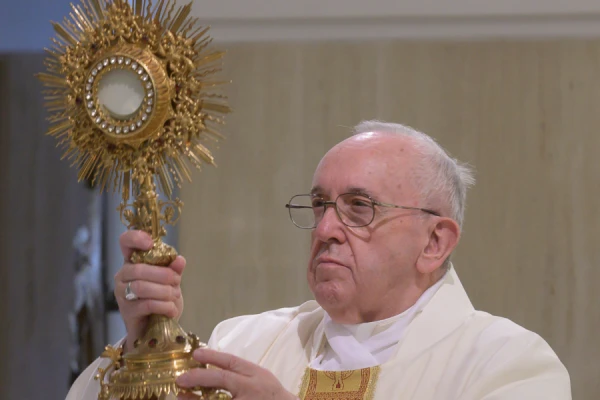

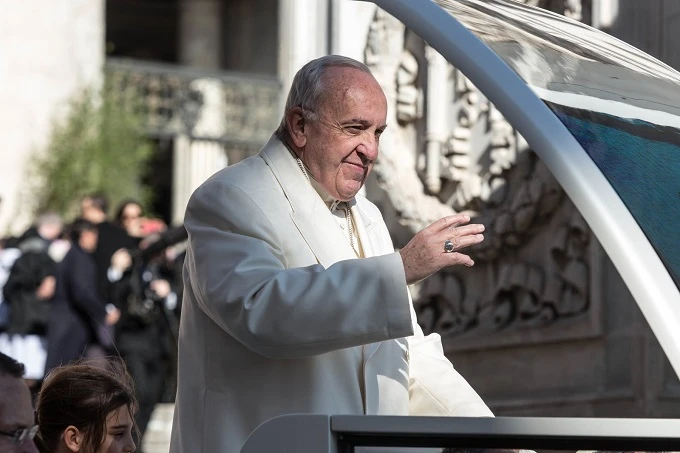
We read from the Holy Father: “Being a Christian is not just fulfilling the COMMANDMENTS. They must be done, this is true, but if you stop there, you are not a good Christian. To be a good Christian is to let the HOLY SPIRIT enter into you and take you, take you where he wants” (caps added).
The wisdom of the perennial Church, but a tough UNITY especially in epochal times—the irreducible Commandments no less than the indwelling Holy Spirit, and vice versa. . .
On this unity, and with an eye to the perplexed Nicodemus, also mentioned by Pope Francis, the historian Friedrich Heer notices in history the conflicted path he calls “NICODEMISM.” In his Intellectual History of Europe (1953), Heer defines Nicodemism as: “the false harmonizing of opposites.”
Heer finds this ambivalence in Islam: “the great thinkers of Islam were masters of Nicodemism; and in this too they set an example to western Europe.” [….] e.g., during the Inquisition in later Italy, for example, ideas “tended to burrow deeper and deeper under AMBIGUOUS symbols, hiding their secret [cultic] wisdom behind an orthodox façade.”
Near the same time, Maximos the Confessor (in Russia) found that “he had been introduced into the most secret meanings of the Holy Scriptures,” while ALSO trying to maneuver intensely nationalistic Russia back toward Constantinople. And, in the 16th-century West, CAMOUFLAGED protests against corruption in all of the ruling classes exploded in a “thousand masks” of art and literature.
Heer points especially toward the pattern of back-and-forth forced conversions (Catholic/ Lutheran/ Calvinist) baked into the peace of Westphalia (1648)—the musical-chairs of local princes who now determined the religion of their own domains (cuius regio, eius religio). Of this boiling aftermath, Heer presciently writes—“Violence was done to the German conscience from which it has not yet recovered [!]”
Not yet recovered?. . . Writes Heer, the seedbed for the 20th-century’s brutally competing ideologies from the “undergound.” And, now Germania’s conflicted and “binding synodal path”—-a church within the Church (?)—-the historically familiar “false harmonizing of opposites.”
Politicians are trying their best. Armed with fearless minds and with confidence resting in their wrists, they are spending days and nights, visualizing how best they can save lives, promote happiness, and look after the well being of the Planet.
Like the Samaritin woman at the well to which Jesus said, God is Spirit and truth and those who worship him must worship him In Spirit and truth; we too are called to do the same.We should be willing to yield to the Holy Spirit, to allow it to possess us..The Holy Spirit can enable us to live the new commandment which says love one another as I have loved you.