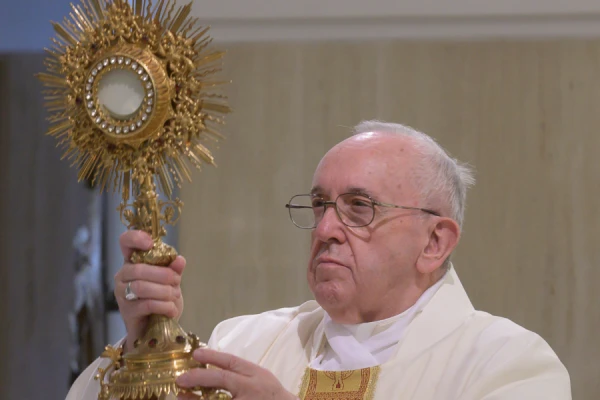
Vatican City, Apr 20, 2020 / 03:40 am (CNA).- Freedom is found in the Holy Spirit who provides the strength to fulfill God's will, Pope Francis said in his Monday morning Mass homily.
“Prayer is what opens the door to the Holy Spirit and gives us this freedom, this boldness, this courage of the Holy Spirit,” Pope Francis said in his homily April 20.
“May the Lord help us to always be open to the Holy Spirit because it will carry us forward in our life of service to the Lord,” the pope said.
Speaking from the chapel in his Vatican City residence, Casa Santa Marta, Pope Francis explained that the early Christians were guided by the Holy Spirit, who provided them strength to pray with courage and boldness.
“Being a Christian is not just fulfilling the Commandments. They must be done, this is true, but if you stop there, you are not a good Christian. To be a good Christian is to let the Holy Spirit enter into you and take you, take you where he wants,” Pope Francis said according to a transcript by Vatican News.
The pope pointed to the Gospel account of an encounter between Nicodemus, a pharisee, and Jesus in which the pharisee asked: “How can a man once grown old be born again?”
To which Jesus replies in chapter three of the Gospel of John: “You must be born from above. The wind blows where it wills, and you can hear the sound it makes, but you do not know where it comes from or where it goes; so it is with everyone who is born of the Spirit.”
Pope Francis said: “The definition of the Holy Spirit that Jesus gives here is interesting … unconstrained. A person who gets carried from both sides by the Holy Spirit: this is the freedom of the Spirit. And a person who does this is docile, and here we talk about docility to the Holy Spirit.”
“In our Christian life many times we stop like Nicodemus … we do not know what step to take, we do not know how to do it or we do not have faith in God to take this step and let the Spirit enter,” he said. “To be born again is to let the Spirit enter us.”
“With this freedom of the Holy Spirit you will never know where you will end up,” Francis said.
At the beginning of his morning Mass, Pope Francis prayed for men and women with a political calling who must make decisions during the coronavirus pandemic. He prayed that political parties in different countries may “seek together the good of the country and not the good of their party.”
“Politics is a high form of charity,” Pope Francis said.
If you value the news and views Catholic World Report provides, please consider donating to support our efforts. Your contribution will help us continue to make CWR available to all readers worldwide for free, without a subscription. Thank you for your generosity!
Click here for more information on donating to CWR. Click here to sign up for our newsletter.

Cardinal Kevin Farrell celebrates Mass in St. Peter’s Basilica for the World Meeting of Families 2022 / Daniel Ibanez/CNA
Vatican City, Jun 23, 2022 / 02:30 am (CNA).
Cardinal Kevin Farrell said on Thursday that Saint John the Baptist is a witness to the sacredness of life from conception to natural death.
The Irish-American cardinal celebrated Mass in St. Peter’s Basilica for the Solemnity of the Nativity of Saint John the Baptist on June 23.
The Mass in English was part of the World Meeting of Families 2022, taking place in Rome from June 22-26 with families from around the world. Families are also encouraged to participate in the event from home via livestream.
Even before Saint John the Baptist was born, “at the moment of Mary’s greeting, [he] recognized the Lord Jesus and leaped for joy in Elizabeth’s womb,” Farrell said.
“A call from God reached him while he was still in the womb,” he noted. “It invested him with the great task of preparing the hearts of humankind to receive the Savior of the world.”
The cardinal, who leads the Dicastery for Laity, Family, and Life, which organized the World Meeting of Families, said Saint John’s reaction to encountering the unborn Jesus points to an important aspect of family life.
“All of this helps us to understand another key dimension of the family vocation,” he said, “to be guardians of the sacredness of human life from the first moment of conception to natural death.”
Saint John the Baptist’s birth is ordinarily celebrated on June 24, but is moved to June 23 when it coincides with the Feast of Corpus Christi or the Solemnity of the Sacred Heart of Jesus, as happened this year.
In his homily, Cardinal Farrell, who is camerlengo of the Holy Roman Church, reflected on the liturgy’s first reading, from the Prophet Isaiah.
“The Lord called me from birth, from my mother’s womb he gave me my name,” Farrell said, quoting Isaiah 49:1.
“The life of each child must be protected and defended precisely because God has great plans for that child’s goodness and holiness right from the beginning,” he said.
“God’s call has reached your children too,” he continued, “right from the beginning, so that all of them may be saints of tomorrow and will make our world a brighter place for all.”
Pope Benedict XVI arrives in St. Peter’s Square in the Vatican for the Oct. 21, 2012, canonization ceremony for Jacques Berthieu, Pedro Calungsod, Giovanni Battista Piamarta, Maria Carmen Salles y Barangueras, Marianne Cope, Caterina (Kateri) Tekakwitha, and Anna Schaffer. / Photo by Franco Origlia/Getty Images
Washington, D.C. Newsroom, Jan 2, 2023 / 14:00 pm (CNA).
During his pontificate, Pope Benedict XVI beatified 870 people and canonized a total of 45 saints. Though his papacy was relatively short, spanning from 2005 to 2013, the 45 people whom he declared saints are models of faith and holiness, celebrated by Catholics all over the world.
Here are seven of the best-known saints Pope Benedict XVI canonized:
St. Kateri Tekakwitha
St. Kateri Tekakwitha, or “Lily of the Mohawks,” was the first Native American saint to be canonized. Born in what is today New York state, she was the daughter of a Mohawk father and a Christian Algonquin mother. She was baptized at age 21 and fled persecution to St. Francis Xavier Mission near Montreal, Canada, joining a community of Native American women who had also converted to Christianity. She is remembered for her suffering, devout faith, courage, and her purity. St. Kateri died on April 17, 1680, at age 24.
Statue of St. Kateri Tekakwitha with lily. Shutterstock
She was canonized by Benedict XVI on Oct. 21, 2012. He said: “Kateri impresses us by the action of grace in her life despite the absence of external help and by the courage of her vocation, so unusual in her culture. In her, faith and culture enrich each other! May her example help us to live where we are, loving Jesus without denying who we are.”
St. Hildegard of Bingen
St. Hildegard of Bingen was an abbess, artist, author, composer, mystic, pharmacist, poet, preacher, and theologian from Germany. Born in 1098, in her late teens she became a Benedictine nun at the Monastery of Saint Disibodenberg. From the age of 3, she experienced visions of God and was asked by her confessor to write them down in what became the influential illustrated book “Scivias.”She founded two monasteries and was a prolific writer of poetry, theology, and sacred music. She died on Sept. 17, 1179.
A sculpture of Hildegard of Bingen by Karlheinz Oswald at Eibingen Abbey in Hesse, Germany. . Gerda Arendt (CC BY-SA 3.0).
St. Hildegard was canonized on May 10, 2012, and declared a Doctor of the Church by Benedict XVI on Oct. 7, 2012. He said: “In Hildegard are expressed the most noble values of womanhood: hence the presence of women in the Church and in society is also illumined by her presence, both from the perspective of scientific research and that of pastoral activity.”
St. Damien of Molokai
The bronze cast of Marisol Escobar’s ‘Father Damien’ in the National Statuary Hall (detail). public domain.
Joseph de Veuster, later to become St. Damien of Molokai, was born in 1840 in rural Belgium. At the age of 13, he was forced to leave school to work on a farm but later decided to pursue a religious vocation with the Congregation of the Sacred Hearts of Jesus and Mary. As a priest, he served victims of leprosy quarantined on the Hawaiian island of Molokai. He eventually contracted the disease, losing his eyesight, speech, and mobility. St. Damien died of leprosy on April 15, 1889. Benedict XVI said of St. Damien, whom he canonized on Oct. 11, 2009: “Following in St. Paul’s footsteps, St. Damien prompts us to choose the good warfare, not the kind that brings division, but the kind that gathers people together. He invites us to open our eyes to the forms of leprosy that disfigure the humanity of our brethren and still today call for the charity of our presence as servants, beyond that of our generosity.”
St. Marianne Cope
St. Marianne Cope was born in Germany in 1838 and entered religious life with the Sisters of the Third Order of St. Francis in Syracuse, New York, in 1862. Mother Marianne served as an educator and opened two of central New York’s first hospitals. She was sent to Kalaupapa on the island of Molokai in Hawaii at age 45 to care for leprosy patients and established an education and health care system for them in the years she was there.
Painting of nun Saint Marianne Cope and images with lepers and her team on Molokai Island at Mary, Star of the Sea, Catholic Church, Kalapana, Hawaii. Claudine Van Massenhove / Shutterstock
Benedict XVI canonized St. Marianne Cope on Oct. 21, 2012. Of her legacy, he said: “At a time when little could be done for those suffering from this terrible disease, Marianne Cope showed the highest love, courage, and enthusiasm. She is a shining and energetic example of the best of the tradition of Catholic nursing sisters and of the spirit of her beloved St. Francis.”
St. Jeanne Jugan
St. Jeanne Jugan was born on Oct. 25, 1792, during the French Revolution. At age 25, she joined the Third Order of St. John Eudes, a religious association for laypersons. After some time serving as a nurse caring for elderly women, she acquired an unused convent building that would hold 40 people and established the Little Sisters of the Poor. At the time of her death on Aug. 29, 1879, 2,400 members were serving internationally.
Portrait of St. Jeanne Jugan (1792–1879), foundress of the Little Sisters of the Poor, by Léon Brune 1855. Public domain
At St. Jeanne Jugan’s canonization on Oct. 11, 2009, Benedict said: “Jeanne lived the mystery of love, peacefully accepting obscurity and self-emptying until her death. Her charism is ever timely while so many elderly people are suffering from numerous forms of poverty and solitude and are sometimes also abandoned by their families.”
St. Pedro Calungsod
St. Pedro Calungsod was born in 1654 in the Philippines. In 1668, at the age of 14, he was among the young catechists chosen to accompany Spanish Jesuit missionaries — among them Blessed Diego Luis de San Vitores — to the Marianas Islands to spread the Catholic faith. St. Pedro was responsible for converting many people, especially through the sacrament of baptism. On April 2, 1672, he was killed, along with San Vitores, while they were conducting a baptism. He is now recognized as a martyr.
Pope Francis and Cardinal Luis Antonio Tagle before a mosaic of catechist St. Pedro Calungsod in St. Peter’s Basilica on Nov. 21, 2013. Credit: Kerri Lenartowick/CNA.
He was canonized on Oct. 21, 2012. Of St. Pedro’s hardships, while visiting the Marianas Islands, Benedict said: “Pedro, however, displayed deep faith and charity and continued to catechize his many converts, giving witness to Christ by a life of purity and dedication to the Gospel. Uppermost was his desire to win souls for Christ, and this made him resolute in accepting martyrdom.”
St. Alphonsa
St. Alphonsa was born in Kerala, India, on Aug. 19, 1910. As a young woman, she rejected all suitors who came her way, as she was determined to enter religious life. In 1923, she suffered an accident that left her burned, disabled, and partially disfigured. She joined the Franciscan Clarist Congregation, and until her death suffered from physical ailments and problems associated with her disability. In her love for God, she embraced her sufferings until her death on July 28, 1946.
1996 stamp of India with photo of St. Alphonsa. India Post, Government of India via Wikimedia Commons
St. Alphonsa was canonized by Benedict XVI on Oct. 12, 2008. She is the first Indian woman to become a saint. In a Vatican statement released on the day of her canonization, she is described as “a victim for the love of the Lord, happy until the final moment and with a smile of innocence always on her lips.”
We read from the Holy Father: “Being a Christian is not just fulfilling the COMMANDMENTS. They must be done, this is true, but if you stop there, you are not a good Christian. To be a good Christian is to let the HOLY SPIRIT enter into you and take you, take you where he wants” (caps added).
The wisdom of the perennial Church, but a tough UNITY especially in epochal times—the irreducible Commandments no less than the indwelling Holy Spirit, and vice versa. . .
On this unity, and with an eye to the perplexed Nicodemus, also mentioned by Pope Francis, the historian Friedrich Heer notices in history the conflicted path he calls “NICODEMISM.” In his Intellectual History of Europe (1953), Heer defines Nicodemism as: “the false harmonizing of opposites.”
Heer finds this ambivalence in Islam: “the great thinkers of Islam were masters of Nicodemism; and in this too they set an example to western Europe.” [….] e.g., during the Inquisition in later Italy, for example, ideas “tended to burrow deeper and deeper under AMBIGUOUS symbols, hiding their secret [cultic] wisdom behind an orthodox façade.”
Near the same time, Maximos the Confessor (in Russia) found that “he had been introduced into the most secret meanings of the Holy Scriptures,” while ALSO trying to maneuver intensely nationalistic Russia back toward Constantinople. And, in the 16th-century West, CAMOUFLAGED protests against corruption in all of the ruling classes exploded in a “thousand masks” of art and literature.
Heer points especially toward the pattern of back-and-forth forced conversions (Catholic/ Lutheran/ Calvinist) baked into the peace of Westphalia (1648)—the musical-chairs of local princes who now determined the religion of their own domains (cuius regio, eius religio). Of this boiling aftermath, Heer presciently writes—“Violence was done to the German conscience from which it has not yet recovered [!]”
Not yet recovered?. . . Writes Heer, the seedbed for the 20th-century’s brutally competing ideologies from the “undergound.” And, now Germania’s conflicted and “binding synodal path”—-a church within the Church (?)—-the historically familiar “false harmonizing of opposites.”
Politicians are trying their best. Armed with fearless minds and with confidence resting in their wrists, they are spending days and nights, visualizing how best they can save lives, promote happiness, and look after the well being of the Planet.
Like the Samaritin woman at the well to which Jesus said, God is Spirit and truth and those who worship him must worship him In Spirit and truth; we too are called to do the same.We should be willing to yield to the Holy Spirit, to allow it to possess us..The Holy Spirit can enable us to live the new commandment which says love one another as I have loved you.
We read from the Holy Father: “Being a Christian is not just fulfilling the COMMANDMENTS. They must be done, this is true, but if you stop there, you are not a good Christian. To be a good Christian is to let the HOLY SPIRIT enter into you and take you, take you where he wants” (caps added).
The wisdom of the perennial Church, but a tough UNITY especially in epochal times—the irreducible Commandments no less than the indwelling Holy Spirit, and vice versa. . .
On this unity, and with an eye to the perplexed Nicodemus, also mentioned by Pope Francis, the historian Friedrich Heer notices in history the conflicted path he calls “NICODEMISM.” In his Intellectual History of Europe (1953), Heer defines Nicodemism as: “the false harmonizing of opposites.”
Heer finds this ambivalence in Islam: “the great thinkers of Islam were masters of Nicodemism; and in this too they set an example to western Europe.” [….] e.g., during the Inquisition in later Italy, for example, ideas “tended to burrow deeper and deeper under AMBIGUOUS symbols, hiding their secret [cultic] wisdom behind an orthodox façade.”
Near the same time, Maximos the Confessor (in Russia) found that “he had been introduced into the most secret meanings of the Holy Scriptures,” while ALSO trying to maneuver intensely nationalistic Russia back toward Constantinople. And, in the 16th-century West, CAMOUFLAGED protests against corruption in all of the ruling classes exploded in a “thousand masks” of art and literature.
Heer points especially toward the pattern of back-and-forth forced conversions (Catholic/ Lutheran/ Calvinist) baked into the peace of Westphalia (1648)—the musical-chairs of local princes who now determined the religion of their own domains (cuius regio, eius religio). Of this boiling aftermath, Heer presciently writes—“Violence was done to the German conscience from which it has not yet recovered [!]”
Not yet recovered?. . . Writes Heer, the seedbed for the 20th-century’s brutally competing ideologies from the “undergound.” And, now Germania’s conflicted and “binding synodal path”—-a church within the Church (?)—-the historically familiar “false harmonizing of opposites.”
Politicians are trying their best. Armed with fearless minds and with confidence resting in their wrists, they are spending days and nights, visualizing how best they can save lives, promote happiness, and look after the well being of the Planet.
Like the Samaritin woman at the well to which Jesus said, God is Spirit and truth and those who worship him must worship him In Spirit and truth; we too are called to do the same.We should be willing to yield to the Holy Spirit, to allow it to possess us..The Holy Spirit can enable us to live the new commandment which says love one another as I have loved you.