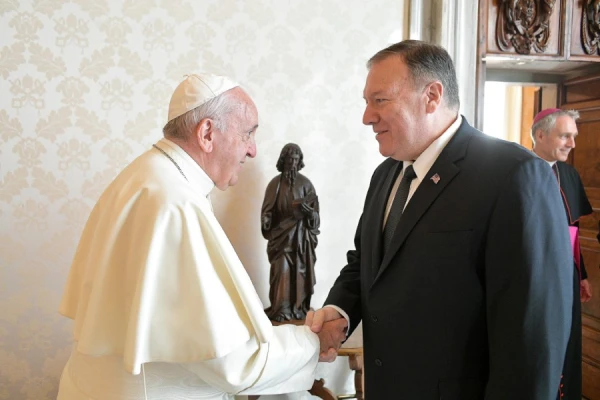
Vatican City, Oct 3, 2019 / 09:00 am (CNA).- Pope Francis met with Secretary of State Mike Pompeo to discuss the preservation of Christian communities in the Middle East and the promotion of religious freedom on Thursday.
According to State Department spokesperson Morgan Ortagus, during the Oct. 3 meeting in Vatican City, the two “reaffirmed” the commitment of the U.S and the Holy See “to advancing religious freedom around the world, and in particular, protecting Christian communities in the Middle East.”
Pompeo’s audience with the pope is part of an international trip to Italy, Vatican City, Montenegro, North Macedonia, and Greece.
The meeting followed a Wednesday session between Pompeo and Vatican Secretary of State Cardinal Pietro Parolin to mark the 35th anniversary of formal diplomatic relations between the U.S. and the Holy See.
At that meeting, Pompeo and Parolin discussed Vatican aid to Venezuela, preventing human trafficking, the conflict in Syria, and promoting international religious freedom.
Pompeo also attended a symposium on Wednesday that was co-hosted by the Holy See’s Secretariat of State and the U.S. Embassy to the Holy See.
At the symposium on “Pathways to Achieving Human Dignity: Partnering with Faith-Based Organizations,” Pompeo condemned human rights abuses committed by leaders in China, Iran, Syria, Burma, and elsewhere.
“When the state rules absolutely, moral norms are crushed completely,” he said. “We must recognize the roots of religious repression. Authoritarian regimes and autocrats will never accept a power higher than their own. And that causes all sorts of assaults on human dignity.”
U.S. Ambassador to the Holy See Callista Gingrich emphasized the importance of the U.S. and the Holy See working together on religious freedom and supporting faith-based organizations that are serving the poor and vulnerable around the world.
“Today, religious freedom is under attack in nearly every part of the world. Faith based organizations, through their unique ability to build trust and encourage dialogue, can play a critical role in turning the tide,” Gingrich said.
In an interview with Sky TG 24 on Oct. 2, Pompeo was asked about the meeting in light of Pope Francis’ repeated exhortation to “build bridges, not walls.”
President Donald Trump made the construction of a wall on the U.S.-Mexico border a key platform of his campaign in 2016, and in February declared a national emergency on the border in order to divert funds to the border that had been appropriated for other purposes.
Pompeo said he was “honored” to meet with the pope, and that “on migration, there are differences in views.”
Where the U.S. and the Holy See could work together is on international development to reduce the need for migration, he said.
“It’s a dangerous journey across Mexico into the United States. A much better solution is to try and create the conditions on the ground in those countries where those people can thrive,” he told SKY News.
If you value the news and views Catholic World Report provides, please consider donating to support our efforts. Your contribution will help us continue to make CWR available to all readers worldwide for free, without a subscription. Thank you for your generosity!
Click here for more information on donating to CWR. Click here to sign up for our newsletter.

Vatican City, Sep 19, 2019 / 10:14 am (CNA).- Pope Francis’ now six-member Council of Cardinal Advisors met this week to continue work on the forthcoming apostolic constitution, incorporating into the draft suggestions submitted by bishops’ conferences and others during the summer.
According to a brief press release from the Holy See press office Thursday, the council met Sept. 17-19, with a focus on “re-reading and modifying the draft of the new Apostolic Constitution,” which has the provisional title Praedicate evangelium.
“This first rereading, which has come to an end, was a passage of listening and reflection that responds to the indications of the Holy Father in the sense of communion and synodality,” the statement said.
The new constitution has been the advisory group’s key reform project since its establishment in 2013, one month after Pope Francis’ election.
The document is expected to place renewed emphasis on evangelization as the structural priority of the Church’s mission, with some predicting the merger of the Vatican’s Congregation for the Evangelization of Peoples and the Pontifical Council for the Promotion of the New Evangelization into a single larger department.
Praedicate evangelium will replace Pastor bonus, the current apostolic constitution on the Roman Curia promulgated by Pope John Paul II on June 28, 1988, and subsequently modified by both popes Benedict and Francis.
Pope Francis attended the council’s meetings, the advisory group’s 31st, when not in other audiences and appointments. On Wednesday morning the pope held his usual general audience, and Thursday morning he had a full slate of appointments, including with Cardinal Reinhard Marx, Archbishop of Munich and Freising and the coordinator of the Council for the Economy, who is also president of the German bishops’ conference.
The Council of Cardinal Advisors is often referred to informally as the “C9,” although there have been only six members since December 2018, when three of the original members, Cardinals George Pell, Francisco Javier Errazuriz, and Laurent Monsengwo, were removed, ostensibly for reasons of age.
In addition to Marx, the other members of the pope’s advisory council are Cardinals Pietro Parolin, Óscar Andrés Rodríguez Maradiaga, Seán Patrick O’Malley, Giuseppe Bertello and Oswald Gracias.
Bishops Marcello Semeraro and Marco Mellino, the secretary and adjunct secretary of the council, were also present at the meetings this week.
The next round of gatherings will take place Dec. 2-4.
Pope Francis embraces a man in a wheelchair at the Wednesday general audience in St. Peter’s Square on June 10, 2015. / L’Osservatore Romano.
Vatican City, Nov 25, 2021 / 10:00 am (CNA).
In his message for the International Day of Persons with Disabilities, Pope Francis said that the Catholic Church needs the participation of everyone, and the disabled must not be excluded from the sacraments.
“As we celebrate your International Day, I would like to speak directly to all of you who live with any condition of disability, to tell you that the Church loves you and needs each of you for the fulfillment of her mission at the service of the Gospel,” the pope said on Nov. 25.
Quoting his 2013 exhortationEvangelii gaudium, he said: “The worst form of discrimination … is the lack of spiritual care.”
“Sometimes, as certain of you have unfortunately experienced, this has taken the form of denying access to the sacraments,” he said in his message.
“The Church’s magisterium is very clear in this area, and recently the Directory for Catechesis stated explicitly that ‘no one can deny the sacraments to persons with disabilities.’”
The theme of Pope Francis’ message for the day is friendship with Jesus, which he said is “an undeserved gift” that all have received and that can help those experiencing discrimination.
Friendship with Christ “redeems us and enables us to perceive differences as a treasure. For Jesus does not call us servants, women and men of lesser dignity, but friends: confidants worthy of knowing all that he has received from the Father,” he said.
Antonietta Pantone, 31, a Rome resident who uses a wheelchair, told journalists it was clear to her from the pope’s message that he considers it important that people with disabilities be part of the Church and not leave the Church.
She shared her personal journey of faith, which included finding a community in the Christian disability group Fede e Luce.
Pope Francis meets with Foi et Lumière members on Oct. 2, 2021. Vatican Media/CNA
Fede e Luce is the Italian branch of the French association Foi et Lumière (known as Faith and Light in the English-speaking world), which began 50 years ago with a pilgrimage for people with disabilities to the Sanctuary of Our Lady of Lourdes in France. The movement has now expanded to five continents.
“I always say: In the eyes of God, we are all equal,” Pantone said, noting that in her journey of faith, friendship has been fundamental.
Friendship with others “demonstrates the closeness of God,” she said.
Pantone also explained how losing physical contact with friends because of the COVID-19 pandemic has been very hard for her and other disabled people, especially her friends who live in residences and not with family.
In his message, Pope Francis addressed the difficulty of the coronavirus outbreak for the disabled.
“I think, for example, of your being forced to stay at home for long periods of time; the difficulty experienced by many students with disabilities in accessing aids to distance learning; the lengthy interruption of social care services in a good number of countries; and many other hardships that you have had to face,” he wrote.
He mentioned in particular those who live in residential facilities, separated from loved ones. “In those places, the virus hit hard and, despite the dedication of caretakers, it has taken all too many lives,” he said.
He also emphasized the importance of confronting these challenges by finding consolation in prayer and friendship with Jesus.
“I would like to speak personally to each of you, and I ask that, if necessary, your family members or those closest to you read my words to you, or convey my appeal,” he said. “I ask you to pray. The Lord listens attentively to the prayers of those who trust in him.”
“Prayer is a mission, a mission accessible to everyone, and I would like to entrust that mission in a particular way to you. There is no one so frail that he or she cannot pray, worship the Lord, give glory to his holy Name, and intercede for the salvation of the world. In the sight of the Almighty, we come to realize that we are all equal,” he stressed.
Pope Francis also noted the continued presence of discrimination, ignorance, and prejudice at all levels of society, assuring people with disabilities that through baptism they are “a full-fledged member of the Church community, so that all of us, without exclusion or discrimination, can say: “I am Church!’”
“The Church is truly your home!” he said.
At a Nov. 25 press conference, Fr. Alexandre Awi Mello said that the Vatican’s Dicastery for Laity, Family, and Life is trying to do more to improve pastoral care for those with disabilities.
“This message, in recognizing that people with disabilities have their place in the holy faithful People of God, is a great invitation, for us in the dicastery, but above all for parish, diocesan and associative realities to take new paths with pastoral creativity,” Awi Mello said.
Fr. Alexandre Awi Mello, secretary of the Dicastery for Laity, Family, and Life, speaks at a Vatican press conference, May 18, 2021. Gianluca Teseo/CNA.
“It is a door that opens to think of pastoral care no longer for, but with…”
On Dec. 6, the dicastery will launch a video campaign with the hashtag #IamChurch. In five videos, Catholics with disabilities from different parts of the world will share about their experiences in the Church.
Pantone, who participated in one of the Vatican’s videos, told CNA that she would like to see the Catholic Church do more to develop courses that allow people with all kinds of disabilities to participate in parish life, such as formation courses to become a catechism teacher.
“I still had some ways to study [to become a catechist],” she said, “but it depends on the type of disability, so if another disabled person wants to be a catechist, the Church should give him all the appropriate tools.”
Pantone said that the Church can do a lot for the disabled, but the recently begun Synodal Journey “is already a step forward which the world of disability sees positively.”
Pope Francis said in his message that “having Jesus as a friend is an immense consolation. It can turn each of us into a grateful and joyful disciple, one capable of showing that our frailties are no obstacle to living and proclaiming the Gospel.”
“In fact, a trusting and personal friendship with Jesus can serve as the spiritual key to accepting the limitations that all of us have, and thus to be at peace with them,” he said.
Vatican City, Mar 19, 2019 / 09:25 am (CNA).- French Cardinal Philippe Barbarin will remain the Archbishop of Lyon, the Vatican announced Tuesday. According to a statement released by the Holy See Press Office, Pope Francis has not accepted the cardinal’s resignation, though Barbarin has stepped back from the day-to-day leadership of the diocese.
Barbarin was convicted by a French tribunal on March 7 on charges of failing to report allegations of sexual abuse committed by a priest of his diocese. He was given a six-month suspended prison sentence and plans to appeal the verdict.
Barbarin met with Pope Francis March 18 to submit his resignation as archbishop. Papal spokesman Alessandro Gisotti said March 19 that Francis chose to not accept the resignation of Barbarin as Archbishop of Lyon but, aware of the “difficulties” of the archdiocese at the present moment, “left Cardinal Barbarin free to make the best decision for the diocese.”
According to Gisotti, Barbarin has decided to “retire for a time,” leaving the vicar general of the Archdiocese of Lyon in charge during his absence.
In a statement on the Lyon archdiocesan website March 19, the cardinal said the pope did not want to accept his resignation, “invoking the presumption of innocence.”
“At his suggestion and because the Church of Lyon has been suffering for three years, I decided to retreat for a while and leave the leadership of the diocese to the vicar general moderator, Father Yves Baumgarten,” he said.
“The Holy See is keen to reiterate its closeness to the victims of abuse, to the faithful of the Archdiocese of Lyon and of the whole Church of France who are experiencing a particularly painful moment,” Gisotti’s statement concluded.
French tribunal president Brigitte Vernay declared Barbarin guilty March 7 “of non-denunciation of ill-treatment” of a minor, according to AFP.
The trial of Barbarin began in January on charges he did not report instances of abuse to judicial authorities between July 2014 and June 2015, in a case involving Fr. Bernard Preynat, who has been accused of abusing dozens of minors in the 1980s and early ‘90s.
In 2017, the cardinal told Le Monde that he did not conceal allegations against Preynat, but that his response to the allegations had been “inadequate.” He said he opened an investigation against Preynat after becoming aware of the allegations against him.
Allegations against Preynat became public in 2015. Prosecutors dropped the case the following year after an initial investigation, but a victims’ group with more than 80 members who say they were abused by Preynat led to a reopening of the case, the Guardian reports.
Preynat was banned from leading boy scout groups in the early 1990s, but remained in ministry until being removed by Cardinal Barbarin in 2015.
The priest will face his own trial later this year.
Barbarin’s trial and conviction comes as revelations of clerical sex abuse and cover up continue to send shock waves through the Catholic Church. The United States, Ireland, Australia, Chile, Argentina, Poland, and Germany are among the countries that have seen recent abuse scandals uncovered.
Leave a Reply