Washington D.C., Jun 26, 2019 / 02:00 pm (CNA).- A new poll has shown that abortion is a top consideration among a large section of voters, indicating the issue may be a crucial policy battleground in the upcoming 2020 elections.
The study, conducted by Monmouth University, surveyed 751 people from June 12 to 17. It found that over a third of respondents rated abortion as either the “most important” or a “very important” issue for the presidential election. An additional 30% of respondents said that the issue was “somewhat important.”
The poll found that Democrats were the most likely to rate abortion as the “most” or a “very” important issue for 2020, ahead of both Republicans or independents.
The 2016 Democratic Party platform included a call to roll back both the Hyde Amendment, which blocks the use of federal funds in most abortions, and the Mexico City Policy, which prevents U.S. overseas aid from going to organizations that provide or support abortion.
Abortion has played an increasing role in the Democratic presidential primary race, with Senator Bernie Sanders publicly backing unrestricted access to abortion up to birth, and Senator Joe Biden publicly reversing his decades of support for the Hyde Amendment.
Among Democrats most likely to weigh abortion rights in determining their vote, 28% said they support Joe Biden for the Democratic nomination, 21% prefered Elizabeth Warren, and 18% hoped Bernie Sanders is the nominee.
The poll also found that while a plurality–32% –of respondents said they thought abortion should be “always legal,” a combined 55% were in favor of making the procedure “legal with limitations” or “illegal with exceptions,” such as in the cases of rape or incest.
Ten percent of respondents were in favor of making abortion always illegal.
Of that 10%, nearly two-thirds said that their pro-life stance will play a “very important role” in the 2020 election. Forty-three percent of the people who said they believe abortion should be legal all times said they consider abortion to be one of their key issues for the presidential election.
Earlier this year, the Trump administration changed Title X regulations, prohibiting funding recipients from co-locating with abortion facilities, a move projected to cost Planned Parenthood approximately $60 million in federal funding.
At the state level, several legislatures have moved to pass so-called “heartbeat bills” and other restrictive abortion laws, many of which are the subject of legal appeals. Other states, most notably New York and Vermont, have codified the 1973 Roe v. Wade decision into law, allowing virtually unrestricted access to abortion throughout pregnancy.
Both Democrats and Republicans said that the other party as too focused on this issue.
Among Republicans, 58% said Democrats focused too much abortion but only 26% thought that their own party gave the matter too much attention at the federal level.
Surveyed Democrats registered nearly identical numbers: only 23% thought federal-level Democrats were spending too much time on abortion, but 64% said Republicans were disproportionately focused on the issue.
If you value the news and views Catholic World Report provides, please consider donating to support our efforts. Your contribution will help us continue to make CWR available to all readers worldwide for free, without a subscription. Thank you for your generosity!
Click here for more information on donating to CWR. Click here to sign up for our newsletter.
Washington, D.C. Newsroom, Aug 11, 2023 / 12:15 pm (CNA).
A Catholic priest pleaded guilty this week to charges of child sex exploitation related to the transport of a minor from South Carolina to Florida s… […]
Metuchen, N.J., Sep 5, 2018 / 02:31 pm (CNA).- Bishop Emeritus Paul Bootkoski of Metuchen said last week that claims of abuse against then-Cardinal McCarrick made to his diocese were reported to the then-nuncio in a timely manner. Accounts from some alleged victims suggest the diocese had been aware of McCarrick’s misconduct long before it was reported.
An Aug. 28 statement from the office of Bishop Bootkoski said Archbishop Carlo Maria Viganò “was mistaken in his recollection of facts regarding abuses committed by Archbishop McCarrick.”
Archbishop Viganò, the former apostolic nuncio to the US, had written that Bishop Bootkoski, as well as Archbishop Emeritus John Myers of Newark “covered up the abuses committed by McCarrick in their respective dioceses and compensated two of his victims. They cannot deny it and they must be interrogated in order to reveal every circumstance and all responsibility regarding this matter.”
According to the statement from Bishop Bootkoski’s office, “the Diocese of Metuchen received the first of three complaints against Archbishop McCarrick in 2004,” after McCarrick had been transferred to Washington and made a cardinal.
“The Diocese of Metuchen promptly reported each claim it received to law enforcement in multiple counties in the different states where the reported offenses took place,” the statement said.
Bishop Bootkoski said he informed the then-apostolic nuncio to the US, Archbishop Gabriel Montalvo Higuera, of the claims received by the Metuchen diocese regarding McCarrick in December 2005, first by phone, and then in writing.
“Any implication that Bishop Bootkoski failed to report the accusations against Archbishop McCarrick to the appropriate church officials and civil authorities is incorrect,” the statement said.
A letter sent Dec. 6, 2005 from Bootkoski to the nuncio summarized that a priest of the Metuchen diocese, who was subsequently dismissed from the clerical state, “alleged McCarrick had inappropriate physical contact with him”; that a former Metuchen seminarian “alleged to have heard rumors of parties held at the New Jersey shore home of Cardinal McCarrick; however, he indicated he was not at any of the parties and put no credence in the rumors”; and that a priest of Metuchen who was subsequently removed from ministry dues to allegations of sexual abuse of minors in the 1990s “alleged McCarrick had inappropriate physical contact with him, including sexual touching, when he was a seminarian, as well as similar encounters with other priests of the diocese.”
According to a July 16 article in the New York Times, Robert Ciolek “filed for a settlement from the church” in 2004.
Ciolek had been a seminarian in the 1980s, and alleged abuse by McCarrick. He was ordained a priest, but left the priesthood in 1988.
In 2005, he received an $80,000 settlement from the Metuchen, Trenton, and Newark dioceses.
But the New York Times reported that Ciolek was contacted “around 1999” by Msgr. Michael Alliegro, who asked him “if he planned to sue the diocese, and then mentioned Archbishop McCarrick’s name.”
Msgr. Alliegro had served as McCarrick’s secretary in Metuchen, and he was vicar of pastoral life for the diocese from 1987 until about 1999.
“And I literally laughed, and I said, no,” Ciolek told the New York Times, adding that Alliegro breathed a sigh of relief.
The New York Times reported another priest was in 2004 “forced to resign under the church’s new zero-tolerance protocols against child abuse.”
That priest told the New York Times that he had written to Bishop Edward Hughes of Metuchen in 1994 “saying that Archbishop McCarrick had inappropriately touched him and other seminarians in the 1980s.”
“He told Bishop Hughes that he was coming forward because he believed the sexual and emotional abuse he endured from Archbishop McCarrick, as well as several other priests, had left him so traumatized that it triggered him to touch two 15-year-old boys inappropriately. The Metuchen diocese sent the priest to therapy, and then transferred him to another diocese.”
The priest was paid a $100,000 settlement by the Church in 2007.
The office of Bishop Bootkoski said that “The Diocese of Metuchen received the first of three complaints against Archbishop McCarrick in 2004.”
It is evident that three men did contact the Metuchen diocese between 2004 and 2005 with allegations against McCarrick.
The first was Ciolek, whose settlement was paid in 2005. The Diocese of Metuchen was aware of his allegation at least as far back as 1999.
The second, a former seminarian, had heard rumors about McCarrick but did not allege having been abused himself.
The third is the unnamed priest who received a settlement in 2007. He first told the Bishop of Metuchen in 1994 that he and other seminarians had been sexually and emotionally abused by McCarrick in the 1980s, and that this had triggered him to touch inappropriately two underaged boys.
Before becoming Bishop of Metuchen, Bootkoski served under McCarrick in the Archdiocese of Newark for 14 years: 11 as a priest, and three as auxiliary bishop.
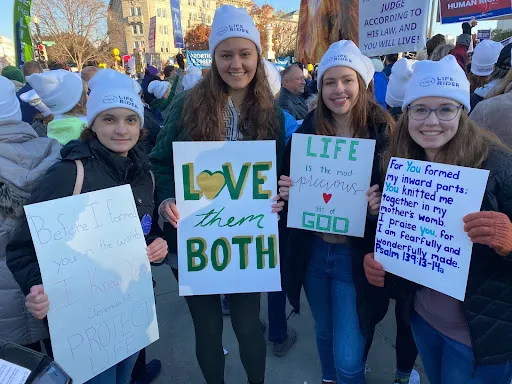
Thousands of pro-life advocates gathered outside the U.S. Supreme Court in Washington, D.C., on Dec. 1, 2021, in conjunction with oral arguments in the Dobbs v. Jackson Women’s Health Organization abortion case. / Katie Yoder/CNA
Washington D.C., Dec 2, 2021 / 08:04 am (CNA).
Anna Del Duca and daughter, Frances, woke up at 5 a.m. Wednesday morning to brave the 30-degree weather outside the U.S. Supreme Court in Washington, D.C. They arrived hours before oral arguments began in the highly-anticipated abortion case, Dobbs v. Jackson Women’s Health Organization.
The case, which involves a Mississippi law restricting most abortions after 15 weeks, challenges two landmark decisions: Roe v. Wade, the 1973 ruling that legalized abortion nationwide, and Planned Parenthood v. Casey, which upheld Roe in 1992.
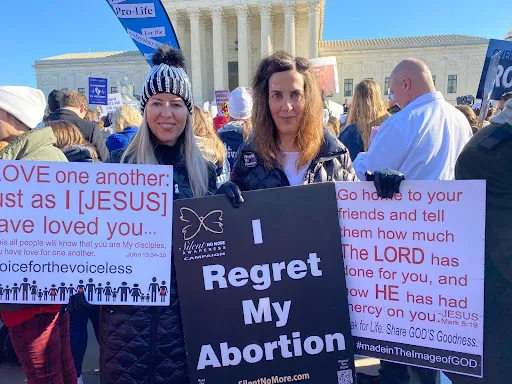
“We’re looking forward to the end of Roe versus Wade in our country,” Anna, who drove from Pittsburgh Tuesday night, told CNA. In her hands, she held a sign reading, “I regret my abortion.”
Anna Del Duca (right) and her daughter, Frances, traveled from Pittsburgh to attend a pro-life rally outside the U.S. Supreme Court on Dec. 1, 2021, in conjunction with oral arguments for the Dobbs v. Jackson Women’s Health Organization abortion case. Katie Yoder/CNA
“I would like to use my testimony to be a blessing to others,” she said, so that “others will choose life or those who have regretted abortion or had an abortion would turn to Jesus.”
Anna remembered having an abortion when she was just 19. Today, she and her daughter run a group called Restorers of Streets to Dwell In Pittsburgh that offers help to women seeking healing after abortion.
Anna and Frances were among thousands of Americans who rallied outside the Supreme Court before, during, and after the oral arguments. To accommodate them, law enforcement closed the street in front of the court. Capitol police also placed fencing in the space in front of the building in an attempt to physically separate rallies held by abortion supporters and pro-lifers.
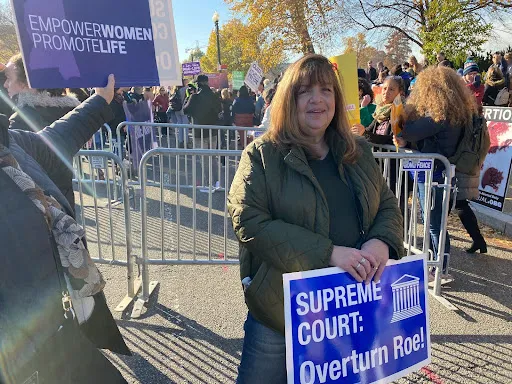
At 21-weeks pregnant, pro-life speaker Alison Centofante emceed the pro-life rally, called, “Empower Women Promote Life.” The event featured a slew of pro-life women of diverse backgrounds and numerous politicians.
“It’s funny, there were so many diverse speakers today that the only unifying thread was that we want to protect preborn children,” Centofante told CNA. They included Democrats, Republicans, Christians, Catholics, agnostics, atheists, women who chose life, and women who regretted their abortions, she said.
She recognized women there, including Aimee Murphy, as people who are not the typical “cookie cutter pro-lifer.”
Aimee Murphy, 32, founder of pro-life group Rehumanize International, arrived at the Supreme Court around 6:30 a.m. She drove from Pittsburgh the night before. Her sign read, “Queer Latina feminist rape survivor against abortion.”“At Rehumanize International, we oppose all forms of aggressive violence,” she told CNA. “Even as a secular and non-partisan organization, we understand that abortion is the most urgent cause that we must stand against in our modern day and age because it takes on average over 800,000 lives a year.”
She also had a personal reason for attending.
“When I was 16 years old, I was raped and my rapist then threatened to kill me if I didn’t have an abortion,” she revealed.
“It was when he threatened me that I felt finally a solidarity with unborn children and I understood then that, yeah, the science told me that a life begins at conception, but that I couldn’t be like my abusive ex and pass on the violence and oppression of abortion to another human being — that all that I would be doing in having an abortion would be telling my child, ‘You are an inconvenience to me and to my future, therefore I’m going to kill you,’ which is exactly the same thing that my rapist was telling me when he threatened to kill me.”
On the other side of the police fence, the Center for Reproductive Rights and the National Abortion Access Coalition and NARAL Pro-Choice America participated in another rally. Yellow balloons printed with the words “BANS OFF OUR BODIES” escaped into the sky. Several pro-choice demonstrators declined to speak with CNA.
Voices clashed in the air as people, the majority of whom were women, spoke into their respective microphones at both rallies. Abortion supporters stressed bodily autonomy, while pro-lifers recognized the humanity of the unborn child. Chants arose from both sides at different points, from “Whose choice? My choice!” to “Hey hey, ho ho, Roe v. Wade has got to go!”
At 10 a.m., the pro-life crowd sudddenly went silent as the oral arguments began and the rally paused temporarily as live audio played through speakers.
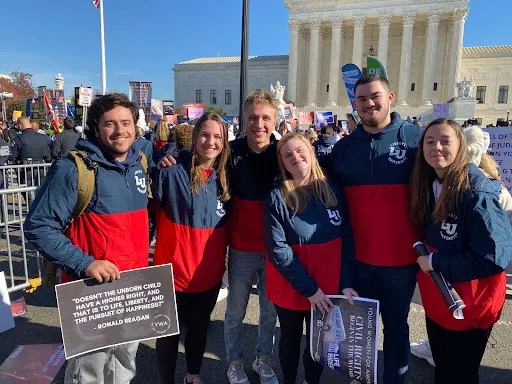
Hundreds of students from Liberty University in Lynchburg, Virginia, traveled to Washington, D.C. for a pro-life rally outside the U.S. Supreme Court on Dec. 1, 2021, in conjunction with oral arguments in the Dobbs v. Jackson Women’s Health Organization abortion case. Katie Yoder/CNA
During the oral arguments, students from Liberty University knelt in prayer. One student estimated that more than a thousand students from the school made the more than 3-hour trip from Lynchburg, Virginia.
“Talking about our faith is one thing, but actually acting upon it is another,” he said. “We have to be the hands and feet of Jesus Christ. So to me this is part of doing that.”
Sister Mary Karen, who has been with the Sisters of Life for 21 years, also stressed the importance of prayer. She drove from New York earlier that morning because, she said, she felt drawn to attend. She came, she said, to pray for the country and promote the dignity of a human person.
“Our culture is post-abortive,” she explained. “So many people have suffered and the loss of human life is so detrimental, just not knowing that we have value and are precious and sacred.”
Theresa Bonopartis, of Harrison, New York, was among the pro-life demonstrators outside the U.S. Supreme Court on Dec. 1, 2021. She runs a nonprofit group called Entering Canaan that ministers to women and others wounded by abortion. Katie Yoder/CNA
She stood next to Theresa Bonopartis, who traveled from Harrison, New York, and ministers to women and others wounded by abortion.
“I’ve been fighting abortion for 30 years at least,” she told CNA.
Her ministry, called Entering Canaan, began with the Sisters of Life and is observing its 25th anniversary this year. It provides retreats for women, men, and even siblings of aborted babies.
Abortion is personal for Bonopartis, who said she had a coerced abortion when she was just 17.
“I was kicked out of the house by my father and then coerced into getting an abortion,” she said. “Pretty much cut me off from everything, and that’s something people don’t really talk about … they make it try to seem like it’s a woman’s right, it’s a free choice. It’s all this other stuff, but many women are coerced in one way or another.”
She guessed that she was 14 or 15 weeks pregnant at the time.
“I saw my son. I had a saline abortion, so I saw him, which I always considered a blessing because it never allowed me to deny what abortion was,” she said. Afterward, she said she struggled with self-esteem issues, hating herself, guilt, shame, and more. Then, she found healing.
“I know what that pain is like, I know what that experience is like, and you know that you can get past it,” she said. “You just want to be able to give that message to other people, that they’re able to heal.”
Residents of Mississippi, where the Dobbs v. Jackson case originated, also attended.
Marion, who declined to provide her last name, drove from Mississippi to stand outside the Supreme Court. She said she was in her early 20s when Roe v. Wade was decided in 1973.
“At the time, of course, I could care less,” she said. Since then, she had a change of heart.
“We were the generation that allowed it,” she said, “and so we are the generation who will help close that door and reverse it.”
Marion, who declined to provide her last name, was among those who attended a pro-life rally outside the U.S. Supreme Court on Dec. 1, 2021, from Mississippi, where the Dobbs v. Jackson Women’s Health Organization abortion case originated. Katie Yoder/CNA
The crowd at the pro-life rally included all ages, from those who had witnessed Roe to bundled-up babies, children running around, and college students holding up homemade signs.
One group of young friends traveled across the country to stand outside the Supreme Court. They cited their faith and family as reasons for attending.
Mathilde Steenepoorte, 19, from Green Bay, Wisconsin, identified herself as “very pro-life” in large part because of her younger brother with Down syndrome. She said she was saddened by the abortion rates of unborn babies dianosed with Down syndrome.
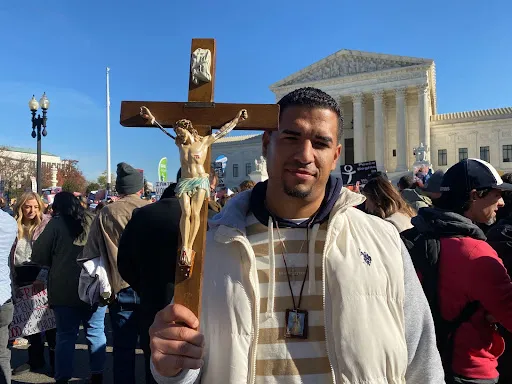
Juanito Estevez, from Freeport, a village on Long Island, New York, at a pro-life rally outside the U.S. Supreme Court on Dec. 1, 2021. Katie Yoder/CNA
Juanito Estevez, from Freeport, a village on Long Island, New York, arrived Tuesday. He woke up at 6 a.m. to arrive at the Supreme Court with a crucifix in hand.
“I believe that God is the giver of life and we don’t have the right [to decide] whether a baby should live or die,” he said.
He also said that he believed women have been lied to about abortion.
“We say it’s their right, and there’s a choice,” he said. When girls tell him “I have the right,” his response, he said, is to ask back, “You have the right for what?”
Mallory Finch, from Charlotte, North Carolina, was among the pro-life demonstrators outside the U.S. Supreme Court on Dec. 1, 2021.
Mallory Finch, from Charlotte, North Carolina, also woke up early but emphasized “it was worth it.” A pro-life podcast host, she called abortion a “human-rights issue.”
“I hope that it overturns Roe,” she said of the case, “but that doesn’t mean that our job as pro-lifers is done. It makes this, really, just the beginning.”





Leave a Reply