

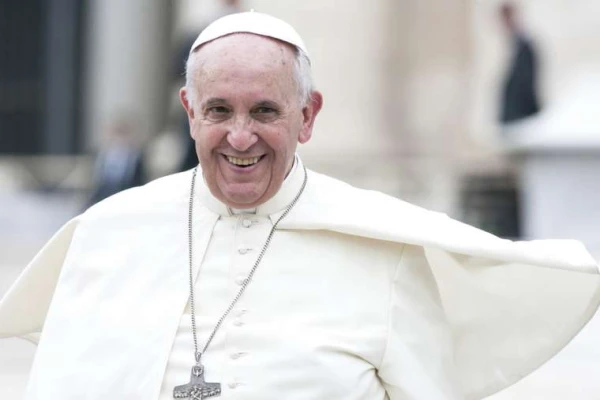
Vatican City, May 29, 2019 / 10:05 am (CNA).- Pope Francis said he reacted “with a sense of humor” to the accusation of heresy made against him earlier this month.
“It does not hurt me at all. Hypocrisy and lies hurt me, these hurt me. But such a mistake, where there are even people who have filled their heads with … no, please, you have to take care of them too,” Pope Francis said in a Spanish interview published May 28.
Mexican journalist Valentina Alazraki asked the pope how he took the accusation that he was a heretic, to which he responded, “With a sense of humor, my daughter.”
“I also pray for them because they are wrong and poor people, some are manipulated. And who are those who signed…?” Pope Francis added, alluding to an open letter signed by a group of 19 Catholics who accused the pope of “the canonical delict of heresy.”
Pope Francis touched on many topics in the 13,000 word interview from clerical sexual abuse to a potential papal trip to China.
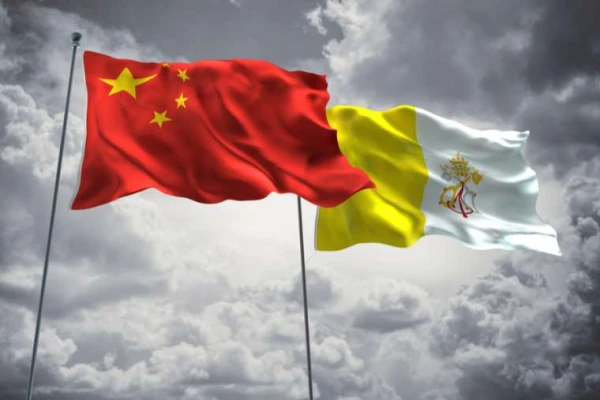
“My dream is China. I love the Chinese very much,” Pope Francis said. “Relations with China are good, very good.”
“The other day two Chinese bishops came to me, one who came from the underground church and the other from the patriotic church, already recognized as brothers. They came here to visit us. This is an important step. They know that they must be good patriots and that they must take care of the Catholic flock,” he continued.
When asked if some Catholics “felt sidelined” by the Sino-Vatican agreement signed in September 2018, the pope responded, “Catholics in general no. Catholics are happy to be united now.”
“In fact Easter was celebrated all together, all together and in all the churches. There were no problems this year,” he said.
Chinese government officials detained Father Peter Zhang Guangjun, an underground priest of the diocese of Xuanhua, after Palm Sunday Mass on April 14. Guanjun was one of three priests held in detention by authorities in China in April 2019.
Pope Francis answered questions regarding scandals surrounding former cardinal Theodore McCarrick, Argentine Bishop Gustavo Oscar Zanchetta, Honduran Cardinal Oscar Maradiaga, Australian Cardinal George Pell, resigned Chilean bishop Juan Barros, and past papal responses to Fr. Marcial Maciel.
“Crises are also about growth; for me it is a crisis of growth, where you have to fix certain things, promote others and move on, ahead,” Pope Francis said.
“I believe that the Church is changing, as shown by the attempts at reform that we are making,” he said.
“The Vatican City State as a form of government, the Curia, whatever it is, is the last European court of an absolute monarchy. The last. The others are now constitutional monarchies, the court is diluted. Here there are still court structures that must fall,” he said.
“People want to reform. For example, the palace of Castel Gandolfo, which comes from a Roman emperor, restored in the Renaissance, today is no longer a papal palace, today it is a museum, it is all a museum,” he said.
Pope Francis said that it is not his reform, but something “the cardinals have requested.”
“The scheme of the court is what has to disappear. And this was requested by all the cardinals, well, most, thanks be to God,” Pope Francis said.
Pope Francis also remarked that criticism of the Church can be a good thing. He said, “Saint Catherine of Siena criticized cardinals and, at times, beat up on the pope. And she was a saint!”
If you value the news and views Catholic World Report provides, please consider donating to support our efforts. Your contribution will help us continue to make CWR available to all readers worldwide for free, without a subscription. Thank you for your generosity!
Click here for more information on donating to CWR. Click here to sign up for our newsletter.


“My dream is China. I love the Chinese very much,” Pope Francis said. “Relations with China are good, very good.”
Does not the last sentence here say it all, so to speak.
Apart from remembering him and the Church in prayer, why should I spend more time on Bergoglio…following “thoughts” like this and yes… his lies?
His philosophy is being anti-philosophical but not anti-ideological.
Lately I prefer St. Augustine and Plotinus along with The Catechism of the Council Of Trent…and yes Scripture. I don’t ask why.
A statistical fact: Argentina has the most psychologists per capita of any country in the world.
Bergoglio-ism: the delusion of “depths” where there are none… punctuated with a open mouthed smile and back titled head.
How much should I or anyone get paid per hour to listen to Bergoglio thinking out loud or sharing/relishing that he reacted “with a sense of humor” to being accused of heresy?
Did Bergoglio react to Jesuit Superior Kolvenbach’s assessment of him as being an unsuitable candidate for the episcopacy with a sense of humor? Or did he know nothing about that evaluation…just like the McCarrick story?
Did his very unsuitability make him suitable for certain others…
For me…time to “move on”
Move on to where, Sir? We as good Catholics must speak out. As Fr Peter Morello put it, “Silence is not an option when truth is compromised”. To “move on” seems to be saying, “I can do nothing so I might as well just ignore what is happening”. I, Sir, cannot do that. I love the Church, the priesthood, the Bishops and Archbishops, the Cardinals and the office of the Pope, but I love God more.
If Pope Francis cannot be accused of formal heresy and perhaps neither material he cannot disclaim error. Praedicate Evangelium the restructuring of the Curia in its Prologue says “Episcopal conferences, including their continental associations, are currently one of the most significant ways of expressing and serving ecclesial communion in different regions together with the Roman Pontiff, guarantor of unity”. In practice Episcopal Conferences are not subject to the Pontiff’s coercive authority as guarantor of unity. Quite the opposite is evidenced in the German Episcopal Conference whose chairman Cardinal Marx announced their synodal findings will be binding on faith and morals [Marx referred explicitly to D&R and the Eucharist and sexual morality]. And the Pontiff’s praise of China and Catholicism as enlightened is perhaps the clearest evidence. The preeminent curial organ for protecting doctrine the CDF has lost its function and primacy given to Propaganda Fides. The restructure of our Church divesting real papal authority dispersing the historical pontifical Magisterial function to Episcopal Conferences to bind and loosen dogma fragments the Mystical Body similar to Protestant Christianity. Without a viable CDF the Pontiff’s agenda of paradigmatic revision encapsulated in Amoris Laetitia, to wit the new Evangelization will replace Apostolic Tradition. Those of us committed to the faith revealed by Christ conferred by the Apostles must honestly identify the reality of what we’re now confronting. If the Antichrist is not among us then it is that which closely typifies Antichrist. As exhorted in Sacred Scripture we need gird our loins for a terrible contest.
A failed attempt at irony by borrowing from Bergoglio’s absurd “move on”… or maybe not a failed attempt at all. Plato himself allows Socrates to fail in Book 1 of Republic…the elenchus, one might say “Socrates” as a process is not really for everyone after all…and that this “process” does indeed corrupt the youth and those not suitable or prepared candidates…especially when it breaks its own rules.
What the Church has always taught…I will follow and speak that out.
Our Lady of La Salette, pray for us.
Bergoglio is more of a counterpuncher than people realize. What gets remembered or taken to task more than Bergoglio is someone’s response to him…lost in the shuffle…the Catechism, the teachings of Christ.
This is less a time for dialectic…more of an exorcism, a purification.
Thank God for Pope Francis. His latest commentary on civil ceremonies for same sex partners is a move forward. I would hope he would focus on a similar civil ceremony of betrothal for young persons in relationship and when they are ready to move in a life-long situation, the church would offer the sacrement of marriage. (I understand such a situation was approved by Paul VI for trial in a diocese in southern France only to be sabotaged by conservative clergy.) If such a move were to take place estranged young persons would return and become contributing members of our Church.