
Vatican City, May 5, 2018 / 03:45 pm (CNA/EWTN News).- Chronic pain reduction. Improvement in paralysis. Restoration of sight amid macular degeneration. These are just some of the results being seen in experimental treatments using virtual reality technology.
And this technology could help answer Pope Francis’ call for doctors and scientists to collaborate in pursuing bold and creative approaches to medicine.
Stressing the importance of ethics and defense of human life, the pope at an April 28 conference called for an “open interdisciplinary approach that engages multiple experts and institutions,” which can lead “to a reciprocal exchange of knowledge.” He also encouraged “concrete actions on behalf of those who suffer.”
For at least one representative who was present at the conference, the future of medical care could rely significantly on the tech industry, using tools such as augmented and virtual reality as a treatment for certain conditions.
In an interview with CNA, Dr. David Rhew said virtual reality is already used in training scenarios for doctors and nurses, but is starting to be used to treat medical conditions as well.
Rhew is the chief medical officer, vice president and general manager of B2B Healthcare for Samsung Electronics America. He spoke at the Vatican’s April 26-28 “Unite to Cure” about the use of VR technology in medicine.
Virtual reality, he told CNA, is already used as a treatment in cases of pain relief, macular degeneration and spinal cord injury, and further research is being done in VR treatments for concussions, brain injury, post-traumatic stress disorder and strokes.
In aiding with pain management, Rhew said the aim of using virtual reality is to lessen dependence on narcotics and help patients deal with their discomfort in a more soothing, natural way.
Rhew said that patients underwent experimental treatment watched a calming video for 10-15 minutes through a VR headset, and afterward it took several hours or even days for the pain to come back, if it did at all.
In one randomized control trial conducted by Cedars-Sinai Medical Center in Los Angeles, 120 patients were randomly selected. Half were given VR pain treatment, while the rest were shown content on a regular television set.
Doctors saw a 52 percent pain reduction in the patients who used VR versus those who watched regular television, which is a “dramatic, remarkable” outcome, Rhew said.
Results have even been seen in children who suffer chronic pain due to sickle cell anemia. In at least one case, he said, a person came in with pain and left with no medication after using the VR headset.
“We’ve actually now been starting to think how can we go beyond even acute hospitalization, and even start thinking about how this could be used in the ambulatory setting and potentially be used to address the opioid epidemic,” he said.
The hope is that virtual reality could be used as an alternative to opioid treatments, so patients never have to start on narcotics, or can stop if they are currently using them.
Macular degeneration – in which the central part of the eye is damaged, usually resulting significant vision loss – has also been successfully treated with virtual reality.
“Researchers have long known that despite the fact that you have injuries to [the macula], other parts of the retina are still in tact,” Rhew said, noting that opthamologists have used virtual reality to target an area of the eye called the “preferred retinal locus (PRL),” which is small and hard to locate, but which can lead to better vision if found and utilized.
“Using the VR headset with an eye-tracking software helps locate the PRL,” and the magnification ability on the camera helps zoom in on the area they are looking for.
In one study carried out by Johns Hopkins University, some patients walked in legally blind and left with 20/30 vision, rhew said. This allows people “to do things they were never able to do – they can now read a book, they can watch TV, they can even do gardening.”
VR technology is currently being used as a treatment by some 80 opthamologist centers across the United States, including UCLA, but not many people know about it, he said.
Spinal cord injuries have also been treated with virtual reality.
“What we’ve seen is that in patients who have injured the spinal cord, like we talked about with the eye, they may have lost some of the major components of the neuro-pathways, but some of the minor ones are still intact, and we in general have not figured out how to utilize those minor ones,” Rhew said.
The virtual reality “tricks” the brain by targeting and activating pathways in the brain and spine that might still be intact and could lead to eventual mobility.
In a case study of eight patients who suffered from chronic paraplegia from anywhere between 3-18 years, after undergoing a year of an intensive VR treatment with physical therapy, “all of them were upgraded from paraplegia to partial paralysis.”
“This can help us in managing patients and restoring function for those with disabilities,” but success depends on individual effort, Rhew said, explaining that “we have it within ourselves but we sometimes need that ability to go over that little hump, and technology can sometimes help us.”
Rhew said he believes the unanticipated rise in VR and digital treatments is due in part to the fact that devices have become more powerful, battery life has grown longer and storage has increased.
Increasing use of mobile phones is also a factor, since the technology can be accessed from anywhere. Additionally, VR can in many cases be significantly cheaper than typical medical equipment.
“We’re going to continue to learn more over the coming years, the technology is going to get better, we’re probably going to able to make further advancements, we’re going to improve the user experience” and will likely participate in more clinical trials, Rhew said.
Doctors will also likely become increasingly aware that they can “truly use this as an adjunct or alternative to things today that are major issues. So I see it improving the lives of people pretty dramatically, especially those with disabilities.”
 […]


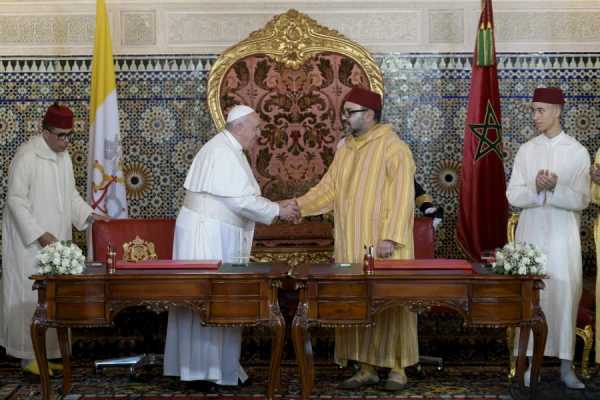

Yes, of course and sincerely, to solidarity, encounter,and dialogue…but fraternity between street-level Muslims (the followers of Islam) and individual Christians (the witnesses to Christ) is one thing, but isn’t it still another–any pluralist(?) and one-world equivalence between the religious belief of Islam and faith in the person of Christ?
The Koran is held to be timeless, from before time and the very essence of Allah. There is only the oneness of Allah, and Mohammed is his prophet. The distant God is the one and all-engulfing “autonomy.”
To consider a civilization tuned-in to the Triune nature of this one God, or to admit to any other “autonomy” such as the gifted and fully human “person” is blasphemy. Likewise, the distinction between mosque and state (Shari’a). Adjustments around the edges, maybe, as Pope Francis detects in Morocco and hopes to expand. But that’s a side story. The unmentioned Pope Benedict had the same hope for Turkey back in 2007.
The whole thing about history and growth and flourishing through time–the fully human mystery as revealed in the Incarnation (two natures in the one “person” of Christ)—is simply off the table, ultimately, as an apostasy from the original, non-historical, monotheistic (monolithic !) and engulfing Islam.
The Aquinas of Faith-and-Reason, for example, is nothing to Islam. And so too is the Western affirmation of elevated mankind and of his history, even when not so betrayed and decadent as now in the secular West.
If even Christianity decides to go chameleon in these chaotic and syncretic times (melded civilizations?), then are we not on the front edge of a new and long ice age in human history? Europe–rooted very much in the historical and incarnate “encounter” (!) between God and Man–fades as a flash in the pan.
Fraternity, yes, even under the wraparound global ethic of “creation”, but as for the perennial Church which is distinctly more than Abrahamic alone, quo vadis? May the intended bridge between civilizations be well-lighted.
For an accurate summary of what Islam/the Koran teaches and believes feel free to Google the various essays of Fr. James Schall, S.J..
“Why does God allow so many religions?” Pope Francis asked at his general audience following the trip.“Scholastic theologians referred to the ‘permissive will’ of God. He willed to permit this reality: that there are many religions,” he said.
That is not exactly an explanation, unless the pope is admitting that the plurality of religions is actually an evil that is counter to His active will.