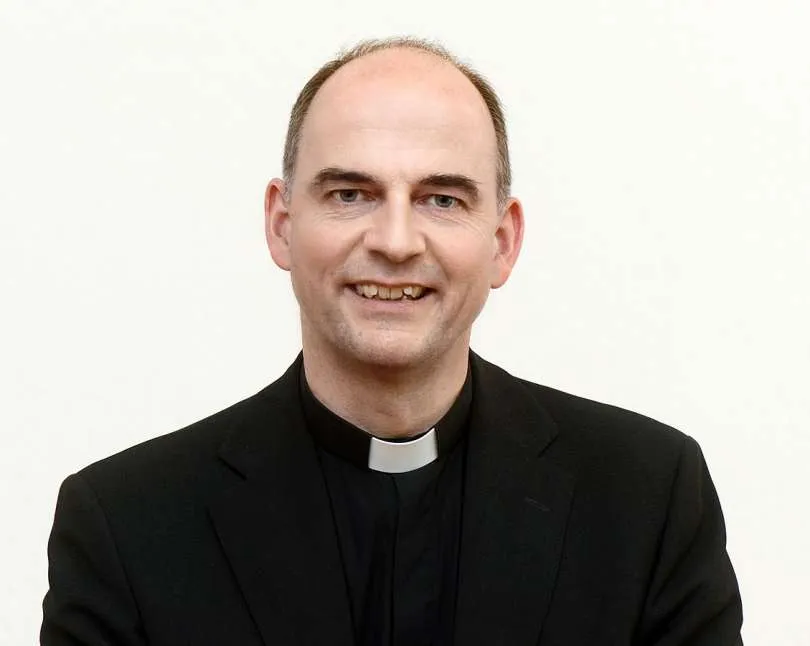
Würzburg, Germany, Jul 6, 2018 / 09:58 am (CNA).- The Bishop of Würzburg issued an open invitation to all Protestant spouses of Catholics to receive the Eucharist on July 5 and 6 while attending Masses celebrated for married couples at the Cathedral of St. Kilian.
Referring to inter-denominational marriages as “denomination-uniting,” a press release published by the diocese says that Würzburg Bishop Franz Jung “especially invited” couples in which one spouse is Protestant to receive the Eucharist in his sermon on July 5.
Jubilee Masses are usually celebrated for couples who have been married for 25, 50 years or longer.
In May, the Vatican rejected a set of norms proposed by the German bishops’ conference on the question of intercommunion. Those norms were subsequently published by the conference as “guidance.”
Bishop Jung announced July 5 that he would discuss in detail the “recommendations made by the German bishops’ conference with his diocesan councils.”
“Today however, on the day of jubilees, I would like to express an invitation to receive the Eucharist to all denomination-uniting marriages in which the two partners have been faithful to one another for such a long time,” Jung continued.
The 51-year-old Jung was installed as Bishop of the Bavarian diocese of Würzburg in June 2018. He is the fifth German bishop to announce an implementation of the bishops’ “orientation document” thus far.
While that document does not universally allow for Protestant spouses of Catholics to receive the Eucharist, it does allows the practice “under specific circumstances” and “in individual cases.”
The Code of Canon Law permits baptized Protestants to receive the sacraments of penance, Eucharist, and anointing in “danger of death,” or in another circumstance of “grave necessity,” determined by a diocesan bishop or bishops’ conference. However, the Church’s law requires that those receiving them “manifest Catholic faith in respect to these sacraments and are properly disposed.”
The other bishops to announce an “implementation plan” of the German bishops’ guidelines are Archbishop Hans-Josef Becker of Paderborn, who introduced the change with immediate effect on Sunday, July 1st, as did Archbishop Stefan Heße of Hamburg a few days later. Archbishop Ludwig Schick of Bamberg has also followed suit, describing certain requirements in addition to the document. Meanwhile Bishops Gerhard Feige of Magdeburg and Franz-Josef Bode of Osnabrück have declared their intentions but have not implemented the move just yet.
If you value the news and views Catholic World Report provides, please consider donating to support our efforts. Your contribution will help us continue to make CWR available to all readers worldwide for free, without a subscription. Thank you for your generosity!
Click here for more information on donating to CWR. Click here to sign up for our newsletter.

Daniel O’Connell, lithograph attributed to R. Evan Sly (EP OCON-DA (17) II) from the National Library of Ireland. / Credit: National Library of Ireland
Dublin, Ireland, Aug 9, 2025 / 07:00 am (CNA).
Daniel O’Connell, known as “The Liberator,” was a pivotal figure in 19th-century Ireland, championing the cause of Catholic emancipation.
Opposed to violence, he advocated for Catholic rights through peaceful means, emphasizing dialogue and legal reform, and organizing mass demonstrations to rally public support and raise awareness about the injustices faced by Catholics.
“Daniel O’Connell’s achievement in forcing the British government to concede Catholic emancipation in 1829 was immense,” Bishop Niall Coll of Ossory told CNA. “The penal laws, a series of oppressive statutes enacted in the 17th and early 18th centuries that targeted the Catholic majority in Ireland, restricting their rights to own land, hold public office, and practice their religion were set aside.”
O’Connell’s efforts culminated in the passage of the Catholic Relief Act of 1829, which allowed Catholics to sit in Parliament and hold public office and significantly transformed Irish politics.
O’Connell was born in 1775 in Caherciveen in rural Kerry. His parents had managed to maintain their land despite the penal laws, thanks to their remoteness, business sense, and help from Protestant neighbors. O’Connell’s earliest years, until he was 4, were spent with an Irish-speaking family that instilled in him an inherent understanding of Irish peasant life.
After studying in France at the English Colleges in St. Omer and Douai during the French Revolution, he returned to Ireland, completed his studies, and was called to the bar. In 1802, then a successful barrister, he married a distant cousin, Mary O’Connell, and they had 12 children — seven of whom survived to adulthood. In 1823 he founded the Catholic Association with the express aim of securing emancipation.
O’Connell’s early experiences were critical to his political and social formation, according to Jesuit historian Father Fergus O’Donoghue, who told CNA that O’Connell’s exposure to European influences undoubtedly shaped his character, his opposition to violence, and his deep-seated opposition to tyranny.
“He witnessed the French Revolution, which appalled him and set his heart completely against violence,” O’Donoghue told CNA. “What Daniel O’Connell really did was produce a political sense in Ireland that was never previously generated. Irish Catholics lived in appalling poverty and were neglected. He energized them. He brought Church and laity together into politics and constitutionalism.”
Bishop Fintan Monahan at Daniel O’Connell’s memorial in Rome. Credit: Bishop Fintan Monahan
O’Donoghue explained how O’Connell’s arousal of a nationwide Irish Catholic consciousness impacted politics and society but also had far-reaching consequences beyond Irish shores.
“When Irish Catholics emigrated, which of course many were forced to do, many of them were already politically aware. That’s why Irish people got so rapidly into American politics and into Australian politics later.”
“He was part of the enormous revival of Irish Catholicism in the 19th century. Before the Act of Union, various relief acts had been passed so Catholics officially could become things like judges or sheriffs, but none really were appointed in numbers. He was blistering in highlighting the difference between the law and reality. He was liberal, which amazed people; he believed strongly in parliamentary democracy. Many Catholics were monarchists and tending to be absolutists and he was having none of that. Under no circumstances would he approve of violence.”
Coll told CNA how O’Connell’s personal reputation extended his influence worldwide: “The fact that he could remain a devoted and practicing Catholic — while supporting the separation of church and state, the ending of Anglican privileges and discrimination based on religious affiliation, and the extension of individual liberties, including those in the sphere of politics — made him a hero and inspiration to Catholic liberals in many European countries.”
Coll continued: “The fact that his political movement was based upon popular support and the mobilization of the mass of the people, while yet being nonviolent and orderly, gave proof that political agitation did not necessarily have to be anticlerical or bloody. The attention his movement and opinions received in the continental European press was remarkable, as were the number and distinction of European writers and political figures who visited Ireland with the express purpose of securing an audience with O’Connell.”
Coll agreed firmly with historians who believe no other Irish political figure of the 19th or early 20th century enjoyed such an international reputation as did O’Connell throughout his later public career.
Among those whom O’Connell also influenced were Eamon de Valera, president of Ireland; Frederick Douglass, social reformer and slavery abolitionist in the United States; and Gen. Charles de Gaulle. Indeed, de Gaulle, when on an extended visit to Ireland, insisted on visiting Derrynane House in Kerry, the home of Daniel O’Connell.
When asked how he knew about O’Connell, de Gaulle replied: “My grandmother wrote a book about O’Connell.” The grandmother in question was Joséphine de Gaulle (née Maillot), a descendant of the McCartans of County Down and his paternal grandmother, who wrote “Daniel O’Connell, Le Libérateur de l’Irlande” in 1887. De Gaulle’s father, Henri, was also a historian interested in O’Connell.
In The Tablet,Dermot McCarthy, former secretary to the Office of the Irish Prime Minister, wrote that O’Connell’s primary legacy was “lifting a demoralized and impoverished Catholic people off their knees to recognize their inherent dignity and realize their capacity to be protagonists of their own destiny.”
Minister for Culture, Communications, and Sport Patrick O’Donovan said last month: “Daniel O’Connell was one of the most important figures in Irish political history, not just for what he achieved, but for how he achieved it. He believed in peaceful reform, in democracy, and in civil rights; ideas and concepts to which we should still aspire today.”
However, in its official communiques praising O’Connell, the Irish government minister failed to mention the word “Catholic” even once.
For O’Donoghue, the absence of any Catholic context is unsurprising given the prevailing secular attitudes among many of the country’s politicians.
Bishop Fintan Monahan, bishop of Killaloe, visited O’Connell’s grave in Rome during the Jubilee for Youth, telling CNA: “In 1847, the Great Famine was at its most severe and O’Connell’s final speech in the House of Commons was an appeal for help for its victims. Due to his physical weakness, this final speech was barely audible.”
O’Connell died in Genoa on May 15, 1847, on the 17th anniversary of the first time he presented himself at the House of Commons.
It was hoped that his heart might be interred in St. Peter’s Basilica in the Vatican. However, Pope Pius IX feared offending the British government on whose goodwill Catholic missionaries depended in many parts of the world. A requiem Mass was offered for O’Connell in the Roman baroque basilica of Sant’Andrea della Valle. The attendance included the future cardinal, now canonized saint, John Henry Newman.
O’Connell had said he wished to bequeath “his soul to God, his body to Ireland, and his heart to Rome.”
Rome, Italy, Aug 1, 2019 / 03:25 am (CNA).- There are many Catholic churches in Rome, but few can boast of having been built through the contributions of Catholics around the world as a gift to the pope.
San Gioacchino ai Prati di Castello is an excep… […]
Madrid, Spain, Mar 9, 2021 / 08:54 pm (CNA).- A 10-year-old girl in Spain fulfilled her childhood dream of becoming a Catholic missionary from her hospital bed shortly before dying from a brain tumor this week.Teresita Castillo de Diego died March 7 in… […]
Leave a Reply