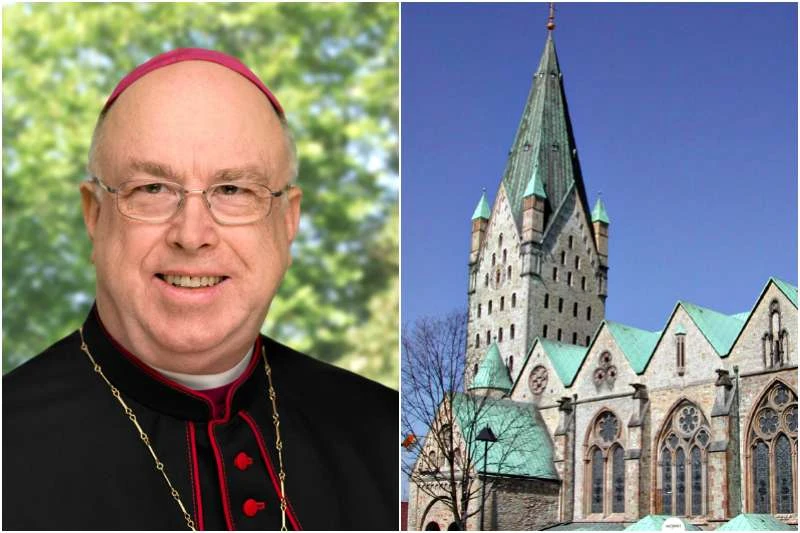
Paderborn, Germany, Jul 1, 2018 / 02:22 pm (CNA).- According to a regional newspaper report, Archbishop Hans-Josef Becker of Paderborn has decided to allow Protestant spouses of Catholics living in his diocese to receive holy Communion “in individual cases.”
As the newspaper Westfalenblatt reported, the archbishop told his presbyteral council on June 27 that the document formerly known as a “pastoral handout,” which the German bishops’ conference has re-published as “pastoral guidance” following discussions with Rome, offers “spiritual help for the decision of conscience in individual cases accompanied by pastoral care.”
“At the meeting of the Council of Priests of the Archdiocese of Paderborn on 27 June 2018, I presented my interpretation [of the document] and formulated the expectation that all pastors in the Archdiocese of Paderborn will familiarize themselves intensively with the guidance document and will act in a spirit of pastoral responsibility,” the archbishop told the newspaper.
Referring to inter-denominational marriages as “denomination-uniting” marriages in the German original, Becker further said that through baptism, their Christian faith, and the sacrament of marriage, two Christians in such unions “are united”. The Protestant spouse in such cases may have a longing and a strong desire to receive the Eucharist, the archbishop continued according to the German newspaper, and therefore it is “a matter of arriving at a responsible decision of conscience.”
At the same time, the 70-year-old Becker emphasized that his move does not constitute a “general permission” to receive Holy Communion.
Founded in 799 AD, the Archdiocese of Paderborn is situated in the German state of North Rhine-Westphalia and home to about 1,5 million Catholics. CNA Deutsch, the German language sister agency of CNA, has reached out to the archdiocese for confirmation, but has not yet received a response.
If you value the news and views Catholic World Report provides, please consider donating to support our efforts. Your contribution will help us continue to make CWR available to all readers worldwide for free, without a subscription. Thank you for your generosity!
Click here for more information on donating to CWR. Click here to sign up for our newsletter.

Illustation of St. Paul Outside the Walls in Rome, before the fire that destroyed it in 1823. / Photo courtesy of Professor Nicola Camerlenghi, from his book “St. Paul’s Outside the Walls, A Roman Basilica, from Antiquity to the Modern Era,” 2018
Rome, Italy, Jul 14, 2023 / 03:00 am (CNA).
As the bicentennial anniversary of the devastating fire at St. Paul Outside the Walls in Rome draws near, the profound significance of the July 15, 1823, event is recalled among those who love the basilica. The tragic incident left an indelible mark on the architectural landscape and the hearts of believers.
Illustration of the destruction of St. Paul Outside the Walls in Rome in 1823, depicted in Professor Nicola Camerlenghi, from his book “St. Paul’s Outside the Walls, A Roman Basilica, from Antiquity to the Modern Era,” 2018. Photo courtesy of Professor Nicola Camerlenghi, from his book “St. Paul’s Outside the Walls, A Roman Basilica, from Antiquity to the Modern Era,” 2018
To commemorate this solemn anniversary, a series of events are planned in collaboration with various embassies, universities, and choirs.
On July 11, the Benedictine friars residing in the monastery at the basilica offered a special vespers service open to the public. Additionally, a community event organized by the nearby university Roma Tre will take place in Rome’s Ostiense neighborhood on July 14 and 15 in the Parco Schuster, a small neighborhood park in the shadow of the iconic basilica. The gathering aims to honor the memory of the great fire and pay tribute to the enduring spirit of the basilica. It provides an opportunity for Catholics, architectural enthusiasts, and community members to come together and reflect on the profound impact of the fire and the subsequent reconstruction efforts, complete with 3D imaging technology developed to show what the basilica used to look like.
Cardinal James Michael Harvey, the appointed archpriest of St. Paul Outside the Walls, expressed the importance of commemorating the tragic event, stating: “We want the future to know that the memory of this event was taken seriously during its 200-year anniversary.”
Harvey also noted that the basilica is organizing an assembly of 19th-century scholars, experts, and historians to visit the basilica and discuss the significance of the tragedy sometime in November. The announcement of this event is still pending.
To gain deeper insights into the fire and its aftermath, Nicola Camerlenghi, assistant professor of Art History at Dartmouth College and a renowned expert in architectural history, shared his expertise during an interview with CNA. According to Camerlenghi, “The fire at St. Paul’s Basilica was a great tragedy. What was lost was the last imperial basilica built in Rome and one of the few monumental buildings from early Christian times that had survived relatively untouched by subsequent alterations.”
Color illustration of historic fire at St. Paul Outside the Walls in Rome, 1823, depicted in Professor Nicola Camerlenghi’s book “St. Paul’s Outside the Walls, A Roman Basilica, from Antiquity to the Modern Era,” 2018. Photo courtesy of Professor Nicola Camerlenghi from his book “St. Paul’s Outside the Walls, A Roman Basilica, from Antiquity to the Modern Era,” 2018
Reflecting on the decisions made during the meticulous reconstruction process, Camerlenghi emphasized the faithful restoration of the basilica. The architects and artisans recreated its original state while adapting to the loss of certain materials and using materials that are more fireproof. As a result of Camerlenghi’s research, 19th-century French writer Stendhal’s journal entry from his time in Rome surfaced, providing a glimpse into Rome after the fire. Stendhal wrote: “I found in it a severe beauty and an impression of calamity such as only the music of Mozart can suggest. The terrible painful traces of the misfortune were still alive… Thus perished the most ancient basilica not only of Rome, but of all Christianity. It had lasted 15 centuries.”
The fire was ruled an accident, caused by a distracted welder named Giacomo who unknowingly left a pan of coals burning on the roof. Despite initial suspicions of arson, conspiracy theories involving revolutionary movements and even the prominent Rothschild family failed to gain traction.
Lithograph image of fire at St. Paul Outside the Walls in Rome, 1823, depicted in “St. Paul’s Outside the Walls, A Roman Basilica, from Antiquity to the Modern Era,” by Professor Nicola Camerlenghi, 2018. Photo courtesy of Professor Nicola Camerlenghi from his book “St. Paul’s Outside the Walls, A Roman Basilica, from Antiquity to the Modern Era,” 2018
The reconstruction of St. Paul Outside the Walls proved to be a formidable undertaking amid the political and cultural turmoil of Rome at the time. To honor the basilica’s historical significance, Pope Leo XII decided to restore it to its former glory, without the architectural modifications and additions that had accumulated over the centuries.
At the bicentennial anniversary of this devastating fire, one is reminded of the enduring faith and unwavering spirit that define St. Paul Outside the Walls and even St. Paul himself. As Camerlenghi noted: “In turn, the reconstruction that ensued was a testament to the importance of the figure of St. Paul to the Catholic Church and indeed to the Christian community at large. No figure has been quite as ecumenical as Paul, the Apostle of the Gentiles.”
Blessing of a plane at Dublin Airport. / Credit: Dublin Airport Authority (DAA)
Dublin, Ireland, Dec 30, 2024 / 09:30 am (CNA).
Dublin Airport’s tradition of blessing aircraft entered a new chapter in 2024 with the appointment of a Nigerian-bor… […]
Las Palmas de Gran Canaria, Spain, Jun 3, 2021 / 13:50 pm (CNA).
Five days after the Canary Islands, an autonomous community of Spain, passed a law recognizing transgender identity, Jonathan Robayna, who pleaded guilty to killing his cousin in … […]
4 Comments
Not a general permission?!?
Who is kidding whom? According to Canon Law, the situation is very rare and usually involves the possibility of immediate death.
Like Fr. Martin and his crusade for homosexuality, this German bishop and his ilk are playing the Congregation for the Doctrine of the Faith for fools.
The permission granted by Archbishop Becker for Paderborn was expected as the beginning. Other German Dioceses will folow and presumably other dioceses world wide. What the Church is experiencing is rationale for furthering communion beyond Protestant spouses to D&R, nominal Catholics and likely any non Catholic That rationale is removal of canonical requirements for receiving the Holy Eucharist. The exception per force becomes the universal. This is not a narrowly crafted decision rather it is consistent with the Vatican’s Paradigm Shift and what Cardinal Gerhard Mueller called “Conversion to the World”. New Epoch exigency is their rationale. The revelation of Christ transcends cultural change, the fallacy that truth is subject to time and has no permanency. It is clear devaluation of the very heart of Catholicism. The Holy Eucharist.
Not a general permission?!?
Who is kidding whom? According to Canon Law, the situation is very rare and usually involves the possibility of immediate death.
Like Fr. Martin and his crusade for homosexuality, this German bishop and his ilk are playing the Congregation for the Doctrine of the Faith for fools.
And apparently with the Pope’s blessing.
The permission granted by Archbishop Becker for Paderborn was expected as the beginning. Other German Dioceses will folow and presumably other dioceses world wide. What the Church is experiencing is rationale for furthering communion beyond Protestant spouses to D&R, nominal Catholics and likely any non Catholic That rationale is removal of canonical requirements for receiving the Holy Eucharist. The exception per force becomes the universal. This is not a narrowly crafted decision rather it is consistent with the Vatican’s Paradigm Shift and what Cardinal Gerhard Mueller called “Conversion to the World”. New Epoch exigency is their rationale. The revelation of Christ transcends cultural change, the fallacy that truth is subject to time and has no permanency. It is clear devaluation of the very heart of Catholicism. The Holy Eucharist.
“Francis the Inscrutable. Who Brakes To Speed Up (Sandro Magister)”. I had to add this addendum by the witty knowledgeable Senor Magister.
“What a surprise.”