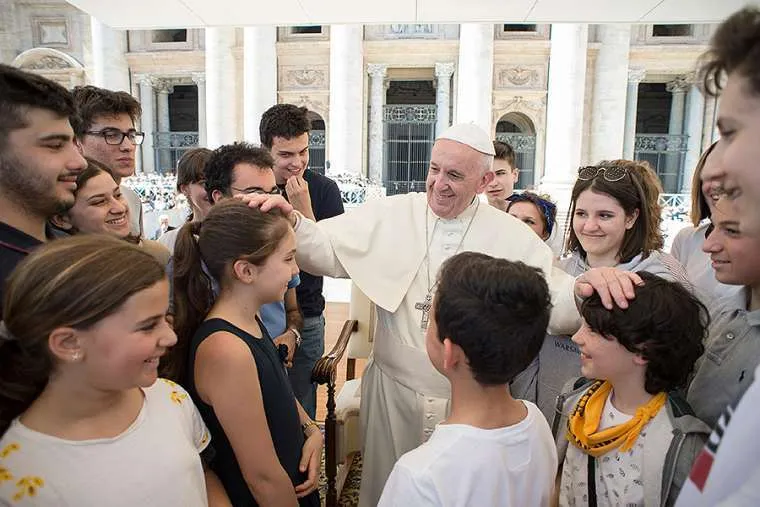
Vatican City, Apr 21, 2018 / 09:35 am (CNA/EWTN News).- On Saturday Pope Francis said that Christians are called to a mission of leading others to an encounter with Jesus Christ, in order that every person might grow in his or her individual call to holiness.
“The men and women of our time need to meet Jesus Christ: He is the path that leads to the Father; He is the Gospel of hope and love that enables us to go as far as giving ourselves,” the pope said April 21.
“It is a matter of carrying out an itinerary of holiness to respond courageously to the call of Jesus, each according to his own particular charism.”
Quoting from 1 Thessalonians 4:13, Pope Francis said: “For a Christian it is not possible to think of his mission on earth without understanding it as a path of holiness, because ‘this is in fact the will of God, your sanctification.’”
This is our mission, he continued. It requires responsibility and joy, generous availability, self-denial, and “trustful abandonment to the divine will.”
Pope Francis spoke about holiness during an encounter with pilgrims from the Italian dioceses of Bologna and Cesena-Sarsina in St. Peter’s Square. The pilgrimage to Rome followed Francis’ own visit to Bologna and Cesena in October 2017.
Quoting from his recent apostolic exhortation Gaudete et exsultate, the pope also spoke about the important role of the Eucharist in helping to transform Catholics “into a holy and missionary community.”
The Eucharist, he said, means “thanksgiving” and makes us feel the need for thanksgiving.
“It makes us understand that ‘we are more blessed in giving than in receiving’ (Acts 20:35), educates us to give primacy to love, and practice justice in its complete form, which is mercy; to know to give thanks always, even when we receive what is due to us.”
The pope encouraged Christians to proclaim the call to holiness in their communities, since it concerns “every baptized person and every condition of life.”
“In holiness consists the full realization of every aspiration of the human heart. It is a journey that starts from the baptismal font and leads up to Heaven and is carried out day by day by accepting the Gospel in concrete life,” he said.
If you value the news and views Catholic World Report provides, please consider donating to support our efforts. Your contribution will help us continue to make CWR available to all readers worldwide for free, without a subscription. Thank you for your generosity!
Click here for more information on donating to CWR. Click here to sign up for our newsletter.

Pope Francis during the weekly general audience at St. Peter’s Square in the Vatican, Sept. 7, 2022. / Daniel Ibáñez / CNA
Rome Newsroom, Sep 7, 2022 / 04:24 am (CNA).
God can speak to us in the unexpected moments of our lives if we learn to listen well to what he is telling us in our hearts, Pope Francis said on Wednesday.
“I will give you a piece of advice: beware of the unexpected,” the pope said Sept. 7 at his weekly public audience.
“Is it life speaking to you, is it the Lord speaking to you, or is it the devil? Someone,” he continued. “But there is something to discern, how I react when faced with the unexpected.”
Francis’ general audience was again in St. Peter’s Square Wednesday after it was held inside the Vatican’s Paul VI auditorium in August to avoid the worst of the summer heat.
Daniel Ibáñez / CNA
The pope opened and closed his encounter with the public by riding the popemobile around the square. The audience marked his second week of catechesis on the theme of “Discernment.”
As part of discernment, the pope encouraged people to reflect on their reactions to even small, unexpected circumstances, such as the surprise arrival of one’s mother-in-law.
“I was quiet at home and ‘Boom!’ — my mother-in-law arrives; and how do you react to your mother-in-law? Is it love or something else inside? You must discern,” he said. “I was working well in the office, and a companion comes along to tell me he needs money: how do you react? See what happens when we experience things we were not expecting, and there we can learn to know our heart as it moves.”
Pope Francis said knowing how to really listen to your heart is an important part of discernment in making a judgment or decision about something.
“We listen to the television, the radio, the mobile phone; we are experts at listening, but I ask you: do you know how to listen to your heart?” he asked. “Do you stop to ask: ‘But how is my heart? Is it satisfied, is it sad, is it searching for something?’ To make good decisions, you need to listen to your heart.”
Pope Francis during the weekly general audience at St. Peter’s Square, Sept. 7, 2022. Daniel Ibáñez / CNA
To illustrate his point, the pope recalled the story of the conversion of Saint Ignatius of Loyola, a soldier enamored with stories of knights and chivalry who was forced to confront his future happiness after he was badly injured in battle.
Bored while his leg was healing, Ignatius read stories of the saints and the life of Jesus when other books were not available to him.
Francis quoted from Ignatius’ autobiography, in which the future saint wrote about himself: “‘When he thought of worldly things’ — and of chivalrous things, one understands — ‘it gave him great pleasure, but afterward he found himself dry and sad. But when he thought of journeying to Jerusalem, and of living only on herbs and practicing austerities, he found pleasure not only while thinking of them, but also when he had ceased.’”
“In this experience we note two aspects, above all,” the pope said. “The first is time: that is, the thoughts of the world are attractive at the beginning, but then they lose their luster and leave emptiness and discontent; they leave you that way, empty. Thoughts of God, on the contrary, rouse first a certain resistance — ‘But I’m not going to read this boring thing about saints’ — but when they are welcomed, they bring an unknown peace that lasts for a long time.”
He emphasized that “discernment is not a sort of oracle or fatalism, or something from a laboratory, like casting one’s lot on two possibilities.”
Francis also said that some of life’s big questions often arise after “we have already traveled a stretch of the road in life.”
Sometimes, we can get stuck on one idea and end up disappointed, he pointed out, adding that doing something good, such as a work of charity, can get us out of that rut by bringing us joy and happiness, feelings which can lead to thoughts of God.
The pope also shared a piece of wisdom from Saint Ignatius: to read the lives of the saints.
“Because they show the style of God in the life of people not very different to us, because the saints were made of flesh and blood like us, in a narrative, comprehensible way. Their actions speak to ours, and they help us to understand their meaning,” he said.
Sometimes, he added, “there is an apparent randomness in the events of life: everything seems to arise from a banal mishap — there were no books about knights, only lives of saints. A mishap that nonetheless holds a possible turning point.”
“God works through unplannable events, and also through mishaps,” he said. “Mishap: What is God saying to you? What is life telling you there?”
At the end of his general audience, Pope Francis expressed his closeness to all mothers, and “in a special way, to those mothers who have children who suffer: those who are sick, those who are marginalized, those who are imprisoned.”
“A special prayer goes to the mothers of young detainees: let hope never be lacking. Unfortunately, in prisons there are many people who take their own life, at times also young people. A mother’s love can save them from this danger. May Our Lady console all mothers distressed by the suffering of their children,” he said.
Vatican City, Aug 15, 2018 / 04:21 am (CNA/EWTN News).- Pope Francis Wednesday named Archbishop Edgar Pena Parra, a member of the Vatican diplomatic corp for over 25 years, the ‘sostituto,’ or ‘substitute,’ of the Secretariat of State.
Apostolic nuncio to Mozambique since 2015, Pena will start in the position of substitute Oct. 15, according to a Vatican statement Aug. 15.
Pena, 58, began diplomatic service to the Holy See on April 1, 1993, and has served in Kenya, Yugoslavia, the United Nations Office in Geneva, and in apostolic nunciatures in South Africa, Honduras, and Mexico. He was nuncio to Pakistan from 2001 to 2014.
Born in Maracaibo, Venezuela, he was ordained a priest in 1985, and made a bishop in 2011. He studied canon law and speaks Spanish, Italian, English, French, Portuguese and Serbo-Croatian.
Pena takes over the position from Cardinal Giovanni Angelo Becciu, who resigned June 29 in anticipation of beginning his assignment as prefect of the Congregation for the Causes of Saints later this summer.
Becciu, 70, who was elevated to the cardinalate June 28, served in the Secretariat of State, under both Benedict XVI and Pope Francis, beginning in 2011. He will start at the congregation for saints Aug. 31.
It is yet unknown if Pena will join Pope Francis as part of the papal entourage on his trip to Dublin Aug. 25-26.
The Secretariat of State is the central governing office of the Catholic Church and the department of the Roman Curia which works most closely with the pope.
Since the publication of Pastor Bonus, Pope John Paul II’s 1988 apostolic constitution which introduced a reform of the Roman Curia, the Secretariat of State has been divided into two sections: the Section for General Affairs and the Section for Relations with States.
The substitute, who must be a bishop, acts as head of the Section for General Affairs, which is responsible for the everyday affairs and service of the pope, including overseeing the facilitation of appointments within the Roman Curia, the duties and activity of representatives of the Holy See, and the concerns of embassies accredited to the Holy See.
Archbishop Paul Richard Gallagher is the secretary for Relations with States, often described as the Vatican’s “foreign minister.”
As of November 2017, Pope Francis established a third section of the Secretariat, specifically to oversee the Vatican’s diplomatic corps, stationed around the world.
Archbishop Jan Romeo Pawlowski is at the helm of the third section, called the “Section for Diplomatic Staff.” Previously apostolic nuncio to Gabon, in 2015 Pawlowski was appointed head of the Office for Pontifical Representations, a sort of human resources office within the Secretariat of State.
Leave a Reply