CNA Staff, Nov 3, 2020 / 05:19 pm (CNA).- Seven months after Northern Ireland’s expansive legal abortion law took effect, pro-life advocates have lamented the lives lost and called for change.
“Tragically, the extreme abortion regime being forced upon the people of Northern Ireland has already resulted in the abortion of at least 719 unborn babies,” Catherine Robinson, a spokesperson for Right to Life UK, said Nov. 3. “Every one of these abortions represents a failure to protect the lives of babies in the womb and a failure to offer full support to women with unplanned pregnancies.”
The latest figures show 719 abortions between March 31 and Oct. 14. Health Minister Robin Swann reported the numbers in response to a question from Member of the Legislative Assembly Jim Allister of the Traditional Unionist Voice party, according to Right to Life UK.
Allister noted that more than 560 people have died of COVID-19 in Northern Ireland in the same period.
“We’re all rightly concerned about the suffering and death caused by the pandemic in NI and across our nation, with every death a tragic loss for families,” McAllister said, according to the Belfast newspaper News Letter. “There is, however, another deadly threat to the lives of the youngest, most innocent and venerable which shamefully is not receiving anything like the same attention.”
“What a contrast – medical professionals strive desperately to save lives, while others abort lives!” said Allister.
Northern Ireland rejected the Abortion Act 1967, which legalized abortion in England, Wales, and Scotland. Bills to legalize abortion in cases of fatal fetal abnormality, rape, or incest failed in the Northern Ireland Assembly in 2016.
Robinson said the previous law in Northern Ireland saved lives.
“Northern Ireland is a country where 100,000 people are alive today because they chose protecting unborn babies over accepting the same abortion law that was introduced into Britain in 1967,” she said.
Northern Ireland is part of the United Kingdom, but abortion law was considered a devolved issue to be under the control of the Northern Ireland Assembly, known as Stormont. However, due to the collapse of a power sharing agreement in the government, the U.K. Parliament last October was able to pass a broad legal abortion regime. Parliament also voted to require same-sex marriage to be recognized in law.
Before March 31, abortion was legally permitted only if the mother’s life was at risk or if there was risk of long term or permanent, serious damage to her mental or physical health. Now, Northern Ireland abortion law now allows elective abortions up to 12 weeks of pregnancy; abortions up to 24 weeks in cases of risk to the mother’s physical or mental health; and abortion without time limit in cases of severe fetal impairment or fetal fetal abnormality.
Right to Life UK says the law in Northern Ireland is even more permissive than in other parts the U.K. and allows abortion up to birth for all disabilities, including cleft lip, club foot, and Down syndrome.
“The people of Northern Ireland did not want these extreme abortion regulations imposed on them and still do not want them,” said Robinson. “Northern Ireland politicians must urgently repeal this extreme abortion legislation imposed upon them and begin conversations on how they can better support women and unborn babies.”
Northern Irish women had been able to procure free National Health Service abortions in England, Scotland, and Wales since November 2017. They were allowed to travel to the rest of the U.K. to procure abortions during the coronavirus outbreak.
Right to Life UK said the figures from six and a half months of legal abortion suggest the Northern Ireland legislation is resulting in more abortions than previously sought. Throughout all of 2019, 1,014 Northern Ireland women are known to have traveled to England or Wales for an abortion, and fewer than 10 traveled to Scotland for an abortion, according to the U.K. Department of Social Care and Scotland’s Information Services.
The pro-life group Precious Life NI held a “life chain” event outside Stormont Oct. 24 to mark the anniversary and to protest the pro-abortion rights aspects of Parliament’s act, known as Section 9. Seventeen “life chain” events took place across Northern Ireland, following social distancing regulations to limit spread of the coronavirus.
“As long as a single precious unborn baby is in danger, then our work is not yet finished,” said Bernadette Smyth, director of Precious Life NI. “Our life chain events today sent out a clear message to our Assembly: repeal Section 9 and restore personhood for Northern Ireland’s unborn children.”
The group’s Stormont display used hundreds of pairs of baby shoes with a boy’s or girl’s name pinned to them, and arranged to spell the letters “664” the previous count of legal abortions in Northern Ireland.
A heartbeat monitor was held to the stomach of a pregnant mother and the baby’s heartbeat was amplified through the public address system. A mother whose son was born with the help of the Stanton Healthcare pregnancy resource center in Belfast spoke at the event and thanked people for their support.
Under Northern Ireland law, abortions may be performed at general practitioners premises, and Health and Social Care clinics and hospitals. Medical abortions are permitted up to 10 weeks, and the first drug used in the two-drug process, mifepristone, must be taken at a clinic.
Right to Life UK warned that abortion backers seek to expand legal access to “do-it-yourself” home abortions using this two-drug regimen, despite what it says are”serious safety concerns.” The U.K. government has allowed these abortions in England, following consultation with a doctor, as have the devolved governments in Scotland and Wales.
“All three governments made the very substantial change without any public consultation, parliamentary scrutiny or debate,” the pro-life group objected.
NGOs like the British Pregnancy Advisory Services and abortion providers like Marie Stopes International have been pressuring Stormont to allow the abortion drugs to be administered at home.
The Republic of Ireland, where 66% of voters chose to legalize abortion in a 2018 referendum to remove strong protections for unborn babies from the national constitution, saw a total of 6,666 abortions in 2019.

[…]



Thus wrote Mahatma Gandhi: “The human voice can never reach the distance that is covered by the still small voice of conscience”.
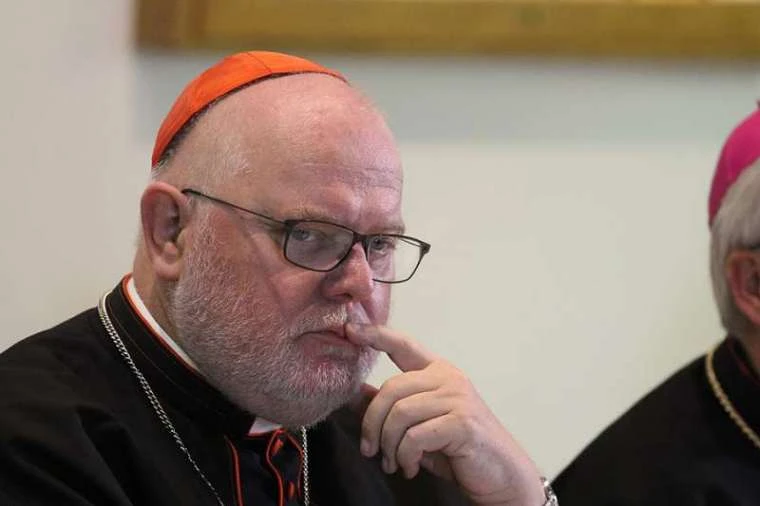
Conscience means to act with knowledge. Cardinal Marx addresses the tension between reason and doctrine favoring doctrine with exceptions such as homosexuality. If reason is the rule of truth then revealed truth is not. “What moves us to believe is not the fact that revealed truths appear as true and intelligible in the light of our natural reason: we believe ‘because of the authority of God himself who reveals them, who can neither deceive nor be deceived’” (CCC 156). Man has the inherent capacity to identify truth that is the basis for forming conscience and responsibility for his actions. That is why Aquinas acknowledged that reason is the measure of truth not the rule.
I have ALWAYS believed that people making rules and judgemments must be a participant in the society in which they govern. Cardinals and Bishops and priests when they are MARRIED seem to have a better understanding and ability to govern on this subject! It is ludicrous to allow this. Much like a married couple should explain Marriage to Teens not a priest. Gosh this is quite a step in the wrong direction!
I suppose in your vision of Church governance Jesus need not apply.
According to CNA German and the German language portal kath.net, what Cardinal Marx has said smacks more of situation ethics than what appears in this current article. Following kath.net (‘Conscience decision of homosexuals must be respected’) the Cardinal warned against ‘blind rigorism’ in sexual morals. ‘Of course there must be a responsibility with regard to the gospel and the teaching of the Church, but (finally) the conscience decision made in freedom must be respected.’ Depending on CNA German the Cardinal stated that ‘questions of sexual morals are decided by your personal – though formed by Christian principles – conscience.’ And again ‘there must be respect for one’s decision made in freedom.’ The Kardinals assertions go well together with the ‘Königsteiner Erklärung’ in which the German bishops after ‘Humanae vitae’ put the decision of the ‘personal conscience’ above the norm of the encyclical regarding contraception. One is reminded of the guidelines of the Maltese bishops on ‘Amoris laetitia’ saying that a divorced and remarried person should be admitted to Communion if, “with an informed and enlightened conscience”, they believe they are “at peace with God”. These guidelines were reportedly acknowledged with gratitude by Pope Francis (http://www.ncregister.com/blog/edward-pentin/pope-francis-thanks-maltese-bishops-for-amoris-laetitia-guidelines).
The post pedophilia era, if there is a post, places the church in a somewhat deleterious fall out. Promises made by Pope Francis to “clean house” of criminal hierarchy began with a tribunal that was short lived. Compounding that false start was a rare display of acknowledgement to two Cardinals that were criminally responsible for moving criminal priests in Boston and Los Angeles. How does a faithful lay person remain so in light of these atrocities against innocent young people? Then we hear all about how our conscience should be involved in sexual matters from clergy who are supposedly a-sexual.
When it comes to restricting the ordination of women, we are living in a netherworld of old manmade tales. Women would make better, less complicated priests. The church may not have spent $1.5 billion to lawyers and the injured children in retribution had there been female clergy.
One day as he was driven up Riverside Drive William Sloan Coffin was asked what he, a Protestant minister, though of the current Catholic Church? He quipped… “they are still trying to steer the car based on what they see in the rearview mirror”. That is a saying any Catholic should remember.
“The church may not have spent $1.5 billion to lawyers and the injured children in retribution had there been female clergy.” The recent (and ongoing) spate of stories about female teachers engaged in sexual relations with teenage boys would indicate otherwise. But perhaps I underestimate the moral propriety of the fairer sex.
You need to stop perpetuating the “pedophilia” myth. The overwhelming majority of abuse cases in the Church involved homosexual ephebophiles – aka chickenhawks; intrinsically disordered sexual deviants masquerading as Catholic Priests.
As for the proposal to ordain women is concerned, we’ve all seen what a disaster that has been for the Anglican denomination. You think you’ve got problems now just proceed on that tangent.
No, the solution is to enforce the longstanding ban on the ordination of homosexuals; reaffirmed in February of 1961 during the Pontificate of Pope St. John XXIII. Furthermore, rid the seminaries, Diaconate, Priesthood, Episcopacy, Curia, College of Cardinals and consecrated religious life of homosexuals and return to a culture where virtues of discipline, obedience, humility and chastity are no longer paid lip service. That is the solution.
Exactly right could not agree w you more. Perfectly said. And to this I would add…religious should wear thier religious clothing Priest and Nuns…
You need a mystical understanding of the Mystical Body of Christ in order to understand the male priesthood. The relationship between Christ and His Church is said to be spousal. Christ is the Bridegroom and the Church is His Bride. When a husband and a wife enter into the one flesh union it is the man who enters into the woman. Likewise, in conception it is the male sperm that swims up to and enters into the female egg. It seems clear that the act of entering within is a male act. The male is the doer of intimacy. The female is the one who receives this intimacy. This explains why Christ came as a male, and why male terms like Father and Son are used to describe God, and why the Church is called Holy Mother Church.
*
Because of the Hypostatic Union, Christ is One Person in two natures, divine and human. The priest acts In Persona Christi, in the person of Christ. In Holy Orders during the ordination the priest is configured to Christ in a very special way. As such, Holy Orders is in the image and likeness of the Hypostatic Union. The priest is the living icon of Christ. Consecrated women religious are considered to be brides of Christ.
*
The priest acts In Persona Christi during the Consecration. In the sacrament of the Holy Eucharist during the Consecration the Real Presence of Christ enters into and becomes one with the bread and the wine. Transubstantiation at its core is a male act. The Body and Blood in a similar fashion enter into the communicant. The Holy Eucharist is a sacrament that is permeated with Christ’s maleness, and gives us a foreshadowing of the final nuptial union that is described in Revelation.
*
Women don’t have to be priests to have an impact on the Church. We can begin with the Blessed Virgin Mary and the women disciples. There are many important women saints: St. Teresa of Avila, St. Catherine of Siena, St Thérèse of Lisieux, and St. Faustina for starters.
*
Any woman who thinks that she has a calling from the Holy Spirit needs to study the works of St. Teresa of Avila, who is a Doctor of the Church. She wrote extensively about prayer and mysticism. St. Teresa was also a reformer who sought to restore a spiritual focus to the Carmelite Order that had fallen into lax spiritual practices. St. John of the Cross joined her in this reform effort. They both met with considerable opposition to their reform efforts. St. John was taken prisoner, jailed, and flogged.
*
The arguments that are being made in an attempt to redefine the priesthood are very similar to the arguments being used in an attempt to redefine marriage.
“On the question of ordaining women to the priesthood, which the German interviewers also raised, the Cardinal gave a short, definitive answer: ‘That really is not for discussion. The pope has spoken decisively on the matter.'”…With all the talk we hear about the importance of dialogue and informed conscience, does it bother anyone else that this is the Cardinal’s quick response to a question burning on the minds of many Catholics, not at all aware or convinced this cannot be changed in the name of, “guidance of the Holy Spirit”? Does it reveal that he does not agree? Is he suggesting he yields in fidelity to the Church’s teaching? #JustAsking