



Timothy S. Goeglein, a former White House official and long-time vice president of government affairs at Focus on the Family, has written an important and timely book. At the beginning, he states his intent:
I will look at the breakdown of marriage and the family, the current lamentable state of many young American males, the impact of cultural secularization, and the loss of teaching true American history, and how each impacted our society.
Statistics and charts galore are available throughout, marking the downfall of family and masculinity. For instance, today we suffer from the lowest marriage rate and the lowest fertility in American history. Most importantly, Goeglein sees the spiritual significance of the numbers. He not only delineates these profound problems but suggests what can and must be done to attenuate them.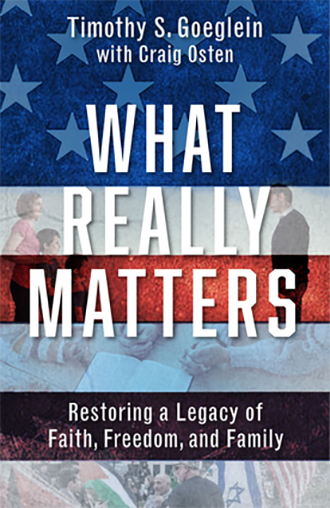
This work is the result of years of deep thinking on these subjects, and it is certainly one of the most comprehensive books written in defense of the family. The tone the book takes is as if Goeglein is talking to you; it is a great conversation.
Goeglein does not shy away from laying out the extraordinary severity of our problems. Neither is he a pessimist. He begins each of his six chapters with the word “restoring”–as in Restoring Marriage; Restoring the Family; Restoring the American Male; Restoring a Well-Ordered Society; Restoring Faith, and Restoring the Importance of History.
In other words, he is not wallowing in distress but carefully thinking through what restoration would take. He illustrates his proposed solutions by referring to American history–the way this country was before these problems beset us. This is why he repeatedly stresses the importance of history. Goeglein quotes President Ronald Reagan to the effect that “if we forget what we did, we won’t know who we are. I’m warning of an eradication of the American memory that could as a result ultimately in the erosion of the American spirit.”
Goeglein thoroughly covers the subject of the family and its components. For instance, men. Where are the men, and what has happened to them? He notes that
one in three men in America—ten million total—with only a high school diploma are now out of the workforce. Men who entered the workforce forty years ago now earn 10 percent less in real income compared to the previous generation. Men account for three out of every four suicides or drug overdoses and are increasingly isolated, with approximately 15 percent saying they have no friends. And, tragically, for future generations, one in five fathers does not live with his children.
Many significant thinkers in the West understood the family as the barometer for the general health of society. William Makepeace Thackeray wrote, “As our families, so is society. If well ordered, well instructed, and well governed, they are the springs from which go forth the streams of national greatness and prosperity, of civil order and public happiness.”
What put the family in the crosshairs of history? The answer is an ideological orientation to reality that requires the transformation of man. Society, responsible for all evils, must be destroyed. To promote universal “brotherhood,” the family must be eliminated. Once society is atomized, once the family ceases to interpose between the individual and the state, the state is free to transform the isolated individual (by force) into whatever version of “new man” the revolutionary visionaries espouse.
G. K. Chesterton wrote that “the men and women who, for good reasons and bad, revolt against the family are, for good reasons and bad, simply revolting against mankind.” By this, he meant that the family is natural to man. Rejecting it is tantamount to rejecting man’s nature. He agreed with Aristotle, who called the family “the first form of association naturally instituted.” It was “naturally” instituted because, as Aristotle pointed out, man is by nature a social being. He needs the society of his fellows not just for the propagation of the species and the prevention of harm, but to achieve good. It is in and through human society that man naturally reaches his fullest completion, and the fundamental cell of that society is the family.
It is the “first” form of association because man does not spring fully formed from the forehead of Jupiter, ready to perform his role in civil society. Rather, he enters it indirectly through the family into which he is born or by which he is nourished physically, emotionally, and morally. The family is antecedent to and makes possible the formation of society. Without the family, that formation is impossible. This is true in the highest sense because a society cannot exist without recognition of adherence to the common good. The common good requires people to act out of motives larger than their own narrow self-interests. Unless people are capable of self-discipline, of placing restraints upon their appetites and desires, the common good cannot be maintained.
The disposition to self-restraint and selfless action is first learned in the family, which has as its foundation the selfless love of the parents for each other and for their children. It is no surprise that juvenile delinquency thrives in families in which this love and discipline are absent, for the children are allowed to develop an unhealthy concentration on themselves, which excludes anything larger than their own well-being. It should be no surprise that some 90 percent of those in prison come from broken families.
Of course, as Thackery suggests, the larger the proportion of such “families” in any society, the more disorderly and disoriented that society will be. Taken to its extreme, the wholesale disintegration of the family would so alter the character of the people as to make rule by the common good impossible. In its place would soon come the role of unrestrained tyrannical will.
But juvenile delinquency—along with sexual license, divorce, and abortion, though very widespread today—is not unique to our age. All of these have afflicted the family to greater or lesser degrees in all centuries. What is distinctive about the modern attack on the family is that it questions the very principle of the family’s legitimacy.
Manifestations of this attack can be seen in the daily promotion of “alternate lifestyles” (always some variation of sexual excess or perversion) as equally valid substitutes for family. The traditional family and its conservative sexual mores are considered nothing more than a product of social conditioning from which we are being liberated by a change in the “times.” Seldom does the understanding of the celebrants of the new lifestyles go beyond this to the root suppositions underlying the “liberation.” Here we will find ideas that amply justify Chesterton’s charge that the revolt against the family is a revolt against mankind. For as far removed as it may at first seem from the controversies swirling about the family today, the attack at its most profound level is the denial of that simple proposition with which we began: that man’s nature is intrinsically social and therefore dependent for its fullest development upon other human beings.
But why would anyone make the claim that man is not naturally social? Thinkers have always been confronted with the fact of evil. Even if it is not seen as evil per se, everyone admits that there is something radically wrong with the world. The Judeo-Christian tradition assigns the source of that evil to original sin–to the cataclysmic dislocation in the relationship between God and man which resulted in “fallen nature.” The essence of that original sin and all other sins is the preference of oneself over God: pride. Salvation–the restoration of the proper God-man relationship–can only be achieved by man renouncing evil with good works in cooperation with God’s mercy and grace. Salvation is then achieved when the good man is united to God in the afterlife.
Of course, by the 18th century, this religious view of the world had seriously eroded. The thought that sin was responsible for unhappiness and pain was met with skepticism. Jean Jacques Rousseau, in his “Discourse on the Origin and Foundation of Inequality Among Men,” made the case, startling even for that time, that society itself is the cause of the evils afflicting man–that before society man lived in an isolated state of nature in which he was perfectly content and happy because the pure “sentiment of his own existence” was so pleasant that “one suffices to oneself, like God.”
There could hardly be a more radical assertion of man’s independence. It was only when, through some unexplainable accident, one man was forced into association with another that this God-like autonomy of man ended. Due to his increasing contact with other men, man began not to live in his own self-sufficient esteem but was drawn out of himself to live only in the esteem of others. In this way, man was “alienated” from himself and enslaved to others.
We see in Rousseau the origin of Marx’s idea of exploitation carried through to Sartre’s existential assertion that “Hell is other people.” It is most important to note that the exclusive preoccupation with oneself, what the Judeo-Christian tradition condemns as pride, is for Rousseau the ultimate good. For Rousseau, whatever interferes with the total self-absorption of an individual is evil.
Nonetheless, Rousseau saw that the blissful isolation and independence of the pre-social state of nature were forever lost, much as was the Garden of Eden. The closest man can come to secular salvation is to abolish those dependent forms of association which have enslaved him to other men and kept him always outside of himself. It must sever, as much as possible, his relations with his fellow members of society so he can return the sentiment of his own existence to himself.
How can this be done? Rousseau describes the accomplishment of this condition: “each person would then be completely independent of all his fellow men, and absolutely dependent upon the state.” Rousseau’s program was to politicize society totally. And his first target is society’s foundation, the primary means by which men are cured of that total self-absorption to which Rousseau wishes them to return—the family. To destroy the family, Rousseau proposes that its primary function of educating its children be taken from it and given to the state:
The public authority, in assuming the place of father and charging itself with this important function – (should) acquire his (the father’s) rights in the discharge of his duties.
The father is supposed to console himself with the thought that he still has some authority over his children as a “citizen” of the state. His relationship with his children has metamorphosed into a purely political one.
Rousseau’s attack upon the family and his exclusive reliance upon the state as the vehicle of man’s redemption is the prototype of all future revolutionaries. The program is always the same: society, responsible for all evils, must be destroyed. Once the family ceases to interpose between the individual and the state, the state is free to transform (by force, of course) the isolated individual into whatever version of “new man” the revolutionary visionaries espouse.
The family is the only refuge from politics in this modern sense. Its good health is therefore essential for the survival of any non-totalitarian form of government. Its politicization inevitably undermines its spiritual dimension as moral teacher and guide, and leaves a spiritual vacuum into which totalitarianism happily steps. Thus, a free people cannot afford to remain indifferent to the family as to its principles of legitimacy or to its well-being. It is therefore valid and necessary for the state to actively promote the family’s prosperity.
This means that the state cannot concede the legitimacy of “alternate lifestyles” which are inimical to the family. For example, to refuse to draw a distinction between the use and misuse of sex by legally allowing commerce in pornography is to teach publicly that no such distinction exists. Such a teaching cannot help but have a deleterious effect upon the family, which relies for its very existence upon the proper use of sex.
The American family today is in a halfway house. It is used increasingly as an instrument of the state, just as the state is increasingly used as a surrogate family: provider, healer, teacher. We end up with a hybrid, which is neither a legitimate state nor a real family, but what the late Russell Kirk called a “universal orphanage.” This has not happened here as it did in China through force of arms exercised by ideologues with a blueprint for the new man, but through the spread of a philosophical and moral relativism, which nevertheless has its intellectual pedigree and the same distorted view of man’s nature. The recovery of the family will require no less than the recovery of the true understanding of that nature–man as ordered to definite ends, to the achievement of “the good” and not man as infinitely flexible, dabbling in “lifestyles as if he were out shopping for his nature.
Let Tim Goeglein be your guide in this. At the very end of the book, he expresses the hope that his book “will be a blueprint” to encourage my fellow citizens to step back, reevaluate the road we currently travel, and return to the original roadmap of faith, freedom, and family upon which our nation was built.”
What Really Matters: Restoring a Legacy of Faith, Freedom, and Family
By Timothy S. Goeglein, with Craig Osten
Fidelis Publishing, 2026
Hardcover, 264 pages
If you value the news and views Catholic World Report provides, please consider donating to support our efforts. Your contribution will help us continue to make CWR available to all readers worldwide for free, without a subscription. Thank you for your generosity!
Click here for more information on donating to CWR. Click here to sign up for our newsletter.

Leave a Reply