


Stephen Bujno holds a PhD in philosophy and an MA in philosophical anthropology, the field that grounds his new book’s central argument. He is a Visiting Assistant Professor of philosophy at Villanova University, where he teaches philosophy and “Ethics for Health Care Professionals” to nursing, pre-med, and biomedical engineering students. His work focuses on bioethics and the public dialogue on contested moral questions.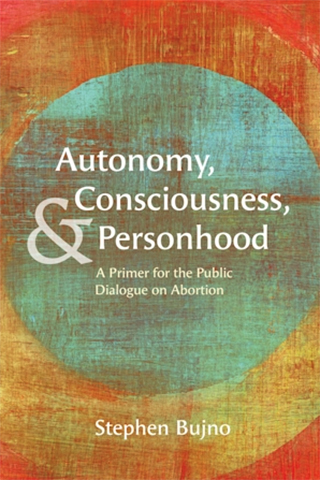
He has lectured to seminarians, clergy, religious, and medical professionals at Saint Charles Borromeo Seminary, Alvernia University, and Saint Joseph’s College of Maine. He is the author of Ethics of Care and Wellness: An Inquiry for Professional, Caregivers, and Patients (Cognella, 2022), Apology: The Idea of Love and the State of Things (Angelico, 2026), and Moral Being: Freedom, Society, and Beauty (Cognella, 2026). His new book, Autonomy, Consciousness, and Personhood: A Primer for the Public Dialogue on Abortion is published by Wipf and Stock (2026),
Dr. Bujno spoke recently with CWR about
CWR: There are many books on abortion that include apologetics, legal analyses, medical ethics texts, etc. What makes this one different?
Dr. Stephen Bujno: Most books on abortion are advocacy works written to convince the reader. At best, some books provide “both sides” and allow the reader to decide. This book is different—or tries to be. It was written to clarify the argument. I am not interested in “teaching” people to win an argument, but I am interested in uncovering why the argument has remained a stalemate for over fifty years.
The failure of public dialogue on abortion is not due to conviction, but to a lack of critical thinking. The “sides” are entrenched, but people are arguing about the wrong things, or the right things in the wrong order. The book tries to diagnose that problem and offer a more productive path forward. I am trying to fill a niche.
CWR: You are explicit that the book takes no position on abortion. For readers of the Catholic World Report, that may raise immediate questions. Does it intellectualize the argument, or what some might fear, make the other side’s argument more convincing?
Bujno: Fair point, but there is a difference between simply making an argument artificially complex and insisting it be made properly. Though the latter often tires people out. About both positions: if you have never encountered the best case for the other side, you have not actually won the argument; you simply avoided it.
A position that can only survive by keeping its opposition weak is itself likely a weak position. I want to move from being convinced to being convincing. This book offers no shortcuts, but that discomfort is productive. The reader who arrives at the conclusion after applying diligence will hold the position that all living humans are persons with moral value with a clarity and a confidence that the “pro-life” slogan cannot provide.
CWR: Then, about that slogan—if this book calls for abandoning the terms “pro-life” and “pro-choice” entirely, how might this read to pro-life advocates?
Bujno: The terms “pro-life” and “pro-choice” are not simply slogans; they function as tribal markers and, for too many, are assumed to be arguments. When I say I am pro-life, I have communicated my loyalty, but I have not yet made my case. And more importantly, I have sidestepped the very conversation that might actually move someone or provide an opportunity for respectful engagement.
Autonomy, Consciousness, and Personhood argues that both sides currently lead with what I identify as their minor premises—bodily autonomy on one hand, biological life on the other. The decisive question is the major premise: what “is” a person and how the “moral value” of unborn humans, or any living human, is understood. Those who hold that all living humans are persons have an extraordinarily powerful argument available to them. But that argument requires engaging the question of personhood and moral value directly, not simply asserting it through a slogan. The label “pro-life” bypasses the argument.
CWR: It seems you use a syllogistic structure. That is a logical argument, but quite different from the definition of an argument the average person is used to. Can you walk us through how you present the syllogistic argument?
Bujno: Yes, and let me first say that an argument in the classical sense is not a quarrel. It is rather a structured path toward a conclusion. Most people come to the abortion debate with conclusions already in hand with the goal of defeating the other. But the syllogistic structure makes one’s reasoning visible, which is where the truth or falsity of the premises becomes apparent and therefore engageable.
It looks like this: the pro-choicer argues that human dignity requires bodily autonomy, and being pro-choice upholds human dignity; therefore, being pro-choice requires bodily autonomy. The pro-lifer argues that human dignity requires biological life, and being pro-life upholds human dignity; therefore, being pro-life requires biological life.
Notice that both arguments treat bodily autonomy or biological life as the major premise (general rule) that infers human dignity as the foundational claim upon which everything else rests.
What I propose is that both arguments have the wrong major premise. If both sides instead begin with the claim that human dignity is tethered to personhood, then they are forced to argue whether bodily autonomy or biological life preserves that dignity. Determining human dignity makes them first argue what is a person and how moral value is applied, and does the unborn qualify?
That is the question that actually decides everything. For those who believe all living humans are persons with moral value from conception, this reorientation does not weaken the argument but forces them to make the case rather than assume it. And a case that has been made logically is far more persuasive than a position that has merely been asserted. That requires dialogue and respect.
CWR: The book devotes substantial attention to the philosophy of personhood—consciousness, capacity, relationality, and what you call the “gradient” view of personhood. Why is this philosophical groundwork so important for the public dialogue?
Bujno: Because, and I say this having watched it happen in the classrooms for twenty years, most people have never examined their assumptions about personhood, and those unexamined assumptions are doing enormous work in their moral reasoning. In twenty years of teaching, I have found that students—even advanced ones—frequently confuse personhood with personality, or assume personhood can be placed on a gradient and even lost.
Typically, the pro-choice position would hold that personhood is assigned by the recognition of another in terms of viability or consciousness. But some argue that consciousness arrives after viability and may not be developed sufficiently for moral value until five months of age. Even in the pro-life camp, there are arguments constantly made based on when the heartbeat begins or if the fetus feels pain.
Either camp conceding those markers solves nothing; it simply moves the point of moral value of the unborn closer to the onset of fertilization or to birth. The book does not resolve these questions, but it forces them into the open where they can be examined honestly.
CWR: Who is the intended audience? Is this a book for the classroom, the parish, the public square?
Bujno: All three, I hope. The book is suited for any context where people of good faith are willing to do the hard work of reasoning together. Parish adult education groups, clergy formation programs, hospital ethics committees, civic forums—wherever people are frustrated by the current impasse and looking for a better way to engage.
But as a primer, this book needed to be at a level of precision. Although written at the college level, it is accessible to an educated general reader who is willing to work. For the Catholic World Report readership, it should be a comfortable fit. The book grew out of the college classroom experience, and it works in that setting because it is designed to be argued with rather than against.
CWR: The Catholic tradition has a rich philosophical inheritance that includes Aristotle, Aquinas, and the natural law tradition. Given that each of these speaks directly to questions of personhood and human dignity, how does the book draw on that tradition?
Bujno: The tradition is present throughout, though not always explicitly named. The book’s insistence that “being precedes ethics” means that one cannot evaluate the morality of any act involving a person without first understanding what a person is. That is thoroughly Thomistic. Aquinas understood that the moral order is grounded in the order of being, and that getting the ontology wrong means getting the ethics wrong.
That is precisely what is happening in the public abortion debate. Both sides have been making moral claims about the unborn while leaving the question of what the unborn actually is largely unexamined.
The treatment of human dignity, as discovered rather than constructed, resonates with the natural law tradition’s understanding of intrinsic worth, which holds that dignity is not assigned by capacity, relationship, or social recognition, but inheres in what a thing is. And the emphasis on the classical distinction between disinterestedness and indifference reflects a scholastic sensibility about the conditions required for honest inquiry. To engage a question disinterestedly is not to be indifferent to the answer but to pursue the answer honestly, following truth where it leads.
What this book attempts is to translate that inheritance into language that works in the broader public square for those who may not share the tradition’s premises. Our arguments have to function outside the household of faith in order to serve the public dialogue the Church is called to engage. The natural law tradition has always understood that the truths it articulates are not exclusively Catholic truths, but human truths accessible by reason.
Aquinas did not solely appeal to revelation to make the case for human dignity; he appealed to reason. That is precisely what this book tries to do, and why I believe it can contribute something to a conversation that has been dominated for too long by assertion and allegiance rather than humility and argument.
CWR: A final question. If this book accomplishes one thing in the public dialogue on abortion, what would you want that to be?
Bujno: I want it to slow people down, to create a pause between the passion and the argument. We have confused intensity of feeling with strength of reasoning for far too long on this issue, and that confusion has cost us the ability to dialogue.
If a reader, regardless of one’s position, finishes this book and finds himself saying, “I still believe what I believed, but now I understand why I believe it, and I can say it more clearly and more honestly,” that’s a win. I would rather see people actually engaging in dialogue over the foundational premise of personhood and moral value rather than performing their allegiance.
If you value the news and views Catholic World Report provides, please consider donating to support our efforts. Your contribution will help us continue to make CWR available to all readers worldwide for free, without a subscription. Thank you for your generosity!
Click here for more information on donating to CWR. Click here to sign up for our newsletter.

Leave a Reply