

 By
By Catholic sisters bring free medical care to Kenya slum, uncover hidden illnesses

NAIROBI, Kenya — Residents in an impoverished informal settlement called “Bangladesh” in Kenya’s coastal city of Mombasa turned up in large numbers for a two-day medical camp July 18–19 organized by Mother Amadea Mission Hospital.
Many were seeking treatment for ailments that had gone untreated for years.
During the two-day medical screening, run by the Congregation of the Sisters of St. Joseph of the Archdiocese of Mombasa (SSJ), many previously undiagnosed and unmanaged cases of noncommunicable diseases — particularly hypertension — along with numerous skin diseases and suspected cases of cancer requiring further evaluation were identified.
Although thousands turned up for assistance, the resources available could only support 1,140 individuals. Those that could not be assisted at the camp were given appointments for free medical services at the sister-run hospital in Mikindani.
In an interview on July 22 with ACI Africa, the sister service of EWTN News in Africa, Sister Veronica Wanjiru, the administrator of Mother Amadea Mission Hospital, said the medical camp is one in an array of community support activities the sisters are engaged in and that it is tied to the SSJ’s charism.
“Our charism is to witness in simplicity the saving mission of Christ among ourselves, those that we serve, and also that we interact with. As sisters of St. Joseph, we are always committed to serving the poor and the vulnerable,” Sister Veronica said.
She added that in the vast Bangladesh slum, many families lack access to healthcare services because of financial constraints, and families also lack awareness about preventive measures to possible ailments. “We therefore organized a medical camp to bring the services closer to them,” she said.
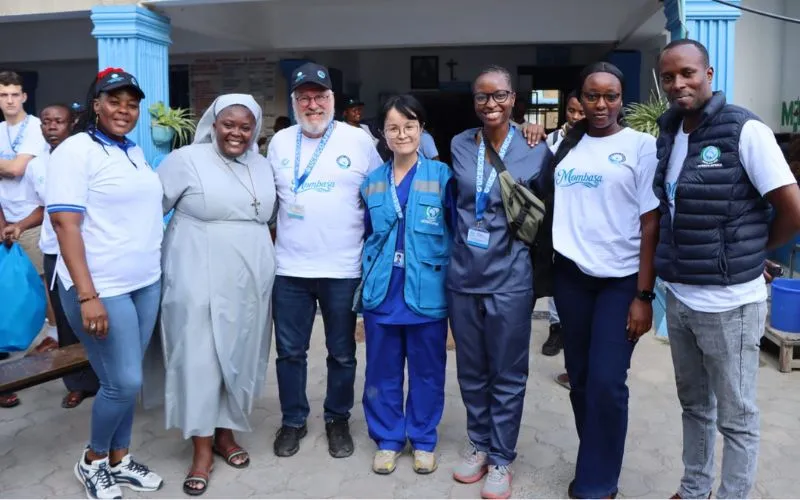
For the medical camp, the SSJ members brought on board several partners, including UCESCO Africa, as well as a team of volunteers from Italy, America, South Africa, and Japan.
Dr. Don Maimba Ocholi, the medical superintendent at Mother Amadea Mission Hospital, told ACI Africa that 63% of those who participated in the camp were female.
Services by the medical team included general consultation and screening for cervical, breast, and prostate cancer as well as counseling and other specialized services such as gynecology, dental, and ENT (ear, nose, and throat).
Ocholi observed a lot of eagerness from the community. “Even though we had announced that our camp would be starting from 8 a.m., there would be people queuing for services from as early as 6:30 a.m.”
Through screening, the experts discovered cases with elevated blood pressure and glucose readings. “Some didn’t even know about their conditions. We found it deeply concerning that there is no regard for screening and early management of these diseases in the community,” Ocholi said.
“We also found that a high number of individuals who had been initially placed on hypertension and diabetes medications had defaulted in management of their conditions due to inadequate social support and financial constraints. So, we had to reinitiate treatment,” he said.
The team also attended to many dermatological and dental cases. Ocholi said that owing to hygiene challenges and the lack of water in the slum community, many residents end up with skin conditions that require medical intervention.
Of the 47 people screened for cancer, one was found “highly suspicious,” according to the doctor, adding: “During the screening, we also discovered some fungal and bacterial infections that were also managed at the site. Those we screened had walked around not knowing they had all these infections.”
The team further discovered general surgical cases that need intervention.
Most medical needs, however, were found not to be covered by the national health insurer, in large part because there is a certain amount of money that must be paid. For most slum residents, the small amount required to enlist for government insurance is a luxury they can’t afford. The sisters have offered to pay this amount for those needing urgent surgery so that the government can cover their operations.
The team at the medical camp discovered that the Bangladesh community needed a lot of counseling and education regarding certain illnesses.
Ocholi spoke about the misconceptions in the community that young people cannot have hypertension and that the poor cannot be diabetic.
He said that in the checkups, however, people as young as 20 were found to have elevated blood pressure.
Some, Ocholi said, blame witchcraft for their diseases.
To curb misconceptions, Mother Amadea Mission Hospital has a 15-member support group for individuals with hypertension. The aim is to help members cope with their conditions and to equip them with skills to create awareness about noncommunicable diseases in the community.
Anne Kamau, director of nursing at Mother Amadea Mission Hospital, painted the picture of an impoverished community unable to access basic healthcare.
Describing the situation of Bangladesh where people wait until it is too late before they seek medical help, Kamau told ACI Africa: “A diabetic lady who had been out of treatment for a while came in with high, unrecordable sugar levels. And because our facility neither has an ICU [intensive-care unit] nor a HDU [high-dependency unit], we had to refer the patient. Unfortunately, she passed on just about an hour after being referred.”
“We live in a community that is sick, a community that needs services. And being a mission hospital, it isn’t just about offering healthcare. We look at this as service to God. We conduct medical camps so that even those who are sick in the villages do not feel forgotten,” Kamau said.
She lauded, in particular, the mental talk that the residents at the camp received, saying: “It is rare to get people in the community coming to seek mental health services even amid the rise in mental issues today. Many people prefer to suffer in silence.”
There was also a talk on cancer. Kamau said the talk on prostate cancer especially encouraged men to be screened. “This was encouraging since men hardly go for such tests,” she said.
Sister Veronica emphasized the mission of the Sisters of St. Joseph, Mombasa, “to reveal Godʼs love to the people,” adding: “By organizing this medical camp I believe that we are living this mission.”
According to the Kenyan sister, locals treat mission facilities, especially run by sisters, as a place where they can experience Godʼs love and care.
“We always see many coming to us even when they do not have money. We still go ahead to give them the services because through this, we are living our mission,” she said, adding: “We are continuing with Christʼs healing ministry. We give our services not just to treat diseases but also to restore dignity, to give hope to the community, starting with those that are very poor and vulnerable.”
In addition to healthcare and wellness, SSJ members are involved in education and care for the destitute and orphans.
This story was first published by ACI Africa, the sister service of EWTN News in Africa, and has been adapted by EWTN News.
If you value the news and views Catholic World Report provides, please consider donating to support our efforts. Your contribution will help us continue to make CWR available to all readers worldwide for free, without a subscription. Thank you for your generosity!
Click here for more information on donating to CWR. Click here to sign up for our newsletter.

Leave a Reply