

 By
By Christopher Olah singled out the duty to the global poor, rediscovering and rethinking what it means to flourish as a human being and the need for discernment on the part of AI model developers.

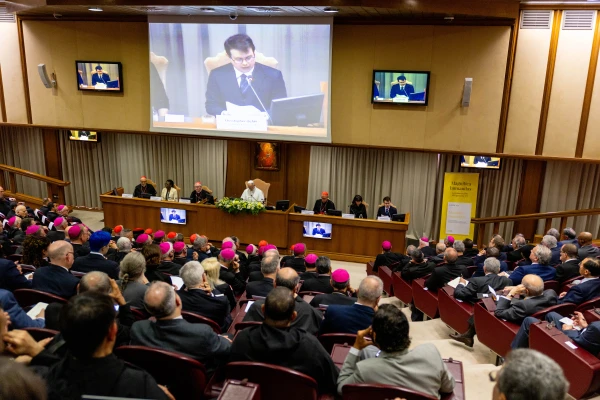
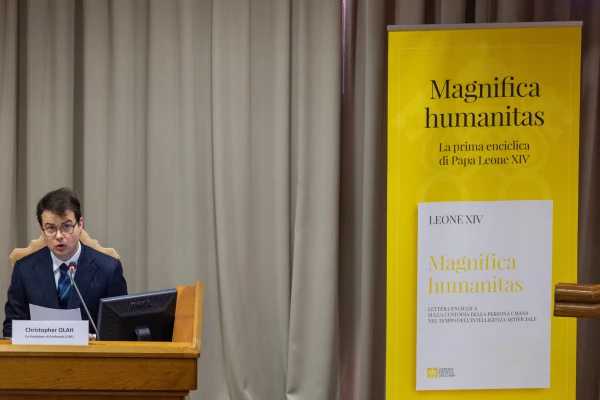
During the presentation of Pope Leo XIVʼs first encyclical, Magnifica Humanitas, the co-founder of Anthropic, Christopher Olah, pointed to three major ethical challenges posed by the development of artificial intelligence (AI) and called for a profound discernment regarding its future.
On May 25, addressing representatives from the realms of academia, diplomacy, and religion gathered in the Vatican’s Synod Hall, Olah stated that the questions raised by AI “are larger than the research community” and cannot be left solely in the hands of scientists or technology companies.
“We need more of the world — religious communities, civil society, scholars, governments, and indeed all people of goodwill — to do what His Holiness has done here: to take this seriously, to look closely, and to push events in a better direction,” he stated.
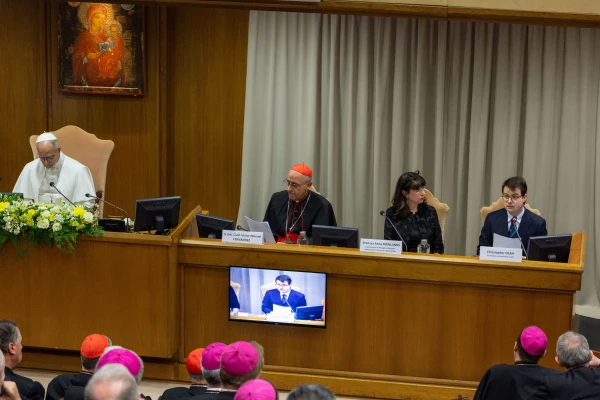
Olah began his remarks by acknowledging that even the most advanced AI laboratories, including Anthropic, operate under economic, geopolitical, and personal incentives that can come into tension with the common good.
“The pressure to stay commercially viable and to stay at the research frontier; geopolitical pressure and the older, plainer pressures of pride and ambition” inevitably influence those who develop this technology, he noted.
Consequently, he underscored the importance of having outside voices capable of questioning and overseeing the development of AI.
“If we want this technology to go well, it is enormously important that there be people outside those incentives — people who care about things going well and insist on safety, who are paying close attention, who are willing to say hard things,” he noted.
In this context, Olah deemed the discernment called for by Pope Leo XIV to be “profoundly timely” and outlined three major issues where the voice of the Church is necessary.
1. Duty to the global poor
The first major concern raised by Olah was the impact of AI on work and global inequalities.
“AI development is concentrated in a handful of wealthy nations. How can we ensure the gains of AI are shared globally?” he asked.
He warned of the “real possibility” that AI could “displace human labor on a very large scale,” which would make supporting affected workers “a moral imperative of historic proportions.”
However, Olah noted that there exists an even more complex challenge: the absence of mechanisms capable of fairly distributing economic benefits.
“We do not have a mechanism for this. It is an unsolved problem, and it is the kind of problem the Church has historically refused to let the world ignore,” he said.
2. Rediscovering and rethinking what it means to flourish as a human being
The second consideration presented by the co-founder of Anthropic was the need to approach technological development from the perspective of human and familial flourishing.
“If AI models are going to be widespread, what does it look like for humans, families, and the world to flourish?” he asked.
“These are not questions that a lab can answer,” he continued.
Olah noted that many parents are already concerned about the impact of technology on their children’s minds, while numerous people feel uncertain regarding the future of their jobs.
In this regard, he highlighted the role of the Church, which he said has spent millennia reflecting on human dignity and the meaning of life. Olah emphasized the need for the Church to continue doing so “into this new moment in history.”
3. The need for discernment on the part of AI model developers
The third concern raised by Olah related to the very nature of AI systems, an aspect he said remains mysterious, even to those involved in developing them.
“I am a scientist. I lead a research team that studies the internal structure of these models — what is actually happening inside them. And I will be honest: We keep finding things that are mysterious, even unsettling,” he stated.
Among these findings, he cited internal structures that “mirror results from human neuroscience” as well as evidence of introspection and internal states that “functionally mirror joy, satisfaction, fear, grief, and unease.”
“I don’t know what that means, but I think it warrants ongoing discernment,” he pointed out.
He even compared the phenomenon to “bringing a fictional character to life,” noting that “we’re entering an extraordinary world where those fictional characters speak to us, do work, have jobs.”
In concluding his remarks, Olah called upon more sectors of society to follow the example set by Pope Leo XIV in seriously addressing the phenomenon of artificial intelligence.
“We need moral voices that the incentives cannot bend. Today is just the beginning — the start of a long collaboration between those of us who are building this and those who can see what we, from inside, cannot,” he noted.
This story was first published by ACI Prensa, the Spanish-language sister service of EWTN News. It has been translated and adapted by EWTN News English.
If you value the news and views Catholic World Report provides, please consider donating to support our efforts. Your contribution will help us continue to make CWR available to all readers worldwide for free, without a subscription. Thank you for your generosity!
Click here for more information on donating to CWR. Click here to sign up for our newsletter.

AI model developers are human and could very well be dragged into the rat race like so many other talented super human mortals who have to compete, meet the deadlines, and remain afloat to receive further fundings. Anthropic co-founder Christopher Olah appears to be blessed with an honest and a sensitive conscience. His reflections, suggestions, and warnings are timely.