

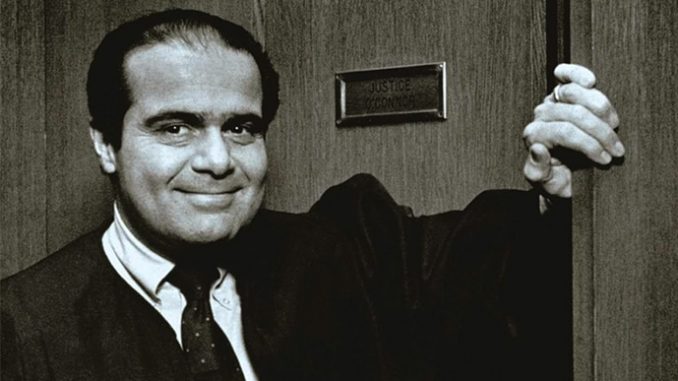
On Antonin Scalia’s first day of Catholic education, an expatriate of the New York City public-school system arriving as a freshman at Xavier High School in Manhattan in September 1949, he beheld a most unusual hybrid. For Xavier, all male back then, was both a Jesuit-run high school and a military academy. Here, the uniformed students, known as cadets, studied marksmanship, filled out a drum-and-bugle corps, and attended Mass before an altar with a spectacular arched apse, beneath which, as part of the rituals, they unsheathed their swords.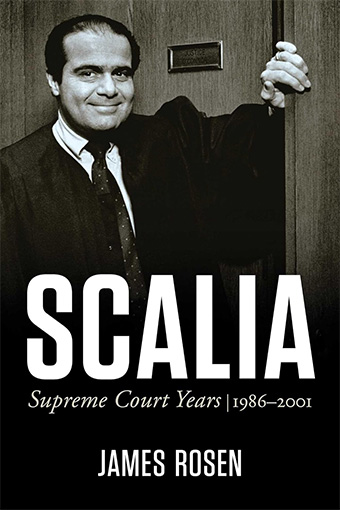
Already a star student—the doted-upon only child of a Sicilian immigrant who became a romance-languages professor and a mother whose parents were also Italian immigrants, and who also became a teacher, devout Catholics both—pudgy Nino was in for a rude awakening. Not only was he suddenly immersed in what he called “a substantially Irish world”; his homeroom teacher, Father Thomas Matthews, “a crusty no-nonsense New England Jesuit [when] Jesuits were allowed to be crusty and no-nonsense,” opened the class with roll call and a rebuke.
Antonin was too much for the white-haired Irishman. After stumbling over the name, he snapped at Nino in a sharp Boston brogue: Who’s your patron saint? Father Robert A. Connor, an Opus Dei priest who, when contacted in 2020, was one of the last surviving graduates from Scalia’s class at Xavier, recalled another incident. “Scalia was maybe three seats behind me,” he said. “Tom Matthews was going through the names…and he got to Scalia, and he says, ‘Goombah!’”
None of this troubled Nino too much. Hailed by his faculty advisor as “the best in his class in every way,” Scalia graduated as valedictorian, as he would also at Georgetown University, another Jesuit institution. The first newspaper article about Scalia, published in the Xavier Review in 1952, reported him “continually strong in his faith,” the product of a “fine Catholic education” by his parents and the Jesuits. Simply recounting all the faith-based activities Nino participated in would not, observed the author, a fellow cadet, “tell the full story of his association with God….Antonin in short has been leading among us a full Catholic life and we know him as a man who can truly be called an ‘exemplary Catholic.’”
The same could be said after Justice Scalia’s death, a little over ten years ago, as he neared his eightieth birthday and the completion of his thirtieth term on the Supreme Court. In the invocation he delivered at the memorial service held for his father at the Mayflower Hotel in Washington, D.C., on March 1, 2016, Father Paul Scalia, vicar of clergy for the Arlington, Virginia Archdiocese and one of the best known, most revered priests of his generation, prayed: “Almighty God…Make us mindful that every good gift comes from you, that we see Antonin’s gifts in your light as coming from your goodness and intended for your glory, so that in honoring him, we honor you, his Creator and Redeemer.”
Scalia himself doubted the Jesuits had shaped his adoption of originalism and textualism, the restrained approach to constitutional and statutory interpretation that changed how American law is drafted, argued, and decided. In an oral history with attorney Judith Richards Hope, conducted in chambers in 1992—unsealed in 2018, its contents first reported in my book Scalia: Rise to Greatness, 1936-1986—he contemplated the question for the first time.
Hope: Do you think that the Jesuit training and the classical training had any impact on the way you approach statutory analysis and interpretation?
Justice Scalia: I don’t know. I can’t say that. Perhaps. I might have been the same without it….Perhaps I have more regard for language and what it says, what it suggests, what it connotes, simply because I have had so much exposure to language in my life—not just English, but French, German and Latin, Greek.…I would not attribute it to the Jesuits in particular.
Others, close to the justice, were unhesitating in drawing a connection between his faith and his reverence for text. Like most major religions, Catholicism is all about sacred texts: the New Testament, catechisms, papal bulls, edicts. The power of the liturgy rests, in part, on the church’s fidelity, across millennia, to sacred rituals developed from foundational writings. God’s word was enduring, immutable, inviolable—particularly in Latin. As Father Scalia noted in his homily at his father’s funeral, held at the Basilica of the National Shrine of the Immaculate Conception on February 20, 2016: “Scripture says Jesus Christ is the same yesterday, today, and forever.”
Where Rise to Greatness traced the formation of Justice Scalia’s faith, at home, school, and church, Scalia: Supreme Court Years, 1986-2001, the second installment in the trilogy, newly published, continues the story by exploring how Scalia erected a firewall between his faith and the core content of his jurisprudence: his opinions. To research this critical part of the justice’s life, I interviewed his family, including Father Scalia, his friends and fellow congregants, and numerous clergy, from Father Malcolm Kennedy, the Opus Dei priest who led Scalia on private retreats and referred to himself as the justice’s “spiritual counselor,” to Father Jerome Fasano, the Scalia’s family priest, pastor, and confessor; a close family friend, present for twenty years of Easters, Thanksgivings, and Christmases at the Scalia home; shepherd of three Scalia children as altar boys, Matthew, Christopher, and Father Paul, at whose first mass Fasano would later preach, and who would ultimately succeed Fasano as pastor at St. Catherine of Siena in Great Falls; the officiant at some of the weddings of Nino and Maureen’s children; performer of baptisms for their grandchildren.
Semiretired when contacted, Father Fasano had declined many requests over the years to discuss his relationship with the justice; consenting for the first time, he recalled his longtime parishioner and friend with love and affection—and a unique window onto his humanity. “A great family,” he told me. “These are people of deep piety and spirituality….The Scalias really opened their home and made me feel like a part of the family.”
Fasano called Justice Scalia “one of the most brilliant people I had ever dealt with,” but recognized his flaws. “I learned very early you didn’t disagree with him…You would always lose an argument.”
Rosen: Can you remember anything you did disagree on?
Father Fasano: Well, church matters….For instance, some practical things, like whether you should tolerate crying children in church. I remember one time he went up to a family of children, barked…If I had been barked at by a justice of the Supreme Court for being noisy!…He said, “I’ve had nine kids! I know how to discipline my kids! I don’t know why they can’t!”…Also, the taste in music: He didn’t like certain pieces that the choir director would choose and he would come and complain to me….We had some different views about how liturgy should be done.
Fasano saw the famous Scalia temper many times, including when the father ribbed him for the repetitiveness in his speeches. “He blew up at me.” I sat in your pew for twenty years! You’ve repeated your sermons!
Rosen: You have mentioned a number of times already, just in our conversation, where he “blew up” at you or he “calmed down” eventually.
Father Fasano: But he’s Italian. I’m an Italian. And I understand that Italian temperament, where you’re volcanic…and then you calm down right away, like a volcano then subsides…I wouldn’t even see it on the moral level as much as a temperamental level….Sometimes a person shows just anger in a very, very volatile way, but it’s not sinful anger.
From his acceptance of Jesus Christ as Lord and Savior, Scalia drew inspiration and comfort. But he strove, in a “ritual of self-division,” to keep his Catholicism out of his interpretations of the Constitution and federal and state statutes. As a matter of law, he opposed efforts to secularize the state; he believed the Founders never intended to strike religion from the public square, only to prevent the government from favoring one religion over another. The Court’s incoherence on the subject—upholding tax exemptions for churches, for example, but not tuition tax credits for religious schools—had drawn Scalia’s scorn as far back as his teaching days, when he enlivened televised debates on PBS.
In life, however, while recognizing his inability to “jump out of my skin,” the justice maintained a strict separation of church and state: essential, he believed, to his daily efforts to be a good Catholic and a good judge, and attested to by a former clerk. “Although his faith never affected his judicial reasoning,” Kristin Linsley said at the Mayflower service, “there were certain parallels—most notably, the centrality of text within its appropriate hierarchy; a deep intellectual tradition; a belief in right and wrong, and the existence of objective truth; and the richness and relevance of historical tradition.”
Scalia spent his Court career rebutting the allegation that he mixed religion and law. In 1992, he was asked by Monsignor Francis Maniscalco, editor of The Long Island Catholic, official newspaper of the Rockville Centre Diocese, to celebrate the paper’s thirtieth anniversary. This meant an appearance at a banquet hall in Woodbury. The monsignor had an even more audacious ask: He assigned Scalia a topic: whether spiritual and judicial obligations “reinforce one another or create a degree of tension…whether, indeed, someone who holds high office in a pluralistic society is able to fulfill the Church’s vision of the laity bringing Christian values to the world.”
It was a bold challenge, and one Scalia accepted. Retired when contacted in 2024, Monsignor Maniscalco remembered Scalia’s visit well. The program called for the justice to receive an award named after the newspaper’s late founder, Rev. Msgr. Richard H. J. Hanley. But Scalia was “very emphatic” about not receiving a plaque. “I already have a roomful of them!” he told the monsignor.
Undaunted, Maniscalco instead presented Scalia, when he bounded onstage, with a relic of St. Antoninus, the justice’s patron saint: the answer to Father Matthews’s bracing question of 1949. One of Scalia’s sons later wrote that the justice was filled with “surprise and delight”; for the monsignor, the moment inspired fear. “I thought I had made a mistake,” Maniscalco told me, “since he was momentarily left speechless—not a very good thing in a guest speaker.”
Scalia’s speech at the Hollow Crest Country Club on October 1, 1992, was entitled “Faith and Judging.” Acknowledging at the outset the “tricky” nature of the subject, Scalia resolved, with a wink, to “stick fairly closely to the text” assigned by Monsignor Maniscalco. “The faith affects all vocations,” Scalia declared. “When Christ said, ‘Be ye perfect, as your heavenly Father is perfect,’ I think he meant perfect in all things, including that very important thing, the practice of one’s life’s work.” Laborare est orare, he reminded: “To work is to pray. And to work badly is to pray badly.”
As always with Scalia, process was king: There is no such thing as a Catholic hamburger, he would say; the closest we could come would be a hamburger that is made perfectly. He believed a judge’s job is not to make policy, from Christian or other perspectives, but “to discern accurately and apply honestly the policies adopted by the people’s representatives in the text of statutes.”
I find myself somewhat embarrassed, therefore, when Catholics, or other opponents of abortion, come forward to thank me earnestly for my position concerning Roe v. Wade. I must tell them that I deserve no thanks; that that position is not a virtuous affirmation of my religious belief, or even a sagacious policy choice, but simply the product of lawyerly analysis of constitutional text and tradition; and that if legal analysis had produced the opposite conclusion, I would have come out the other way, regardless of their or my views concerning abortion. My religious faith can give me a personal view on the right or wrong of abortion; but it cannot make a text say yes where it in fact says no, or a tradition say “we permit” where it in fact has said “we forbid.”
His Catholic fans cared little about such subtleties. They had waited a generation to see a pre-Vatican II Catholic ascend to the Court, and they greeted Scalia rapturously. A conservative scholar exulted in 1986: “Judge Scalia will employ constitutionally pertinent criteria in examining abortion issues, and lead the Court out of its current confusion and constitutional lawlessness.”
According to one account, Scalia “always took the deepest personal umbrage at charges that he was a results-oriented judge, and a Catholic results-oriented judge to boot.” In 2008, CBS News’ Lesley Stahl raised it anew on “60 Minutes.”
Stahl: What is the connection between your Catholicism, your Jesuit education, and your judicial philosophy?
Scalia: It has nothing to do with how I decide cases. My job is to interpret the Constitution accurately. And indeed, there are anti-abortion people who think that the Constitution requires a state to prohibit abortion. They say that the Equal Protection Clause requires that you treat a helpless human being that’s still in the womb the way you treat other human beings. I think when the Constitution says that persons are entitled to equal protection of the laws, I think it clearly means walking-around persons.
Such public engagements with matters of faith, on the biggest of stages—the Supreme Court! “60 Minutes”!—made the justice, already one of the leading exponents of law in his time, also a leading exponent of Catholicism in his time. His collected writings in this vein, On Faith: Lessons From an American Believer, including “Faith and Judging,” would be issued posthumously.
“Antonin Scalia was neither the first, nor the last, Catholic appointed to the Supreme Court,” one scholar noted, “but he was the most outspoken about his faith off the bench.”
Asked if Catholicism was the “rocket fuel” that propelled his father to the pinnacle of the law, Father Paul said: “I think it’s a large part of it.”
Maureen Scalia—Nino’s partner in exemplary Catholic living for fifty-five years, primary figure in the raising of their nine children, living saint—agreed. In an exchange of emails in January 2024, I asked about her husband’s comment at his swearing-in ceremony, conducted at the White House on September 26, 1986, as President Reagan, and the other justices, sitting and retired, looked on. He thanked Maureen, “an extraordinary woman and without whom I wouldn’t be here—or if I were here, it wouldn’t have been as much fun.”
A moment of intended chivalry had turned out differently—with the man of the hour suggesting he might have been able to scale the mountain without his life partner. “Of course, he could have done it without me,” Mrs. Scalia told me, before adding: “I do think our shared faith, which we truly cherished, was a major factor.”
If you value the news and views Catholic World Report provides, please consider donating to support our efforts. Your contribution will help us continue to make CWR available to all readers worldwide for free, without a subscription. Thank you for your generosity!
Click here for more information on donating to CWR. Click here to sign up for our newsletter.
Scalia was more than just another conservative vote. He was an intellectual force. No one has really taken his place.
I have recently finished reading the first volume of Rosen’s Scalia trilogy and am now reading the second. These books are good in every way, revealing the many facets of one of the most interesting justices (and Catholics) of my now rather long lifetime. I highly recommend them and hope to live long enough to read the third volume.