


The 16th Annual Napa Institute Summer Conference will be held at The Meritage Resort and Spa, 875 Bordeaux Way, Napa, California, July 22-26, 2026. The event features presentations by a variety of prominent Catholic clergy and laity, fine dining, and opportunities for personal prayer before the Blessed Sacrament, Mass, Confession, and spiritual direction.
According to organizers, the conference is founded on three pillars: community, formation, and liturgy. Their website states: “Each year, the Holy Spirit is at work bringing together Catholic leaders from across the country—from lay apostolate leaders and politicians to Hollywood actors and entrepreneurs—to advance the Church’s mission and build up the Kingdom of God.”
In conjunction with the nation’s 250th anniversary, the conference theme for 2026 is: “A More Perfect Union: Renewing Our Faith to Renew the Nation in ‘America 250’”. Featured speakers include pro-life activist Lila Rose, biblical scholar and Franciscan University professor Scott Hahn, Msgr. James Shea, president of the University of Mary, Larry Arnn, president of Hillsdale College, Fr. John Burns, founder of Friends of the Bridegroom (seeking the renewal of the priesthood and religious life), and legal scholar Robert George.
For additional information or to register, visit the website or contact Jean Jacoby at jjacoby@napa-institute.org or (855) 740-NAPA (6272).
CWR spoke with Napa Institute founder Tim Busch about the event. Busch launched the annual conference 16 years ago at the suggestion of Mark Brumley, president of Ignatius Press.
CWR: Who attends this conference each year?
Tim Busch: We draw about 700, including bishops and priests, religious and lay Catholic leaders.
Our attendees are people who are serious about bringing their faith into the world, leaders in business, media, education, ministry, and many other fields. People come not only to learn from thoughtful speakers, but to meet others who share the same desire to live their faith boldly in the culture. There is something rejuvenating about spending a few days surrounded by people who take both the intellectual life and the spiritual life seriously.
Most attendees leave with new friendships, fresh ideas, and a renewed sense of mission to return home and lead well in their own communities.
CWR: How can those unable to attend in person still benefit from the conference?=
Tim Busch: In the months following the conference, our Napa Institute will post its talks, both main stage and breakout sessions, free of charge on YouTube.
Additionally, if you visit our Napa Institute YouTube channel, you can access previous years’ presentations free of charge. I think you’ll find these talks both interesting and inspiring, and with the wide variety of speakers we welcome, there’s something there for everyone.
CWR: For those who do attend, a big focus of the conference is prayer, Mass and the sacraments.
Tim Busch: Yes, liturgy is a core pillar of the Napa Institute. Throughout the week, attendees will have access to over 100 liturgical celebrations in various locations throughout the day, including Masses each day with prelates. This will include Masses in both the Ordinary and the Extraordinary form, as well as Masses of the Ordinariate of St. Peter [former Anglicans now in communion with Rome].
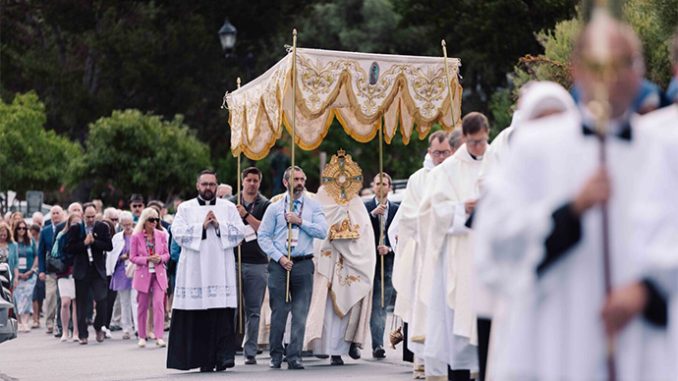
Additionally, on Thursday morning, we will again hold our popular Eucharistic procession, moving prayerfully around the grounds of the Meritage Resort and Spa. It has become one of the most meaningful moments of the week as hundreds of attendees gather in public witness of faith.
CWR: Talk a bit about the food, social environment, and accommodations available for participants.
Tim Busch: The food is an unexpected conference highlight. Napa is one of the great culinary regions in the world, so the conference leans into that reality in a serious way.
Hospitality sits at the heart of the Napa Institute experience, and that means gathering people around exceptional meals, thoughtful wine pairings, and long conversations at the table. Attendees regularly say some of their most meaningful connections happen over lunch or dinner, sharing a glass of Napa Valley wine while continuing the discussions sparked during the day’s sessions. In the evenings, the atmosphere turns relaxed and social, with guests gathering under the Napa night sky for cigars and wine, making new friends and reconnecting with familiar faces from years past.
It is a beautiful balance of prayer, friendship, and the kind of hospitality that defines the Napa Institute experience.
The conference is held at the beautiful Meritage Resort and Spa, a full-service resort nestled in the vineyards of Napa Valley. Guests can stay onsite in elegant rooms or spacious suites, making it easy to move between conference sessions, meals, and the many amenities the resort offers. The property includes multiple restaurants, a spa, walking paths through the vineyards, and stunning views of the valley.
Staying at the Meritage allows attendees to fully experience the conference while enjoying the atmosphere of one of Napa’s most welcoming and relaxing resorts.
CWR: Tell us about the arts festival that precedes the conference.
Tim Busch: This year, we are inviting guests to arrive two days early for the Napa Institute Arts Festival, returning for its second year after a wonderful inaugural gathering last summer. The festival brings together actors, filmmakers, musicians, writers, and visual artists who are using their creative work to shape culture in meaningful ways. It is an opportunity to celebrate beauty, storytelling, and the role of the arts in renewing culture.
Actress and Catholics & Cappuccinos host Siobhan Fallon Hogan will serve as the event’s emcee, helping guide an evening that highlights how creativity and faith can work together to inspire audiences and elevate culture.
If you value the news and views Catholic World Report provides, please consider donating to support our efforts. Your contribution will help us continue to make CWR available to all readers worldwide for free, without a subscription. Thank you for your generosity!
Click here for more information on donating to CWR. Click here to sign up for our newsletter.

According to an ancient tradition, the prefect—the official head of the empire’s pagan religion—ordered that Laurence hand over all the Church’s treasure. As told by Ambrose: “For when the treasures of the church were demanded from him, he promised that he would show them. On the following day he brought the poor together . . . [and distributed the riches to them.] When asked where the treasures were which he had promised, he pointed to the poor, saying, ‘These are the treasure of the Church.’ And truly they were treasures, in whom Christ lives, in whom there is faith in him. . . . These treasures Laurence pointed out, and prevailed, for the persecutors could not take them away.”
WE READ: “Most attendees leave with new friendships, fresh ideas, and a renewed sense of mission to return home and lead well in their own communities [and] In the months following the conference, our Napa Institute will post its talks, both main stage and breakout sessions, free of charge on YouTube.”
SUMMARY: From the talks, why not some extracted and distilled messages capable of being acted upon? As a famous statesman once challenged: “will it play in Peoria”? For example, and regarding the principles of Catholic Social Thought, a compendium of one-paragraph case studies on what has been done better or differently since last year’s sessions? And, of course, any new ideas about next year’s hors d’oeuvres.
We read: “Most attendees leave with new friendships, fresh ideas, and a renewed sense of mission to return home and lead well in their own communities.”
Some concrete ideas, from the back bleachers:
Among the NAPA conference members, what could be the right kind of focused communication with likely attendees from Legatus?
Or, during the coming year, with university administrations set on gutting what’s left of meaningful Liberal Arts core requirements?
Or with their local diocesan bishops of the USCCB, in need of better connections with the laity (whose distinct role in the Church is all that complicated stuff in the secular domain (Gaudium et Spes)?
Or, even with the Society of Catholic Social Scientists (SCSS), and with local Newman Centers, and maybe the Fellowship of Catholic Scholars?
Might some NAPA members consider a closer connection (even financial?) with the Lumen Christi Institute at the University of Chicago?
Or with the work of the longstanding curriculum reform work of the American Council of Trustees and Alumni (ACTA)?
Or, again from Legatus attendees–are there any creative proposals on how Pope Leo might close the looming billion-dollar gap in the Vatican pension fund?
And, about Catholic Social Thought (CST) and internal corporate culture–where the “triple-bottom-line” might be in play, what different forms does this take? Employee Stock Ownership Programs (ESOPS)? E.F. Schumacher in “Small is Beautiful” (1973) featured an on-the-ground three-way a business model consisting of profitability with profit sharing, research and development, and annual shared decisions on which external and charitable organization to support—including employee hours on the street.
SUMMARY: from the NAPA breakout sessions, what are the succinct and transferable working ideas (and contact info) that might be collected on simple 4” x 6” cards? And noted in a concluding plenary session? And then possibly disseminated a post-conference, bullet-point website display, in addition to the mentioned and narrative YouTube display?
An influential and leavening “town hall meeting” product (but not postured as a so-called Synod on Synodality!).
Why did Robert George not focus on the childs right to a mom and dad in his friend of the Court submission to Obergefell? And why in his recent America 250 speech at UVA (home of created equal) *not* mention the imperative to abolish abortion (slavery’s twin!)??