

 By
By The U.S. and Israeli strikes on Iran brought major conflict to the Middle East and sent Christian pilgrims scrambling for safe harbor there.

“We’re going to Cairo.”
That’s how husband and wife Father Albert and Abby Scharbach discovered that their pilgrimage in Israel had been cut short by the launch of the current Iranian conflict.
The Scharbachs — Father Albert is a priest of the Ordinariate of the Chair of St. Peter, having originally served as a priest in the Anglican church — spent the morning of Feb. 28 on the Jordan River and at the Mount of Beatitudes. They were enjoying a lunch of “St. Peter’s Fish” by the Sea of Galilee when their tour guide announced to the group that they needed to leave immediately for Cairo.
“We were given two hours to pack and then we were going across the Egyptian border that night,” Abby said.
Unbeknownst to most of the group, the strikes in Iran had begun, making Israel a prime target for retaliation from the Iranian regime. Joint strikes by Israel and the United States starting on Feb. 28 brought destruction to major sites in Iran, including Tehran and Qom, and led to the deaths of major Iranian leadership including Ali Hosseini Khamenei. In retaliation, Iran has struck many sites in the Gulf region.
Father Albert said he was aware of the “high probability” that such an incident could occur during their pilgrimage, and the group had indeed been instructed earlier in the pilgrimage to proceed to bomb shelters in the event of any danger.
Once the military operations began, however, the group was quickly hustled out of Israel and into Egypt, though there was still danger there.
Father Albert said the route from the border crossing of Taba to their destination of Cairo normally might have taken four-and-a-half hours, but due to fears of ISIS in the region, the bus took a circuitous eight-hour route instead.
“We had a police escort,” Abby said. The escort consisted of one man in a pickup truck and one man with a gun on one of the buses.
“I don’t know what they could have done against a terrorist group, but they were there,” she said.
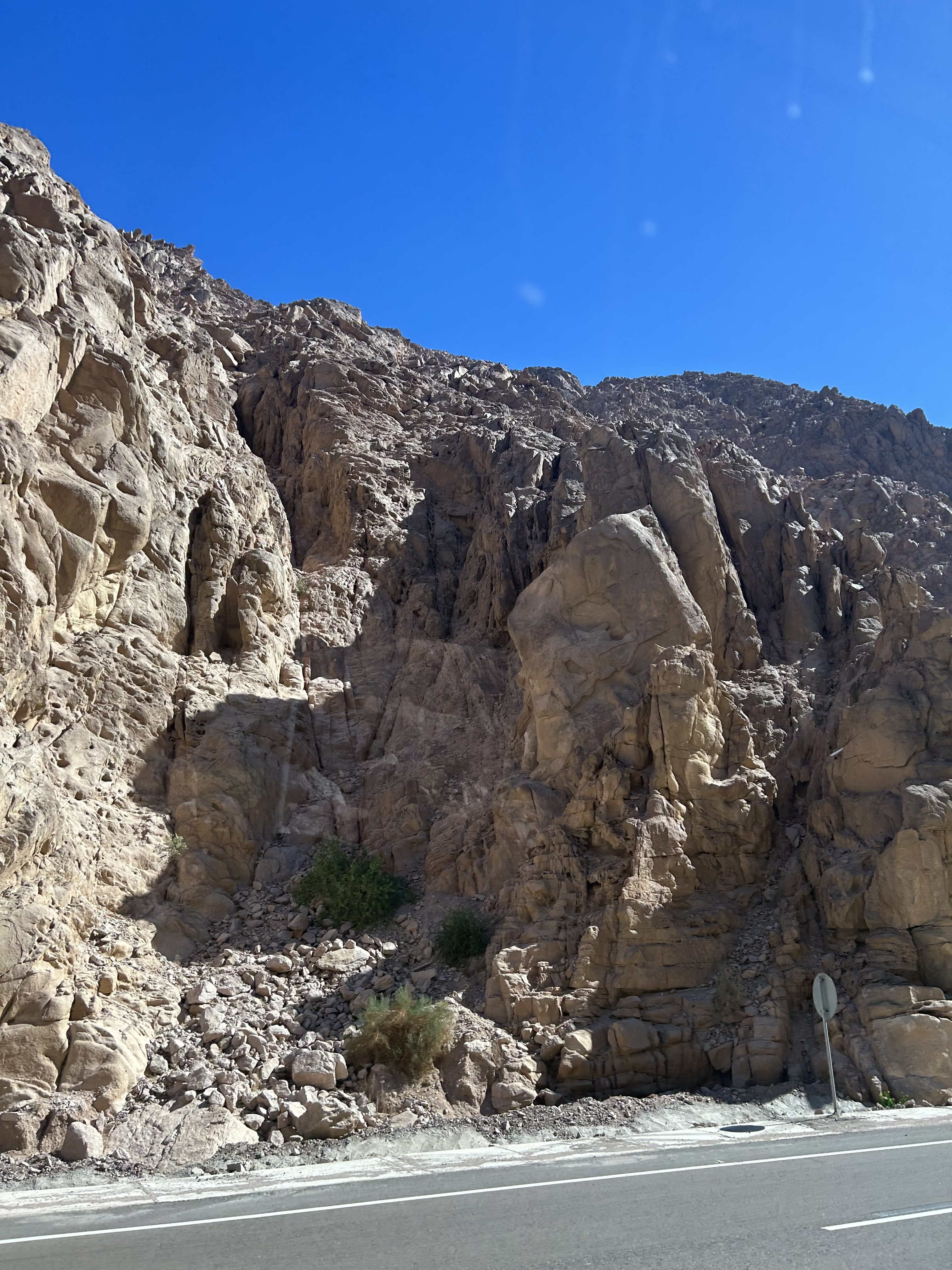
The Sinai Desert is a monotonous landscape of “dark-colored rocks,” they said, though the group passed close by Mount Sinai, where Moses is recorded as having received the Ten Commandments.
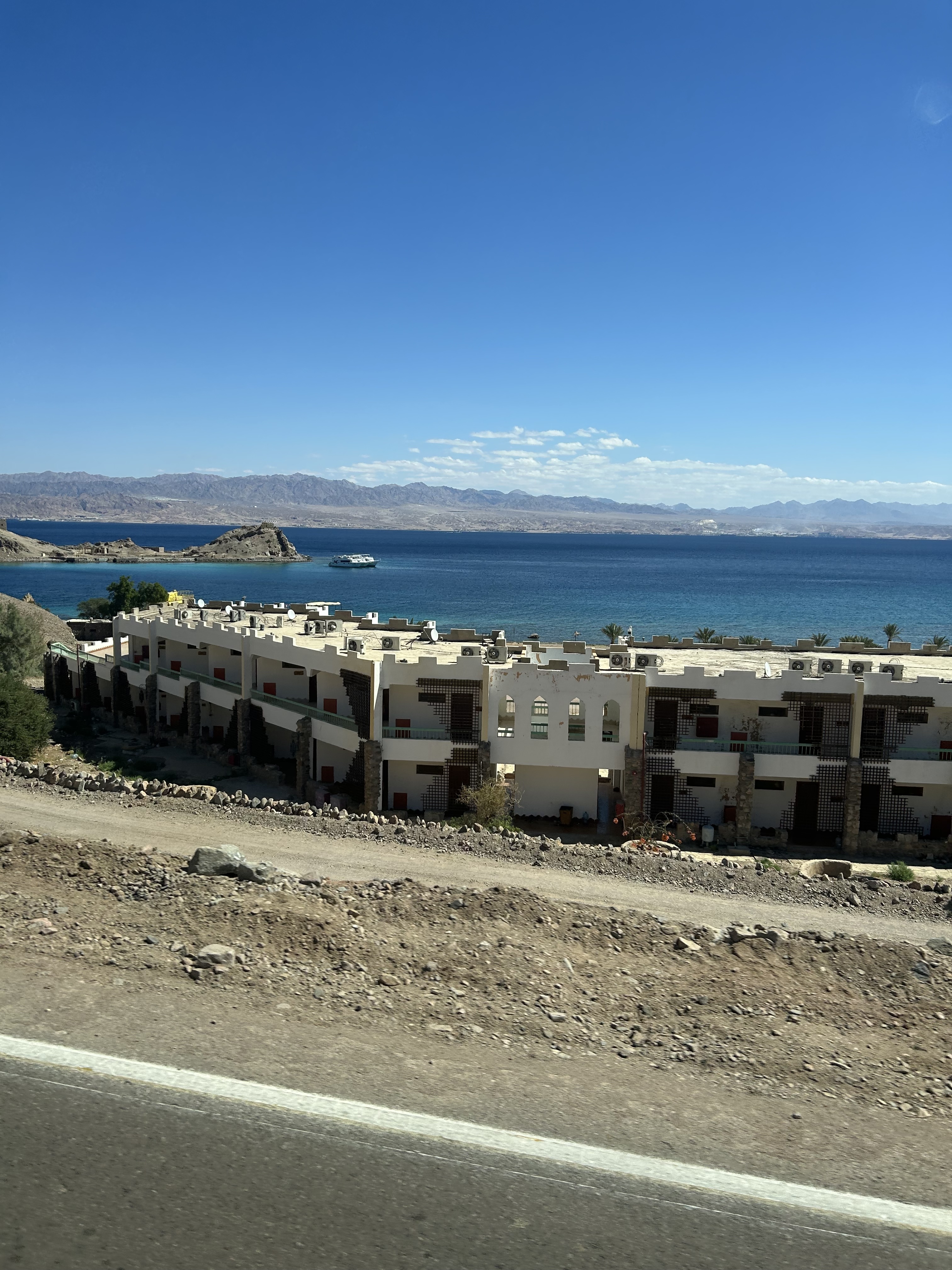
Meanwhile, “all along the Red Sea were resorts — resort after resort, all of them abandoned on this beautiful sea,” Abby said. “There is nothing there.”
The desolate region was visibly more Islamic than the surrounding urban environs, with Muslims dressed in traditional garb including keffiyeh and thawb. Father Albert said the group was warned “not to wear any Israeli symbols or American flags” during brief rest stops along the road.
Though the process to get to Cairo was a lengthy one, the Scharbachs said they got off relatively lucky. Crossing the border at Taba took three hours, they said, but had they waited another day, the process could have been drawn out to 48 hours or more given the huge crush of tourists converging on the site.
Once in Cairo, the groups were quickly routed to any available outbound flights. The Scharbachs took a flight from Istanbul and from there to the United States. “There were others going to Europe,” Father Albert said. “Any airlines, any itinerary they could find, they were putting people on flights.”
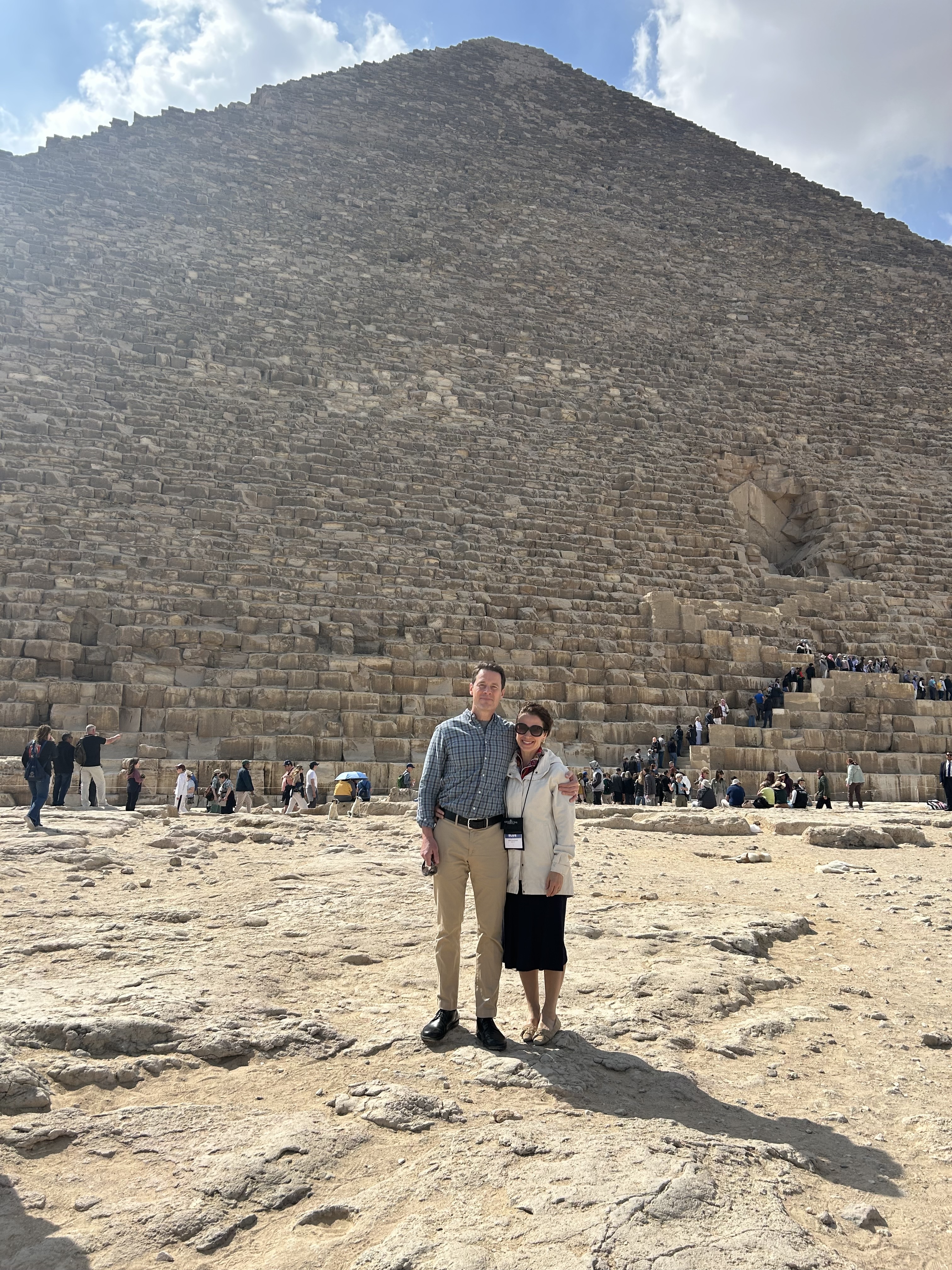
Still, during their brief stopover in Cairo, the Scharbachs were able to take in some of the historic city, including the Giza pyramid complex. “The tour group took good care of us,” Abby said.
‘This is not just going to be a couple of weeks’
While the Scharbachs were able to safely evacuate the region, others haven’t been able to get out, and planned pilgrimages to the Holy Land have been postponed indefinitely amid the conflict.
John Hale, the president of Corporate Travel Service, said the organization is still trying to figure out what travel in the region will look like in the near future.
A broad-based travel enterprise, Corporate Travel Service includes an entire division devoted to faith-based experiences.
Hale, a Catholic, said that while the group has no pilgrimages to Iran, it sponsors trips to Israel, though the conflict is “disrupting future pilgrimages” there for the time being.
“We’re right in the middle of it, so we don’t have any concrete details,” he said. “In the past what we’ve typically done is either postponed a pilgrimage and hopefully moved people to another one or else scheduled a future pilgrimage to the Holy Land when we’re able to send people.”
Steve Ray, a filmmaker who with his wife, Janet, launched the “Footprints of God” pilgrimage program after filming a documentary series of the same name, said pilgrimages in the region are often “fraught with danger” to begin with.
The Rays have been sponsoring trips to the region for over 20 years, since 2005, he said. Pilgrimages have been put on hold there numerous times in the past, including after the outbreak of the Israel-Hamas war in 2023. Ray said his tour group returned from a pilgrimage there on Oct. 5 of that year, just two days before the conflict broke out.
The organization resumed trips in December 2025, but with the Iranian conflict, tours are once again on hold. Ray said an affiliate in the region told him: “This is going to be protracted for a long time. It’s not going to be over in a couple of weeks.”
Ray admitted that pilgrimages to the Holy Land require flexibility. “We learned early on that with Israel you have to be adaptive,” he said. The group has pilgrimages planned to holy sites in Europe, he said, as well as in Ireland and on the Mediterranean.
In spite of the harrowing experience of evacuating a country amid a military conflict, meanwhile, the Scharbachs expressed no regret about going in the first place.
“Even though there was danger, it was so important, and we were called to go,” Father Albert said. “It wasn’t an uncalculated risk. It was that important to go when we had the opportunity.”
Abby said that among the holy sites the couple visited was the Church of the Holy Sepulchre, where Father Albert was able to celebrate Mass.
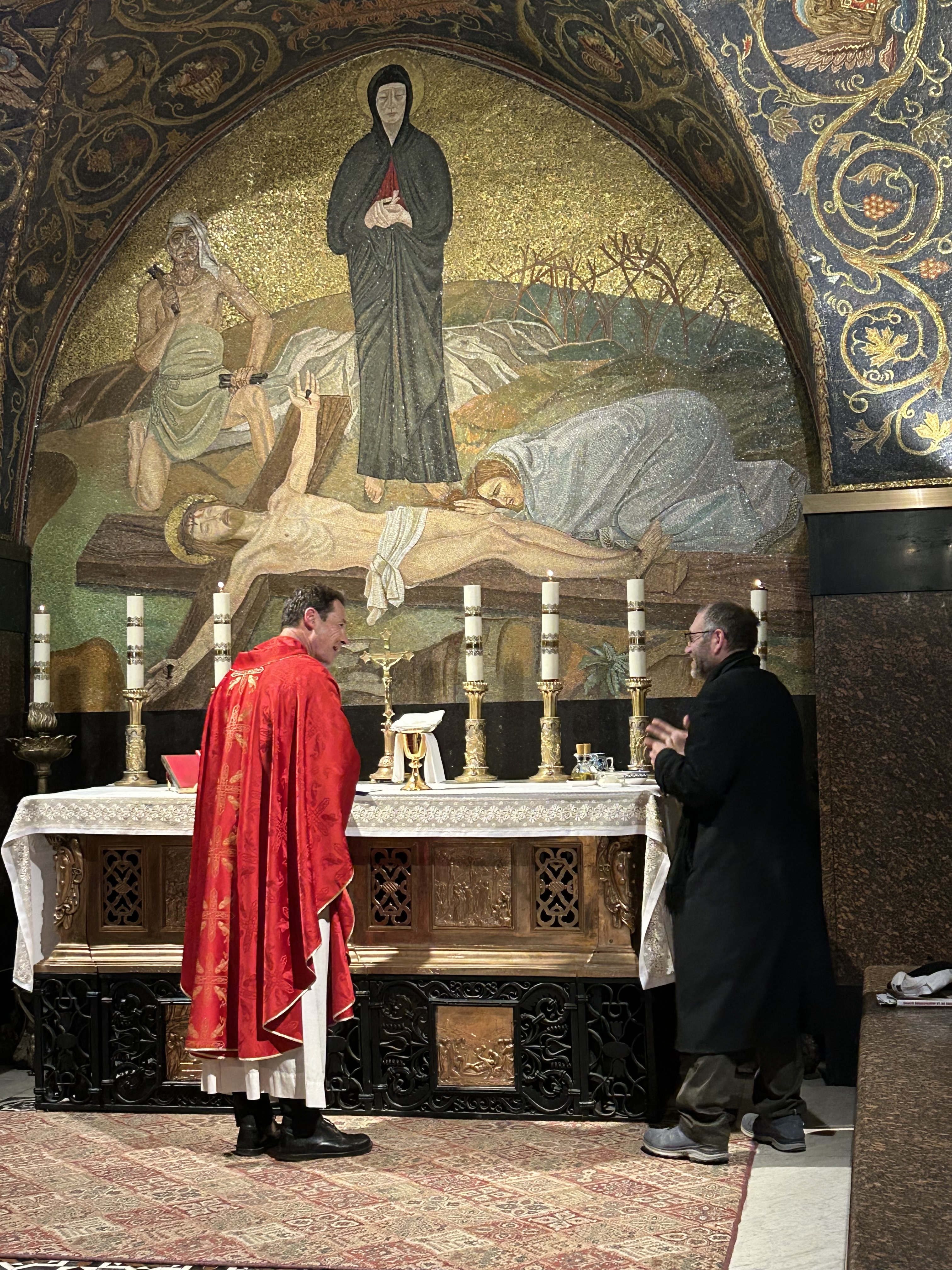
“This was meaningful for us, besides the obvious [reasons], because the parish we serve is Mount Calvary,” she said. “We offered Mass for the people of Mount Calvary on Mount Calvary.”
“I would go back to the Holy Land in a heartbeat,” she added. “It was that beautiful.”
If you value the news and views Catholic World Report provides, please consider donating to support our efforts. Your contribution will help us continue to make CWR available to all readers worldwide for free, without a subscription. Thank you for your generosity!
Click here for more information on donating to CWR. Click here to sign up for our newsletter.


Leave a Reply