


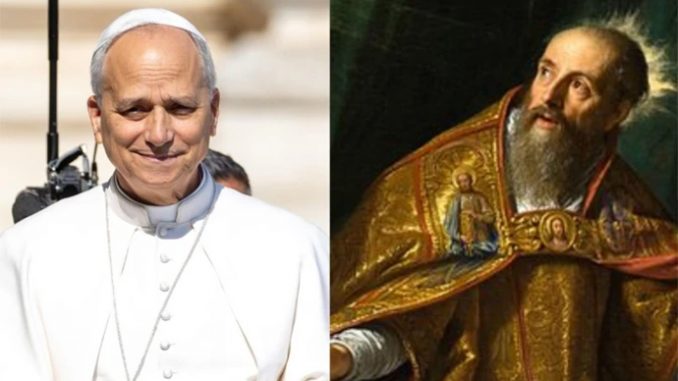
As the saying goes: When a person tells you who they are, believe them.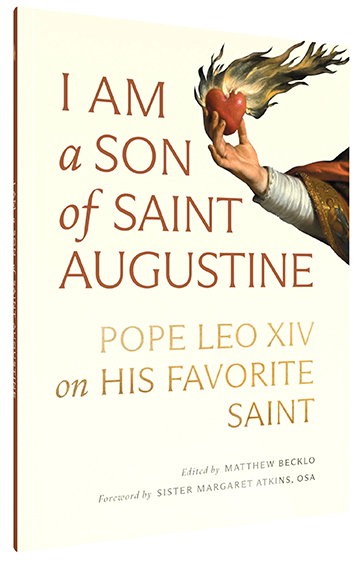
So I argued after the election of Pope Leo XIV, the first American pope, last year. Standing on the loggia of Saint Peter’s, his expression showing the emotion of so great a calling, Robert Prevost did not introduce himself as a Chicagoan, a Chiclayoan, a canon lawyer, or even a bishop—important though all of these clearly are to him. He introduced himself as an Augustinian, “a son of Saint Augustine.”
Indeed, almost the entirety of his adult life up to that moment—his education, his priesthood, his missionary work, his leadership roles, even his episcopal motto—bore the influence of the Doctor of Grace.
Pope Leo XIV told us who he is—and we should believe him.
I Am a Son of Saint Augustine: Pope Leo XIV on His Favorite Saint, a new booklet I had the honor of editing for Word on Fire, attempts to get us better acquainted with the mind and heart of our Augustinian pope on his own terms. The brief text collates excerpts from Prevost’s writings, speeches, and interviews from before his election, as far back as his doctoral dissertation on the local prior of the Order of Saint Augustine, and from the early months of his papacy, up to and including his first apostolic exhortation, Dilexi Te.
But the heart of each reflection, whether old or new, is Augustine: his life, his works, his spirituality, his thought—and the order that bears his name.
Of course, this could only be a snapshot in time. Leo XIV has continued to reference the bishop of Hippo again and again since the book went to print. Perhaps most notable were his comments on Augustine’s City of God in his so-called state of the world address, delivered to members of the diplomatic corps accredited to the Holy See on January 9. In fact, according to the Vatican’s website, Leo’s references to Augustine have already surpassed those of his predecessor, and he is on track, within just another year or two, to exceed even Benedict XVI in this regard—a man who also once defined himself as a “decided Augustinian.”
And Leo hasn’t just been tipping his hat to this great Church Father in a direct way; he’s also been drawing out, indirectly, distinct themes and emphases from the august Augustinian tradition—four of which seem most prominent.
The first is interiority—Augustine’s discovery of his own “restless heart” within amid the various pleasures of the world without. This theme, so vivid in the Confessions, came to the fore in Bishop Prevost’s 2012 interview with Catholic News Service around the Synod of Bishops on the New Evangelization. But it’s also something he began talking about as pope almost immediately. The homily for his papal inauguration Mass begins with a reference to Augustine’s timeless line: “You have made us for yourself, and our heart is restless until it rests in you.” He referenced the line again the following month in his video message to young people, challenging them, “That restlessness is not a bad thing, and we shouldn’t look for ways to put out the fire. . . . We should rather get in touch with our own hearts and recognize that God can work in our lives.” And in a meditation that same month for the Jubilee of Seminarians, he challenged future priests, “You need to work on your interior life. . . . Keep in mind Saint Augustine’s constant invitation to return to the heart, because it is there that we will find God.”
A second motif is clarity—the bishop of Hippo’s deep concern for truth, as the light of the divine mind illuminates our own minds. This includes, of course, philosophical and theological truth. But for Augustine, truth finds its origin and end in the one who declared himself “the truth” (John 14:6): Christ Jesus. As the Augustinian canoness Sister Margaret Atkins remarks in the foreword of the book, Leo XIV—a canon lawyer by training—has a certain “clarity of Augustinian vision.” And that vision is rooted in “a shared search for truth, for Christ who is the Truth.” This theme of truth emerges time and again in Prevost, from his 2020 message to a Panama parish (“Always seek the truth. God is truth”) to his July greeting to Augustinian sisters (“A culture without truth becomes an instrument of the powerful”). And as Christ is, as he said in his first address to the College of Cardinals, “the ultimate hope of all who sincerely seek truth,” the Church must “return to the primacy of Christ in proclamation.”
A third prominent theme is charity—the Doctor of Grace’s burning love for God, which overflows into love for man. Emblazoned on Leo XIV’s coat of arms is the emblem of the Order of Saint Augustine: a red heart aflame and pierced with an arrow, symbolizing precisely this love. Having searched restlessly for the truth and found it in Christ, Augustine’s soul was filled with the love of God—the very foundation upon which the City of God is built. “This is the hour for love!” Leo declared in his inaugural homily. “The heart of the Gospel is the love of God.” Yet this greatest commandment, Leo knows with Augustine, is intertwined with a second: love of neighbor. “The two go hand in hand,” Prevost remarked to CNS in 2012. Our love should also extend in a special way, as Leo makes clear in Dilexi Te, to the poor, whether they be poor spiritually or materially: “The Doctor of Grace saw caring for the poor as concrete proof of the sincerity of faith. Anyone who says they love God and has no compassion for the needy is lying (see 1 John 4:20).”
Fourth and finally is unity—Augustine’s emphasis on the Church’s oneness in the one Christ. In the run-up to the papal conclave, the New York Times ran a piece with a headline that didn’t age well: “As Cardinals Prepare to Elect a Pope, One Motto Is ‘Unity.’ That’s Divisive.” Unity—within the Church, among Christians, in the wider world—has been one of the great hallmarks of the Leonine pontificate thus far, and it’s been anything but divisive. Indeed, his episcopal motto taken from Augustine, which he’s publicly referenced multiple times already as pope, is “In Illo Uno Unum” (In that One, [we are] one). In 2023, Prevost, remarking on his motto to Vatican News, said, “Unity and communion are truly part of the charism of the Order of Saint Augustine, and also of my way of acting and thinking.”
We can look again to Leo’s inaugural homily, where he said, “I would like that our first great desire be for a united Church, a sign of unity and communion, which becomes a leaven for a reconciled world.” But Leo has not just thought and spoken about unity; he has also been a doer of this word, opening up new avenues of discussion on the liturgy, welcoming bishops and clerics across the theological spectrum for private audiences, and holding historic visits with both Patriarch Bartholomew I and King Charles III. Leo’s repeated stress on synodality, dialogue, and listening should be understood, it seems, in connection with this aspect of the Augustinian charism, together with its balancing drive toward truth.
Interiority, clarity, charity, unity—or, we might say, searching, finding, loving, binding—this is the great Augustinian program. All four themes are centered on Christ; yet all four are also oriented toward the world, drawing it in all its restlessness, confusion, coldness, and fragmentation to the only one who can bring it that great gift of peace, the name of Augustine’s own basilica in a badly divided Hippo.
It’s a tall order today, as it was in the fifth century. But the son of Augustine, from day one, has appeared just the man for the job.
If you value the news and views Catholic World Report provides, please consider donating to support our efforts. Your contribution will help us continue to make CWR available to all readers worldwide for free, without a subscription. Thank you for your generosity!
Click here for more information on donating to CWR. Click here to sign up for our newsletter.

I have recently been reading Augustine, Plato, etc to see for myself what these male writers of the past have to say. The male bias is present: women are largely and aside, even though Augustine seemed to care about his mother and perhaps actually listened to her in the long run. It is time for the church as a whole to wake up to the reality that the “No Girls Allowed” mentality reflects a limited level of emotional development for many males in power. Not all power is about physical strength. A great deal of power exists within emotional maturity and ability to honor the Spirit and Intelligence of Women. The balance in perspective is missing and sorely needed.
As a woman myself (mom, former professional with a Masters Degree) I am beyond weary of women who won’t get off this boring bandwagon. Men and women are different. In appointing men to the clergy, the Church follows the example of Jesus. Who, one assumes, if he wanted women in such a position would have done so. Period. If this makes you feel inferior, you have my sympathy. It does not have that impact on me, or many other women I know who have a solid sense of themselves not dependent upon their work or the opinions of others. I recommend the mindset. DIFFERENT is not the same as INFERIOR. Get it? I have found a ministry of service in the church and am happy as a clam with doing it. No desire for priesthood. As women continue to take up increasing spots in colleges, name their female babies male names, and do jobs for which most are physically unfit (fireman, soldier), this whine about women not being given sufficient equal footing is tiresome. There are female EVERYTHING in the world, except for the lone example of Priest. Give it a rest.
His appointments so far, do not make him a disciple of St. Augustine. The Bishops and Magisterium appointments are strongly in favor of liberal men and women with heretical views of Church doctrine. Promoting for sainthood a man who slept naked with a child. Allowing the dismantling of the TLM. Allowing the Germans to continue on a path that is more schismatic than the SSPX. What would St. Augustine say to his actions and words?
Ms. Yiteech…the non-aggressive and balanced-perspective of a speed reader! Now, about Augustine and human interiority toward “the Spirit”:
“I entered into my inmost being […] I saw above that same eye of my soul, above my mind, an unchangeable light. It was not this common light, plain to all flesh, nor a greater light, as if it were, of the same kind, as though that light would shine many, many times more bright, and by its great power fill the whole universe. Not such was that light, but different, far different from all other lights. Nor was it above my mind, as oil is above water, or sky above the earth. It was above my mind, because it made me, and I was beneath it, because I was made by it. He who knows the truth, knows that light, and he who knows it knows eternity” (The Confessions, Book 7, Ch. 10:16).
Those with “emotional maturity” can’t miss the harmony between this “perspective” and, say, the even more eloquent Marian “fiat.” Mary, usually said to be– by both “intelligent” men and “intelligent” women– a real woman for all seasons. Neither gay nor Gaia. (And, to say here that Augustine “seemed [!] to care for him mother” doesn’t quite rise to the level of an intelligent comment.)
This gives me a new hopefulness and love for our Holy Father, Pope Leo. I admit, I have been hesitant to embrace him and all popes since Saint Pope JPII set the bar so high. I want to follow Pope Leo’s example built upon St. Augustine’s teaching, to seek truth and work toward unity within our church and our world.
Let’s not assume that the feminine genius is not reflected in our church. It is a privilege and blessing to be authentically feminist as a well loved and cherished member of my family, parish, diocese and greater church. Thank you!
Clear and succinct article. Thanks.