

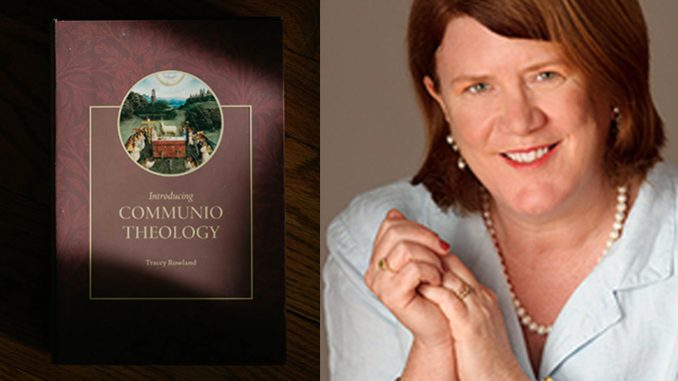
Editor’s note: The following address was given in Sydney, Australia, on February 5th, at the launch of Introducing Communio Theology, written by Professor Tracey Rowland and published by Word on Fire Academic.
The late Holy Father, Pope Francis, once described female theologians as “strawberries on the cake”.1 I am confident that he intended this as a term of endearment. Nevertheless, it obviously invited misunderstandings, implying that the “feminine genius” is merely a decorative addition to the otherwise “masculine” substance of Catholic intellectual life. But in this happy context–the launch of a marvellous new book, Introducing Communio Theology–the cake analogy, at least to my mind, proves rather useful.
Let me begin by saying that its esteemed author is no silk-soft “strawberry”—someone added ad ornamentum to the theological enterprise. Professor Rowland is a globally respected scholar of remarkable theological breadth. More pertinently, she is one of a select few within the academy who understands the suppressed theological aberrations that quietly animate “modernity” and “post-modernity—precisely because she is familiar with the influential layers of the German philosophical cake, which have been baked and, I would say, burnt over the last five centuries.
And, most important of all, Professor Rowland loves God, loves the Catholic faith, and cares deeply about the future.
It is this rare combination that enables this work on communio to make such a timely and needed contribution within our present cultural and ecclesial moment. The intended audience reflects this. As Professor Rowland herself acknowledges, one might assume that such a book would be pitched principally at those already familiar with the writings of the so-called “founding-trio” of communio–Henri de Lubac, Hans Urs von Balthasar, and Joseph Ratzinger.
However, Rowland’s target audience is actually the “younger generations of Catholics”.2
Disillusioned by the crisis, confusion, and contradiction that pervades public discourse (particularly on issues like identity, meaning, and purpose), young people today are far more theologically curious—wondering whether there is a via tertia (a “third way”) between cultural nihilism, on the one hand, and what one might call, ecclesial nostalgia, on the other. (The idea that all we need to do is “reboot” to 1958, before the “fall” that was Vatican II.) Rowland believes that a deeper discovery of communio scholarship might help Catholics to discern that third way/via tertia since it can help “separate the wheat from the chaff in post-conciliar theology.”3
As the book notes well, “communio” is not so much a theological school–like “Thomism or Scotism”–but, rather, a theological and cultural sensibility; borne out of a friendship between the “founding-trio” and finding its most powerful literary expression in the international journal of the same name. Its guiding motivation is best summarised as “unity and communion among Catholics” that flows from, rather than in opposition to, the “entire treasury of the Catholic intellectual tradition”. 4
Rowland’s book follows this same instinct. It is not a history of communio so much as a demonstration of how it can work as a grammar capable of clarifying and illuminating some of the most pressing issues of our time–from feminism to the priesthood, from ecological stewardship to secularism.
I will not pursue these topics here. It is enough to say that what Professor Rowland offers is a relevant and compelling way of navigating the present and of envisaging reform in continuity with the tradition. Instead, I thought to highlight, briefly, three recurring themes that I found particularly stimulating and encouraging throughout the book.
The first is the critique of anthropological extrinsicism, also known as the two-tiered ‘cup-cake’ approach to nature and grace; the second is its engagement with Immanuel Kant; and the third is its theological understanding of the bureaucratisation and what I would refer to as the “agencification” of the Church.5
Against Extrinsicism
One of the book’s most important claims is that the crises we face today should not be viewed as primarily moral or existential; they are intrinsically theological. Perhaps one helpful way to begin to open the door here is by asking a question that I do not think gets asked often enough: Why do we keep losing the culture wars? And why is it that, despite decades spent discerning a supposedly “secular” lingua franca, we continue to struggle to communicate—and defend—the intellectual credibility of the Church’s teaching?
The issue here, once again, is not tactical but theological. A hallmark of the communio approach is its insistence on asking what vision of reality is actually adequate to understand the Church’s present crisis. On that score, it was the work of Maurice Blondel and, more famously, Henri de Lubac, that has led to a greater appreciation for how theological assumptions about nature and grace have quietly shaped modern notions like the “secular”, “public reason”, and “sociological neutrality.”
Theological extrinsicism views nature (including human nature) as possessing its own, ontologically distinct, telos apart from grace. To return to the cup-cake analogy, “grace”, as Rowland puts it, is viewed as “merely a kind of icing or decorative ‘topper’ on the cake of nature that does not penetrate its substance…”6 As such, it became a theological commonplace in recent centuries to reject the Augustinian insight that human beings possess a natural desire for God and to decouple (ontologically) realities that “ought to be held in tension”: nature and grace, faith and reason, Scripture and Tradition, philosophy and theology.7
Rowland argues that a hallmark of communio theology is a rejection of these “bastard dualisms”, and an ardent call to Christians to stop breathing life into the idea of the secular by treating it as something philosophically neutral instead of a theological heresy. For as the Second Vatican Council famously declared in what could be considered a motto of communio: “The truth is that only in the mystery of the incarnate Word does the mystery of man take on light.”8 In other words, instead of trying to engage the world on its “own terms” by seeking some kind of correlationism with “fashionable philosophies”, we will get further if we put our faith in an explicitly Christocentric and Trinitarian vision that refuses to separate “Christian values” from “Christian sacraments”.
The Kantian Anxiety
If extrinsicism names the theological mistake, its most influential philosophical articulation can be found in the dualistic view of reality of Immanuel Kant. Rowland refers to Kant throughout the book more than any other modern philosopher.
When I arrived at the University of Cambridge in 2014 to read for an MPhil in the Philosophy of Religion, I was struck by the extent to which the metaphysics paper was structured around Kant’s First Critique. Moreover, I was even more surprised by the fact that I was often asked, particularly as a man of faith, to declare my hand as to whether I believed Kant was my “metaphysical hero”–the one who, although denying knowledge of God, made room for faith in the realm of practical (moral) reasoning–or my “metaphysical villain”–the thinker who reduces religion to nothing more than a wispy transcendentalism, void of dogma and doctrine. Such was the significance of this question that it virtually determined who you would (or could) work within the faculty.
Tracey Rowland’s book wasn’t available in 2014, though I wrote to ask her advice on how to approach Kant. Even then, she pointed me to the communio scholars, especially von Balthasar. I remember arguing–in suitably Cambridge fashion—that Kant functioned as an “epiphenomenal prophylactic”, a polite way of meeting Kantian obtuseness with my own rhetorical manoeuvring.
Rowland makes clear that another strength of the communio scholars lies in their willingness to engage seriously with figures such as Kant and Hegel. even finding reasons to respect the philosophical provocations of Nietzsche. This, to my mind, is a genuinely Catholic—and indeed Thomistic—instinct. Nevertheless, in Chapters Five and Six, Rowland shows how the Kantian notion of “pure reason” has underwritten much of the impoverished exegesis of Scripture (associated with an exclusive recourse to the historical-critical method), as well as repeated attempts to reduce Christianity to little more than a moral code/set of autonomous values.
Here she helpfully cites the words of Joseph Ratzinger, who said that: “If the door to metaphysical knowledge remains barred, if we cannot pass beyond the limits to human perception set by Kant, then faith will necessarily atrophy simply for lack of breathing space.”9
Bureaucracy and Agencification
Once faith is deprived of the metaphysical breathing space described by Ratzinger, it is no longer allowed to live as mystery and truth but is increasingly treated as something to be “managed”. This leads me to a third recurring theme I really appreciated in the book—its willingness to engage with the meteoric rise of a bureaucratic and an agencified mentality in the life of the Church.
Yet, the question that Professor Rowland presses, even if at times implicitly, is the fundamental one: What kind of theological assumptions or attitudes must already be in place for a “purely organisational or bureaucratic concept of Church” to have emerged?
This question is particularly urgent if it is indeed the case that younger generations are willing to see whether the Church can offer authentic leadership amid the confusion, grounded upon a truer vision of the human person. If so, what will they find when they arrive? A prophetically Christocentric-Trinitarian Church or a beige-boring-bureaucratic Church?
On this point, Rowland is characteristically witty and accurate, even if blunt. The latter (beige, boring, bureaucratic) is arguably the most bitter consequence of an underlying extrinsicist anthropology; haunted, even if unknowingly, by a pseudo-Kantian disavowal of sacred knowledge—preoccupied, instead, with appearances, procedures, risk-assessments, and the generation of endless committees. (What exactly these committees and agencies do often remains noumenal knowledge–only God knows–but they do, at least, give the appearance of productivity and life.) Nevertheless, “Committees [tend to] generate lowest common denominator documents and policies.” This is because “bureaucratic control”, as St John Paul II said, stifles and kills “initiative and creativity”.10 The Church and its pastoral plans begin to look and sound no different from that produced by a corporate entity.
Against this trajectory, Rowland encourages us all (though, I think, special consideration is given here again for young people and seminarians) to take inspiration from the example of the likes of Lubac, Balthasar, and Ratzinger. “One reason why the trio is so important”, she writes, “is simply that they were the best and brightest of their generations”, and, thus, they could have “so easily have sought the honours and baubles” of secular academies or ecclesiastical safe spaces.11
The reason their theology remains profound and prolific is that they refused to be “company men in beige cardigans”, imbued by an equally beige (and boring) institutional personality; always smiling but deeply concerned not to say anything that might rock the ‘episcopal-ecclesial boat’. Ratzinger “never forgot that the strongest opponents of the Nazi regime were strong-minded individuals…who were not afraid to be different…”12
Catholic theology, Catholic leadership, and Catholic cultural engagement should never be beige or boring; in fact, they should always be the most generative and prophetic discourse in existence because they are inspired by prayer (communion with God). The communio scholars insisted that the Church “must never lose sight of our eternal destination, and together with theology it must develop an anthropology which gets to the heart of the matter.”13 This is what Rowland’s book does and what the world is looking for — not a bureaucratic, agencified Leviathan, but a courageous, counter-cultural communion.
Concluding Thanks
To return, finally, to the strawberry: if the analogy ever invited misunderstanding, this book corrects it decisively. Professor Rowland’s work is not an ornament added to Catholic theology, but yet another contribution to its very substance.
On a personal note, I count it as a tremendous honour to have been asked to launch such a book. I remember that in my fifth year in the seminary, I received feedback on an essay that said my paper “relied too much on the works of Tracey Rowland” and directed me to “re-read the articles from Karl Rahner and Joseph Komonchak.” If you had told me, now some 17 years ago, that I would one day be asked to launch a book by Australia’s leading theologian, I would have laughed hysterically. But, as Ratzinger also said, “where humour dies, the spirit of Jesus Christ is assuredly absent.”14
So, on that note, I invite you to join me in congratulating the wonderful–and most decidedly non-strawberry–Professor Tracey Rowland.
Endnotes:
1 Pope Francis made this remark at a gathering of the International Theological Commission, held December 5th, 2014.
2 Tracey Rowland, Introducing Communio Theology (Elk Grove Village, IL: Word on Fire Academic Press, 2025), 8. To those less attuned to our cultural and ecclesial moment, it might be tempting to assume that such an audience scarcely exists, or, even if it does exist, it would largely be disinterested in what this text has to offer. Such an assumption–irrespective of how widespread it might be–is demonstrably false. Without question, a growing number within the next generation are open to giving God and, in particular, the Catholic faith, a second look. Various studies and statistics support this, and, in a certain respect, the collapse of things like the New Atheist movement has helped occasion it.
3 Ibid., 9.
4 As is well known, communio emerged, in part, as a response to the Concilium movement established in the 1960s, which became associated with the likes of Rahner, Congar, Schillebeeckx, and Kung. In certain influential strands, Concilium also became associated with attempts to apply Critical Theory, drawn from the Frankfurt School, to desacralize the Church’s structures in the name of “progress”. But it soon became clear that the “progress some such scholars envisaged “no longer represented a unified concept” and, more troubling still, “it was perilously close to dissociating itself from the core of the Christian tradition.” Joseph Ratzinger, Principles of Catholic Theology, 388, quoted in Rowland, Introducing Communio Theology, 15.
5 Agencification refers to the way in which large bureaucracies (especially governments) have tended to create semi-autonomous “agencies”; established with the hope of increasing things like efficiency, flexibility, and expediency. Yet, it has been argued that multiplying structures often produces the opposite effect. As responsibilities become fragmented across specialised offices, coordination grows more burdensome, and the original vision of the institution’s mission becomes harder to maintain. Although this is obviously a “secular” phenomenon, there are signs that a similar dynamic might also be at work in the contemporary church. c.f. Sjors Overman & Sandra van Thiel, “Agencification and Public Sector Performance: A Systematic Comparison in 20 Countries”, Public Management Review, 18:4, 611-635.
6 Rowland, Introducing Communio Theology, 214.
7 In other words, epistemological distinctions should not lead to ontological separations.
8 Second Vatican Council, Gaudium et Spes, 22.
9 Joseph Ratzinger, Truth & Tolerance, 135, quoted in Rowland, Introducing Communio Theology, 135.
10 John Paul II, Centesimus Annus, no. 25, quoted in Rowland, Introducing Communio Theology, 290.
11 Rowland, Introducing Communio Theology, 75.
12 Ibid., 69.
13 Joseph Ratzinger, “Communio: A Program”, quoted in Rowland, Introducing Communio Theology, 61.
14 Ratzinger, Principles of Catholic Theology, 84.
If you value the news and views Catholic World Report provides, please consider donating to support our efforts. Your contribution will help us continue to make CWR available to all readers worldwide for free, without a subscription. Thank you for your generosity!
Click here for more information on donating to CWR. Click here to sign up for our newsletter.

Leave a Reply