


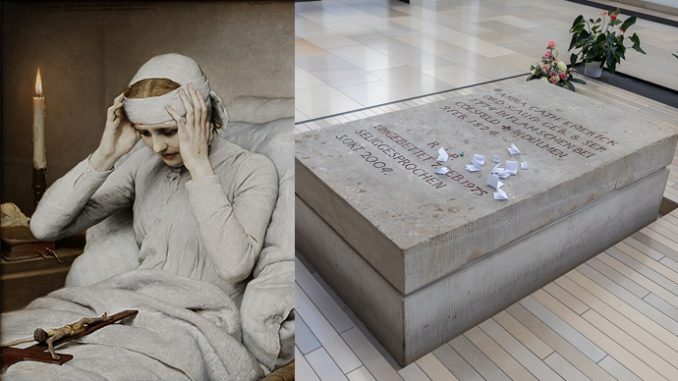
Sometimes it can take decades or even centuries for the Catholic Church to acknowledge that a holy man or woman should be considered a saint.
While Pope Saint John Paul II made the promotion of canonizations a hallmark of his pontificate, it is more common in Church history for canonizations to proceed very slowly. The Church has generally been willing to wait for many years for God to make known His will about the sanctity of a deceased Catholic. On the other hand, sometimes the Vatican chooses to delay canonizations for the sake of peace in international politics. For example, now would not be a propitious moment for the Vatican to honor the many Catholics who have died as martyrs in communist China.
However, there are other reasons that the beatification of Anne Catherine Emmerich was delayed until 2004, almost two centuries after her death. One reason is that she claimed to be the recipient of mystical experiences, even though some contemporary investigators publicly called her a fraud. Another reason is that while the writings containing her detailed visions of the life of Christ have inspired some Catholics, some have argued that the poet Clemens Brentano—who published her visions years after her death—was the true author.
Can we know the truth about this controversial woman?
Anne Catherine Emmerich (1774-1824)1 was born in a village in northern Germany. She came from a poor, Catholic family and helped on the family farm until she began working as a seamstress. As a young woman, she tried to enter multiple religious orders but was refused by them all because she did not have enough money to pay the required dowry.
One religious community finally agreed to accept her if she would learn to play the organ, and she took the position of a servant in the household of an organist, on the promise that he would teach her. However, she soon discovered that the organist and his family were penniless and often starving. Anne never learned to play the organ. Instead, she spent her wages to support the family, and her own mother sometimes brought extra food for the family. After several years, one of the organist’s daughters was accepted into a community of Augustinian nuns, and the nuns agreed to accept Anne as well.
Anne was overjoyed to finally be able to fulfill her dream of becoming a nun. However, she was ill so often that she couldn’t perform many of her assigned duties. During the times when her health improved, she was very careful about observing the Augustinian rule, much more careful than most of the other nuns in her community. Some of the nuns were inspired by Anne’s unfailing cheerfulness, but other nuns resented being upstaged by a mere novice and made her life difficult.
Although Anne was allowed to take religious vows, she was not able to live as a nun for very long. The German government forced Catholic religious communities to close, and she and the other nuns had to leave their convent.
A poor widow accepted Anne into her home as a servant. But, once again, Anne was sick so frequently that she became a tenant in the woman’s home. One of Anne’s sisters served as housekeeper instead. That’s when the news of Anne’s mystical gifts began to spread.
According to Anne’s family, Anne had loved to pray since she was a little girl. Although she could sometimes be a moody child, she was deeply empathetic toward the needs of the poor and gave generously to beggars. Anne’s childhood friends later reported that Anne was very sensitive about doing what was right and was scrupulously worried about committing even the smallest sin. She also told her friends that she had seen visions of her guardian angel, our Lord, the Blessed Mother, and threatening figures, one time in the form of a black dog.
When she was in the convent, other nuns noticed that Anne ate very little food and that sometimes when she prayed, she would become insensible to anything else for long periods of time, typically called a spiritual ecstasy. Anne suffered painful headaches, which mimicked the pain felt by Christ due to the Crown of Thorns.
Shortly after Anne was forced out of the convent and began living in a private home, her friends saw signs that she had received the stigmata. Bloody wounds appeared on her hands, feet, chest, and head, and began to bleed with no apparent cause. Witnesses said that Anne was sometimes swept away in spiritual ecstasies during prayer. But when she was awake, she was cheerful and full of love for God despite her pain. She almost completely stopped eating and drinking, and when she was forced to eat, she became violently ill. Like some other mystics of the Church, Anne was able to survive for years even though she only consumed the Eucharist.
Of course, the news spread all over town that a young woman had mystical gifts, news which eventually spread throughout Germany. Since Anne was not living in an enclosed community, visitors could—and sometimes did—appear on her doorstep and insist on seeing her. Some were pious Catholics who became regular visitors as they sought her spiritual advice and medical remedies. Other visitors pestered her with embarrassing and foolish questions, and they distorted her words to mean whatever they wanted. If Anne was in a spiritual ecstasy when these nosy neighbors showed up, she could not stop them from examining her wounds. It appears that Anne’s sister, who was often rude toward Anne, allowed these visits.
Some of Anne’s visitors were medical doctors who were certain that she was a fraud or was mentally unwell. Those skeptical doctors often changed their minds after examining her and acknowledged that she was a woman of sound mental health. They were inspired by her faith and kindness, but they could not explain the source of her mysterious wounds.
The early nineteenth century was not an easy time to be a faithful Catholic, particularly in Germany. Events like the French Revolution and the Napoleonic Wars had caused many to turn away from the Church and God Himself. The secular authorities repeatedly sent doctors to examine Anne with the intention of disproving any supernatural cause. Those doctors examined Anne’s wounds, bandaged her wounds in a way that caused her even greater pain, and assigned nurses to keep her under 24-hour surveillance. After multiple intrusive examinations, the authorities still had no proof that she was secretly eating or inflicting the wounds upon herself. Undeterred, they simply lied. They ignored their own results and publicly stated that she was a fraud.
Anne had many loyal, devout friends, including priests, who were won over by her faith, kindness, and patience in suffering. They were also inspired by her retelling of the visions she received. For example, she often described seeing events from the life of Jesus and His Mother. She told them how things looked and what people said, filling in details from the Gospel accounts that seemed surprisingly realistic to her friends. Although Anne had only a limited education and never left her native Germany, these visions displayed a remarkable knowledge of events from the Bible.
One of Anne’s most regular visitors was a German poet, Clemens Brentano. Clemens was from a wealthy family and had only recently returned to the practice of his Catholic Faith when he met Anne. But he was won over by her faith and spent innumerable hours talking to her and taking down notes about her visions.
Anne’s health slowly deteriorated, and she died in Dülmen in 1824. Her tomb was opened twice after her death because of rumors that her body had been stolen. Both times, her body was found to be incorrupt.
Nine years after her death, Clemens published his first collection of her visions, The Dolorous Passion of Our Lord Jesus Christ. Other writings followed, which have since been translated into other languages. Some of the details from The Dolorous Passion were incorporated into Mel Gibson’s famous film, The Passion of the Christ. Over the years, many scholars have examined these writings and have been surprised by the accuracy of the descriptions of Holy Land geography and history, although others have pointed out inaccuracies as well.
When Pope John Paul II beatified Anne, the Vatican noted that this was done in recognition of the heroic virtue she displayed throughout her life and of the miracles associated with her intercession. But the Vatican also carefully pointed out that Clemens Brentano was the author of the writings bearing Anne’s name. Since documents were found in Clemens’ library after his death that demonstrated he had performed his own research on the Holy Land, he could have (consciously or unconsciously) added his own research to the writings he attributed to Anne.
Modern readers may find these works either inspirational or questionable. But that does not change the fact that the evidence of her life—separate from the visions—demonstrated that she was worthy to be called Blessed Anne Catherine Emmerich.
There is another argument against Anne’s holiness related to the fact that she shared these visions with others at all. It may sound very holy to receive visions from God, but great saints of the mystical life, most notably Saint John of the Cross, have written that we should be very careful about attaching any great importance to visions. It is easy for us to misinterpret their meanings, become more attached to the visions than to God Himself, or become proud.2
However, it appears that Anne shared her visions more out of innocence than pride. After all, she did not write books or try to publicize the visions. She was bedridden and simply shared her spiritual insights, including the visions, with those who cared enough to come visit her and talk to her about God. The simplest explanation is that Anne was one of those pure souls who received visions of angels from childhood and who generally assumed that this happened to everyone. Padre Pio of Pietrelcina seemed to think the same thing.
Perhaps God granted these mystical experiences to Anne for the sake of her own salvation. Or perhaps her visions and the physical signs of the stigmata helped to strengthen German Catholics during the nineteenth century, when skepticism toward the faith was particularly widespread in society. The books containing her visions have remained popular for more than a century, have inspired many Catholics in their own meditations on the life of Christ, and, it must be noted, have not been formally condemned by the Church.
On the other hand, perhaps these visions were really intended to help one specific person get to Heaven: Clemens Brentano. According to modern biographies, Clemens lived a restless life and flitted from one emotional extreme to another. If Anne Catherine Emmerich’s God-given purpose in life included helping even one troubled soul to seek God’s grace and make it into Heaven, then she deserves the title of holy woman and—maybe someday—saint.
Endnotes:
1 Her name is also sometimes spelled Anna Katerina Emmerick. Although biographies often refer to her as Sister Emmerich, a common practice in Germany, she is referred to by her first name throughout this article.
2 See Saint John of the Cross, Ascent of Mount Carmel, chapter 19, for example.
If you value the news and views Catholic World Report provides, please consider donating to support our efforts. Your contribution will help us continue to make CWR available to all readers worldwide for free, without a subscription. Thank you for your generosity!
Click here for more information on donating to CWR. Click here to sign up for our newsletter.

Leave a Reply