


As Catholics mark the Feast of St. Josephine Bakhita on February 8, harrowing testimonies from survivors of human trafficking across Africa are shedding light on the horrendous treatment they endure.
John, a mechanic from Nigeria, is one such survivor. He recalls being trafficked to Libya in 2015 after being promised a good-paying job that would generate the income he needed to eventually migrate to Europe.
“When I got to Libya, I discovered it was all a lie,” he told CWR.
“Terrible things were done to us in that place,” he said, revealing scars on his body as proof. “Eventually, I was sold out for $300 to go and work in a mine.”
A widespread and predatory system
John’s tragic experience is not an isolated incident but a stark illustration of a widespread and predatory system. Across Africa, traffickers are using the desperation of young people searching for a better life to cash in, trafficking them under false pretenses within and across borders.
This horrifying trend is confirmed by disturbing new evidence and on-the-ground investigations, which have exposed a transnational criminal enterprise that has ensnared at least 3,000 Cameroonians—predominantly youths from the country’s conflict-ridden North-West and South-West regions, who have been forced from their homes as a result of a separatist conflict that is now in its tenth year, and that has displaced over a million people, with a conservative 6500 others declared dead.
Compiled by the Justice and Peace Commission of the Diocese of Kumbo in collaboration with partners in Nigeria, the findings reveal that these victims are lured from their homes with promises of lucrative employment. Instead, they are held against their will in at least ten squalid camps in Nigeria, where they are forced to sleep on bare floors and are subjected to horrific exploitation.
The captors use the victims as leverage to extort exorbitant ransoms from their impoverished families before ultimately selling them into modern-day slavery, a harrowing reality corroborated by video evidence and victim testimonies.
Jane, a Cameroonian lady living in Nigeria, has issued a desperate public warning after her cousin was trafficked through Nigeria, and is presumably held in one of the camps in the West African nation.
Speaking in a raw and emotional tone, Jane explains that the victim, who was promised a job in Bahrain, was lured from Cameroon through Nigeria before falling into the hands of a sophisticated trafficking operation.
She recalled that her cousin had contacted her from Cameroon, announcing his plans to travel through Nigeria on his way to Bahrain, where a brother of his awaited his arrival.
“I had to talk to him,” Jane said, her voice breaking. “I called him and said, ‘Please send me a screenshot of your approved visa… How can you travel if you don’t have a visa?'” Her cousin’s evasiveness was the first major red flag in a journey that quickly spiraled into a nightmare.
According to Jane’s account, her cousin arrived in Nigeria and was initially told he was in Lagos. However, his traffickers diverted him to a hotel in Ibadan. There, the scheme gradually came to light. The victim was told that the “brother” who was awaiting his arrival in Bahrain had been in a serious accident and had been held by the police, and therefore needed $400 to bail him out.
The traffickers, who had already collected over 700,000 CFA (about $1600) from the victim in Cameroon, seized his passport, national ID, money, and even his Cameroonian SIM card, isolating him from his family.
The last Jane heard of his cousin was that he had been taken from the hotel in Ibadan, and was being transported by bus to a location she couldn’t trace…
“My cousin has been trafficked,” she asserted, tears running down her cheeks.
Jane is now sharing the story widely on social media to prevent others from suffering the same fate. Her primary message is one of caution for her fellow Cameroonians.
“If you have anybody telling you about jobs… that you have to pass through Nigeria to get there, you should think twice. You could be dealing with kidnappers,” she warned.
Disturbing escalation
In Uganda, Sister Ritah of the PACTPAN Network has compiled facts and figures that reveal a disturbing escalation in human trafficking across the country, with official figures potentially masking the true scale of a crisis that disproportionately targets children.
While government statistics show over 1,000 cases annually, with 1,006 reported in 2023 and a rise to approximately 1,068 in 2024, independent monitoring suggests the reality is far grimmer. Over 3,200 cases and nearly 4,965 victims were identified by late 2024, of whom a shocking 2,543 were children.
The data suggest that children make up more than half of all trafficking victims, subjected to horrific abuse, including sexual exploitation and forced labor.
Despite a legal framework, including the 2009 Anti-Trafficking in Persons Act, the country’s justice system is struggling to respond effectively. The report points to a vast gap in prosecution, with only 11 convictions secured from 331 court cases in 2023. While convictions rose to 101 in 2024, they remain critically low compared to the number of victims.
Sister Ritah identifies critical challenges in fighting the scourge, including under-reporting, judicial delays, weak evidence gathering, and a critical lack of shelter facilities, which sometimes forces victims to be housed in police cells.
The grim global statistics
The International Labor Organization reports that over 50 million people worldwide are trapped in modern slavery, generating an estimated $150 billion in illegal profits annually.
Africa bears a significant portion of this crisis, with a 2018 Global Slavery Index estimating that 9.2 million people on the continent are trapped in modern-day slavery, accounting for nearly a quarter of the global total enslaved.
The prevalence is highest in Eritrea (90.3 per 1,000 people) and Mauritania (32 per 1,000), while Nigeria, Ethiopia, and Egypt have the highest absolute numbers due to their large populations.
The ILO further reports that forced labor accounts for nearly 40% of cases in Africa. However, the most common form of trafficking is forced marriage, which affects over half of all victims, as young girls and women are often forced into marriage in exchange for money, to settle debts, or resolve family disputes, leading to a cycle of sexual and physical abuse, domestic servitude, and sexual exploitation.
A continental army against human trafficking
As the crisis continues to fester and grow, the Pan African Catholic Theology and Pastoral Network (PACTPAN) has now come up with what it calls an ‘Army against Trafficking in Persons in Africa.’
The coordinator is Kenyan religious sister Leonida Katunge, who says the idea is to turn the very tools traffickers use to recruit their victims into weapons against the scourge.
“Human traffickers increasingly use social media and digital platforms to deceive, recruit, and exploit vulnerable people, especially young people seeking work, education, or a better life,” Katunge told Crux.
“False job offers, fake travel opportunities, and online grooming have become powerful tools of harm,” she explained.
Sr. Katunge stated that this year’s campaign has an intentional focus on reclaiming the same digital tools used to cause harm and transforming them into instruments of protection and hope.
This multi-faceted strategy, themed “Digital Evangelization for Human Dignity: Ending Trafficking in Africa,“ she explained, will see the coalition use social media to share truthful, life-saving information, promote safe and informed migration, raise public awareness about traffickers’ recruitment tactics, and amplify messages that uphold human dignity, freedom, and hope.
Katunge emphasized that the same platforms traffickers used to recruit will now be used to educate, warn, and safeguard.
She stressed that the campaign’s primary goal is empowerment, not fear, explaining that the objective is to ensure that people, especially the youth, can make informed choices and recognize danger before it becomes exploitation.
Katunge’s continental 23.000 strong ‘army’ recruited in nearly 50 countries across Africa has been speaking with one voice against the scourge.
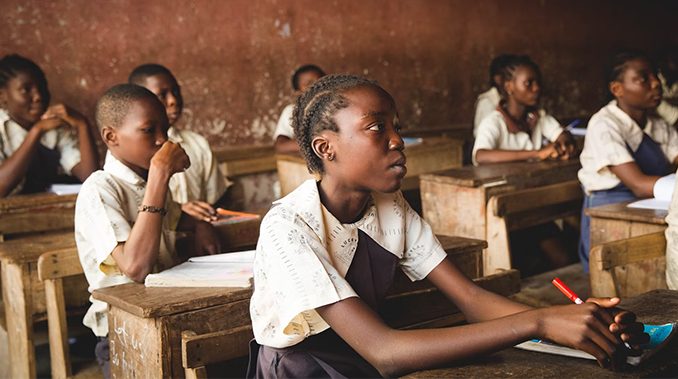
Across the continent-from Lesotho to Burkina-Faso, from Kenya to Mozambique, school kids and young people have been engaged in activities such as poetry, song, and sketches, all geared towards raising awareness against a crime of which they are largely the primary victims.
St. Josephine Bakhita: A shining light for survivors
St. Josephine Bakhita’s feast day on February 8th marks the anniversary of her death in 1947.
The patron Saint of Sudan and victims of human trafficking remains an inspiration to all survivors of human trafficking, having shown remarkable resilience as a victim herself.
Born in 1869 in Sudan, Bakhita was kidnapped at age nine, sold into slavery, and brutally tortured. She was brought to Italy, where she encountered the Canossian Sisters, chose to remain with them, and became a religious sister. Despite her suffering, she forgave her captors.
“If I were to meet the slave-traders…I would kneel and kiss their hands, for if that did not happen, I would not be a Christian and religious today,” Bakhita notably said when speaking of her enslavement.
She died in 1947 and was canonized in 2000.
“Bakhita’s story shows spiritual freedom through forgiveness despite great suffering. We gently encourage survivors toward this journey, as forgiveness can break the invisible chains left by traffickers. Her life teaches that healing is possible and true freedom begins within,” Sr. Katunge said.
The Feast of St.Bakhita will therefore be used to “center survivors’ dignity through creative expression, engage youth and faith communities across Africa and the diaspora via digital platforms, use art as advocacy against human trafficking, and foster continental solidarity through a shared virtual space.”
If you value the news and views Catholic World Report provides, please consider donating to support our efforts. Your contribution will help us continue to make CWR available to all readers worldwide for free, without a subscription. Thank you for your generosity!
Click here for more information on donating to CWR. Click here to sign up for our newsletter.

Leave a Reply