

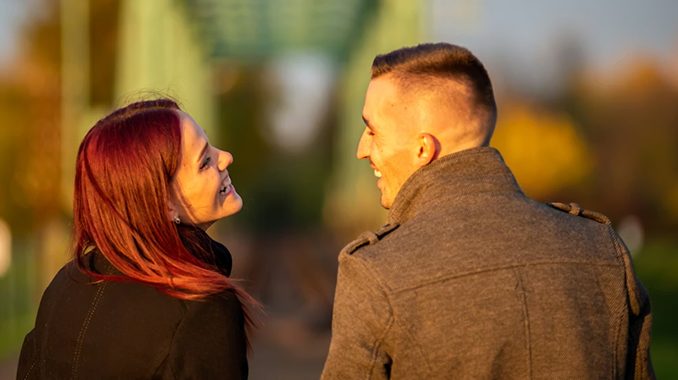
Emily Wilson Hussem is an internationally recognized Catholic speaker, best-selling author of seven books, and YouTuber who shares her faith both online and at events around the globe. After pioneering social media matchmaking posts and seeing success, she and husband Daniël Hussem co-founded SacredSpark, a new online platform to help single Catholics connect for the goal of sacramental marriage.
Daniël Hussem is a passionate Catholic with over a decade of experience in marketing, product strategy, and technology from the tech-startup world, most notably as the co-founder of Seven Fourteen Media. He holds a Master’s degree in Business & Economics from Tilburg University in the Netherlands. He and Emily live in California with their three children.
They spoke recently with CWR about SacredSpark and online dating for Catholics.
CWR: What’s your assessment of the state of Catholic dating today? What are the top one or two problems single Catholics are facing?
Emily: One of the biggest problems in dating is a real breakdown of communication. Just the ability to ask a woman on a date or talk about how you’re feeling—those skills have been lost over the years, and that has seeped into the dating culture as a whole, both secular and Catholic.
That makes the first step of dating—a man asking a woman on a date—really hard. Many Catholic singles are working on this issue within themselves, but they’re having a hard time dating because they’re meeting people who are still struggling with it.
Daniel: The other issue is, where do they go to connect and find one another? As a young Catholic single, where do you go nowadays? We try to cover both of those grounds with SacredSpark. It’s a place of online connections, for offline relationships. You don’t actually date on an app; you date in real life. It’s a mess out there!
That’s the long and short of it, and we’re just trying to do our part to bring some light and hope into it.
CWR: You recently keynoted at the Fresh Start Conference, a small, application-only conference for single Catholics. What stood out to you about the single people who attended? Were those communication difficulties confirmed?
Emily: I was blown away by how amazing the singles who attended were. What stood out to me most was their vulnerability. Some of them came very openhearted, very openly saying, “I really hope to meet my match here.” The vulnerability it took to apply and invest the ticket price, and show up was amazing. There was a lot of laughter, a lot of joy, and a lot of community at the center.
Daniel: A lot of the guys came up to talk to me, and we did see that lost art of just having a conversation. They’re always thinking ten steps ahead—should I ask her out, what if she says “No”—instead of just making a connection. So it was great to see an initiative like this, to provide a dedicated space for Catholic singles to connect, pray together, go to Mass together, and be in camaraderie together, in a low-pressure setting.
CWR: What did you see lacking in existing online dating platforms for Catholics, and how does SacredSpark supply what’s lacking?
Emily: Over the years, I’ve seen a huge struggle for single Catholics to connect with each other. It’s a well-known problem: if I’m a young woman who goes to a parish in Portland, Maine, where most people are in their eighties, it’s hard to find a Catholic guy.
So I started making matchmaking posts online. Those exploded across the internet, and there are, I think, almost 20 marriages that have come out of those posts. Meeting on social media is a wonderful thing, but it was more of a “band-aid” instead of a real solution.
So we got to thinking, “How can we create that space intentionally for them, a space that’s human, and helpful, and personal, to connect Catholic singles, not so they can date on an app, but so that they can connect in person? Maybe they live three blocks from each other, but just never had the opportunity to meet in person.”
Daniel: The matchmaking posts showed the need and desire for Catholic singles, especially younger adults, to connect. There are other Catholic dating platforms out there as well, but they tend to lean toward an older crowd now. We needed a space that’s modern and new, but also combats some of the pitfalls of online dating.
In general, online dating, especially secular online dating, is extremely superficial: people write somebody off based on a photo or a one-sentence bio, and they skip to the next one. So we wanted to create a space where intentionality is at the forefront, and that is very human. SacredSpark has audio and video prompts, so you can show more of yourself online and spark that connection, so you can then take it offline and travel toward a sacramental marriage.
Emily: For example, let’s say I’m a person who loves plants. In my video introduction on SacredSpark, I can say, “Hi, I’m Emily, and I love tending to my plants. Here are all my houseplants.” Or you can make funny jokes in your audio prompt to attract someone who would like that. We really want you to shine as the person you are, with all your quirks and your joy.
CWR: SacredSpark has a unique matchmaking feature: singles can invite a friend or family member to be their matchmaker. How does that work? And who makes a good matchmaker?
Emily: That was born out of the matchmaking posts. Someone would comment on them, saying, “My brother Justin is 31, he lives in Wisconsin, and he’s looking for a girl who loves the outdoors and wants to eat the steaks he cooks on the grill.” And so many connections happened from that! This is the tradition of setting people up, and we wanted to bring that into the digital era.
So a single can log on and invite a matchmaker, or the matchmaker can sign up first and invite their single friend to SacredSpark. As a matchmaker, I can go through the profiles on SacredSpark and send ‘likes’ on her behalf to men’s profiles. Or, if that man has a matchmaker, I can correspond with his matchmaker and say, “Tell me about your friend, he looks like a great fit for my friend, do you think they would be a good fit for each other? How can we connect the two of them?”
So, we wanted to bring that lost art of supporting singles into the digital space to make more connections.
Daniel: A good matchmaker is someone who knows your heart, someone you know and trust. We don’t want it to be a gimmick; we want it to be intentional. Also, when the single invites the matchmaker, the first thing we have the matchmaker do is review the single’s profile and see how this person is presenting themselves, and consider how they can improve their profile.
So, it creates accountability where the matchmaker can give you feedback and help you out to make a good but accurate first impression.
CWR: Can someone be both a matchmaker and single themselves?
Daniel: Yes, there is the ability to switch between the two roles.
CWR: SacredSpark launched recently, on October 29th. Can you share any success stories you know of so far, either from beta testers or active users?
Daniel: Yes, we ran a beta before launch, and we had one couple in the beta group meet, which was fabulous. Since launch, we’ve had over 13,000 matches—two people expressing mutual interest in each other.
So, it will be interesting to see the data on how many of those turn into dates, relationships, and sacramental marriages. We’ve also had some people delete or pause their accounts, indicating they met someone. We’re working on setting up an internal system that will be able to track these more accurately.
Emily: I have a personal friend who went on her second date from SacredSpark and another personal friend who went on his third date from SacredSpark recently. And we’ll have other people who tag us on social media saying they went on a date, so that is encouraging and very exciting. The good thing is, it will be growing over time, so that’s why it’s important to get the word out.
CWR: Is there anything else you’d like to share that readers should know?
Emily: We created a course called Dating 101 that’s entirely free. It’s one thing to say, “Catholic dating is a mess!” and complain and scream about it; it’s another to fix the mess.
So we very intentionally created this eight-chapter course that people can do on their own or in groups, which brings people through self-reflection and prayer with the Lord to examine the heart before jumping into the dating pool. Because part of the problem is that people don’t really evaluate their heart and consider what God is calling them to before jumping into dating—they just jump in and cause a lot of heartache and mess.
So, we encourage singles to take a step back, breathe, pray, and walk through the practicals of how you date and how you have hard conversations. We found that lots of pieces of the puzzle were missing, and we want to offer that to the Church, alongside offering SacredSpark to help singles connect after they have done this hard work.
Daniel: This course and some of the features, like video prompts, should help with the breakdown of communication we talked about before. It walks people through the practicals, like how to ask a woman out, or how as a woman to be open to pursuit, how to discern, etc.
We have a lot of other formational resources that are in the works to help with other stages of the relationship. With secular dating apps, the goal is to keep people on the app because that’s how they make money, but for us, the end goal is to get people to an actual sacramental marriage: to build up the Church one relationship at a time.
So, we don’t want to say, “Here’s a place to connect and off you go; we’ll see you at the ‘finish line’ of a sacramental marriage.” No, we want to journey with, support, and guide couples to get to that goal.
CWR: Is Dating 101 required to use SacredSpark?
Daniel: No, but it’s encouraged! We send it to everyone when they sign up and promote it. It was professionally recorded in a studio, with a lot of time and effort, so it’s great.
Emily: It’s not that you have to graduate from it in order to use SacredSpark, but we promote it all the time and say, “This is free, this is for you, and we want you to be confident and have that ability to communicate, whether on SacredSpark or out in the world.” We want Dating 101 to help singles all over the world, whether or not they’re on SacredSpark, and the reviews so far have been amazing.
Daniel: The content isn’t just stuff you can apply in dating, it’s for you as a person too, in way more aspects of your life. There are worksheets to help you evaluate past wounds and understand why you perceive people a certain way or why you look for a certain ‘type.’ It reframes things to look at things from a Christ-centered perspective.
CWR: And if two people have gone through the same course, they should have the same understanding of how to proceed with dating, right?
Daniel: Yes, it’s the unofficial playbook of how we interact and communicate on SacredSpark.
Emily: In a healthy, positive, hopeful way.
(Editor’s note: This interview was lightly edited for clarity.)
If you value the news and views Catholic World Report provides, please consider donating to support our efforts. Your contribution will help us continue to make CWR available to all readers worldwide for free, without a subscription. Thank you for your generosity!
Click here for more information on donating to CWR. Click here to sign up for our newsletter.

Old fashioned matchmaking is something needed even if it uses new fangled technology. But old fashioned Jewish matchmaking today involves credit and background checks.
Making connections is great but making sure is important, too. I’ve met several women who connected with men who later turned out to be different people than what they presented themselves to be. Trust but verify.
I am so glad I am not navigating the dating world of today and relying on digital dating.
It was an emergent phenomenon at the end of my dating days, but even then it seemed so hollow. Instead of navigating from that often defensive and awkward first meeting, discovering that other person as they discover you, people are commoditized into age, profession, interests and a whole bunch of attributes that fit your pre-defined palette.
The ability to sort on pre-defined attributes is great screening stocks or buying cars or finding restaurants or lodging, but people are not commodities or services that you buy.
It’s unfortunate that the Church -especially the Bishops that spend all their time militating for illegals, or LGTBQI+ (or whatever the hell it is now) don’t worry about the ever diminishing number of young people that are engaged with their faith enough to provide them with the opportunity to meet others when they are single and ready to mingle.
EPIC FAIL.
Pitchfork:
Well stated.
mrscracker: much wisdom in what you say.
I’ve come to think that children ought to seek out a potential spouse without actually signalling an intention to marry, have the parents meet the potential spouse and exercise veto power over the choice. Parents can see warning signs before the offspring who are smitten with emotion which clouds their judgment.
Most of all, I have frequently cautioned young people never to sleep with a potential future spouse because it will cloud their judgment about the choice (to say nothing about the morality of it).
MrsC. I don’t know if I would apply Ronald Reagan’s “Trust but verify” in this discussion. It contains an attempt to improve relations with Gorbachev. And, it worked. They became friends. Established a new world order. The Russian even attended Nancy Reagan’s funeral.
Today, it is not just connecting with a Catholic mate. One woman demanded I reveal my wealth, investments, and bank accounts.
I could not “Trust but verify.”
She has a right to your bank account info, maybe not at first, but once the relationship gets going and things appear to be moving in a certain direction? Yes, I think so.
.
It might have contained $3.24 and a lot of gambling debt, or worse. Women have to “protect” themselves every bit as much as men do these days.
I met a college educated woman who became engaged to a man who owed thousands of dollars to the IRS & presented himself as being a decade younger than his real age.No way would that have happened through a Jewish matchmaker.
These days, I can’t help but think–and I don’t really approve of pre-nups–but the so-to-be-married couple needs to meet with a 1) lawyer and 2) financial planner to make sure the money is order, and everyone understands who has what, who owes what to whom, and how they intend to handle it. Have a plan, etc.
.
I don’t think DH and I understood what we were getting into, but we had solid examples of what married/family life should be, and we made it work. Money was pretty easy back then. No debt. One (well, two) seldom used credit card.
.
Young folks today? Even my own? Yeah, not so sure about the money part. Way back when you actually handle money. Like real money. Coins. Checks sent through the mail to took a month to clear. That kind of thing.
.
Now it is all electronic and Venmo, and things don’t always happen instantly. (They’ve finally started to figure that out.)
.
The stats aren’t good for Millenials, as one I saw stated that over 40% have regular arguments about money and spending. That can’t be good for a married. Gen Z can barely read. That’s gotta be even worse.
In the past generations, they used to call dating “sparking.” My uncle was trying to spark one of the neighbor’s daughters, and as he entered into the farmhouse the father woke up in his chair and greeted Uncle E with,”Next time you come in bring an armful of wood!”
I’ve read that we shower too much and that throws off the phermones when meeting potentials.
I’ve concluded that in many cases the woman marries the man planning to change him and the man marries the woman hoping she won’t change.
Women’s liberation has not helped the marriage statistics.
That is interesting about showering. There is much we really don’t know.
There may be a connecting with women-on-the-pill “choosing” men they would not choose once they go off the Pill, and this is thought to lead to some divorces (from a study in 2008). The study is somewhat controversial though.
Matchmakers, must be a daunting “job” for sure.
I can speak of my dilemma as a single man in my forties. I did not focus on Catholic women. I knew few. I did not seek out a “matchaker”. My matchmakers were my close friends, some of whom were also seeking a mate. I did use “Online dating”. It was a disaster.
I lost my first wife at 42 and remained single for 14 years. My two sons attempted to help. What happened next was a life-changer.
We were at a YMCA dinner honoring my contributions. My son David knew a woman and introduced us. She was beautiful, loving and smart. My Catholic faith was challenged. Gail divorced her gambling husband, who had sent their family into bankruptcy. She also experienced domestic violence. We decided to get married. Our pastor, Father Damas, said Gail could not marry because she did not have an annulment. Jim would not comply. Retribution?
Given the blatant dilemma, dogma does not even consider our serious and unique plight.
We finally married and living a happy life.
“My Catholic faith was challenged.”
And it was defeated.
Do you think you are the only person ever introduced to an otherwise compatible person, only to find out the person was previously married to a nasty piece of work?
Some of us faced that temptation multiple times.
“Given the blatant dilemma, dogma does not even consider our serious and unique plight.”
There was no “dilemma”. You had a choice. You could have moved on or maintained a platonic relationship. There was no duress here. Not only does your post betray a sense of entitlement in thinking that you faced a “serious and unique plight”, I note you felt in necessary to state that you were at a dinner “honoring my contributions”.
Mr. Morgan may have been able to be married in the Church in the case of an annulment being granted, the Pauline Privilege, etc. I hope it all worked out for him & his bride. It’s good to hear about happy endings.
Unless his intended was no longer bound by her vows to her husband through the means you listed or the man’s death, then we have a Catholic in an invalid civil marriage, who should not be be receiving who is thunderously immersed in criticizing politicians and politics he dislikes, doesn’t agree with or doesn’t understand. So what’s the “happy ending”?
Again:
“Given the blatant dilemma, dogma does not even consider our serious and unique plight.”
is rather telling. Dogma is used here as a pejorative, as a capricious and superstitious stricture that is unreasonable and unaccommodating to Mr. Serious and Unique. Never mind that the indissolubility of marriage came from Christ himself.
As a younger man, I passed on multiple divorcees (no matter how compelling the cause which I never take at face value, because there’s always his side, her side and the truth) so I know of what I write. Then again, I wasn’t afflicted with Tudor Syndrome.
There was a column written after the SCOTUS took an ax to the institution of marriage with Obergefell, by a fan of the outcome (one Andrew Koppelman), but not of Kennedy’s decision in which Kopelman wrote “All of Kennedy’s worst traits — the ponderous self-importance, the leaps of logic, the worship of state power — were on display”. Never mind that Koppelman, as an adherent of the decision also displayed those traits.
Morgan D exhibited those traits in one post.
No, I think I’ve heard that about the pill’s effect.
Remember the margarine commercial, “You can’t fool Mother Nature!”?
A Socrates quote just came across my phone:”By all means marry. If you get a good wife you’ll be happy. If a bad one you become a philosopher.”
So good to see this. The cream is rising here.
Eight years ago my wife of 35 yrs passed. I was young enough to pick up life and go forward but the “dating” would be tough, mostly looking impossible because of the current state of social life. I was directed to Catholic Match, and met a woman who had also just had a similar death. It turned out well, married 7 yrs now, the proper way. Young, and old, need this, and I look forward to seeing this grow.