

 By
By Ahead of his 80th birthday, Cardinal Christophe Pierre sat down with “EWTN News In-Depth” anchor Catherine Hadro to discuss his tenure as the Vatican’s representative to the U.S.
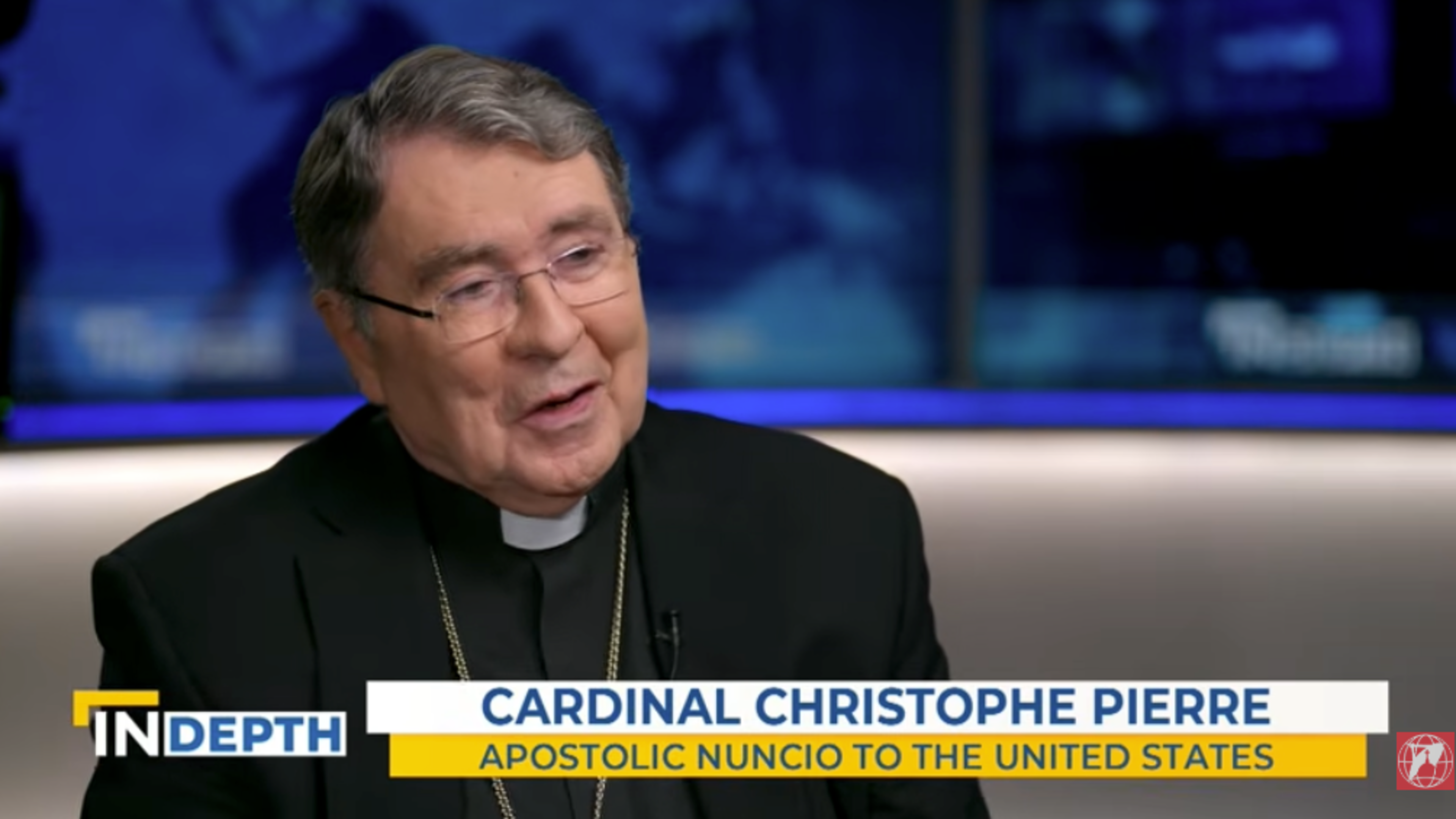
The relationship between the Vatican and the U.S. Catholic bishops is not as contentious as people might think, according to Cardinal Christophe Pierre, who offered insights into his role as papal nuncio to the U.S. since 2016 during an interview with “EWTN News In-Depth” ahead of his 80th birthday.
The French-born prelate described the past 10 years serving as the papal representative to the U.S. as “very beautiful” and “difficult” years, touching on topics such as allegations of tensions between the Vatican and the U.S. bishops under the late Pope Francis, the Synod on Synodality, the Eucharistic revival, political polarization, and immigration.
Pierre turned 80 on Jan. 30. Cardinals remain cardinals for life, and age-specific norms mean that cardinals retain their title and may continue other functions but cannot vote in papal elections after this age. Pierre’s successor is expected to be named shortly.
Pope Francis
In his interview with “EWTN News In-Depth” anchor Catherine Hadro, Pierre dispelled notions of heightened tensions between the Vatican and U.S. bishops under the late Pope Francis, saying: “We have to be very careful when we speak about the tensions between the Holy Father and the bishops. I think the tensions are normal.”
“We are not in a war,” he said. “I have never seen a war. Sometimes people have said the bishops in the United States are at war with the Holy Father. This is not true. I’ve been 10 years here, and I’ve been working in nine countries for the last 50 years, and I would not say that the American bishops have had war with the Holy See or the pope.”
While Pierre acknowledged that “Pope Francis has provoked us [at times],” the prelate described the late pontiff as “a magnificent leader,” citing his intuition and “capacity to discern where we are in today’s world.”
Though the synod often caused confusion among bishops and laypeople, Pierre noted how Francis encouraged people to “continue to work together, continue to discern, and continue to listen to each other, and to the world.”
“This is precisely what Pope Leo will do,” Pierre said. “He wants to to meet the young people, to listen to them, but also he wants them to listen to him because he’s the leader. So I think the challenges have been at that level.”
The Church and U.S. politics
Pierre stressed the need for civic actors to “to remain faithful to the mission of the Church,” which he said is “not to reproduce in our Church the polarization of society but to be a place where we can heal and help the people to rediscover unity.”
The Eucharistic revival, he said, has served as a way to “rediscover what is the center for the Church,” namely, Christ and his presence in our lives.
The nuncio warned against the temptation to become “culture warriors” in service of defending ideas and ideologies rather than “contemplating Christ in my life.”
“Sometimes we give more importance to the idea, and from idea, you have ideology,” he said. “We become defenders of ideologies.”
The Church receives the Gospel as a gift while with ideology we construct it according to our own preferences, keeping what we like and discarding what we don’t, Pierre said.
Immigration
Pierre praised the role of Church in the area of immigration, saying he has “not seen any division” on the topic. “In the Church, the bishops are together,” he said. “I am very proud of this Church.”
The nuncio stressed that a solution to the problem of immigration must be solved and encouraged Catholics to “not be afraid to speak up.” He called on elected officials to resolve the current crisis, saying: “If they don’t resolve the problem, they create the problem.”
Ultimately, he said, “the center of our message [as a Church] is the value of the human person” and noted that migrants make up approximately 40% of the 80 million Catholics in the U.S. “So should we abandon these people or not?” he said. “They are human beings.”
If you value the news and views Catholic World Report provides, please consider donating to support our efforts. Your contribution will help us continue to make CWR available to all readers worldwide for free, without a subscription. Thank you for your generosity!
Click here for more information on donating to CWR. Click here to sign up for our newsletter.
Leave a Reply