


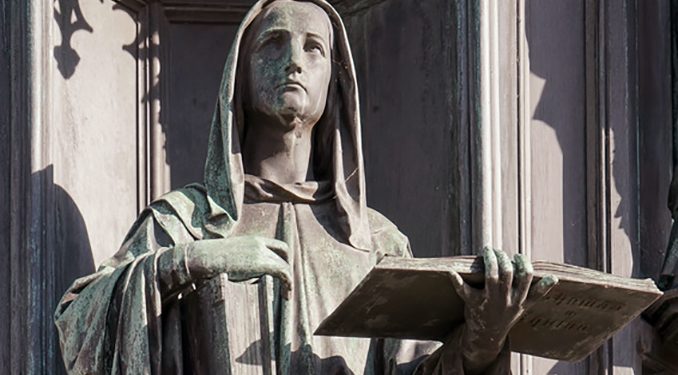
In December 2024, I had the great fortune of venerating the skull of one of my great spiritual and intellectual heroes: Saint Thomas Aquinas. We had gathered up our four kids in the minivan, driven a short distance from home, and within moments, found ourselves cranium to cranium with the Church’s Common Doctor.
What struck me that day as I knelt with my kids before the skull of Aquinas was fittingly Thomistic: the sudden hereness and thisness of this man who, for most of my life, has mostly been a kind of abstraction—an ethereal locus of ideas more than a flesh-and-blood human being. Here was the engine room of all the philosophical wisdom of the Summa theologiae; this carried the expression of the man who, navigating his particular moment in history, thought the great thoughts we now quote to no end. Thomism didn’t fall from the heavens ready-made; it needed an earthling named Thomas to hammer it up.
The relics of the saints convey to us a deeply incarnational truth: We, too, right here and now, are called to be holy as they were holy—to be imitators of them as they were of Christ (see 1 Cor. 11:1). In the case of Saint Thomas Aquinas, that holiness is bound up with the life of the mind—a sanctity whose intimate relationship with sanity is on full display.
How much does Aquinas’s luminous mind have to teach a fragmented age—one in which digital immersion decimates our attention spans, AI distorts our sense of the real, and political polarization wreaks havoc on society, from the whole of the nation down to its building block, the family? What does this saint-sage have to say to a culture deracinated from its Christian soil, drained of its philosophical weight, and struggling to stand upright in the winds that blow?
Needless to say—a Summa or two. But four lessons, in particular, seem to rise above the rest—two of which speak to his good mind, and two to the good fruit it bore.
1. Faith and reason go together—and in that order.
Thomas Aquinas, Bishop Barron wrote in his book on the man, was “a saint deeply in love with Jesus Christ.” Everything he wrote—from his Summa theologiae to his biblical commentaries to his Eucharistic hymns—was an invitation to encounter the Word made flesh. To miss this is to miss him.
Yet it’s also impossible to deny that he cuts an impressive figure across the history of ideas. From his adaptations of Aristotelian metaphysics to his famous “five ways” of rationally demonstrating God’s existence, his work has decisively shaped not only the Catholic Church but also the whole heritage of Western thought. Even Graham Oppy—“the most formidable atheist philosopher writing today,” according to William Lane Craig—stands in awe of what Thomas accomplishes in the Summa: “There will be very few contemporary philosophers who produce a work that can stand against that one.”
Thomas’s own life thus bears witness to the harmony and mutual strengthening of faith and reason, of religion and science, which are so often pitted against each other today as enemies. Yet as that life drew to a close, Thomas, after a mystical experience of things above, declared that all he had written was straw by comparison. Reason, in the end, is reduced to contemplative silence before the living God: “Those things which are of faith,” he writes, “surpass human reason, hence they do not come to man’s knowledge, unless God reveal them.”
2. Truth and love go together—also in that order.
Thomas was thus a man whose life was dedicated to truth—the truth about God, first and foremost, but also the truth about man and the world. The modern obsession with foundational certainty has given way to a postmodern obsession with deconstructing every possibility—a view from nowhere collapsing into a view from anywhere. Thomas’s pursuit of truth was both more modest than the moderns and more plumb than the posts—in a word, more human.
Yet any attempt to portray him as a cold-hearted, calculating rationalist is doomed to failure. His Eucharistic hymns reveal a man deeply in love with God and determined to love what God loves—a man for whom, love, in a real sense, has become everything. Aquinas understood, as he put it, that “the love of God is better than the knowledge of God.” After all, “even the demons believe—and shudder” (James 2:19).
But which of these aspects of human life—intellect or will, truth or goodness, knowledge or love—has primacy, in an absolute sense, over the other? We tend to jump immediately to love, and not without good reason, but Aquinas—rational and modest as he was—saw that truth inevitably takes the lead role in human life: “The true is prior to good” and “signifies something more absolute,” and “nothing is loved save what is known.”
The ultimate case study in Aquinas’s insight is love itself—a word that, divorced from truth or at least dictating it from above, has come to mean just about anything other than what it truly means: to will the good of the other. As Benedict XVI would later put it: “Truth is the light that gives meaning and value to charity.”
3. Test everything; hold fast to what’s good.
Aquinas’s harmonizing of both faith and reason and of both truth and love plays out in the methodology of the Summa—a relaxed yet rigorous approach toward just about any question about God, the world, and man the mind can conjure, including the most fundamental: “Does God exist?”
And in bringing all the powers of his soul, mind, and heart to bear on each question—objection by objection, response by response—Aquinas displays an admirable breadth, a courteous capaciousness of thought. He takes alternative viewpoints—the pagan Aristotle, the Jewish Maimonedes (“Rabbi Moses”), the Muslim Avicenna and Averroes—into careful consideration. In fact, not only does he not “straw man” opposing viewpoints, reducing them into superficial caricatures to immediately tear down; he “steel mans” them, building up the strongest case possible. Even on the question of God’s existence, he formulates a stronger case for atheism than many modern atheists do, formulating formidable objections in light of the problem of evil and the apparent self-sufficiency of natural explanations.
Aquinas—thoughtful, careful, refined, even gentlemanly—was the model interlocuter. He wasn’t scared of or emotionally reactive to another man’s opinion; confident that all truth is from God, and that truth can’t contradict truth, he steadily tested everything, holding fast to what’s good (1 Thess. 5:21).
4. More magnanimity, less vainglory and pusillanimity.
Thomas Aquinas dedicates the whole Second Part of the Second Part of the Summa to the virtues, both theological and cardinal. But he himself was a sterling example of one virtue in particular that he classifies under fortitude—namely, magnanimity (literally, “great-souledness”). That this virtue is sorely lacking today is abundantly clear; in fact, one could make a strong case that it’s the virtue of which we’re most in need, the one that could start to pull all of our frayed strings together.
Why? Because magnanimity, as Thomas defines it, is a “stretching forth of the mind to great things.” Lest we reduce this to, or paint it as, a “mere idea,” he adds that “since a virtuous habit is denominated chiefly from its act, a man is said to be magnanimous chiefly because he is minded to do some great act.” Thomas didn’t just talk about it; he was about it. He lived what he wrote: a great-souled pursuit of all reality as it is, not as we want it to be—or fear it to be.
Thomas contrasts magnanimity with both the excess of vainglory (along with presumption and ambition) and the defect of pusillanimity—that is, cowardice, or literally, “small-souled-ness.” The curious convergence of both excess and defect, of both a prideful and fearful stretching forth of the mind, is the great danger of these first decades of the internet age. And the giveaway, as Aquinas saw, is in our bodies. We have restless legs: “Quickness of movement results from a man being intent on many things which he is in a hurry to accomplish,” Thomas writes, “whereas the magnanimous is intent only on great things; these are few and require great attention, wherefore they call for slow movement.”
And we have flapping tongues (or, more often, clacking keyboards): “Likewise shrill and rapid speaking is chiefly competent to those who are quick to quarrel about anything, and this becomes not the magnanimous who are busy only about great things.”
To be busy about great things, even on, perhaps especially on, the internet—a seemingly impossible task in 2026. But with the God of Thomas Aquinas, all things are possible.
If you value the news and views Catholic World Report provides, please consider donating to support our efforts. Your contribution will help us continue to make CWR available to all readers worldwide for free, without a subscription. Thank you for your generosity!
Click here for more information on donating to CWR. Click here to sign up for our newsletter.

Leave a Reply