


In the middle of the seventeenth century, Blaise Pascal was not alone in worrying that his nation and continent were no longer Christian enough. Today, the idea of a Christian society is much farther removed from reality than in Pascal’s time, and yet, as T.S. Eliot wrote in his introduction to the 1958 Dutton paperback edition of Pascal’s Pensées, the modern world still contains a fair number of people who still find “Christianity, and Catholic Christianity, to account most satisfactorily for the world and especially for the moral world within.”
Pascal’s work offers wisdom for considering not only how to be authentic Christians in every generation, but how to rebuild Western society today based on the faith that has long defined it. Pierre Manent, the elder statesman of French political philosophy, re-interprets Pascal for our times, kindling hope for a faithful future.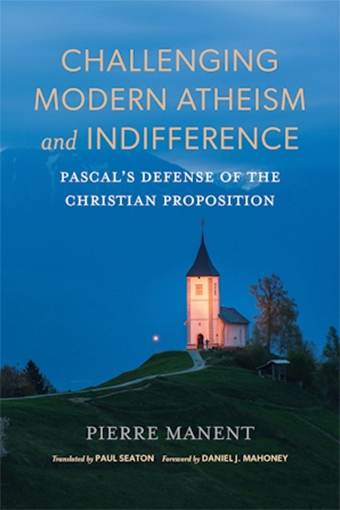
In his new book from the University of Notre Dame Press, Challenging Modern Atheism and Indifference: Pascal’s Defense of the Christian Proposition (translated by Paul Seaton), Manent begins with a blunt assessment of the current spiritual state of his home continent: “Europe does not consider the question of God, except to hold it at a distance. It only touches upon it in order not to be affected by it.” In Europe today, and arguably in the United States as well, one hardly knows where to begin examining what Christianity is, should be, or should do for the individual person. More importantly, few dare even ask about the possibility of being a Christian people. As Manent notes in an earlier work, his 2015 book Beyond Radical Secularism, Christian society has become almost overnight “a world as distant from us as the Greeks and the Romans.”
It was a glitch in the secular system; therefore, when crowds of rosary-wielding young adults surrounded the imperiled Cathedral of Notre Dame in Paris on 15 April 2019, pleading that it be spared. On that day, as Father Jean-Marc Fournier ran inside to save the relic of Christ’s crown of thorns from the flames, it was as if the highest values of a bygone age had intruded into the settled relativism of post-Christendom. A church, and by extension the Church, seemed all-important to the world again. Or perhaps a sleeping giant briefly woke up.
In such moments, the indifference to Christianity rooted in what Eliot describes as Voltaire’s “unbelieving point of view” seems absurd. We realize all is not lost. There is unruined religious territory left after all, and exciting work of restoration awaits us who believe. As Daniel J. Mahoney writes in his assiduous foreword to Challenging Modern Atheism and Indifference, “Europe cannot escape the orbit of the Christian proposition.”
We could still be a Christian we.
And yet, the impetus to keep our gaze fixed on the remnants of an incarnated divine reality quickly loses its hold amid myriad competing, individualized worldviews. Very few people nowadays are as antagonistic to revealed religion as the philosophes or the communists were, but in the context of our pluralist consensus, a faith worth dying for may seem quaint at best and dangerous at worst.
In this way, our world is not so far removed from Pascal’s. When he was born, France had recently emerged from decades of devastating religious wars, and the default mode of many Catholics was set on harmony instead of truth. Today, the situation is similar: Make peace with the world at all costs, aided by theories like denominationalism and interfaith dialogue to diminish differences. Even the most devout among us may find false wisdom in what Manent identifies as a Jesuitical tendency to “double the church,” a rhetorical strategy that softens the blows of any conflict between the sacred and the profane, supposedly keeping us all safe from the fallout of rigidity.
But there is no neutral space. In place of the old dogma has come a new version, delivered with the force of modern comforts and technological diversions.
The materialism that troubled Pascal during the mercantilist boom of Louis XIV has become more insidious in the digital age. “Instead of forcing people to obey,” Manent explains, “it will be a matter of attaching them to you by providing the goods they desire.” The keyword here is “providing,” since the face of avarice these days does not look so much like pride of possession as ease of use. “You will own nothing and be happy,” the World Economic Forum tells us. This promise of happiness is false, however, primarily because without a real sense of belonging to the body politic, let alone the body of Christ, its hearer has no deep understanding of the first word of the sentence: you.
Moreover, either through old-fashioned greed for gold or new-fangled well-enough-being made possible by video streaming and deliverable food, our material credit and spiritual debit have been universalized in a way that Pascal foresaw in 1660. Manent writes, “instead of the small number having free rein to exercise their concupiscence while the majority is forced to repress theirs,” Western post-Christians across all classes and races have equally fallen prey to what Pascal prophesied as “the great transformation.”
The filmmaker Jean-Luc Godard noticed something like this transformation when, in his 1966 film Masculin Féminin, he noted we had become “les enfants de Marx et de Coca-Cola.” Manent assesses the cultural shift more theologically, describing the choice of the peoples of the centuries-old Christian imperium “to be born anew…this time to a baptism of erasure.” On this point, Manent’s analysis is more sophisticated than just pooh-poohing dominant Liberal ideology and all of its accompanying -isms.
It was neither the storming of the Bastille nor even the Bolshevik Revolution that annihilated the priority of our Christian baptismal identity. Rather, as Manent argues in Beyond Radical Secularism, France’s collective re-baptism came not with the onset of the Enlightenment, nor with Napoleonic Gallicanism, nor even with the Third Republic’s turn-of-the-century policy shift towards la laïcité, but in the unleashing of technocratic evil associated with the Nazis and World War II. The transformation was not fully apparent for another twenty-five years, when, by the end of the 1960s, there was a general sense of exhaustion throughout the West, as if the great human endeavors were locked in our past.
Wherever we peg the turning point that led to the demise of Christianity as the organizing principle of Western societies, Pascal’s thoughts are useful in any attempt at renewal for France and far beyond. Here, Manent’s challenge to the West is sophisticated, unbound by mere nostalgia for a time when faith really mattered. As we cannot turn back the clock, undoing this “erasure” will require reckoning with present errors and finding the Word anew.
It will not do, Manent tells us, to follow the quasi-Epicurean path of a figure like Montaigne, let alone a sinister iconoclast like Rousseau, who both seek to relativize, if not celebrate, the intrinsic weakness of humanity. Manent notes that to a curious mind like Montaigne’s, there is a temptation to think that “evil has an incomprehensible place in us, and it would be injudicious to seek to extirpate all its roots from ourselves.” For the host to avoid killing himself along with his parasite, there is a strong tendency for Christians and non-Christians alike to replace the concept of repentance with “candor” or “veracity.” What matters is one’s honesty to himself more than his anguish over sin or even the hope of salvation itself. Forget about the idea of redemptive suffering.
But the dilemma of choosing either honesty to oneself or obedience to God is specious, and not just at the individual level. What has made the West great, despite its flaws, is our commitment to justice and our dependence on grace amid the reality of original sin. Our true liberty comes not from within, but by the work of the Liberator, who “reveals humanity to itself,” alerting us to a form of slavery that masquerades as freedom. Manent poetically describes this life of liberty in a dogmatic Christian community as “the grand drama of the whole.”
Here we come to perhaps the greatest selling point of Manent’s new book: his defense of Pascal’s joy, and an invitation to our own joyful existence, which is both individual and collective. Manent reminds us that our judgment of a man of faith like Pascal is clouded “because we assume the human problem is solved.” Thus, Pascal could appear even to today’s faithful Catholics as a dour Puritan who takes all the romance out of orthodoxy. In this way, Pascal’s wager, which is often oversimplified as a utilitarian bet on heaven over hell, does not exactly feel like the experience of a kingdom that has come near. Rather, according to this distortion, a life of faith feels mostly like a Sisyphean ordeal governed by fear of loss. Thus, a whole society that takes this caricature of Pascal’s wager seriously would surely feel like it inhabited a dark dungeon of superstition, which is, sadly, the way many modern people think of a time when the body politic and the body of Christ largely overlapped.
Manent insists, however, that it is the modern unbeliever who is finally joyless, and the modern unbelieving society that has no hope. In one of the most riveting passages in Challenging Modern Atheism and Indifference, Manent writes:
The Christian’s way of proceeding does not consist in banging one’s reason against the mystery, at the risk of finding in it darkness and scandal, or, on the contrary, casting imaginary “light” on it. Rather, it consists in connecting ever more closely what the mystery says with what the most common human experience says, in order to nourish in oneself the Christian experience: experience of the bondage of the will, of human liberty shackled, and the inseparable experience of a liberation, of being set free.
Manent does not mention the great French filmmaker Eric Rohmer (a contemporary of the aforementioned Godard), but I must do so briefly, as he is largely responsible for my own appreciation of Pascal as a source of profound encouragement. In two of Rohmer’s films, My Night at Maud’s (1969) and A Tale of Winter (1992), Rohmer engages directly with Pascal, suggesting a modern human destiny that bets on God’s promises for true happiness in this world, eschewing both Marx and Coca-Cola, as well as the idea of faith as a depressing this-world hedge against eternity misery. As I describe in my book The Faith Unboxed, Rohmer’s exploration of Pascal’s ideas in both of these films (and others indirectly) brings us not to an oppressive state of rigor, but to an experience of abundance. Likewise, in Manent’s timely re-evaluation of Pascal, we understand the Christian proposition offers us all “a grace that leaves little room for sadness.”
The message of Pascal is, finally, a call to conversion. Importantly, it is a society-wide conversion, which would be beneficial even to the individuals who resist it or ignore it. This conversion offers not only a better collective identity, but solid individual identities, where the exceptions to norms of Christian morality no longer have to bear the weight of self-construction and self-validation, but instead become eligible for the mercy at the heart of the majority ethos.
As Eliot said in his lecture “The Idea of a Christian Society” in 1939, “it would be a society in which the natural end of man—virtue and well-being in community—is acknowledged for all, and the supernatural end – beatitude – for those who have the eyes to see it.” Christianity, after all, is the principle that first animated the apostles as one body in the Upper Room and then eventually transformed the Roman Empire. For centuries thereafter, the Gospel has been the framework of a system that provides the largest and strongest possible “we” the world has ever known. It must be rediscovered.
Any serious Western thinker today should give thanks to Pierre Manent for reminding us of Pascal, and the enormity and urgency of his proposition. It remains an open question to many Catholic intellectuals whether Liberalism is ultimately compatible with Christianity, but if Christians are truly willing to wake up to their calling, there is no possibility of continuing to silo our faith separately from the public thing, one way or another. The mantle that T.S. Eliot laid down for the Anglosphere in the mid-twentieth century is long overdue for being picked up since, as Manent reminds us, there remains ever before us, even in this strange century, “the possibility of a God who is the friend of human beings.”
With such a magnificent target in our sights, how could we not fix our aim and take a long shot?
Challenging Modern Atheism and Indifference: Pascal’s Defense of the Christian Proposition
by Pierre Manent
Translated by Paul Seaton, foreword by Daniel J. Mahoney
University of Notre Dame Press, 2025
• Related at CWR: “Challenging Modern Atheism and Indifference: Pascal’s Defense of the Christian Proposition” (Oct. 3, 2025) by Carl E. Olson.
If you value the news and views Catholic World Report provides, please consider donating to support our efforts. Your contribution will help us continue to make CWR available to all readers worldwide for free, without a subscription. Thank you for your generosity!
Click here for more information on donating to CWR. Click here to sign up for our newsletter.

“Europe cannot escape the orbit of the Christian proposition.” We could still be a Christian we.
Being a realist and a critical thinker I struggled to find reason for promise. Where they’re “unruined religious territory left after all, and exciting work of restoration” of significance. Although I cannot resist the wit, knowledge, and faith inspired hope that would.
No need to recount the enormity of the moral, intellectual debacle we’re aware of. To recover. That requires theological hope, certainly a virtue not to be ignored.
We read: “As Eliot said in his lecture ‘The Idea of a Christian Society’ in 1939 [lectures], ‘it would be a society in which the natural end of man—virtue and well-being in community—is acknowledged for all, and the supernatural end – beatitude – for those who have the eyes to see it’.”
Also from Eliot:
“We are always faced with both with the question ‘what must be destroyed?” and with the question ‘what must be preserved?’ and neither Liberalism nor Conservativism, which are not philosophies and may be merely habits, is enough to Guide us [….] But the Church cannot be, in any political sense, either conservative, or liberal, or revolutionary. Conservatism is to often conservation of the wrong things; liberalism a relaxation of discipline; revolution a denial of the permanent things” (“The Idea of a Christian Society,” Harcourt, Brace & Co., 1940, pp. 14, 102). In his Preface, the Anglican Eliot expresses his indebtedness to the Catholic Christopher Dawson and Jacques Maritain.
About “revolution” versus “the permanent things,” we are delighted that the now concluded consistory of cardinals in Rome didn’t wallow in the hermeneutics of discontinuity—the swampy “paradigm shift” thingy.
A very interesting and helpful article. I look forward to reading both Manent’s and the author’s works.
Petiprin braves this flow-through positive presentation of Pascalian logic, knowing there is a Pascal skeptic lurking in these comboxes. What I see is constructive Pascalism, where his ambiguities are arranged in such wise as to come out like blooming roses.
One example against, in my view, this here is contrary to VATICAN II:
‘ This conversion offers not only a better collective identity, but solid individual identities, where the exceptions to norms of Christian morality no longer have to bear the weight of self-construction and self-validation, but instead become eligible for the mercy at the heart of the majority ethos. ‘
And it exactly captures Pascal.
Another, that the wager can easily be joyless and ugly and insincere.
Further, separately, notwithstanding the proposition that the wager would not go into rigour, it is not showing anywhere where it DIDN’T go back into the same rigour in which Pascal was immersed, in those times. Where are the conversions of that milieu? Not even Pascal himself. It was all papered-over acceptance which the immediate biographers multiplied.
This does indeed describe those situations back then and the resistance abiding there, which is NOT “our experience of the wager” -:
‘ Here we come to perhaps the greatest selling point of Manent’s new book: his defense of Pascal’s joy, and an invitation to our own joyful existence, which is both individual and collective. Manent reminds us that our judgment of a man of faith like Pascal is clouded “because we assume the human problem is solved.” Thus, Pascal could appear even to today’s faithful Catholics as a dour Puritan who takes all the romance out of orthodoxy. In this way, Pascal’s wager, which is often oversimplified as a utilitarian bet on heaven over hell, does not exactly feel like the experience of a kingdom that has come near. Rather, according to this distortion, a life of faith feels mostly like a Sisyphean ordeal governed by fear of loss. Thus, a whole society that takes this caricature of Pascal’s wager seriously would surely feel like it inhabited a dark dungeon of superstition, which is, sadly, the way many modern people think of a time when the body politic and the body of Christ largely overlapped. ‘
Pascal’s ambiguities in thought, mode of actions, non-affirmations subsequent to the bull, would fit to the condemnations.
https://en.wikipedia.org/wiki/Cum_occasione