

“To understand the depth of the issues and why Leo might be the perfect man for the job,” said Ken Craycraft in his CWR review of Christopher R. Altieri’s new book, Leo XIV: The New Pope and Catholic Reform (2025, Bloomsbury Continuum), “the reader can do no better than to take up and read Christopher Altieri’s insightful and engaging book.”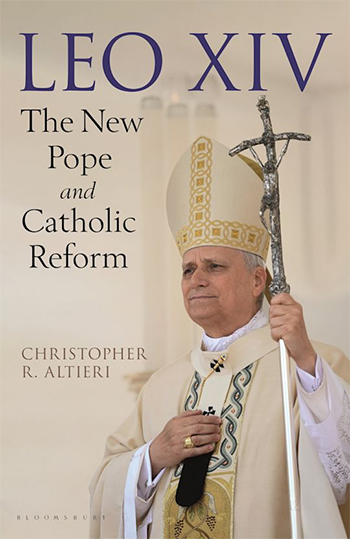
“Chris Altieri offers more than insight into the background and thinking of Pope Leo XIV, as important as that is,” said author and CWR contributor Amy Welborn.
“In lucid, balanced prose,” Welborn said, “[Altieri] provides a cogent, honest, wise analysis of the situation of the Church in this present moment in a way that few other authors are managing right now.”
Altieri’s analysis, she said, is “grounded in the historical, theological and spiritual realities of the Church as it is and as it is called to be in this broken world, so needful of the Gospel, clearly proclaimed and confidently—and competently—shared.”
John L. Allen Jr. of Crux, where Altieri is Senior Editor for News and Affairs, praised Altieri as “a provocative and passionate writer, with views forged by decades of experience and a deeply original intelligence.”
“He’s never been better than he is here,” Allen said, “as he plumbs the early promise of the papacy of Leo XIV, from the tri-cultural character of the new pope’s formation to his roots in a distinctly Augustinian spirituality.”
“While it’s all compelling,” Allen said, Altieri is especially to be read on the looming challenges of institutional reform—which, as ever, is where the rubber truly meets the road.”
“This is essential reading,” Allen said, “not only on the pope but on the Church in our times.”
Long-time readers of CWR should not be surprised by such assessments, as Altieri’s informed and careful analysis has appeared regularly in these pages over many years, couched in lively prose conveying sober judgment.
CWR spoke with the author recently.
CWR: Writing and publishing books about rapidly changing current events is a challenge. What are the basic strokes of how this book came about following the election of Pope Leo XIV?
Christopher Altieri: Well, without saying too much, Dominic Mattos of Bloomsbury Continuum approached me in May—we have a mutual friend who made introductions—and asked whether I would be able to write something in the way of biography, on a very tight production schedule. If memory serves, I countered with the suggestion of something biography-adjacent, which would point toward the need for a full biography of the man in the office, but focusing itself on the office and the circumstances of the Church into which the new man—Leo XIV, it happens—had come.
I felt—I knew—I had no shortage of useful things to say about that latter subject. Indeed, I had said many of them, piecemeal, over the years—and decades—in this job. The challenge, for me, was to pull them together and then to see for myself what I really thought of the situation broadly and generally, without losing sight of the particulars.
If I may put it this way: I felt a little like the plumber you call after giving yourself a headache trying to DIY a persnickety bit of home repair. He comes in, pokes around a little bit, bangs on something or other, makes two turns with his wrench that fix the problem, and sends you a bill for $1000.
You’re not paying for the fifteen minutes he spent on your issue. You’re paying for the decades of experience that gave him the wherewithal to come in and solve it for you in fifteen minutes, without tearing out walls and pipes.
Now, the big difference between me and the plumber is that I don’t actually fix anything. I only share my view of the papal office and of the Church in this historical moment, one view that is—I hope—informed and clear-eyed.
CWR: So, what is the state of the papacy in 2025, and what are the biggest challenges faced by the new pontiff?
Christopher Altieri: Mrs. Altieri would be very sore with me if I answered that fully—she wants folks to have to buy the book—but I can say this: It seems to me that the papal office itself has developed over the course of the past century, and especially in the rough half-century since Pope St. John Paul II came into it, from a Roman office with universal jurisdiction to a global office centered in Rome.
Only a little more specifically, the challenges facing the pope—whoever he is or may be—in the middle of the 21st century are primarily problems of governance.
I do not think we are used to thinking of the papacy—the papal office—as an office of government. I’ve said elsewhere, probably in the pages of CWR, that doctrine is important in an “Is the earth still orbiting the Sun?” sort of way, while governance is concerned with whether the house is sound. In the great scheme of things, it is far more important that Earth continue to orbit the Sun.
Doctrine has a way of taking care of itself—a long and frequently, even invariably messy way, but a way—but if the house needs maintenance and frequent repair, especially if it is a big old house. If the house is on fire, Earth’s regular orbit will not put the fire out.
One way to understand the dogma of indefectibility and that of infallibility is as a guarantee that it will, even despite the very best efforts of clerics from the pope to the last parish curate.
Here too, however, the business is complicated by the ineluctable fact that matters of doctrine and matters of governance are wrapped up with one another.
CWR: Almost no one thought Robert Francis Cardinal Prevost OSA could or would be elected pope. Looking back, as you do in the book, should that reasonable assumption have been qualified and his odds shortened? Why do you think he was elected?
Christopher Altieri: His election certainly surprised me. I talk about my real-time reaction to the news in the book. I was live-to-air when it happened. In fairness to everyone who discounted him, though, the man who became Leo XIV gave himself impossible odds heading into the conclave, too, and for much the same reason those of us who discounted him did: The cardinals would not elect anyone from the US.
While I was recovering from the shock—it began almost as soon as I recognized his name and continued as I waited to return to air—I realized how well he fit the profile of the fellow for whom I thought the cardinals would be looking. I know I wrote about that profile with CWR readers. Basically: An institutionalist who isn’t a cog in the Roman machine, someone with knowledge of the Church’s international role and global footprint who is not a career diplomat, a fellow with stage presence—the ability to carry an audience in several languages—but who does not crave the limelight and who would be willing to stay home and govern, and—finally—someone whose leadership record on clerical abuse and coverup could sustain almost immediate and searing public scrutiny.
On that last point, especially, the man we now call Leo XIV had weathered a couple of major storms. His skeletons were out of the closet, in other words. That was the best for which the group in the Sistine could reasonably aspire, I think.
As I read and thought and spoke with people, it became clear to me how his Augustinian spiritual formation and his time in global leadership of his Order of Saint Augustine both contributed to his profile, as did his training and experience as a canon lawyer.
I could say much more, but I don’t want to give away the store.
CWR: You are especially interested in how Leo’s Augustinian background will guide and focus his governance. How do you think that will look and work?
Christopher Altieri: I really want to know, too. I had a piece in Crux recently, in which I said that we would only really enter the “Leonine” era after the extraordinary consistory on January 7-8 of the new year.
That said, I think the keys to understanding him will be his thoroughly Augustinian anthropology, already evident in his speeches and homilies, and in his equally Augustinian sense of history as a mode of consciousness, an attitude of the soul, and, when it is infused with the theological virtue of hope, an aptitude of the spirit.
CWR: The rapid rise of AI and related technological changes has been remarked upon several times already by Leo. What sort of background and experience—theological and pastoral, especially—does he bring to the topic? And how important will this be for his pontificate and for the Church?
Christopher Altieri: It will be crucial, indeed, one of the measures by which the success or failure of his pontificate will be gauged. If I have my man, however, Leo will work to leverage what Pope St. Paul VI called the Church’s “expert[ise] in humanity”—the profound and perduring anthropological insights of which the Church is custodian and carrier—and to bring that expertise to bear on the social and civilization disruption we are all experiencing
I expect him to try to do that in a way that recovers and retrieves a coherent notion of nature—especially and particularly of human nature—and to articulate it in terms accessible to persons in the 21st century.
It is a tall order.
CWR: You examine in detail the financial challenges (and scandals) in the Vatican. Leo has remarked that there is work to do on financial reform, but he has discouraged apocalyptic rhetoric around the state of Vatican finances. What do you make of his approach to what has been a crisis for quite some time now?
Christopher Altieri: One really interesting—and possibly telling—thing Leo did in the first months of his pontificate was to reverse a 2022 decision of Pope Francis, who had ordered all curial offices to move investment funds to the Institute for the Works of Religion, the IOR or “Vatican Bank” as it is commonly known. Leo rescinded the order and once again permitted curial departments to use institutions outside the Vatican for investment activities.
There was little in the way of explanation from official channels, but the fact of the reversal was news in itself and showed a leader willing to part ways with his predecessor on such matters.
If I may return, just a little, to your earlier question about Leo’s Augustinian experience and formation—here I mean specifically his formation in the Order of Saint Augustine—it is noteworthy that his two terms in the global leadership of his Order exposed him to the challenges of limitless demands on all sorts of resources in conditions of perpetual scarcity.
Managing the tensions that such circumstances inevitably engender always requires both ruthless mission discipline and real human sensibility.
CWR: You worked in the Vatican communication apparatus for many years, and you also know it well as a journalist. The problems with Vatican communications, you argue, are structural and cultural. Can you remark on both?
Christopher Altieri: I almost said, “Happily,” because I nurture fond memories of my Vatican service—more than a dozen years of it at Vatican Radio and, at the tail end of my time, in the Secretariat (now Dicastery) for Communications—and I continue to be in awe of the competence and downright grit of many professionals who work in the Vatican’s comms apparatus.
To be frank, however, it is something of a sore subject for me.
Those professionals are hamstrung by a siloed system that does not understand their work or even try to understand it, often as not, and are frequently stymied by principals formed in a top-down leadership culture that literally does not know how to rely on the knowledge and experience of its own people. Curial culture produces senior leaders who ignore advice and in fact frequently do not ask for it. Curial culture discourages and sometimes actively punishes initiative.
For what it’s worth, I think Pope Francis understood this facet of the problem very well.
G.K. Chesterton has a line somewhere, about the reformer always being right about what is wrong, and generally wrong about what is right.
That line comes to mind in this context.
Francis’s solution—not only insofar as Vatican communications are concerned—was to govern largely without his curia.
I do not know whether Leo will be able to make much—or any—headway in these regards. My crystal ball is on the fritz. That said, I do think he understands instinctively or intuitively that repair of the Vatican’s communications culture specifically is mission-critical, and for one very straightforward reason: The Church’s whole purpose is to communicate the Good News of salvation to the world.
CWR: From our work together at CWR, I know how central good governance and authentic justice are when it comes to the Vatican, and both are discussed often in your book. Can you share with readers some of your more specific thoughts and observations on both, and discuss how they are related (or should be) in the reality of Vatican affairs?
Christopher Altieri: Now, you’re tempting me, Carl. You and I could go for hours on this—we have gone for hours on this—but for now, I will resist the temptation, and invite readers to get the book.
I will say this, though, just a taste of the sort of thing they’ll find when they do, an idea readers of CWR will recognize as one I have often discussed: Catholics have a right to good government. They have a right to knowledge of the character and conduct of their rulers in the faith. They have a right to know how their money is being spent, and to know what churchmen charged with the conduct of justice—a public good—are doing in the name of God and His holy people, the Church.
If people cannot trust clerical and hierarchical leaders to tell the truth about such relatively minor things as what they’re doing with people’s money, or with more important things like the administration of justice, then people cannot trust clerical and hierarchical leaders when they tell them that God took human flesh and died for our sins and rose from the dead to draw us into the very inner life of His divine Trinity.
I do not think it is moon-eyed for people to expect that the pope and the Vatican should strive to lead by example in these regards.
That said, the Church is a power structure—at least, she has a power structure—and where there is power, there will be abuse of it.
The work of journalists—if I may use a baseball metaphor—is not so much to call balls and strikes as though scribblers were umpires. The work is to call the game, sometimes like a play-by-play announcer and sometimes as an in-studio game analyst. Color commentators have a place and a role in this, too, but there is no following the game if their voices are all you have to go on.
CWR: Without trying to don any prophetic work wear, what do you think we might see in Leo’s pontificate in the next few years?
Christopher Altieri: I think I mentioned my crystal ball being fritzy, so, let me hedge a little with this while I try to give you an answer worth the name.
Basically, I expect the Leonine pontificate to be a work of consolidation and absorption—to say it with terms borrowed from the great veteran Vaticanista, Andrea Gagliarducci, who is a dear old friend as well as a fellow scribbler.
I know that many people have been hoping the new pope would act with great alacrity to reverse some of his immediate predecessor’s measures. That has not happened, and I can’t say I am surprised it hasn’t happened. I always thought people nourishing those hopes were bound to be disappointed.
Almost as soon as I knew the cardinals had elected Prevost as Pope Leo XIV, however, I knew that the folks hoping for perfect continuity with Pope Francis were going to have a hard time, too, and even that they were going to have the harder time of it.
Exactly how Leo will go about that work, and how well, remains almost entirely to be seen.
The strength of my book, if I may say so myself, is in offering a view of what the work really is, hence what it will necessarily entail, and about why the cardinals looked to Leo as the man to whom they would entrust the moment.
I have tried, in other words, to capture and bring into hard focus the real circumstances of the Church Leo XIV must govern and of the world in which he must govern her, situating that view within the scope of recent events, while also embracing the sweep of history that sees the Church as at once militant and peregrine, on her way to eternity.
CWR: Any final thoughts?
Christopher Altieri: Only to say how grateful I am to CWR and to you, not only for the opportunity to talk about my book, but also—especially—for the opportunity to contribute to these pages over the years, and to say how fondly I hope to be a part of this work in the new Leonine era.
If you value the news and views Catholic World Report provides, please consider donating to support our efforts. Your contribution will help us continue to make CWR available to all readers worldwide for free, without a subscription. Thank you for your generosity!
Click here for more information on donating to CWR. Click here to sign up for our newsletter.

A great discussion between 2 trustworthy men.
As to justice and governance, the Augustinian principle is the candid assertion that all people, absent God’s divine influence, tend toward choosing to sin.
As to doctrine and governance, these are, as Chris Altieri put it above, all wrapped up together, along with justice. Without going into naming names (though names have been mentioned here in the pages of CWR, and elsewhere), when men don’t even pretend to hold and teach the very Gospel itself, and they are made priests and bishop and cardinal (and Pontiff), should anyone be surprised that the Church becomes incapable of governance?
But in the end, there is Hope, in Jesus Our King, who became flesh, and sacrificed Himself, the rose from the dead, to teach us what Truth is all about.
God bless all who persevere in Hope.
This is a rather lengthy and worthy article that basically tells us nothing.
Altieri kept his cards close to his chest.
Altieri: I expect him to retrieve a coherent notion of human nature accessible to persons in the 21st century. A plausibly addressed if.
All swirls around this one issue. What man is, for the Christian not as defined by contemporary culture rather as revealed by God in the Son of man.
Fr. M:
Precisely…thank you…and Amen.
True, Father.
“his roots in a distinctly Augustinian spirituality.”
Apparently this is not so.
“Chesterton has a line somewhere, about the reformer always being right about what is wrong, and generally wrong about what is right. Robert understands that there appears to be division in Christ’s Church, but he fundamentally does not understand that we can know through both Faith and reason, that this division is due to those who reject The Deposit Of Faith, and in reality, have ipso facto separated themselves from The One Body Of Christ by rejecting Sacred Tradition, Sacred Scripture, And The Teaching Of The Magisterium Of Christ’s Church Grounded In Sacred Tradition And Sacred Scripture, The Deposit Of Faith Christ Has Entrusted to His Church For The Salvation Of Souls.
https://www.semperreformanda.com/de-unitate-ecclesiae-on-the-unity-of-the-church-by-augustine/
https://strangenotions.com/augustine-faith/
Not sure that a full book on Leo’s papacy is appropriate at this point. after all, he has been in office less than a year, so what exactly is Altieri writing about? We have very little information about Leo in terms of who he is as a person and what his priorities will be as pope. Maybe we should wait and see how things unfold.
Altieri holds his cards close to his chest! 🤗
We are poped out after Francis. We needn’t hear from a Pope everyday on all sorts of opinions. All Pope Leo has to do is throw out Traditionis custodes and end all speculation for women ordination Ex cathedra and the Church will be renewed and revitalized. Mission accomplished!
Reading the recent and future path under Pope Leo XIV is still a bit like reading braille through a mattress. But yours truly is encouraged by significant details…
FIRST, about women ordinations, for example, a recent press release (I failed to save the link) of the relevant “expert Study Groups on ‘hot button issues'” reported that the controverted agenda toward deaconesses is totally off the table; and that activism toward mainstreamed homosexuality is at least demoted from the legitimacy of a “controversial issue” to the lesser status of only an “emerging concern.” Apparently, some things happened before the January 7-8 event to at least sanitize the consistory of cardinals.
SECOND, generally, it also seems that the entire battery of more than a dozen Study Group reports launched by the Synod on Synodality—and scheduled to report in December 2025—was gracefully submerged and even replaced by the consistory. The silence says much.
THIRD, at the consistory Pope Leo noted that he would be working most closely with his dicasteries—after encouraging less bickering among the dicasteries, reported a few days earlier—rather than possibly having them effectively upstaged institutionally by geographic congregationalism …the synodal process involving “continental synods” as earlier proposed by Cardinal G. to then front-end a grand synod in Rome (rebranded earlier this year as the “2028 Ecclesial Assembly”).
FOURTH, the consistory was framed as less of a fluid roundtable event than an institutional dialogue between the papacy and ALL of the cardinals. Not the alternative of national groupings (e.g., der Synodal Weg?), and not excluding the experienced and sidelined cardinals beyond the age of 75.
FIFTH, Pope Leo anchored future work in the starting-block Vatican Council and its Documents….Recall that Pope Benedict clearly contrasted the “real Council of the Documents” (!) from the “virtual” Council of the media, that is, the detached “spirit” of the Council–of which the curiously self-referential synod-on-synodality (say what?) seemed a late stage in devolution.
SIXTH, yes, the theological and moral outlier Cardinal Radcliffe gave the keynote verbiage at the consistory, but all in all, the emerging picture seems to be one of careful zig-zag navigation through the flotsam-and-jetsam “mess” of the past decade and decades. A near-term path that protects the Barque of Peter from subversion just as it did Navy ships in World War II from submarine attacks.
SUMMARY: Considering these Braille points of restored governance, all looks well after less than one year. Continuity with the real Council and with all three of the subsequent popes.
Peter D. Beaulieu:
I want to have some level of the hope you expressed. It would be fortified if the powerful statements made by Cardinal Zen on 1/8/26, highly critical of the synodal process, complete with noting its blasphemous abuse of the Holy Spirt, were actually delivered directly to the consistory, or was it just a sidenote. If it was direct, it might be a salvo for the start of a counter revolution.
If Mr. Olson reads this, please consider publishing Cdl. Zen’s statement and note its context.
Vaticanese is a specialized language of its own. Subtle signals not even in words can tell all, and with no blood on the floor. Here from the back bleachers is more of my uncredentialed intuition…
Three points and a proposition:
FIRST, as an apparent fifth-column agenda to effectively replace the sacramental/governance structure of the Church—the “hierarchical communion” (Lumen Gentium, Chapter 3 and the Explanatory Note)—with only an ongoing theological/sociological “process” or a “congregational” (c)hurch. . . a so-called synodal “paradigm shift” in this form (a form!) now will fade into the wallpaper. Instead, simply a “style” of listening as already in the many pastoral and parish councils.
SECOND, retained will be a valuable style as with Pope Leo engaged with all of his cardinals (not simply the recent inner circle). And, rather than a layered exercise of more local, regional, and continental synods all pointing to a third and self-validating (!) synod-on-a-synod-on-synodality as proposed in early 2025 for 2028.
THIRD, now, about the style (no longer the process as a de facto structure), Pope Benedict XVI already credibly and more accurately addressed this legitimate need decades ago. Not the recent adulteration of a distinct “synod ‘of bishops’” but an overlapping “ecclesial assembly” or–“Communio” (think, too, of his journal by that name in counterpoint with the alternative “Concilium” journal).
Benedict XVI (then Ratzinger) used these terms (not “synodality”) when he reflected on the partial loss of the “Ecclesial Assembly”—or “Communio”—following the Council of Trent. In response to the Protestant rupture, Trent clarified Church teachings, and restored the sacramental Apostolic Succession and the ordained priest as more than a seeming “cult-minister” (his words), but as a bearer of sacramentality through Holy Orders. (More than sola Scriptura.) This response also entailed an unfortunate “separation” (his word) of the baptized laity from the baptized-and-ordained clergy—again, a lessening of “Communio”—”the problem of the laity, which arose at this time and still haunts us today” (Ratzinger’s words, “Successio Apostolica,” as Chapter 2 in “Principles of Catholic Theology,” Ignatius, 1982/Ignatius 1987).
PROPOSITION: The consistory of cardinals meeting with Pope Leo seems less a continuation of the so-called magisterium of Francis I than a recollection of the overall magisterium of the perennial Catholic Church. A wise substitute for layered synodality in 2026 to 2028? No clumsy course reversal with false martyrs. But also a competent/less-deforming effort to simply foster so-called synodal “listening.” In one phrase: no longer carelessly casting the Successors of the Apostles congregationally–“primarily as facilitators” (the synodal “Vademecum”).
JBG:
JPII already ended all speculation for women’s ordination Ex cathedra. But with a wimpy level of orthodox defenses of the faith over the past 13 years, even defined teaching is easily ignored.
The church is in apostacy. Pope Bergogoio created a mess that can only be resolved by Divine intervention. “Bishop against bishop and cardinal against cardinal and the church will be full of those who accept compromises” –Akita. Leo is following the Bergoglio new synodal church. He meets with James Martin. Timothy Radcliff is still giving the synod “spiritual” reflections. Get a grip on reality on the state of the church.
Leo blessed a block of ice with Arnold Swartzenegger. That’s all I need to see.
The word REFORM has historically negative résonances for Catholics.
The many protestantisms, products of wo called reform, are for ever performing makeovers of their novel thing,
Popes should stick the apostolic brief.
Wonderful.