


Christmas is the season of pondering the paradox of the Incarnation itself. What was found in the stable at Bethlehem was far greater than everything outside. This is no mere poetic exaggeration. The infinite God assumed a finite human nature. What was in this child, no bigger than a breadbox at first but soon to grow in wisdom and stature, was the Divine Nature that is far more vast than the starry sky above.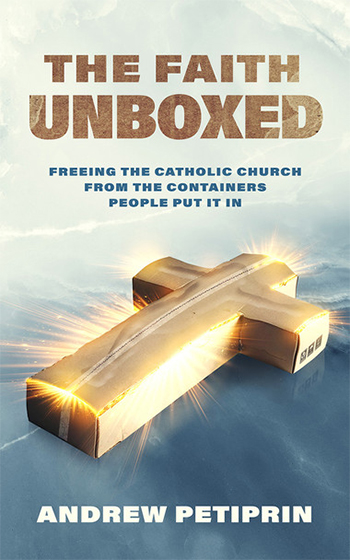
All true Christians ought to (and many do) acknowledge this mystery and so want to keep Christ in Christmas. The more difficult part is keeping the Mass in Christmas—or, at least, the idea of the Mass celebrated in communion with the bishops in communion with the bishop of Rome. From both outside and inside the Church, there are intellectual and spiritual barriers to seeing the Catholic Church as the Body of Christ and thus bearer of the infinite. Some of these barriers are simply the scandals that arise from a Holy Church attaching to herself those whose holiness is rudimentary at best and mostly potential. Like Jesus, the Church dines with sinners and welcomes their company. It is simply another aspect of the Scandal of the Incarnation. Why would God not only take on a finite human nature but also associate with those who have soiled it so?
There are a great many other barriers that stand in the way of potential converts and push out Catholics with difficulties who are looking elsewhere for a spiritual home. Andrew Petiprin’s 2025 book, The Faith Unboxed, was written with an eye to helping both groups. An author and former Episcopal clergyman with degrees from Yale and Oxford, Petiprin came into the Church in 2019. He has served as a fellow at the Word on Fire Institute, founded the Spe Salvi Institute with Bobby Mixa, and published books and articles.
As his title hints at, and his subtitle, Freeing the Catholic Church From the Containers People Put It In, spells out, the barriers are really those misguided ideas people have about what the Church is—but, in fact, isn’t—that get in the way of seeing her as the Body of Christ. The Church is the way to Heaven, not another merely human group about which one can say, as Flannery O’Connor did of a merely symbolic Eucharist, “To hell with it.”
The main problem, as Petiprin explains in his introduction, is that the Church “fits no categories and resists all labels.” Like Jesus, whom the people of his day could only understand in the categories they knew (“Some say John the Baptist, others say Elijah, and others Jeremiah or one of the prophets”), the Church cannot be understood as completely opposed to the ideas people have of her. Nor can she be understood only within them.
Thus, the intellectual boxes that Petiprin covers in his eight chapters—Church as ideology, denomination, religion, institution, club, escape, dictatorship, and preference—all possess truth to them.
For instance, in the first chapter, Petiprin observes that the word “Catholicism” never appears in the Catechism of the Catholic Church nor in any other Catholic Church documents that he can find. The reason is that Catholic faith is not an “-ism,” an ideology that promises to solve every conundrum or explain every difficulty we have. The Church does indeed teach certain truths as absolute and not subject to falsification. The Catholic faith is not that Jesus is probably God, murder is wrong in most situations, or the Eucharist is the Body, Blood, Soul, and Divinity of Christ pending further experiments. Yet the Church does not hold these truths as if they replace the need to use our natural reason to figure things out nor a tool that can get us around natural truths nor a blow torch that clears off every cloud obstructing our view of what God is up to amid the mess. “Like the story of Israel in the Old Testament, the story of the Church is about not the triumph of a way of thinking, but the embrace of a way of life.”
The reader of this review might, with justification, be a little bit skeptical. Can you have a way of life without a way of thinking that guides it? I don’t think Petiprin intends to downgrade the idea component in the chapter, but someone who reads only this chapter might come away thinking it goes a bit too far in downplaying the truth of life in favor of the way. That may well be because Petiprin sees his likely readers as coming from Protestant groups that do tend to be overly analytical.
It might also be because, as he describes therein, one of his experiences as a young Evangelical that pointed him toward the Catholic Church long before he entered it was a trip to the Cathedral of Notre Dame in Reims, France, where he sensed something deeper than mere “ideas”: “I looked around at the stained-glass windows and caught a glimpse of the uncreated Light whose will had created me and whose love was sustaining me, even in my tumultuous adolescent years.”
Apologetic and theological arguments are necessary and even essential. For most human beings, however, they are rarely sufficient. Petiprin’s own story is part of his argument for seeing the Church as she is and not limited by our smaller boxes. His own personal story is introduced at appropriate moments and in doses small enough to indicate that while this isn’t merely about his experience, his experience is a part of it. The great Protestant novelist Frederick Buechner once observed that most theology is autobiographical in nature, connected to the experience of a flesh-and-blood person. The theologian, however, wants to put distance between “the idea and the experience.” Petiprin has more in him of what Buechner describes as “another class of men—at their best they are poets, at their worst artful dodgers—for whom the idea and the experience, the idea and the image, remain inseparable.” Petiprin belongs to this class, and his book shows that he fits Buechner’s self-assessment: “I cannot talk about God or sin or grace, for example, without at the same time talking about those parts of my own experience where these ideas became compelling and real.”
Petiprin excels at using both popular and high art to illustrate his points. In “The Religion Box,” Petiprin uses a 2023 social media skit produced by Apple, the 1973 film The Exorcist, several of Plato’s dialogues, Augustine’s City of God, and plenty of Scripture to make the point that Catholic faith is more like philosophy than it is like ancient (or much of modern) religion. Thus, for those worried about his earlier words about a “way of life,” he shows that it is indeed theological truth that lights the way and nourishes life. “Only the real Christ, God and man united, provides unity amid diversity, eschews the priority of any category of identity beyond ‘son of God,’ and promotes universal brotherhood and the common good.”
His chapter “The Denomination Box” shows how Catholic doctrine allows Catholics to see other Christians as Christians without giving in to the “denominational” option of thinking that the Catholic Church is “just one option among others.” Instead, a proper understanding of the Catholic teaching on sacraments shows us that “Protestants are not something else (we’re all Christians!), but they are somewhere else (in a different or lesser degree of communion).” Rather than draw on his own experience here, he cites Newman’s recollections of having some truth as an Anglican and longing for the whole.
“The Institution Box” is a useful chapter for both Protestants and Catholics who see the vast bureaucratic and legal machinery of the Church and blanch at being part of it. Rather than quote the old joke about being a Catholic because one does not like organized religion, Petiprin approaches it from a positive angle. The Church is not, in his view, an institution. She is a kingdom, a people, a community, the Body of Christ. Because she is in this world, however, she builds all sorts of institutions that are meant to make this life better by bringing man to his destiny of being “transformed by Christ into Christ.” He doesn’t quote Benedict XVI here, but it would be useful to reflect on the late pontiff’s observation that the only permanent institution in the Church is the three-fold order of service that is diaconate, priesthood, and episcopate. In other words, the institutional nature of the Church is really just the org chart for her leaders.
Those interested will want to read more of Petiprin’s own words about these boxes and the others. Petiprin’s book is a good addition to popular, poetic Catholic ecclesiological apologetics of older figures such as Chesterton, Karl Adam, and Henri de Lubac, and more recent writers such as Dwight Longenecker and Ian Ker. The Faith Unboxed provides useful lenses for seeing the Church as like the stable in Bethlehem. The inside is larger because God Himself dwells therein.
The Faith Unboxed: Freeing the Catholic Church from the Containers People Put It In
By Andrew Petiprin
Catholic Answers, 2025
Softcover, 160 pages
(Editor’s note: This review originally appeared in slightly different form in The Catholic Servant and appears here with kind permission.)
If you value the news and views Catholic World Report provides, please consider donating to support our efforts. Your contribution will help us continue to make CWR available to all readers worldwide for free, without a subscription. Thank you for your generosity!
Click here for more information on donating to CWR. Click here to sign up for our newsletter.

She is a Church [eklesia] a community a people set apart – instituted by Christ the Son of God. While Petiprin’s analogy of a box presenting barriers to those would be members with, without personal issues she does exist as a form of collective unity, that the good of the individual is found in the common good of the whole.
Yes. Christ the central figure is greater than the external box analogy his worship surpasses individualism requiring conformity to the living expression of humanness of this central figure. Barriers in this sense are better understood as what it takes to commit in spirit and in truth to Christ.
A poetic, more philosophical vision has value insofar as we realize the interior crucifixion required to surrender oneself in deference to our neighbor and the common good of the body.
She is a Church [ekklesia – a called out assembly], a community a people set apart –
I entered the Church because I knew I had to. I neither liked it or felt comfortable in it, and I felt that in many ways it had gone off the rails. This was in 1984- liturgical experimentation, rogue nuns and priests , and mass lay exiting. But I entered because there was nowhere else to go. Protestantism had no foundation. Many of their various denominations had fine edifices, but they were all built on sand, while the Catholic Church edifice seemed to be crumbling, I knew it had a solid foundation built on the solid Rock of Peter. I knew that it could be repaired or even replaced in time. Over the past four decades since I became Catholic I have seen much rebuilding and repair taking place, and I feel very much a part of it all and very much at home. I am ever grateful for my Protestant past and what they taught me and the nurturing and fellowship that they extended to me. I feel that God has and is using them to extend His Kingdom. In many ways they exist because of our weaknesses and failures over the years. Perhaps, just perhaps we will be one before the end times come. That is my hope.
A quibble here: even a true “idea” does not rise to the level of a dogma.