


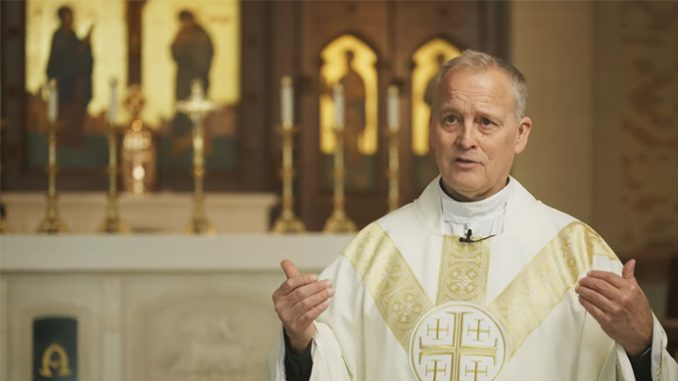
It was not my own bishop who baffled me, just to be clear. It was instead the Most Reverend Michael Martin, OFM Conv., Bishop of Charlotte. In fact, his recent pastoral letter woke me from my blogmatic slumber. It had been years since I had posted a blog, but because actions like his might one day reach as far as Lansing, I decided to offer a parish priest’s perspective.
Bishop Martin came to my attention earlier this year when he announced that, in his diocese, in order to complete the implementation of Pope Francis’s Apostolic Letter Traditionis Custodes, he was going to limit the celebration of the Traditional Latin Mass in the Diocese of Charlotte to one chapel, a renovated former Protestant church in Mooresville, NC.
A few days later, a draft document on liturgical norms for the Diocese of Charlotte was leaked. It made for remarkable reading. Lengthy and filled with prohibitions and preferences, it seemed allergic to many things that were “old” or, better still, smacked of tradition. Ad orientem worship, Latin responses, altar rails, even candles on the altar and missal stands were called into question. Since the author(s) seemed never to have read Sacrosanctum Concilium I wondered if it might be an AI hoax meant to make the bishop look bad. Nope; it was authentic.
The Spirit of the Liturgy
The reason I care is that I’m a priest who has tried to enact principles from Pope Benedict XVI’s wonderful text, The Spirit of the Liturgy. I have long appreciated what one might call Pope Benedict XVI’s “mutual enrichment” doctrine, and it has influenced the way I celebrate the Mass.
Beginning in Advent 2012, I set up what is called the “Benedictine Altar Arrangement” on the altar. It helped me “face east” even though I still celebrated Mass facing the people. A couple of years later, during Advent, I began celebrating the Novus Ordo ad orientem. It was a major change for me and for the faithful of my parish.
Personally, I found that “turning around” transformed my ability to pray the Mass. And it wasn’t just me. After I made the change, members of my parish mentioned that they never before realized how much they looked at the priest’s face during the Eucharistic Prayer. Now, instead, they were looking at Jesus on the crucifix.
Though I tried it as an experiment for Advent, I’ve never turned back.
Eliminating Kneelers and Altar Rails
Even if Bishop Martin never ends up prohibiting other traditional elements of worship, such as ad orientem, many will feel a sense of loss and frustration that they will no longer be able to have the benefit of a kneeler or altar rail for communion.
The list of mandates is pointed and plain:
- Temporary or movable fixtures used for kneeling for the reception of communion are to be removed by January 16, 2026.
- Clergy, catechists, ministers of Holy Communion, and teachers are to instruct communicants according to the normative posture in the United States. They are not to teach that some other manner is better, preferred, more efficacious, etc.
- The use of altar rails, kneelers, and prie-dieus are not to be utilized for the reception of Communion in public celebrations by January 16, 2026.
These actions stem from inferences Bishop Martin draws from the norms of the USCCB (included in the General Instruction of the Roman Missal). He claims,
The episcopal conference norms logically do not envision the use of altar rails, kneelers, or prie-dieus for the reception of communion. Doing so is a visible contradiction to the normative posture of Holy Communion established by our episcopal conference.
Even if we grant the bishop’s questionable logic, he admits that the norms have been changed to allow individuals to receive communion on their knees. The norms do not demand uniformity of posture, so why eliminate kneelers and altar rails? If he is willing to allow people to receive on their knees, why make it harder for them?
A Pastor’s Experience with Patens, Prie-Dieux, and Altar Rails
Since my arrival at my current parish in 2012, I have steadily sought to help recapture a sense of reverence in the celebration of the Mass and a recognition of the sacredness of the Blessed Sacrament. The use of patens to catch hosts (or particles thereof) fostered that, beginning in 2012. Shortly thereafter, members of the lay faithful started kneeling to receive. More followed, without ever a prompt from me.
As a pastoral response, I first brought out two prie-dieux on each side of the center aisle, where I distributed communion. People could stand or kneel as they saw fit, some receiving in the hand, some on the tongue. It was not planned or organized; it was organic. I expanded the number of kneelers to three on each side, then finally four.
Please note that I have never instructed the lay faithful about this. I didn’t say this, or that was “better.” But the opportunity to kneel conveniently (especially for those who were aged) made it possible for more of those who preferred to kneel to do so.
Bishop Martin seems to believe that the faithful are kneeling because someone told them to. My sense is that when the faithful see others kneel, they often desire to do so too. It’s not people telling them what to do, but rather others showing them what’s possible.
Our recent church renovation included the reintroduction of the altar rail. The dedication of the altar was this past January 25, 2025, fifteen months before Bishop Boyea’s 75th birthday. As we worked through the design and construction phases, I often mentioned that I wanted the interior of the church to fulfill the promises of its exterior. Like many churches after Vatican II, my church had been “updated” in ways that flattened it, effectively diminishing the sense of transcendence and participation in the heavenly liturgy. Frankly, it was more auditorium than temple. See for yourself.
Prior to the renovation, I had only rarely distributed communion at an altar rail. When we began celebrating Mass in the renovated church, I was struck to see my sons and daughters in Christ at the altar rail. Whether kneeling or standing, they were waiting patiently and (so it seemed to me) prayerfully to receive the One they came to worship.
An altar rail is not just a physical aid to those who need it. In my experience, it allows a bit of “holy tarrying” in the presence of the Lord, as the faithful wait for me or an extraordinary minister of holy communion to bring the host to them. Even though it allows such prayerful tarrying, it’s more efficient in terms of time required for the distribution of Holy Communion. In my book, that’s a win-win.
Paths Forward
My own experience makes me equal parts frustrated and sad for the Diocese of Charlotte.
I can’t help but wish that Bishop Martin would one day, with an open heart and mind, celebrate Mass at St. Ann’s where I had the privilege of celebrating a Nuptial Mass in November 2017. I’d recommend that he distribute communion at the altar rail and observe.
See how they wait and how they receive. They love Jesus.
My advice to the lay faithful, even if he never does what I propose, is to keep on praying, keep on receiving, and keep on having babies. The future is theirs. And it’s reverent.
(Editor’s note: This essay was posted first on the author’s personal blog and is reposted here in slightly different form with kind permission.)
If you value the news and views Catholic World Report provides, please consider donating to support our efforts. Your contribution will help us continue to make CWR available to all readers worldwide for free, without a subscription. Thank you for your generosity!
Click here for more information on donating to CWR. Click here to sign up for our newsletter.

Many are called, but few are chosen. Some priests (bishops, archbishops, cardinals, and popes) truly yearn, hunger after Jesus Christ. They follow him in humility without rancor, impatience, or demeaning manner. They orient themselves to serve others as if they were constantly in the presence of Jesus Christ himself. Too often we have those who serve as if Jesus Christ were incidental to their perceived priorities while ignoring their flock.
Some will provide lip service, but their hearts are far from the Savior.
In Charlotte, the bishop forbids kneeling to receive the Body of Christ – the Savior who died for our sins and gave us the possibility of being deified in Him. Yet in Rome, the Vicar of Christ allows the faithful to kiss his ring. You figure!
Yes, I do figure the bishop in Charlotte has power/psych issues, clearly. I figure the Bishop of Rome, should he choose, could resolve this with one phone call. It won’t happen, of course. So the faithful pewsitters will needlessly suffer.
And not a single cleric above the parish level gives a damn.
Speaking of not giving a damn, the status of Rev Marko Rubio, accused of molesting young sisters, is still unresolved.
This is abuse of the faithful, in spades.
My dear Deacon, two things not related. Why the bitterness?
Says you.
Well done, fr…. This problem is called TMS… Tight Mitre Syndrome… It cuts off circulation to the brain, but apparently it affects the heart as well…
God save us! History is replete with this type…
“My advice to the lay faithful, even if he never does what I propose, is to keep on praying, keep on receiving, and keep on having babies. The future is theirs. And it’s reverent.”
*****
Amen.
Father, I used the link you provided to see your before and after church images. Yes, your Vatican 2 renovated church was horrific. I have as a visitor been in many such churches and they provide no inspiration to worship, no sense of holiness. My mothers church in another state is one such “modernized” church. In my opinion the traditional churches were diminished in an effort to draw Protestants as converts and for no other reason. Which of course failed to have any effect except to negate the wishes of our own faithful. They do indeed look like an office lobby or some such department store space. I dont generally find Jesus in the shoe department. Disgusting. I like your new church version, especially the paintings of the saints behind the altar which evoke the look of traditional Icons. Lovely.
I do not attend a Latin Mass ( no local access) but do indeed like it when during certain liturgical periods our church has a response or two sung in Latin.
People like Bishop Martin make me sad. Their actions are dismissive, authoritarian and non-edifying. Beyond praying for him, I suggest the members of the churches which are under his thumb withhold donations until he is removed from office. This guy is an administrator, not a pastor. The people deserve better.
I am old enough to just remember kneeling at the altar rail as the way everyone received Holy Communion, all on the tongue as handling the body of Christ wasn’t even a thought.
It was reverent and should be the only way to receive now as well. Father Mattson’s comment about looking at the priest’s face vs. Christ crucifed is stunning.
That’s the problem, “ the ONLY way to receive communion” this attitude divides the church. W
Very nice.
Yep. Keep on having babies. Or start!
Glory Be to God!
I will remember the people of Charlotte at Mass on the Epiphany especially at the Gospel, where Matthew states that they knelt before him and presented their gifts!
How I’d hoped that the “Francis effect” would have died with the former pontiff! Unfortunately, “liberal” and “progressive” clerics cling to their failed spirit-of-Vatican-II fantasies of finally creating a Brave New Church. Haven’t they gotten the message that it didn’t work, it doesn’t work, and it never will work? Are liberals really as far behind the times as I began sensing they were forty years ago?
The author, Fr. Steve Mattson, offers comfort to his readers, hope to us, courage, and patience. Make this man a bishop. Key criteria: love God and neighbor, believe Jesus is King and shepherd souls to him. Done ✅. Praise the Most Holy Trinity for wise and welcoming priests like Fr. Steve Mattson. May God send us more shepherds after his own heart.
I see things slowly changing here in “Liberal “ New England. More reverence, more silence, more devotional candles, occasional incense and replacement of tabernacle behind altar. Not necessarily to change everything over night. People slowly discover things that were familiar to their grandparents and a distant memory to parents. It takes time and we must not be rash and in a hurry to force things on people. This priest is very wise and humble in allowing people to change slowly. This way their devotion will be genuine and of the heart. I think his approach is good and worthy to be copied. God bless him and his ministry.
I went to a New Year’s vigil Mass last evening and the church I visited was absolutely packed full. Standing room only in the back.
They had 2 kneelers at the front for those who wished to kneel for Communion and people were kneeling here and there on the floor at the side of the altar where Communion was also being distributed.
I was really encouraged to see so many folks at Mass for a Holy Day in the middle of the week.
Have a Happy New Year, Mr. Connor!🙂
Has this website done focus group testing and realized that its audience is mostly trads? Is that why articles like this are posted more frequently? How about supporting the liturgical reforms of V2? That video and the ideas in the blog post are the most clericalist, reactionary, retrograde things I have seen and read in a long time.
Why do we need to do “study group testing” when you are here to tell us who our audience is? Sigh.
By the liturgical reforms of V2, are you referring to how SC says “the use of the Latin language is to be preserved in the Latin rites,” states that Gregorian chant “should be given pride of place in liturgical services,” says nothing about ad orientem going away, etc., etc.?
What, exactly, about Fr. Mattson’s essay and the renovation at his parish is contrary to the Council and its documents? (Answer: Nothing at all.)
“That video and the ideas in the blog post are the most clericalist, reactionary, retrograde things I have seen and read in a long time.”
That’s ridiculous. But at least it’s rather funny. Or sad.
Anyone who pays attention or is able to read knows that CWR is operated by Ignatius Press, which is a strong proponent of the “reform of the reform”. Figure it out.
Sebastian: you say, “….the ideas in the blog post are the most clericalist, reactionary, retrograde things I have seen and read in a long time.”
I’m guessing you’ve never encountered spiritual exercises that saints have recommended for centuries to discover whether you actually possess religious faith. Among these involves considering whether you are capable of accepting that truth, because it originates exclusively in the mind of God, and none at all from His creatures, other than articulating witness to His truth, never changes. This is self-evident to an honest mind, very different from a dishonest mind, an atheistic mind without self-awareness, like those who consider God to be wrong or confused or clerical in His own way.
Jesus was a reactionary. He knew of our vanities.
Well you’re here reading CWR, Sebastian.
Happy New Year!🙂
Thank you Father Mattson. Your perspective and insights reflect your love for your flock and for your vocation to the priesthood. May God bless you. Please pray for the faithful Diocese of Charlotte.
When Napoleon threatened to abolish the Catholic Church, Cardinal Ercole Consalvi, Sec of State to Pope Pius VII allegedly replied
“Your Majesty, we, the Catholic clergy, have done our best to destroy the Church for the last 1,800 years. We have not succeeded, and neither will you”.
Not an original comment I grant but it is just as valid when it comes to certain “Princes” Of The Church.
I do wonder what these prelates think about worldly monarchies and their protocols—or maybe even at the Vatican.
Still, when I enter a Catholic Church, I first look for the tabernacle light that informs me my Creator is present.
We have lost the “awe” of that realization and therefore too many churches have devolved into community gathering spots with some Christian environmental touches.
I am reminded of the Protestant minister who once said that if he truly believed God was present in the tabernacle, he would be proceeding on his knees upon entry.
Incidentally, much more attention is drawn to those who receive Our Lord Jesus Christ (increasingly so) on their knees in the aisle than by kneelers. So this Bishop may well have unintentionally awakened otherwise distracted souls.
One assumption underlying kneeling for communion seems to be that there is something wrong or illicit or irrelevant about it. Else, why the prohibition?
The only advantage that standing for communion offers is that it helps to move the line along. (Every second counts! And they add up so quickly!)
And if one were to attempt to make the case that kneeling versus standing involves no inherent difference, that person would simply be revealing himself/herself as clueless. The kneeling posture as seen numerous times in the Gospels–people kneeling before Christ in particular–should be enough to make the point for those with eyes to see.
Next thing you know he will want to take away the altar bells!
Sadly, Bishop Martin has also done something else that disturbs me. Parishes in his diocese have historically undergone renovations and additions in order to beautify Gods house. These projects are reviewed and approved by the diocese and rightfully so to ensure that they meet certain criteria. I imagine that the financing plan is thoroughly reviewed, the plan is appropriate for the church and the congregation can support the work. Bishop Martin has put approved renovations on hold so that they do not conflict with his desire to raise $150 Million for “his” projects.I find it sad that the parishioners hard work is secondary to the Bishop’s excessive personal plan. I wish I knew what motivated his decision. He/his staff sent out a survey asking if there was support for his plan. I have personally spoke with some of the “special” people he sent it to and all have told me they were not in support but it seems he is moving ahead full speed. His plan does not include funding any of the existing approved projects. He did publish a Planning Study Executive Summary that did not address any of the concerns from the survey responses.
I’m joining the Avila Institute in praying and fasting for Pope Leo to put a stop what tantamount to the persecution of trad Faithful Catholics faithful to teachings of the Church. He meets with Bishops in January. What’s going on in Charlotte is sad as is what has happened in the Archdiocese of Detroit. Very similar with Bishop Edward Weisenberger. I’m 73 and can’t fast but I will pray for theses bishops at daily Mass.
Bishop Martin’s letter has made me even more prayerful and protective for our faith and traditions. I don’t care what the Bishop decrees regarding kneeling for the reception of the Eucharist. I will follow my heart and my soul’s yearning instead. Receiving the living Lord to come into my body and soul is not something I do lightly. I will continue to kneel before my Lord out of holy fear, reverence and humility.
Satan has a target on all that is Holy, good and true. I will fight on my knees in prayer for Bishop Martin that he may do the will of God and no other’s bidding.
My wife and I have met with him, a wonderful man and compassionate priest! Monsignor Mattson has an authentic ring to it wouldn’t you say?
It seems so ridiculous making a big fuss over kneeling or not for Communion. Our Catholic Church should be open to all for Communion, including non-Catholics. Does anyone think that Christ died on the cross just for Catholics? All men matter; it is the hardest thing in all theology to believe.