


National Catholic Register, Dec 27, 2025 / 04:00 am (CNA).
St. John, both an apostle and an evangelist, played a very prominent role in many of the New Testament narratives. He was part of an inner-circle trio with his brother James (the Greater) and Peter, partaking in privileged incidents with Jesus: the raising of Jairus’ daughter, the Transfiguration, and the agony at Gethsemane.
John and his brother James were nicknamed “Sons of Thunder” by Jesus. Exactly why they were given this title is not explained. However, the two brothers did exhibit at least two instances of audacious behavior: wanting to bring fire from heaven down upon some Samaritans who refused to listen to the message of Christ and asking Jesus for special places of honor in heaven.
Within the Gospel of John, there are five different references to “the disciple whom Jesus loved” (13:23, 19:26, 20:2, 21:7, 21:20). Over the centuries, the vast majority of biblical scholars have deemed this beloved disciple to be John himself. These mysterious references actually point to a less thunderous personality; for example, the beloved disciple resting his head on Jesus’ chest at the Last Supper and Jesus requesting the beloved disciple to take care of his mother, Mary.
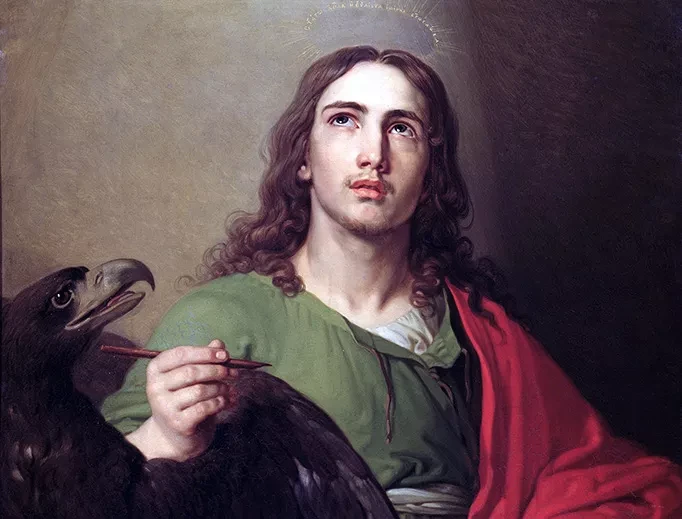
Tradition places John in Ephesus (in modern Turkey) after Pentecost, where he cared for Mary and perhaps wrote the fourth Gospel. John’s Gospel stands out from the other three, offering a unique portrayal of Christ and his message. This Gospel is symbolized with an eagle; its opening words urge the thoughts of readers to soar upward — sort of like an eagle — toward God (John 1:1).
It is probable that either John himself or a disciple of his wrote the three Epistles of John. Many claim that he also wrote the Book of Revelation, a work chock full of mystical imagery, during an exile on the island of Patmos (Greece).
John is believed to have lived to an old age and died of natural causes. A basilica in Ephesus reportedly held his remains for a time, but that church is now in ruins.
The feast of St. John the Evangelist is Dec. 27. He is the patron of many things including writers, booksellers, and friendships.
This story was first published by the National Catholic Register, CNA’s sister news partner, and has been adapted by CNA.
If you value the news and views Catholic World Report provides, please consider donating to support our efforts. Your contribution will help us continue to make CWR available to all readers worldwide for free, without a subscription. Thank you for your generosity!
Click here for more information on donating to CWR. Click here to sign up for our newsletter.


Another exceptional feature of the Apostle John is the deference toward him by the Sanhedrin. When Christ was being interrogated by the high priest, while Peter, fearful, was outside by the fire trying to appear anonymous – John was inside among the Sanhedrin and onlookers. No one challenged him. Perhaps it was his youthful innocence. Or was it that he always gave the Sanhedrin a favorable price for fish?
As to whether he died of natural causes it brings home his self assumed importance. He and brother James had their mom put in a plug with Christ that they be especially honored in heaven each at Christ’s side.
That is brought home again when Christ foretold Peter’s martyrdom, asked whether he loved him more than the others. As Peter followed Christ who said follow me John went along without an invitation. Peter objected. Our Lord chastened him saying what business was it of his to question whether John would be martyred, leaving the others to assume John would not die.
Apparently, according to the essayist Theresa Doyle-Nelson no one knows how John died. Or whether he did die. Might it be he rode up to heaven in a flaming chariot like Elijah to the chagrin of Peter. After all, he was favored to care for Jesus’ beloved Mother.
Then, despite anomalies, John had a heart to heart, heart to mind intimacy with the Word become man. Peter would beg John to ask him questions, John so close, accepted by Christ that he lay his head against his breast. Virtually listening to Christ’s heartbeat, what emanated from within.
How else could youthful John be infused with profound theological insight? Christ loved his innocent purity, John love of Love itself. There are friendships between men that a perverted world doesn’t understand.
St Basil the Great and Saint Gregory Nazianzen were an example.Their mutual love a foreshadow. With John and Christ it went deeper because of the divine Word, the source of all good, the reward of priests, whose full realization is the Beatific Vision.
He disseminated the Good News with clarity and style. Apostle and evangelist Saint John – Pray for us.