

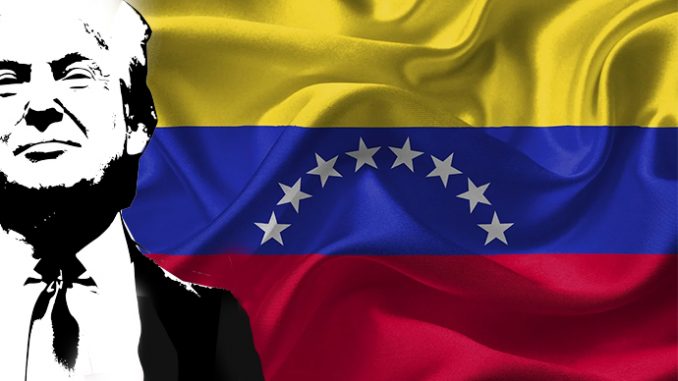
To all appearances, the United States is preparing for war with Venezuela. For months now, American military forces have been blowing up Venezuelan boats said to be carrying drugs. The U.S. has deployed a fleet of warships off the country’s coast. President Trump has said that “this is war” and that “very soon we’re going to start doing it on land too,” and he has ordered the closure of airspace over Venezuela.
He has also declared that Nicolas Maduro’s “days are numbered” as president of Venezuela and ordered him to resign and leave the country. And it has been reported that the administration is planning for a post-Maduro Venezuela.
Goals and rationale are unclear
What are the goals of, and rationale for, the conflict? Trump cites Venezuela’s status as a source of drugs, criminals, and unwanted immigrants entering the United States. Administration officials and Republicans in Congress routinely characterize Maduro’s regime as “narco-terrorist,” and they’ve long criticized the socialist dictator for the human rights violations and economic chaos that have plagued Venezuela. The point of the conflict thus seems to be regime change, in the interest of punishing and deterring state sponsorship of the drug trade.
Yet the administration has sent mixed signals. Trump has also denied that he is seeking regime change, as has Secretary of State Marco Rubio. Trump’s controversial recent pardon of former Honduran president and convicted drug trafficker Juan Orlando Hernandez tells against a serious concern with punishing state-sponsored drug trafficking. Trump has also declined to say one way or the other about whether he would send ground troops into Venezuela, or to address just how far he would go in order to oust Maduro.
Hence, whether the U.S. really does intend to go to war—and if so, what the point of the war would be–are murky at best. So too is the legal basis of the war, and of the means used to fight it. There has been no congressional authorization for such a war, though this is required by the Constitution. True, modern U.S. presidents have not respected the spirit of this restriction much. But they have at least still generally felt the need to get Congress to rubber-stamp military actions they’ve already initiated or decided they wanted to carry out. It is better if presidents continue at least partially and grudgingly to adhere to the letter of the law in this way, rather than setting a precedent for simply ignoring Congress altogether.
To be sure, the administration’s emphasis has been on the claim that the drug runners they have been targeting are “terrorists.” And it seems that the administration is operating under the assumption that military attacks on these people are therefore legal, given congressional authorization, after 9/11, for the use of military force against terrorists. But as Andrew McCarthy has argued, such a defense is specious, because drug trafficking simply does not fit the definition of “terrorism” under federal law. (And it is sheer sophistry to suggest, as some have, that drug trafficking counts as “terrorism” insofar as the drug problem has “terrorized” American families, brought “terror” to addicts, and so on. These loose uses of the term “terror” are completely irrelevant to the question of the legal sense of the term. You might as well argue that producers of crime thrillers and horror movies are “terrorists” insofar as they cause audiences to feel “terror.”)
There are other problems with the attacks on the boats. In at least one case, it has been alleged that the boat targeted was actually a fishing boat rather than a drug-running boat. In another, and especially controversial case, it appears that survivors of an attack were killed in a second attack despite having been rendered harmless by the initial attack. This is contrary to jus in bello just war criteria, and even some on the right-wing end of the political spectrum have judged it to be a war crime under U.S. law.
As this indicates, the situation is, to say the least, problematic from the point of view of just war theory. Some readers might be surprised that I would think so, since a few months ago I argued in an article at Postliberal Order that military action against drug cartels could be just. But there are several crucial differences between the sort of scenario I described there and what is going on now with respect to Venezuela.
First, the targets I had in view were not merely criminals guilty of running drugs, but violent thugs guilty of actions that really can plausibly be described as “terrorist,” such as political assassination and the murder of civilians as a means of securing control over territory. Second, I was envisaging military action aimed at taking out the specific individuals carrying out or ordering such acts, rather than some expansive program of regime change. Third, I noted that such action would have to be carried out using only morally acceptable means of warfare. Fourth, I also noted that alternatives to military intervention would have to be tried first.
The just war doctrine applied
Let’s consider the current situation in light of the just war doctrine developed by thinkers like Thomas Aquinas, which holds that for military action to be justifiable, it must meet four criteria: first, it must be in the service of a just cause; second, it must be performed by lawful authority; third, this authority must have the right intention; and fourth, the war must be fought using only right means.
Each of these calls for elaboration:
1. Just cause: Part of what this first criterion requires is that a war must be fought for a legitimate end. As to what sort of end would be legitimate, the just war tradition came to hold that it could only be the defense of some right violated by the nation against which the war is fought. Naturally, repelling aggression would be an example, since for one nation to aggress against another is for it to violate the rights of the victim nation. But other aims, too, can count as the defense of a right, and in theory, even some of the ends sought by the Trump administration could count as the defense of a right. For example, it can, in principle, be legitimate to fight a war in order to stop drug trafficking, since drug trafficking violates the rights of the nation into which drugs are being trafficked. And it can, in principle, be legitimate to fight a war to liberate the people of a nation from an oppressive government, since such a government violates its own citizens’ rights.
The trouble is that having a legitimate end in view is only a necessary condition for having a just cause for war, not a sufficient condition. The just cause condition includes other elements as well. For one thing, going to war must be a proportionate response to the rights violation. For example, suppose an enemy nation had killed a handful of American citizens. It would be absurd to use this as a pretext to launch a full-scale war likely to result in tens of thousands of casualties on both sides. That would be massively out of proportion to the harm being remedied.
There must also be a reasonable hope for success. War is extremely destructive and can easily spiral out of control, so it should never be entered into without strong grounds for thinking that the desired outcome can be realized. And it must be realized in a way that does not bring about even greater evils than the ones the war is a response to.
The war must also be fought only as a last resort. That is to say, it must be clear that the ends the war is meant to secure cannot be realized short of war.
Finally, the “just cause” criterion requires not only that the goal of a war is just, but also that it must be known to be just. That is to say, it’s not good enough if someone, somewhere, might be able to cobble together some plausible rationale for the war. The public authorities taking a nation to war must themselves actually have such a worked-out rationale for it.
When all of these aspects of the “just cause” condition are considered, it is clear that the Trump administration has not met it, at least not yet. For example, it has not shown that a regime change war is a proportionate response to the evils it seeks to remedy. Indeed, some of the administration’s rhetoric seems clearly either uninformed or dishonest. Homeland Security Secretary Kristi Noem has claimed that destroying the cocaine carried on Venezuelan drug boats has “saved hundreds of millions of lives.” In reality, fewer than 30,000 people die of cocaine overdose in the U.S. each year, and most of this cocaine comes from countries other than Venezuela. Some have also tried to connect Venezuela with the fentanyl trade, but in reality, fentanyl is linked with China and Mexico rather than Venezuela (as even one of Trump’s closest political allies has emphasized).
Nor is it clear that a regime change war would remedy rather than exacerbate some of the problems the administration is trying to address. For example, such a war could generate a refugee crisis that would add to, rather than decrease, the number of immigrants trying to enter the U.S. And as recent American military history has dramatically shown, attempts at regime change often yield results very different from those intended.
Nor has the administration made clear why actions short of war would not suffice to realize the ends it seeks to achieve. Indeed, the administration has made no clear and coherent case at all for war with Venezuela (let alone a just war case for it), so that it can hardly be said that its cause for war is known to be just.
2. Lawful authority: As the just war tradition emphasizes, having a good end in view is by no means sufficient for a war’s being just. Not everyone has the right to resort to war as a means to realize such an end. In particular, private individuals do not have that right. Only public authorities have it.
Now, in the American system, the power to authorize war lies with Congress. That is why, as already noted, even presidents keen to act unilaterally often seek some kind of congressional approval, at least where large-scale or prolonged military actions are concerned. For a president to make war altogether independently of Congress is thus contrary to the rule of law. It is analogous to acting on his own behalf, as a private individual would do, rather than as an agent of the lawful public authority (which is what a president is when acting as commander-in-chief in a congressionally authorized war). And as I noted above, it will not do to pretend that the administration’s actions against Venezuela are somehow legitimized by Congress’s authorization of military action against terrorists.
It seems clear, then, that the administration has also not met the second, “lawful authority” condition for a just war, at least not yet.
3. Right intention: The just war tradition insists that even when there is a just cause for war, and the justice of this cause is known, a war will still be unjust if this cause is not the true motivation for which the war is being fought. For example, if there is a clear morally legitimate cause for a war, but the public authorities who publicly appeal to that cause in fact secretly have some other and illegitimate reason for going to war (such as the prospect of financial gain, or of personal glory), the war will be morally tainted.
In the present case, some have suggested that a motivation for war with Venezuela is to get access to its oil. At least one GOP lawmaker has indicated as much, though others have cast doubt on this idea. Given Trump’s extreme egotism, it is also not unreasonable to wonder whether he sees a war with Venezuela as a way to make his mark on history. But that is speculation, and it would be unwise to put much emphasis on it given the points already made.
Even if we were to concede that there is no strong reason to doubt that a conflict with Venezuela would meet the “right intention” criterion for a just war, that does not change the fact that it has not been shown to meet the first two criteria.
4. Right means: Just war doctrine holds that even if fought for a just cause, by lawful authority, and with a right intention, a war can still be unjust if immoral means are deployed in waging it. Among the requirements of this fourth condition, the one most relevant for present purposes is the imperative to avoid deliberate attacks on non-combatants.
The Trump administration’s dubious attempt to stretch the definition of “terrorism” to rationalize attacks on drug boats gives serious grounds for doubt about whether a war with Venezuela would meet this condition. So too does the incident in which men already rendered helpless by one strike were deliberately killed in a follow-up attack. Narcotics trafficking is gravely evil, but those engaged in it are not, per se, terrorists, nor are they in any other way relevantly like combatants in a military conflict. To be sure, the paramilitary forces some drug cartels have made use of can plausibly be regarded as legitimate military targets, but it is sophistry to pretend that this entails that just anyone associated with drug running somehow counts as a combatant. It is also true that a case can be made that drug kingpins are worthy of the death penalty, but what that would justify is execution after due process of law, not indiscriminate firing upon anyone suspected of involvement in the drug trade.
Hence, if the Trump administration does not confine attacks to military targets and continues to blur the distinction between combatants and non-combatants, it is hard to see how a war with Venezuela could meet the fourth, “right means” criterion of just war doctrine.
Given the unique gravity of war and the potential unforeseen harms of even justifiable military actions, the burden of proof is always on those who want to go to war, not on those who recommend against doing so. That burden can sometimes be met, but the Trump administration has so far failed to meet it.
(Editor’s note: This essay was first posted, in slightly different form, on the author’s blog, and is posted here with the kind permission of the author.)
If you value the news and views Catholic World Report provides, please consider donating to support our efforts. Your contribution will help us continue to make CWR available to all readers worldwide for free, without a subscription. Thank you for your generosity!
Click here for more information on donating to CWR. Click here to sign up for our newsletter.

Where’s the justice for the tens of thousands of young people who were murdered by Venezuela’s narco-terrorism? Where?
Who in our Catholic Church will stand up to speak for the dead young people of our nation? Who?
Those dead young Americans died from drug overdoses, not gunfire or IED’s. Are they blameless for their own deaths? We need to assume responsibility for our own actions and mistakes, not blame others.
Maduro is a gangster, but if we attempted regime change for every country run by gangsters, we would be very busy indeed. By the way, those boats blow up by the Navy were not even headed for the US. More theater from Hegseth.
These weren’t necessarily overdoses. If they died by fentanyl, they were murdered.
Proportionality doesn’t work as Professor Feser states. The test is as follows: (i) is the objective of restoring peace sufficiently important to justify the resort to arms; (ii) is the use of arms rationally connected to the objective; (iii) could a less intrusive measure have been used; and (iv) having regard to these matters and to the severity of the consequences, is a fair balance struck between the interests of peace and the sacrifice in human life necessary to secure these interests?
Probability of success and last resort interact as follows. A prospective belligerent is not bound to exhaust all peaceful alternatives to war beyond the point at which probability of success peaks and then diminishes.
Right means (jus in bello) are separable from just cause (jus ad bellum). The fact that war crimes are committed by a belligerent does not deprive him of jus ad bellum – the appropriate remedy for war crimes is the criminal punishment of soldiers responsible for them.
As for legitimate authority, it would seem that the power of Congress is limited to declaring war in such a manner that changes the legal status of enemy persons resident in the US, and which resolves any doubt of whether the nation is at war and of whether a person is guilty of treason for adhering to a foreign enemy.
Fentanyl’s a whole different ballgame, William. And it’s more complicated than drugs heading to the US. Venezuela’s involved in all sorts of narcoterrorism both here & abroad.
It is my understanding that most Fentanyl originates in China. I don’t see us attacking China. They will not be bullied. Venezuela is a distraction meant to distract people from the lousy economy.
I realize the seriousness of the drug problem, but again, if there was little or no demand for drugs, China, Venezuela, etc would not be providing the drugs. Perhaps we should focus on reducing demand? We need treatment programs and yes, some discipline on the part of the addicts.
Maduro is a rotten apple, but we cannot blame Venezuela for all of our problems.
It’s distressing that our Catholic vice president has stated on Twitter that he doesn’t give a (expletive) about whether or not our military is committing war crimes in the Caribbean.
It’s distressing that the president is forgetting his promise of keeping America out of forever wars and regime change.
Well written, Dr. Fesser.
David B: Genuine men protect the vulnerable from predators…at all costs.
Real Catholic men don’t take women to abortionists. Real Catholic men safeguard their children from sexual predators. Real Catholic men do what’s necessary to insure that narco-terrorists aren’t able to ply their chemical weapons against their children and the children of their neighbors. Unfortunately, far too many of our Catholic men are feminized wimps.
Diogenes: “Real Catholic “ men also strive to live the Beatitudes! – which can be considered feminized wimpism.
Real Catholic men don’t ignore the Church’s criterion for Just War.
Real Catholic men don’t murder unarmed combatants who have surrendered.
Real Catholic men insist that their elected office holders uphold the laws they took an oath before God to enforce.
Real Catholic men don’t simp for wannabe strong men who have more in common with Henry VIII than with George Washington.
Real Catholic men remember when St. Dominic Savio proclaimed “Death rather than sin.”
Perhaps being the strong silent type is more “Catholic” than being a blustering bully?
The issue of the drug running boats involves both military and law enforcement aspects, and therefore must be viewed as such. For example we see military essentially performing law enforcement in Washington D.C.
This is addressed by Thomas R. Wood in a December 12, 2025 article in The Catholic Thing, and I believe worth considering. I list a few paragraphs from that article below:
“Unfortunately, Archbishop Broglio’s statement deepens the confusion. He acknowledges the scale of our country’s drug catastrophe, but then writes:
In the fight against drugs, the end never justifies the means, which must be moral, in accord with the principles of the just war theory, and always respectful of the dignity of each human person. No one can ever be ordered to commit an immoral act, and even those suspected of committing a crime are entitled to due process under the law. . . .We do not know if every sailor on a vessel presumed to be carrying illegal drugs knows the nature of the cargo.
The archbishop thus conflates just war principles, which aim to minimize the barbarity of an anarchic international world, with due process, which relies on legitimate domestic authority and courts to ensure rights and must themselves be checked by those rights.
If we look for broader principles behind the statement’s words, the only possible inference is that the U.S. military must somehow ensure not only adherence to just war principles as codified in the U.S. Law of War, but also guarantee due process rights, and even discern the state of awareness in each enemy combatant’s mind, before taking action.
I cannot believe that Archbishop Broglio intended to insist that American soldiers, sailors, and airmen read Miranda Rights to those they are fighting. But his statement conveys that message.”
Another TDS rant from Feser. This is getting old. Just as a point of clarification, Dr. Feser, no one has appointed you to be the conscience of the nation. And there won’t be a war with Venezuela. You should know by now that Trump plays hardball until people are ready to negotiate.
Feser’s argument against is plausible, although based on principles developed during the mediaeval era. Not that the principles themselves are not well articulated and just, rather, do they address conditions on the ground in a contemporary, highly technical environment with different logistical issues to contend with – if the party seeking to wage war finds conviction based on data that cannot be disclosed?
For example, in certain cases of conspiracy/sedition the data collection apparatus [agents, system of data collection] cannot be disclosed. As occurred with Isis and US sleeper cells. Furthermore, is it beneficial to the party claiming to have a just cause, here the clandestine delivery of highly addictive death dealing drugs that endanger both public and national security – giving the presumed offending party exact knowledge of what form of war will be waged, its plans, logistical parameters?
It seems in our current situation the issues are more complex, and difficult to be compartmentalized as argued in this essay. In such an environment as today a leader may have compelling reason to be convinced that warlike action is required.
Interesting phrasing, “developed during the mediaeval era.” I’ve heard similar statements made regarding the Church’s teaching on aritifical contraception.
On the other hand, wouldn’t common sense contend that better to address and mitigate a minor threat than to defer until the threat is of greater magnitude. The state is chartered to maintain law & order as effectively as possible to sustain the general welfare.
From a different angle, one not skewered by derangement, it appears that our President is ending a war, not starting one. It’s a war that has killed tens of thousands and maimed even more. It was allowed to continue unabated because prior administrations were lax in protecting our country. Political hate and anger are not appropriate threads in a Catholic publication.
“Political hate and anger are not appropriate threads in a Catholic publication.”
If you’re referring to the essay itself, please give examples.
As for “derangement,” Dr. Feser makes a cogent and calm argument. If there are errors in the argument, point them out. There’s already too much ad hominem nonsense flying around.
“Political hate and anger are not appropriate threads in a Catholic publication.”
Those are the building blocks of MAGA ideology, integralism, and groyperism.
America first says it all. The first will be last!
How about we wait and see what actually happens before jumping to conclusions and casting stones? Or is that too much to ask from Feser, who seems to be blinded by his TDS?
What part of Dr. Feser’s arguments, which assess the known facts and carefully view them in light of the Church’s just war tradition, are wrong? Referring to TDS is ad hominem sloppiness. If he’s in error, demonstrate it.
I have a problem with attacks on boats in waters that are under the jurisdiction of foreign nations or under International Maritime Law. Why not target them by our coat guard when they enter our waters? Even if they were carrying drugs, how do we know there destination? We have a right and obligation to police and prosecute those who violate our laws and should work with the International community, but should not take unilateral actions outside of our borders. Perhaps the golden rule can be applied here- how would we feel if a foreign nation bombed boats in our waters?
(And it is sheer sophistry to suggest, as some have, that drug trafficking counts as “terrorism” insofar as the drug problem has “terrorized” American families, brought “terror” to addicts, and so on. These loose uses of the term “terror” are completely irrelevant to the question of the legal sense of the term…”
*****
I’m repeating, but I seriously can’t think of a single family whose lives haven’t been impacted by drugs in some terrible way. We can talk about linguistics till the cows come home, but drugs absolutely have terrorized American families. I think anyone reading the news headlines recently would agree.
Dr Feser makes some good points but his argument is ultimately not persuasive.
I believe that President’s Trump’s goal is indeed regime change but for more than drug running. Reliable numbers are hard to obtain but it appears that the “Cartel of the Suns” is exporting about 250 tons of mostly cocaine per year. Even if this is relatively small it is still a lot of death.
Maduro’s regime is a criminal enterprise and is a threat to the region, which includes us. So the just cause is removal of a gangster from the neighborhood. Surely it is righteous to get rid of gangsters.
In a democracy like ours, lawful authority is ultimately political as well as legal. President Trump appears to understand this and I believe he has the politics right and is operating within at least the intent of the law. By and large, the American people support him therefore his authority is legitimate.
Much is made of the so-called “kill them all” order, for which no credible evidence exists. My own take, as a former professional solder, is that the Navy was given the mission to “sink the boat” and it required two shots to do so. The intention was to sink the boat, not to kill the crew. I can understand how this might seem to be a meaningless distinction.
Dr. Feser goes into great and, in my opinion, irrelevant detail about the legalities of terrorism. I do not consider the boat crews to be terrorists but rather enemy combatants. Unlike Dr. Feser, I see the war against Venezuela as being already in full swing.
“Given Trump’s extreme egotism, it is also not unreasonable to wonder whether he sees a war with Venezuela as a way to make his mark on history. But that is speculation, and it would be unwise to put much emphasis on it given the points already made.” If it is unwise to put much emphasis on this then why did you even include it? This is a cheap shot and I almost stopped reading right there. Next time I will.
“Unlike Dr. Feser, I see the war against Venezuela as being already in full swing.”
Where is the congressional declaration of war?
Why is the president not sharing relevant information with Congress, or even the American people?
If this is a war, why are unarmed enemy combatants not treated as such, with Geneva Convention protections, but are rather summarily executed?
Secretary Hegseth saying he himself gave the order to kill them all isn’t enough evidence for you?
“Maduro’s regime is a criminal enterprise and is a threat to the region, which includes us. So the just cause is removal of a gangster from the neighborhood. Surely it is righteous to get rid of gangsters.”
Hello, Iraq 2.0!!!
“Maduro’s regime is a criminal enterprise and is a threat to the region, which includes us. So the just cause is removal of a gangster from the neighborhood. Surely it is righteous to get rid of gangsters.”
Name one country that isn’t a gangster state. Brazil and Mexico certainly are and are capable of far worse in this hemisphere.
We can’t police the world.
Many foreign governments, especially in Africa and Latin America are run by gangsters. In the old days, if the dictator said that he was anti communist, we supported and threw money at him. So we ended up in bed with some nasty characters. Was that justified? Hard to say.
We cannot engage in regime change for every gangster government. We would be at war continuously. Venezuela has lots of oil, so I wonder if “big oil” is affecting this?
By the way, Trump told the President of Columbia that he is next. Are we going to engage in regime change for every country that we don’t like?where does it end?
The Church’s “Just War” tradition is wrong. There. I said it.
Excellent Article and Summary, Dr. Feser.
“…the burden of proof is always on those who want to go to war, not on those who recommend against doing so. That burden can sometimes be met, but the Trump administration has so far failed to meet it.”