

Puebla, Mexico, Dec 11, 2025 / 07:10 am
Although millions of faithful recognize Tepeyac Hill in Mexico City as the site of the apparitions of Our Lady of Guadalupe, not many know that the miracle of the imprinting of her image did not occur there, but in a place that is now practically forgotten.
According to tradition, in December 1531, the Virgin appeared to an indigenous man named Juan Diego and asked him to request that the first bishop of Mexico, Friar Juan de Zumárraga, build a “sacred little house,” a chapel at the foot of Tepeyac.
As a sign for the bishop, the Virgin Mary caused roses to bloom in the middle of winter on the arid hill and asked Juan Diego to carry them in his cloak. When he arrived at the bishop’s residence to show the bishop the roses, he unfolded his cloak, and the image of Our Lady of Guadalupe was miraculously imprinted on it.
After the miracle, the cloak was placed under the care of Friar de Zumárraga in this house, while a small chapel was ordered to be built at Tepeyac, which would be the first shrine for Our Lady of Guadalupe.
The old archbishop’s palace
Father José de Jesús Aguilar, a priest of the Archdiocese of Mexico and a researcher of the Guadalupe event, posted a video in which he pointed out that “many people know that the Virgin appeared at Tepeyac, but they don’t know where the miracle of the imprinting of the image occurred.”
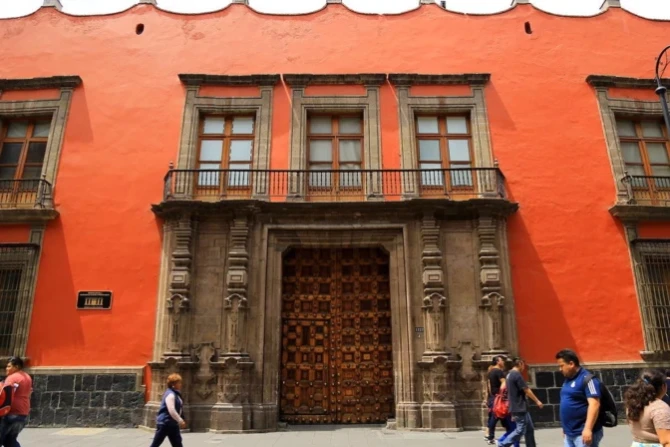
He explained that in 1529, Friar de Zumárraga acquired the so-called Casa de Medel, located in what is now known as the Old Archbishop’s Palace, next to the metropolitan cathedral of Mexico City, which was under construction at the time.
He established his residence at that site in 1530, and it was there that he received Juan Diego. However, he noted that “it is necessary to understand that, although the location is the same, we won’t see the building as it [appeared] in Juan Diego’s time because it has undergone changes.”
In 1629, the edifice was damaged by a flood that affected Mexico City. Almost a century later, in 1720, it was expanded by Archbishop José Pérez de Lanciego Eguiluz y Mirafuentes. Between 1730 and 1747, the building was completely rebuilt by Archbishop and Viceroy Juan Antonio Vizarrón y Eguiarreta.
Currently, the building where 33 archbishops once resided retains its red façade, and on either side of the main entrance, it features Latin inscriptions from the Book of Revelation. On the left, it reads, “He who sat on the throne said,” and on the right, “I am making all things new.”
Restoration efforts
According to Aguilar, this building served as the residence of the archbishops until the Reform Laws, in the mid-19th century, forced the Church to vacate it. In 1867, it housed the offices of the Chief Accounting Office, and later the Treasury Archives, the Pension Payment Office, and a printing press.
Currently, the building functions as the Museum of the Secretariat of Finance.
Aguilar recounted that an effort was made to recognize the religious value of the site, for which a sculpture of Juan Diego and Friar Juan de Zumárraga was commissioned. He said that it was blessed by St. John Paul II and “was made with the intention of placing it somewhere in the former archbishop’s palace, or even on the street in front of it, to commemorate that it was the site of the miracle.”
“Unfortunately, the civil authorities did not allow it,” said the priest, who was the deputy director of radio and television for the Archdiocese of Mexico at the time. The artwork was finally installed on the side of the metropolitan cathedral, a location that, in his opinion, “loses its meaning.”
“But with or without the sculpture, with or without a plaque, let’s hope that little by little, the news that the image was imprinted on the tilma in this place will lead more and more people to learn about this fact,” he added.
This story was first published by ACI Prensa, CNA’s Spanish-language news partner. It has been translated and adapted by CNA.
If you value the news and views Catholic World Report provides, please consider donating to support our efforts. Your contribution will help us continue to make CWR available to all readers worldwide for free, without a subscription. Thank you for your generosity!
Click here for more information on donating to CWR. Click here to sign up for our newsletter.

Leave a Reply