



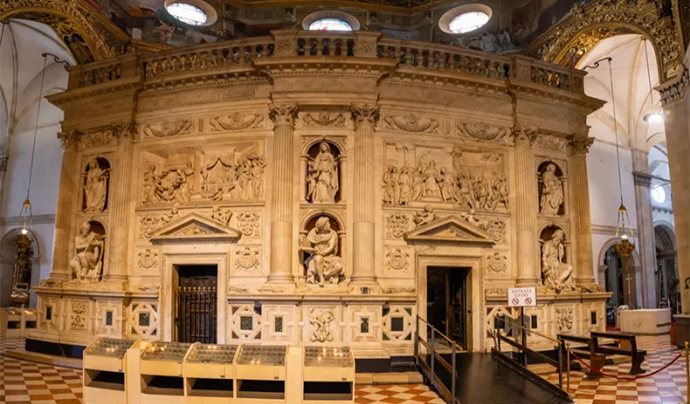
Today marks an important Marian feast arising from the devotional life of the Church and especially of the lay faithful, the feast of Our Lady of Loreto. Traditional accounts report that, on December 10, 1394, the small house in which the Virgin Mary had lived was transported by angels to the small town of Loreto (in central Italy, not too far from the Adriatic).
Much ink has been spilled, especially in modern times, over whether the stone structure housed in the Basilica della Santa Casa is or is not the structure in which the Annunciation occurred. One is not required to believe that the walls within the basilica were transported by angels, or indeed was the house of the Annunciation at all (though I think there is stronger evidence for the truth of the story than some would admit).
What cannot be denied is that since the fourteenth century on, the Holy House has become a focal point for Catholic devotion in Italy and indeed around the world. Great saints have visited Loreto, wishing to honor the Incarnation and the Mother of God: St. Ignatius of Loyola, St. Charles Borromeo, St Benedict Joseph Labre, St. Therese of Lisieux, and St. Josemaria Escriva, just to name a few off the top of my head.
Why? What draws these holy men and women, and indeed around four million faithful each year, to this place? Why did Pope Francis decide to include the Feast of Our Lady of Loreto in the universal calendar of the Church, taking today from the realm of a local or national celebration and putting it front and center for the Church throughout the world?
If I may splice two popular phrases together, the answer is as clear as the writing on the wall. Written near the Holy House is the Latin phrase: Hic verbum caro factum est. This is an echo of the inscription on the altar at the Basilica in Nazareth from which the Holy House was reportedly taken: Verbum caro hic factum est. Both phrases mean the same: The Word became flesh in this place.
That is what today’s feast celebrates. That’s why so many saints and so many lay faithful down to this very day go out of their way to make a pilgrimage to Loreto. It’s fitting that, perhaps a third of the way into our Advent journey, we have such a striking reminder of why we are making our hearts ready once again. We are a forgetful people, and our hearts are sometimes so small that we cannot keep the graces of the Annunciation all year. So, as we ready for the Christmas season proper, the Church reminds us of the reason: the Second Person of the Most Blessed Trinity, the Co-Eternal Word of God, very God from very God, became Man, so that we men and women might become children of God, adopted by grace into the heart of the Trinity itself.
For many, the words of the Creed can remain abstract. But one of the many ways in which Christianity scandalizes the world is in the belief that God works in and through history. I believe there is credible evidence that the structure venerated in Loreto is the Holy House. But if it is not, it is still important that we celebrate the fact that in a house very much like it, the Word became flesh.
Perhaps the altar at Nazareth doesn’t mark the exact spot of the Annunciation; perhaps it took place in a spot a few feet to one side or another. But the message of today’s feast is clear: these places are holy and are a source of inspiration to millions because the Incarnation really happened. “When the fullness of time had come, God sent His Son, born of a woman.” St Paul’s simple phrase summarizes the awesome mysteries of Advent and Christmas in just a few words.
Pope St John Paul the Great, in the text used in the Church’s Office of Readings for today’s feast, calls the Holy House of Loreto an icon. Just as when we gaze upon sacred art, when we look upon the Holy House, we open ourselves up to receive graces related to the mysteries we venerate. St John Paul reminds us that Loreto is for everyone: the lay faithful, who bear witness to the Gospel by living with fidelity their daily existence, just as Jesus, Mary, and Joseph lived their so-called “hidden life” in Nazareth; priests and especially consecrated religious, who with their prayer and self-oblation daily echo the Fiat of Mary spoken within these walls; workers, who united their labors with the Son of Man who first learned a trade in the shade of these stones; and especially the poor, as we are reminded of the Son of God who though He was rich, became poor for us.
And none of this would be possible without the “Yes” of the Virgin Mary, whose own conception we celebrated just two days ago. Today’s feast reminds us of the why of the Immaculate Conception, reminds us why we honor Mary in the first place. Hic Verbum caro factum est. In her womb, the Word became man.
And in two days, we will celebrate the glorious way in which, by becoming the Mother of God, Mary has become the Mother of us all, but especially of the poor and the humble of heart: the Feast of Our Lady of Guadalupe. A great way to observe today’s feast would be to pray the Litany of Loreto, a prayer which finds its origin in the shrine in Italy, honoring the one in whom God first dwelt among us, and asking for her intercession.
When we gaze upon Our Lady of Loreto, is our humility like hers, or are there places where our service of God can grow stronger? Are we as prompt to say our own Fiat when God calls us to obedience? If we still find no room in our hearts for the One coming again at Christmas, perhaps it is not too late to prepare a room, through Confession, through penance, through emptying ourselves in true humility.
Our Lord came first to a humble building of stone; this year, may He make His dwelling with us as well.
If you value the news and views Catholic World Report provides, please consider donating to support our efforts. Your contribution will help us continue to make CWR available to all readers worldwide for free, without a subscription. Thank you for your generosity!
Click here for more information on donating to CWR. Click here to sign up for our newsletter.

Like the Shroud of Turin the House of Loreto leave us with more questions than answers. Seemingly modern science can neither prove or disclaim its authenticity. The big question is exactly how did stones which came from Palestine get mortared together with mortar only found in Palestine? Even today it would be extremely difficult to move a wall, and much less three walls of a crude hut of stone and brittle mortar without it falling to pieces. Then again how to transport this very heavy and brittle structure over land to a ship without it falling apart? Another theory suggests that the stones were transported separately and reassembled on site. If this was the case, why is the mortar made of elements found in Palestine and not Italy? Would the people then known that there was a difference in mortar and gone to the bother to take dry mortar to Italy for the reconstruction? And this was all over one thousand years after Mary’s visitation! Perhaps in the future advances in science and technology will help us to understand better the phenomena, but until then we are free to either believe or disbelieve the fantastic claims. As for me, I just scratch my head in wonderment! 😰