


EWTN News, Dec 10, 2025 / 10:00 am
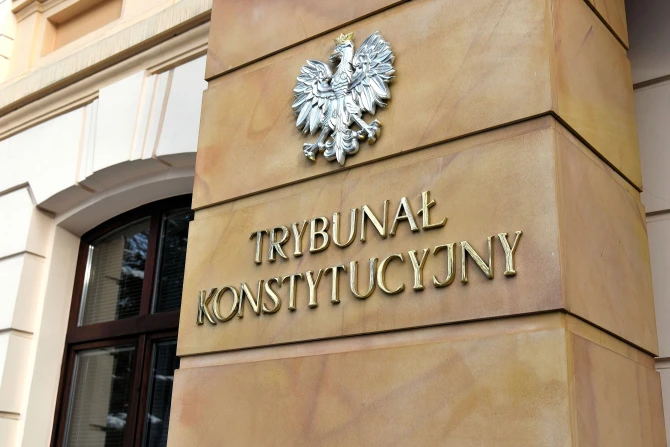
Poland’s Constitutional Tribunal unanimously ruled Dec. 3 that the Communist Party of Poland (KPP), founded in 2002, is incompatible with the nation’s 1997 constitution, citing papal encyclicals condemning communism as it effectively banned the organization and ordered its removal from the national register of political parties.
The court said the party’s program embraces ideological principles and methods associated with totalitarian communist regimes, which the Polish Constitution explicitly prohibits.
“There is no place in the Polish legal system for a party that glorifies criminals and communist regimes responsible for the deaths of millions of human beings, including our compatriots,” said Judge Krystyna Pawłowicz as she presented the tribunal’s reasoning. “There is also no place for the use of symbols that clearly refer to the criminal ideology of communism.”
Article 13 and the constitutional ban on totalitarian ideologies
In its ruling, the tribunal pointed to Article 13 of the Polish Constitution, which forbids political parties or organizations whose programs reference totalitarian methods and practices, including those associated with Nazism, fascism, or communism. The constitution also prohibits groups that promote racial or national hatred, encourage violence to seize political power, or operate with secret structures or undisclosed membership.
After reviewing the party’s documents, ideology, and activities, the court concluded that the KPP’s stated goals aligned with communist totalitarianism and therefore violated Article 13.
The decision comes almost five years after Poland’s former justice minister and prosecutor general, Zbigniew Ziobro, submitted a request to the tribunal to have the KPP outlawed. Last month, Polish President Karol Nawrocki also filed his own application.
Historical claims and the Church’s teachings on communism
The KPP identifies itself as the ideological heir to several earlier communist movements in Polish history, including the original Communist Party of Poland (1918–1938) and its precursor, the Social Democracy of the Kingdom of Poland and Lithuania (1893–1918). It also claims continuity with the postwar Polish Workers’ Party (1942–1948) and the Polish United Workers’ Party, which governed the country during the communist era from 1948 until 1990.
In its written justification, the tribunal took the unusual step of referencing Catholic social teaching, citing passages from two papal encyclicals condemning communism.
The judges referenced Pope Pius XI’s 1931 encyclical Quadragesimo Anno, which condemned communism’s reliance on class struggle, abolition of private property, and its record of “cruelty and inhumanity” across Eastern Europe and Asia. They also cited Pope Pius XI’s later encyclical Divini Redemptoris (1937), which warned that communist movements sought to inflame class antagonisms and justify violence against perceived opponents in the name of “progress.”
The tribunal used these texts to illustrate what it described as the inherently totalitarian nature of the ideology underlying the party’s program. It also served as historical evidence of communism’s documented practices and global impact, well understood by the framers of Poland’s post-communist constitution.
Party to be removed from register
The judges concluded that the KPP’s activities violated constitutional prohibitions on organizations referencing totalitarian methods, ordering the party’s removal from the national register and effectively dissolving it.
During the hearing, the chairwoman of the KPP’s national executive committee, Beata Karoń, argued that, while her party has “a certain vision of what it wants,” if the proposals are unattractive, the party simply won’t gain support in elections.
The ruling reflects the broader challenge faced by countries once under Soviet domination, which continue to reckon with the political and cultural wounds of communist rule while working to rebuild their institutions and identity in a post-totalitarian era.
If you value the news and views Catholic World Report provides, please consider donating to support our efforts. Your contribution will help us continue to make CWR available to all readers worldwide for free, without a subscription. Thank you for your generosity!
Click here for more information on donating to CWR. Click here to sign up for our newsletter.

May they also be aware of that other potential, “open or thinly disguised totalitarianism” (St. Pope John Paul II), the “Demon in Democracy” (Ryszard Legutko).
Good.
Now ban Socialism. Karl Marx, the founder of Communism, once said that “in order for socialism to succeed, the family must first be destroyed”.