


ACI Prensa Staff, Dec 5, 2025 / 14:38 pm
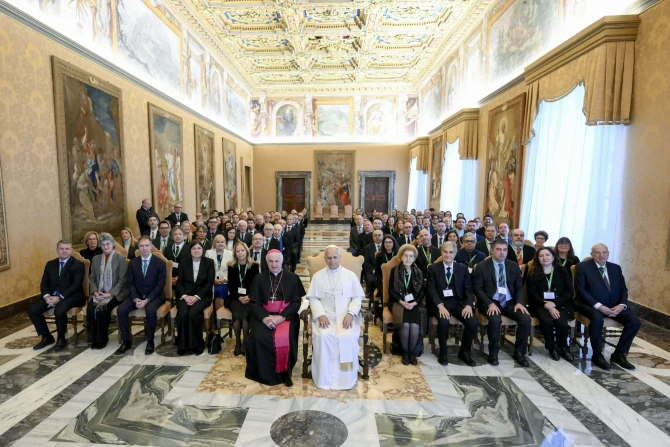
Pope Leo XIV reflected Dec. 5 at the Vatican on the challenges posed by artificial intelligence during a meeting with members of the Centesimus Annus Pro Pontifice Foundation and participants in the Strategic Alliance of Catholic Research Universities.
In his address, the Holy Father pointed out that artificial intelligence affects certain essential characteristics of the human person, “such as critical thinking, discernment, learning, and interpersonal relationships.”
For the pontiff, this has a real impact “on the lives of millions of people, every day and in every part of the world.”
“How can we ensure that the development of artificial intelligence truly serves the common good and is not just used to accumulate wealth and power in the hands of a few?” he then asked.
To answer this question, the pope urged deeper reflection on “what it means to be human in this moment of history” — that is, those who are called to be collaborators in the work of creation and not simply “passive consumers of content generated by artificial technology.”
“Our dignity,” he added, “lies in our ability to reflect, choose freely, love unconditionally, and enter into authentic relationships with others.”
He also emphasized that this technology raises “serious concerns about its possible repercussions on humanity’s openness to truth and beauty, and capacity for wonder and contemplation.”
Consequently, he noted that “recognizing and safeguarding what characterizes the human person and guarantees his or her balanced growth is essential for establishing an adequate framework for managing the consequences of artificial intelligence.”
Leo XIV mentioned his concern about the vulnerability of children and young people in this new reality, where their freedom and spirituality are at stake, as well as their intellectual and neurological development.
Therefore, he warned that “the ability to access vast amounts of data and information should not be confused with the ability to derive meaning and value from it.”
In this context, he emphasized that “it will therefore be essential to teach young people to use these tools with their own intelligence, ensuring that they open themselves to the search for truth, a spiritual and fraternal life, broadening their dreams and the horizons of their decision-making.”
He also emphasized the need to “restore and strengthen their confidence in the human ability to guide the development of these technologies. It is a confidence that today is increasingly eroded by the paralyzing idea that its development follows an inevitable path.”
Finally, the Holy Father affirmed that these objectives can only be achieved through “widespread participation that gives everyone the opportunity to be heard with respect, even the most humble.”
This story was first published by ACI Prensa, CNA’s Spanish-language news partner. It has been translated and adapted by CNA.
If you value the news and views Catholic World Report provides, please consider donating to support our efforts. Your contribution will help us continue to make CWR available to all readers worldwide for free, without a subscription. Thank you for your generosity!
Click here for more information on donating to CWR. Click here to sign up for our newsletter.

What meaning, the word “truth” or even the word “meaning” or the word “word”, as the created analogue universe of contingent stuff that ex-ists is displaced by a swarming digital sandstorm of data at our “fingertips” or whatever.
Interior life, what’s that?
Human intelligence has brought humanity thus far. Whatever enhances integrity, transparency, honesty, accountability, fellow feeling, justice, respect, solidarity, and co-humanity can be great for the well-being of fellow pilgrims.