


Istanbul, Turkey, Nov 29, 2025 / 03:10 am (CNA).
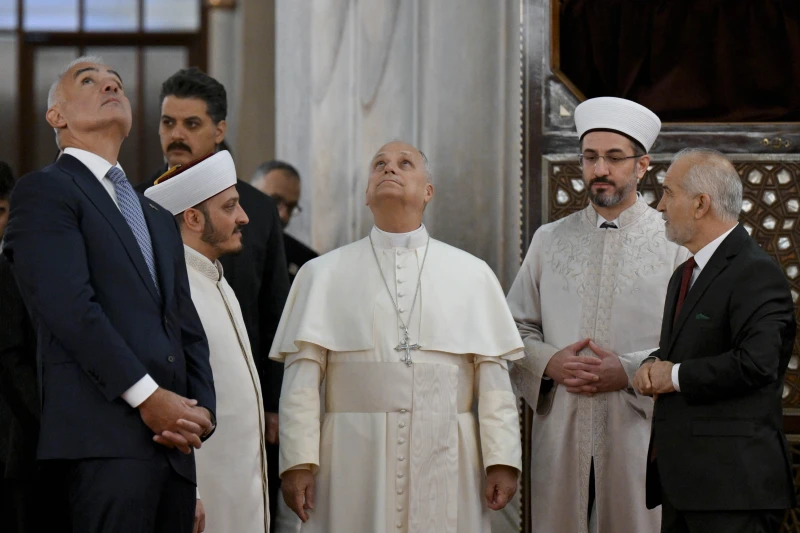
Pope Leo XIV started his third day in Turkey on Saturday with a visit to the Sultan Ahmed Mosque in Istanbul. The visit was a gesture of respect towards the Islamic world, fraternity with Muslims, and continuity in building bridges of interreligious dialogue, though the pope declined an invitation to pray in the Muslim house of worship.
The so-called “Blue Mosque” stands as one of the most important Islamic buildings in Istanbul. Its beauty, its scale, and its history continue to attract visitors from all over the world. It also holds a unique place in the relationship between Christianity and Islam, as several popes have passed through its doors in silence and respect.
Benedict XVI visited the mosque in 2006 during his visit to the country. The visit came less than three months after an address he made in Regensburg, Germany, in which he quoted a medieval emperor’s description of Islam as “evil and inhuman” and “spread by the sword,” provoking a fierce reaction in the Muslim world. The Vatican’s spokesman at that time, Fr. Federico Lombardi, said that Benedict paused for meditation inside the Mosque. Pope Francis entered the mosque in 2014 and stood in what the Vatican described as a “moment of silent adoration” of God inside the Muslim place of worship.
After Leo’s visit on Saturday, the Holy See Press Office said in a statement that “the pope experienced the visit to the mosque in silence, in a spirit of reflection and attentive listening, with deep respect for the place and for the faith of those who gather there in prayer.”
One of the pope’s hosts for the visit, muezzin Aşgın Musa Tunca, told reporters afterwards that he had told the pope he was welcome “to worship here,” but that Leo had replied: “No, I am just going to look around.”

A notable omission from Leo’s itinerary, and a point of tension in Catholic-Islamic relations, is Hagia Sophia, the Byzantine church-turned-mosque that the Turkish government designated a museum open to all faiths in the 20th century. Popes Paul VI, John Paul II Benedict XVI and Francis all visited the monument on previous papal visits to Turkey. Francis said he was “deeply pained” when the government turned it back into a mosque in 2020.
Asked on Thursday why Leo would not be visiting Hagia Sophia, Bruni said: “It simply was not put on the program”.
The “Blue Mosque” which Leo visited on Saturday was built between 1609 and 1617 by Sultan Ahmed I. It occupies part of the site where the Grand Palace of Constantinople once stood. The goal was to make it the most important place of worship in the Ottoman Empire.
The construction process was carefully organized. The name “Blue Mosque” comes from around 21 thousand turquoise ceramic tiles placed along the walls and the main dome. Walls, arches, and columns carry the famous Iznik tiles in tones from blue to green. Light entering through 260 small windows also gives the prayer hall a remarkable atmosphere.
The Sultan Ahmed Mosque is the only mosque with six minarets. Most mosques have four. Only the one of the Ka’ba in Mecca, Saudi Arabia, exceeds it, with seven.
Correction: A previous version of this article referred to Father Federico Lombardi as Father Pietro Lombardi. The article has been updated with the correct name.
If you value the news and views Catholic World Report provides, please consider donating to support our efforts. Your contribution will help us continue to make CWR available to all readers worldwide for free, without a subscription. Thank you for your generosity!
Click here for more information on donating to CWR. Click here to sign up for our newsletter.



Anticipate that this article will be a hot one for our resident Islamic scholar. Although I am not, I’ll add a few words.
Hagia Sophia, Holy Wisdom, relates to the Blessed Virgin Mary, and her title seat of wisdom. Greek Orthodox made the Theotokos declaration Council of Ephesus 431 AD an iconic theme decorating the interior. Turkiye did not efface the Virgin Mary, Mother of God icons after the transition to an Islamic mosque. They are instead covered with curtains during prayer. The Turkish government retained the title, in Turkish Ayasofya-i Kebir Cami-i Şerifi, which translates Hagia Sophia Holy Grand Mosque.
Understandably, and correctly Leo XIV declined to visit the Holy Grande Mosque because of the insult to the previous Hagia Sophia usurpation by Islam. A visit would be a form of recognition. Nevertheless, there’s wonder revolving around Islamic reverence of the Blessed Virgin, her title partially retained in the new Muslim designation – and the Fatima history and miracles. Fatima, the Muslim princess who converted to marry a Spaniard. Does this deference to Our Lady spell a future conversion?
About Pope Leo visiting a mosque—and then about the concession to Muslims to build mosques across Europe…during his earlier visit in Turkey, Pope Benedict petitioned the equivalent concession (reciprocity), or right, to found new seminaries in Turkey.
Perhaps this assertion on behalf of Christians in Muslim lands is also intended to better ensure at least the continued institutional autonomy and influence of the Church in the future of a post-Christian Europe, and a continued place for those human values that under the earlier St. Benedict were the taproot of European culture.
Jurgen Habermas, sometimes referred to as “the pope of secularism,” has seemed to call for a “two-way understanding of tolerance: the church-state relationship . . . (as) one based upon reciprocity.” This wording is from commentator Virgil Nemoianu (“The Church and the Secular Establishment: A Philosophical Dialog between Joseph Ratzinger and Jurgen Habermas, Logos, 9:2 [St. Paul, Minnesota: University of St. Thomas, Spring 2006], 22). The secularist Habermas offers this seasoned reflection: “Christianity, and nothing else, is the ultimate foundation of liberty, conscience, human rights, and democracy, the benchmarks of Western civilization” (citation p.41, fn. 19). Including, but more than lowest-common-denominator fraternity…
In some zig-zag way, might it be that dialogue with the fused mosque-state of 7th-century Islam will help ensure a more prominent place in the modern West where the distinction/separation of church and state need not mean the marginalization of the Church atop a few remote mountain tops as in the time of the monastic St. Benedict.
When might the charter of the European Union refer to Europe’s Classical and Christian heritage, both, rather than only the Classical?