



There is a certain majesty and real beauty to be found in everyday life. If we have the eyes to see it, everything from rising in the morning, to going to work, to doing the dishes, to sitting silently in the company of family and friends, to wrestling with a toddler at Mass, to sharing a meal–all of these can be paths to holiness, and signs of the graces and blessings of God in our lives.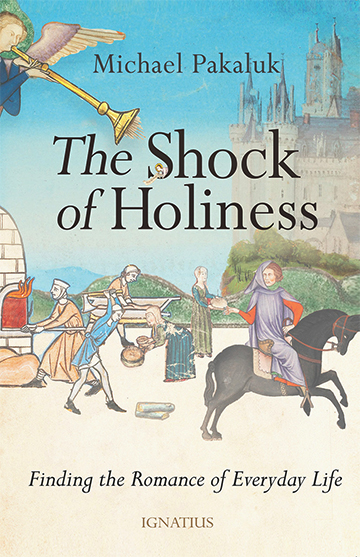
Michael Pakaluk’s new book, The Shock of Holiness: Finding the Romance of Everyday Life (Ignatius Press, 2025), dives into the sometimes hidden depths of seemingly ordinary holiness. With essays exploring the quotidian yet eternal wonder of moms at Mass, holy water, the crucifix, St. Joseph as a role model, sex, food, and dinosaurs, The Shock of Holiness invites readers to new insights on some of the simplest truths of the Catholic Faith.
Pakaluk recently spoke with Catholic World Report about his new book and the importance of practicing holiness in everyday life.
Catholic World Report: How did the book come about?
Michael Pakaluk: I love the essay as a literary form, and I have immensely admired great Christian essayists such as C.S. Lewis and G.K. Chesterton. I have aspired to be like them. Newman’s sermons are also essays, in a sense. Ignatius Press has published all 8 volumes of Newman’s Parochial and Plain Sermons, printed on thin paper in a single volume. One year, I read through all of them for spiritual reading. (Looking back, I can’t believe that I did so. But I did.) I wanted to be like Newman and think like Newman. He formed the way I look at Scripture and at the Christian life.
I have published a lot of essays, hundreds or even thousands of them. It seemed to me that a good number of them had lasting value. They were not merely “journalism,” which means “writing for the day,” but rather they could stand the test of time. I put together a selection of about 200 such essays—I had a sense of which ones to pick from fan mail that I receive—and I sent them to some very good friends, who agreed to read and “grade” them for me: “A” meant “a keeper,” “C” meant a reject, and “B” was borderline. I took the intersection of all the As and sorted them into different groupings. Hence, the collection.
I would say that I regard a good essay as one which makes a new point, and which is a true point, and which does so with a certain sparkling character, or brilliance. So, this is what I strive for: novelty; truth; brilliance.
When I sent them to Ignatius, I was delighted that the press loved the essays and wanted to publish them. Someone told me that Fr. Fessio once remarked, “No one wants to read collections of essays, unless they are by Chesterton.” I seem to have broken through that barrier.
The title I proposed (given the genesis of the essays) was Parochial and Plain Essays. Ignatius wisely nixed this title and said to me, “Why don’t you use instead the title you gave to one of your sections, ‘Shock of Holiness’?” So that’s how the book came to be and how it received its title.
CWR: The subtitle of the book is “Finding the Romance of Everyday Life”. Why is it important to find the romance in everyday life?
Pakaluk: It’s funny, but I began by using the word “enchantment,” as Rod Dreher does. But I became disenchanted with “enchantment,” because that word had its origins in magic and spells.
To me, what I want to talk about is better described as romance. So I went through the book, changing everywhere “enchantment” to “romance.” I am convinced that Christianity is the source of everything we have called “romantic”: romantic tales of chivalry; romantic courtship; romantic novels; romantic images and gestures. Why is it important to find the romance in life? Why is it important to put salt on your food? (Have you ever forgotten to put salt in a recipe and realized how bland it tasted, almost inedible?) Why is it important to light a lamp when you wish to walk around in a dark room?
This is what Our Savior said: You are the salt; you are the light. Life without romance is bland and dark.
CWR: How much of your reflections on “the romance of everyday life” comes from your own experience? You’re certainly a veteran husband and father!
Pakaluk: To be honest, I think it takes a long time to develop the perception of it. Or perhaps you start with it easily and then easily lose it. Ordinary life for a mom or dad of a large family implies a lot of work, a lot of chaos, a lot of frustration, and changed expectations. You need to learn to distinguish your feelings from objective reality. And also our faith needs to grow, so that we can “see” the supernatural life which is there, and its effects.
Yes, most definitely, these essays represent a kind of attainment for me, the fruit of the hard work of Christian living and discipleship over many years.
CWR: Your reflections on St. Joseph were one of the most interesting parts of the book for me. Do you have a great personal devotion to St. Joseph?
Pakaluk: I wish I could say that I have. Yes, I have a similar devotion to what I think many Catholics have. But St. Joseph has been a difficult figure for me to get close to, because so little is said about him. He is an extremely humble and hidden saint, although very great. Those essays on St. Joseph were written during the “Year of St. Joseph,” when I spent a lot of time pondering his life.
It turns out, I would say, that what we are able to discern about St. Joseph is in direct proportion to the time and attention we put into contemplating him. He is not ostentatious. But he will greet you if you look for him. Many readers have appreciated those essays for helping them to do that.
CWR: Can “finding the romance of everyday life” help us appreciate the larger questions as well—God, the meaning and purpose of our lives, etc.? How so?
Pakaluk: We begin with faith in God, or maybe fear of God, leading to faith in God. At first, we “meet” God only in prayer, or reading the Bible, or attending worship services. But then, as Christians, we are presented with a task: how can we meet God every day, in the details of our lives?
Yes, I would say that this is the meaning of life: to live every moment in the presence of God, and to reveal God to others in the concrete details of our lives. God allows us a lot of creativity in doing so.
CWR: Is this a book for Catholics only, or could it be beneficial for non-Catholics as well?
Pakaluk: In reality, all Christians are Catholics; they simply do not recognize it. By baptism, they belong to the One, Holy, Catholic, and Apostolic Church. Our division of Catholic versus non-Catholic is fundamentally unreal. That being said, these essays do tend to focus on realities that Catholics recognize and appreciate better. However, I think non-Catholics might find them intriguing.
CWR: What do you hope people will take away from the book?
Pakaluk: Each essay has its point and lesson. It would be necessary to ask that question separately for each essay.
CWR: Is there anything else you would like to add?
Pakaluk: Yes, two things. First, it is a beautifully composed and printed book, with a colorful and attractive cover, and appealing paper, binding, and print. Second, it would make a great gift, especially to young people.
If you value the news and views Catholic World Report provides, please consider donating to support our efforts. Your contribution will help us continue to make CWR available to all readers worldwide for free, without a subscription. Thank you for your generosity!
Click here for more information on donating to CWR. Click here to sign up for our newsletter.

Is there an e-copy of the book. If yes, how do I get it please
Yes; here is the link.
Opus Dei was never meant to have a charism apart from its founder in his priesthood.
You and I may not be Opus Dei but all faithful ought to rally on this problem happening in Opus Dei. As well, as I see it, it’s an attack on the whole Church.
The most recent statement from them I can find was saying, don’t worry nothing negative is occurring and “no decisions have been made yet”.
A “romance” aspect to vocation was/is a theme in Escriva’s spritiuality and a part of his own originality. I have been saying that the “review” which Opus Dei is “undergoing” is playing false with its true spirit and mission amounting to an attack on the whole Church in addition to Opus Dei. Putting a responsibility on all the faithful to actively resist it. We can not be so caught up in our “own romance story” that we have no care for justice for our brothers and sisters in Christ.
See CATHOLIC HERALD third link, Opus Dei responds, Jack Valero is saying “revision of statutes” is a legitimate process; yet details remain sketchy and one of the ongoing defects left unaddressed is having the not consecrating as bishop of the “prelate”.
Valero just can not say “nothing to worry about ….. ” and leave it like that.
https://rorate-caeli.blogspot.com/2025/12/towards-francis-dream-of-extermination.html
https://elwanderer.com/2025/12/01/hacia-el-exterminio-del-opus-dei/
https://thecatholicherald.com/article/opus-dei-responds-to-claims-of-drastic-reform
https://thecatholicherald.com/article/report-claims-opus-dei-faces-sweeping-reform
*****
New Anniversary of Personal Prelature
Saint John Paul II erected Opus Dei as a personal prelature on November 28, 1982. Here is an address he gave at a workshop on the Apostolic Letter “Novo Millennio Ineunte,” on March 17, 2001, in which he outlines his hopes for the Prelature.
https://opusdei.org/en-us/article/address-of-john-paul-ii-on-opus-dei/
*****
Therefore, We, with the plenitude of Our apostolic power, having accepted the opinion which Our Venerable Brother the Most Eminent and Most Reverend Cardinal Prefect of the Sacred Congregation for Bishops had expressed to Us, and making good, in so far as it is necessary, the consent of those who have, or think they have some competence in this matter, command and desire the following to be put into practice.
I
Opus Dei is erected as a personal Prelature, international in ambition, with the name of the Holy Cross and Opus Dei, or, in abbreviated form, Opus Dei. The Sacerdotal Society of the Holy Cross is erected as a clerical Association intrinsically united to the Prelature.
II
The Prelature is governed by the norms of general law, by those of this Constitution, and by its own Statutes, which receive the name “Code of particular law of Opus Dei”.
https://www.ewtn.com/catholicism/library/erection-of-opus-dei-as-a-personal-prelature-1986
A number of things come to mind reading the Holy Father’s reflections on the “kitchen spirituality” theme coming from Br. Lawrence. Vocations among different sorts or personalities have common traits and themes, reflecting the one source in Jesus Christ. Yet they are distinguishable in their details individual, community and circumstantial; and in their impacts. It can even be that two saints appear spiritually as twinned, as like natural twins; at the same time though, just as with twins, their characters, characteristics, strengths and weaknesses, all take on their own respective identities and nuances.
In the eyes of the Saviour James and John shared a sibling “thunderous” make-up by which each went on to complete his life in ways that do not resemble and for that matter do not connect as natural siblings. Except for the double signification, the essential vitality of the Church and the role of the BVM. The BVM entrusted to John is the BVM of the Divine Election given to James for them to win their crowns, the Lady of the Pillar.
In other words it would be a wrong to homogenize sanctity in the Church. Actually the Church does not do this and already knew this in the sense that she has always pursued after her saints, with the justice due to them.
Pope Leo’s “Here we go Lord, you are in charge” reminds of Escriva comforting his parents about his progress at the seminary, “It just takes getting used to.” Something of the Holy Spirit had already touched him by then and he knew what his dedication would mean; he had already resigned himself (in the good sense) to serving it and had set about bringing it into life in a genuine practice of patience.
I wished to say something to Pakaluk about St. Joseph. It USED to be that St. Joseph was left in a relative obscurity but with the coming of Escriva and JPII, that can no longer be said about him. The faithful priesthood in Opus Dei bear witness to him and their conscious vocational focus on him has been growing a long time – a great body of devotion and reflection on the Head of the Holy Family being shared, in effect DAILY, among members of Opus Dei.
I am avoiding bringing my small discussion here to specific conclusions. I avoid pre-screening its obvious definite import. Opus Dei has its own place in the Church within the vision of the founder which has to stay true. Which was already being true.
Dan Brown tried satirizing it. Others try hacking it. Some insiders seem to want to parasitize it and offer it over for scavenging. Spending too much time on “self-reflection” not really like Opus Dei at all.
‘ “It’s a very simple book by someone who doesn’t even give his last name,” the pope told journalists on the papal plane Dec. 2. “I read it many years ago, but it describes a type of prayer and spirituality where one simply gives his life to the Lord and allows the Lord to lead.”
“And if you want to know something about me, that’s been my spirituality for many years, in midst of great challenges — living in Peru, during years of terrorism, being called to service in places where I never thought I would be called to serve to — I trust in God, and that message is something that I share with all people,” he continued.
After being asked what it was like for him during the conclave, Pope Leo mentioned the book and said: “I resigned myself to the fact, when I saw how things were going, [that] this could be a reality.”
“I took a deep breath. I said, here we go. Lord, you’re in charge, and you lead the way,” he said. ‘
https://www.catholicworldreport.com/2025/12/03/the-kitchen-friars-book-that-inspires-pope-leos-spirituality/