


Toronto, Canada, Nov 16, 2025 / 08:00 am
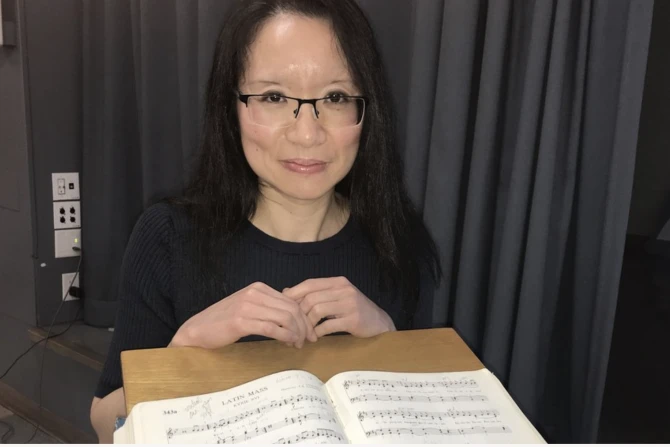
Sixteen hundred years ago, St. Augustine was credited with saying, “He who sings, prays twice.” Today, scientific research shows that he who sings, performs, or listens to music also enriches and strengthens his brain, according to Catholic neuroscientist Kathlyn Gan.
Not only that, but sacred music may produce even more beneficial effects.
Gan, who leads a research laboratory at the University of Toronto, delivered the uplifting news to about 50 people at an Oct. 30 talk at St. Francis de Sales in Burnaby, Ontario.
In her hourlong presentation “The Neuroscience of Sacred Music,” Gan, a former choir director and accompanist, described how research showing that music can be part of a healthy lifestyle that helps counter the mental decline that accompanies aging.
Music can also help prevent the onset of Alzheimer’s disease, which, in up to 95% of cases, can be driven by nongenetic factors, including obesity, high blood pressure, smoking, deafness, brain injury, and social isolation.
Not only does music stimulate the brain in special ways, but it also fosters healthy social connections when performed in a group setting, said Gan, currently a liturgical musician in the Archdiocese of Toronto.
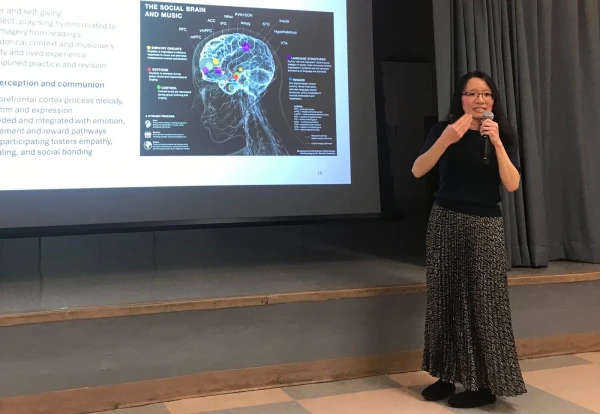
Speaking with The B.C. Catholic, she said music is encoded and integrated by multiple brain regions, stimulating neural pathways that regulate memory, movement, reward, emotion, and empathy.
“Based on those effects, music can help us keep our minds active and foster social connections, which in turn can help us mitigate the risk of Alzheimer’s disease,” she said.
Gan, who earned her doctorate at Simon Fraser University in Burnaby and did postdoctoral studies at Stanford University in California, said music therapy is widely used as part of a holistic treatment approach to improve behavioral issues and encourage social connections during mid- to late-stage Alzheimer’s.
Gan noted that the CBC recently reported that doctors in Montreal have partnered with the city’s symphony orchestra to prescribe music as medicine.
“Physicians will get prescriptions that they will give to patients,” said Mélanie La Couture, CEO of the Montreal Symphony Orchestra. “The patients will call us, and we will give each patient that calls us two tickets for free.”
Even more benefits could conceivably come from listening to or singing sacred music, which Gan defines as any music — from chant and classical to jazz and gospel — that contributes to the solemnity and beauty of the Mass, promotes deeper reflection on the scriptural readings and homily, and glorifies God.
That said, it will be challenging for scientists to prove sacred music’s special benefits because of listeners’ or musicians’ subjective perceptions of music and their varying depth of spiritual formation and understanding, Gan said.
At the very least, however, listening to or performing sacred music helps a person grow in faith and to love God, she said in her presentation.
Along with the three degrees she earned at SFU, Gan also holds an associate diploma from the Royal Conservatory of Music and is an accomplished classical pianist who shares her talent and faith in churches and the wider community. These outings include performances with her piano students at retirement homes and long-term care facilities, as well as playing piano in music-therapy and spiritual-care programs.
She views her music ministry as a form of prayer that challenges her not only to recognize scriptural themes and imagery but also to communicate them “in a manner that honors the historical context of the hymns and shares my own spirituality and lived experience.”
Her studies and ministry have not only deepened her appreciation for the human mind’s complexity and capacity for mirroring Christ’s humility, compassion, forgiveness, and love, but they’ve also “encouraged my spiritual growth and enriched my faith,” she said.
This story was first published by The B.C. Catholic and is reprinted here with permission.
If you value the news and views Catholic World Report provides, please consider donating to support our efforts. Your contribution will help us continue to make CWR available to all readers worldwide for free, without a subscription. Thank you for your generosity!
Click here for more information on donating to CWR. Click here to sign up for our newsletter.

Agreed with the comment’s headline without reading its contents. The mind, centered in the brain, was made to find its realization and health in the spiritual, music a powerful conveyance.
We develop neurological pathways for good or to our [brain’s] detriment. Why we are subject to addictions, or good habits. My conviction is that poorly formed, deleterious pathways may be erased by turning to the dynamics described by neuroscientist Kathlyn Gan.
Listen to Gregorian chant or Palestrina when you can. Make time for what amounts to neurological medicine for the soul.
Evidence of the spiritual nature of the soul is in the ability to reverse the material neuro pathways without medication by willing to do so.
For example, regarding addiction to pornography, despite the difficulty for long term addiction it can be done by a competing interest, our redemption and the salvation of others. Offering the effort for others is itself a pronounced act of commendable charity. Certainly prayer for intercession from our Blessed Mother, and most especially directly to Christ, the very source of all good, of the gift of grace.